Produce for sale from the Tomato Lady-Friday August 21

Jannine's bean tee pee

Hi folks.  I know many of you locals follow my blog. I have 125 tomato plants and 3o heirloom varieties this year.  For some unknown reason my tomatoes are taking their time turning red (or orange or striped or black or purple). This is weird as I would have thought that they would all be kicking ass by now and I would be at the Farmers Market. The weather has been nice and warm, the rain wonderful and the tomatoes look great-just still green. Ah mother nature! Whata ya going do? I’ve learned years ago to just surrender to her. So…

Since I don’t have enough tomatoes ready (I need boxes and boxes of them) for the Farmer’s Market this Saturday, I do have some heirloom tomatoes to sell plus I have LOTS of other heirloom veggies—Shishito peppers, wonderful varieties of french and Italian green beans—Rattlesnake beans, Italian Romano beans, Trionfo Violetto beans, Royal Burgundy beans and some french filets, tasty sweet cucumbers and fantastic huge ruby red chard that melts in your mouth when steamed and drizzled with a fine balsamic vinaigrette.

I will be selling them from 2 -4 pm this Friday August 21 at our studio:

Liquid Light Glass
926 Baca Street #3
Santa Fe, NM
Call me if you have questions. 660-4986

I will be starting at the Santa Fe Farmer’s market Saturday August 29th from 7 am-1 pm. But don’t be late as I will sell out probably by 11 am. You can find me inside the building-just look for my ‘TOMATO LADY’ SIGN above my booth.

So come catch up with me and get some fantastic veggies for yourself this Friday without the parking hassles! Hope to see you here at the studio!

Identifying Tomato Curly Top Virus (CTV)-more info

Photo credits: curly top disease - photo courtesy of http://ucanr.org/blogs/blogcore/postdetail.cfm?postnum=3352

Curly Top Virus (CTV) on tomatoes
Last year, the Beet Leafhopper which transmits ‘Curly Top Tomato Virus’ was rampant in our gardens and devastated many of our tomato plants. I lost only 4 plants out of 74 to it but only because I take extraordinary measures to protect them. Here is some information on the beet leafhopper., how to identify it, symptoms and how to protect your plants.

The Beet Leafhopper flies in on the winds in early June through July, jump on the tomato plants and taste them. It is a big problem in the Southwest and inland in California where it is hot. They don’t even like to eat tomato plants but sample them, transmitting the disease in the process, then fly off to visit other plants.

Identifying Beet Leafhoppers
The beet leafhopper is very small-about 1/8 inch long, pale green to light brownish green and has wings that look like a tent when folded up vs spread out like a moth. See photo on left. They come when conditions are dry, hot and windy. Sound familiar? This is typical June weather here in the greater Santa Fe area.

I notice they leave after the monsoons come in July when it is cooler and wetter. You will know if they are in your garden as they come in and when you walk around your garden, you’ll see jumping little green bugs that fly off when you walk by. Then they leave—flying to the next garden. Because of this, you can’t really spray anything to get them because they hop so fast and only stay in the garden a short time—here today, gone tomorrow. By the time you notice something is wrong with your tomato plant, they are long gone. It takes about 2 weeks for symptoms to show up.

Symptoms
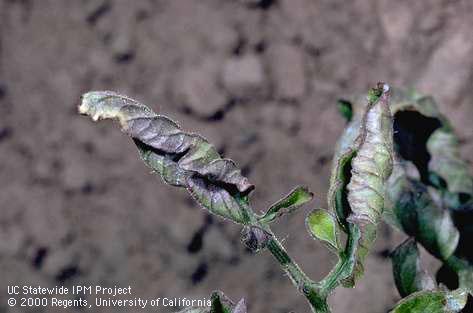
closup of leaves of curly top virus

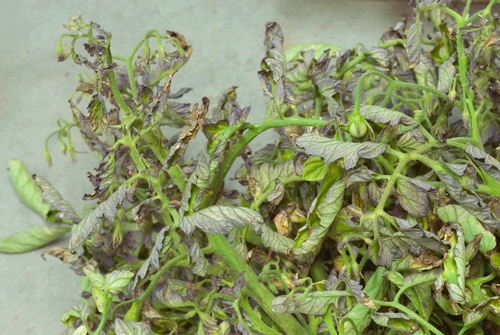
Your tomato plant leaves will start to curl and the underside of the leaves and veins will turn a purplish color as pictured above.
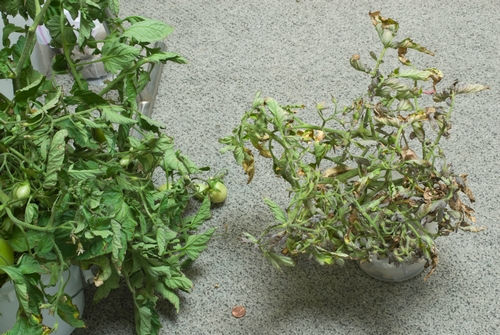
 

curly top virus_helthy plant

Tomato Curly Top Virus-beginning stages and advanced stages


The leaves then start to wilt and the plant will look stunted. You might think it needs water but it doesn’t, it is sick and won’t recover. ‘Curly-Top Virus’ is only transmitted from bug to plant and is NOT transmitted from plant to plant hence you will see a healthy plant next to a sick plant. The pictures above show 2 plants with curly top. The first one is beginning to be sick with curly leaves and the veins will turn purple.  The second plant in the picture is advanced.

Now there are three cases where you may think you have curly top virus but may or may not have it.
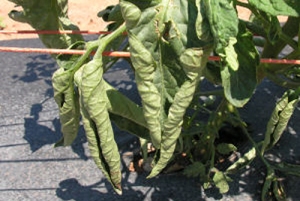
Denver Downs Farm, Anderson, SC;  High temperature on black plastic; lower leaves only.

Physiological Leaf Roll-Photo courtesy Clemson University

The first condition that may not be Tomato Curly top Virus is Physiological Leaf Roll that can happen on some tomatoes and could be caused by various factors including stress and that is not necessarily curly top-if you plant has rolled leaves but no purple veins as shown above, it possibly has physiological leaf roll and look for why it may be stressed. It is getting enough water, too much water, too much nitrogen? Also drought, pruning, root damage and transplant shock can all be reasons for leaf roll. For more info on this condition go here.
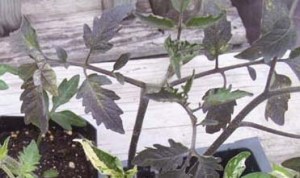
purple tomato_purlple leaves

Phosphorus deficiency in tomatoes happen when the weather is still cold-not in June.

The second condition is early in the season, sometimes the leaves turn purple when it is still cold outside. This is a phosphorus deficiency. This never happens in June or later when it is warm but more in May if you plant early and it is still cold outside.

The third condition (no pic) is if you are growing a purple or black variety of tomato your plant may have purple veins so don’t pull it unless it start to looks sick with the curly leaves and looks like it needs water.

Remedies
There is NO CURE for this virus and if your tomato (or pepper for that matter) shows signs of the disease, you should pull the plant. You could leave the plant in BUT if another wave of leafhoppers come by and a healthy leafhopper bites your sick plant, it only takes 10 minutes in 90°F weather for it to be able to transmit the disease to one of your healthy plants. The best thing to do is pull any sick plant and dispose of it. I don’t compost ANY tomato plant that shows disease.

Here are some remedies:
• Leafhoppers do not like shade and if your plants are partly shaded, that may help keep them off but since most of us grow tomatoes in full sun that might be difficult.

Create a physical barrier with row cover

Put row cover over tomato plants

• The main thing I do is create a physical barrier between the bugs and the plants.  I now cover all tomato plants with row cover until the bugs pass. Wrap the row cover around your tomato cage and put a piece on top of the cage BEFORE they come.

• Lastly you could put out some tomatoes later in the season after the bugs leave but you’ll have to put in early season varieties so you can still harvest before the season ends. I buy gallon size at that point so as not to be too far behind. A couple of years ago when I was out at the Santa Fe Community Garden, I noticed many rows of sick tomato plants but one row of perfectly healthy plants and when I asked about them, it turned out they were put out about a month later than the rest of them and by then the leafhoppers were gone.

Dry, sunny, windy weather are perfect conditions for the leafhoppers so look out this summer-conditions are ripe again!

I remove the row covers after the monsoon season comes. They usually leave or are suppressed by then. Monsoon season historically comes in early-mid July.

Santoro lettuce-a great butterhead variety

IMG_5764

This year, one of the lettuces I grew is called Santoro, a type of butterhead lettuce that is heat-resistant, cold resistant, has a wonderful taste and grows really big if given the chance. I got the seeds from Cooks Garden seed catalog. I started them inside the house on Jan 29, transplanted them into 2″ pots on Feb 14 and transplanted them again into the greenhouse in mid April.  I read somewhere Santoro lettuce can produce 12″ heads if you give them the room. So I spaced them really far apart to see if they could get that big. They say if you crowd big varieties they will never reach their maximum size. In the picture above I’ve picked the outer leaves to eat and wanted to see if they would grow back. The heads on the right haven’t been touched yet. As you can see I picked pretty hard. They grew back almost to the same size as the ones that weren’t picked.

IMG_5763

A couple of weeks later-Check out the size of these heads-a full 12 inches across. They are still growing in the greenhouse but now I’m picking the whole head  (instead of just the outer leaves) as I had to make way for the tomatoes that will grow in there. In fact I already have all 18 tomato plants (in wall of waters) inside the greenhouse as of May 13. I know it will get too hot for lettuces inside the greenhouse this summer so I’m starting to pull them to eat.

santoro lettuce_17 inches

May 31-I just picked this last head of Santoro lettuce yesterday (shown above between the tomatoes in the wall of waters) and it hadn’t bolted yet even though the temperatures in the greenhouse have gotten over 80 degrees. It’s handled 19 degrees to over 80 degrees! It reached 17 inches across! Hasn’t gotten bitter and is still soft and wonderful to eat. I’ve never had such great lettuce as this year, not only with this lettuce but with all of them in the greenhouse. Seems I’ve figured out how to be successful with them. I’ve done a lot of research on them from Nov-Dec to find some great varieties that were cold tolerant and now I’ve researched out what varieties of lettuce are heat tolerant, hoping to grow them in the shade this summer here in Santa Fe without bolting. Most of us don’t even try to grow lettuce in the summer as it is pretty warm here. I will list the heat tolerant varieties of lettuce in the next post and do an experiment with some of them outside in the garden.

SNOW-May 16th?!! Yes

Well I hope the wall of waters will keep my newly planted tomato plants warm enough with the snow we had today. Not much snow but then tomatoes don’t like snow at all! And I hope it’s not too cold tonight. They do like this rain though…

Great Weather! Time to Plant?

RAIN5

Wow! Great weather this weekend with no wind, warm temperatures and wonderful rain today. I hear tomorrow brings more rain. Today we had some great rain and boy is it welcomed. The native plants and trees and all of our plants are sucking it up. I can’t remember getting this much rain at this time of year in May. A great big plus is the night temperatures are starting to warm up too with the next 10 nights suppose to be from 35°F- mid 40’s. Pretty cold but above freezing.

So can we plant tomatoes? Is it time? Well that depends on whether the nighttime temperatures remain above freezing. Of course the first frost-free date is officially May 15th historically speaking, but back in 2011, we had a very warm May and many of us planted early as it never got below freezing that May. Is this one of those Mays? Who knows, unless you have a magic ball. By the way, I waited to plant my giant pumpkins till later in 2011 (as they are so frost tender) and my 2010 State Record got broken that year by someone who went for it early. I guess I should have put them in but I just didn’t want to chance it. You have to be a bit of a gambler to put your plants in now.

tomatoes in wall of waters 1

But if you are a gambler and want to plant your tomatoes early, be sure you plant using wall of waters (WOW) as shown above.  If you use them, and the temperatures dip below freezing, they will protect your new tender plants. I always use them even when the nighttime temps are in the 40’s as I feel they provide more heat at night and keep them from setbacks. The cells of water warm up all day and give back the warmth at night to the plants like little greenhouses or cloches. Once they outgrow the WOW’s  (like in the photo above), take them off  the tomatoes, which will probably be late May. Do not leave them on all summer.

Are you chitting those potatoes?

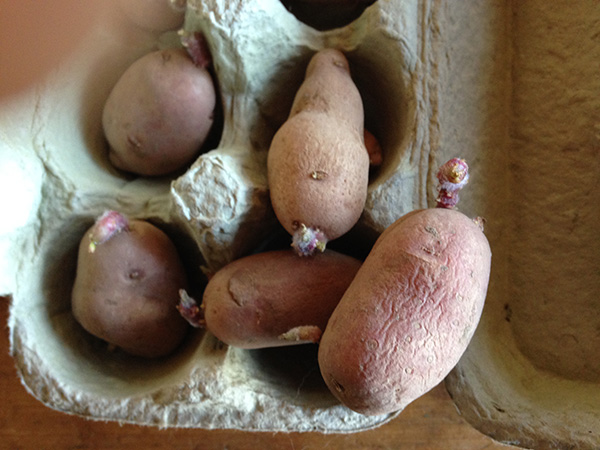
chitting potatoes_closeup

Are you chitting your potato seeds yet? Careful how you say that! You can get potato seeds at the local nurseries now if you plan to grow them this year. Potato seeds are actually smaller potatoes that you plant. Don’t use grocery store potatoes as most of them have a sprout inhibitor on them to reduce sprouting which is what we want.

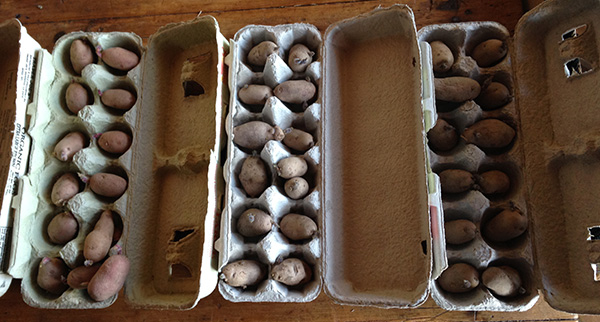
chitting potatoes

Chitting is letting your potatoes grow those little ‘eyes’ out. Put them in indirect sunlight. I use egg cartons to hold them so the eyes don’t break off. After they grow ‘eyes’, you should plant them this month-April. Chitting potatoes now will let you harvest them 2-3 week earlier when harvesting them later in the late summer.

This year, I’m growing them in ‘potato bags’ instead of a garden bed. My friend, Janet had fabulous luck with them last year-in fact she got more than I did in a raised bed so I’m trying her way this year besides it opens up another bed for me to grow other veggies in.

For more info on growing and chitting your potatoes, go to my original post ‘Growing and Chitting Potatoes’

Garlic in February!

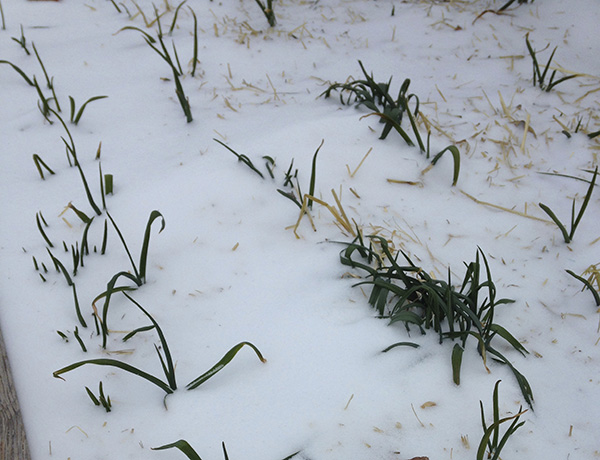
garlic in febThe garlic is starting to come up nicely, even through the snow. I believe it wakes up when the daylight hours get long enough. By planting garlic in the fall, you’ll get larger bulbs and will be able to harvest earlier in the summer. I planted it in late October and put straw over it to protect the bulbs from winter. Looks like it worked! The straw keeps the bulbs from freezing and the snow can melt through it and provide moisture. Didn’t even have to water it this winter. Such an easy crop to grow and fresh garlic is the best!

Lettuces to grow in winter

lettuce-jan 16, 2015

Here is some lettuce I harvested from my unheated greenhouse on January 16th! I’ve been experimenting growing some cold hardy lettuce varieties (Winter Wunder and Marshall Red Romaine) this winter.  I told you I would report back and here is my first harvest. I find it amazing that they survived some very cold nights 6 to 8°F (-14 to -13°C for my European friends) in the greenhouse with only some winter weight row cover over them for added protection. I planted them from transplants instead of seeds in November so they had a good head start. It’s really fun to see something ‘green’ growing this time of year and yummy too.


Starting COLD HARDY VEGETABLES Super Early

lettuce_greenhouse germinating

So now that the Persephone period is almost over and the magic date of January 15th is upon us, what does that mean? It means our day lengths are getting longer and January 15th is when we start getting 10 hours of daylight that will continue to get longer every day. Have you noticed already it now gets dark around 5:30 instead of 5 pm? The darkest time of the year is over. What does that mean to gardeners? To learn how to start cold hardy vegetable seeds super early outside and how also how to start them inside read on.

STARTING COLD HARDY VEGETABLE SEEDS OUTSIDE: cold frme opened
If you want to try growing cold hardy vegetables outdoors at this time of year, you will need a cold frame, low tunnel or hoop house.

If you already planted cold hardy vegetables late last fall in a cold frame, low tunnel or hoop house, you may have noticed that the little seedlings haven’t been growing much at all as winter set in. Now with longer daylight hours, they will start to grow again and barring any devastating freezes, they will continue to grow and you can get cold hardy crops earlier this spring.

In late winter, before you have harvest your winter crops, decide what you want to plant in your bed once space opens up in your cold frame.  As the end of the Persephone period draws near (January 15) , you can re-seed the openings created from your harvesting or you could start planting seeds in your bed if you don’t have anything growing. My soil in my unheated greenhouse is at 40°F right now (as of January 12). Lots of cold hardy vegetables germinate in cold soil.  They will be slow to start at first but they will start as your soil warms up to 40°F and warmer. Now with the day light getting longer, you can think about starting early. The winter sowing you do will be ready for harvest by early spring, often long before the same crop when grown outside without protection. A bonus is many of the cold hardy winter crops don’t like our springs, bolting on the first few warm days so you’ll be able to harvest that spinach before it bolts!

Some cold-hardy plants planted inside a cold frame, low tunnel or hoop house can tolerate a hard freeze at night, provided they are allowed to thaw during the day. The plants must be completely thawed before you harvest them. In addition, put some winter row cover over seedlings at night to give them an additional 4-6°F protection even though they are already in a cold frame, etc. Remove the row cover on days when it is above freezing. Watering is necessary to get crops started, but they will generally need very little water during the winter season-early spring once established.

STARTING VEGETABLE SEEDS INSIDE:
I’ve already written about starting seeds inside on many earlier posts.
To learn all about starting seeds indoors to get a head start go here:
https://giantveggiegardener.com/2012/03/08/starting-seeds-inside/

WINTER HARDY VEGETABLES
The following list of winter vegetables to grow is from ‘The Winter Harvest Handbook’ by Elliot Coleman. These can be planted either as transplants (first started inside under lights) or outside as seeds in cold frames, low tunnels or hoop houses.

Asian greens-Tatsoi, Pak Choi (Mei Quing Choi), Mizuna, Tokyo Bekana,Komatsuna

arugula-Astro, Sylvetta

beets-Red Ace, Merlin, Touchstone Gold

beet leaves-Bull’s Blood, Red Ace

carrot-Napoli, Mokum, Nelson

chard-Fordhook Giant, Ruby Red, Argentata

claytonia

endive-Bianca Riccia

leek-Tadorna

lettuce-Red Saladbowl, Tango, Rex, Rouge d’hiver

 mache-Vit

minutina

mustard green-Toyoko Beau

radishes-Tinto, D’Avignon, Cherriette

scallion-White Spear

sorrel

spinach-Space

turnip-Hakurei

watercress

2014 garden-then and now

long shot of garden

Cold Damage on Winter Crops

garden dec 9 2014

Well  here it is in early December and not surprisingly, most of the outside crops in the main garden, ‘bit the dust’ as they say—died. A few are still alive. It is warmer now—here are the results of those cold snaps we had.


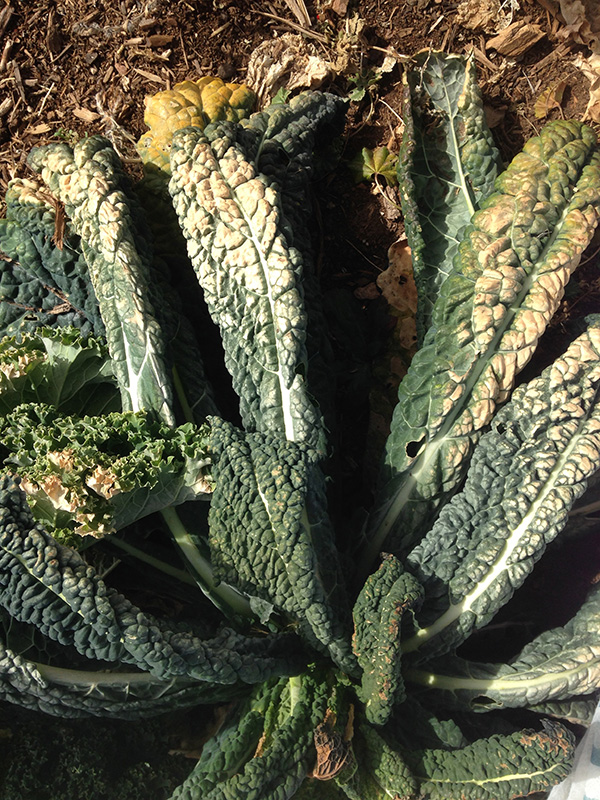
The Toscano Kale with freeze burn. It is more sensitive to cold temperatures  than other kales

Toscano Kale

The Toscana (aka Lacinato or dinosaur) kale got severely damaged. It is cold sensitive and although it’s not completely dead, it is unharvestable. Here it is with the leaves burned from the cold.


Russian Red kale is still alive

Russian Red kale


The Russian Red and Curly Leaf kale are still going and have some damage as well but the new growth is doing well. I haven’t watered them at all-nature has with a little snow and a nice rain the other day- almost an inch. I do have them covered with 2 layers of winter weight row cover.

gourds in field

The gourds are still drying in the field. Some are starting to get lighter in weight so I will put those in the garden shed to finish drying. The rest will stay outside until they dry more.

bubble wrap down on windowsThe green house is button up fairly tight now with just a little venting at the top panels. I’ve put the bubble wrap on all the windows (bubbles faced to the window) for extra insulation. I’ve also put the 4 barrels with water in them on the north wall for them to absorb heat in the daytime (I took them out during the summer), releasing the heat at night (the theory is that the sun which is lower and further to the south will hit them on the north wall and warm up in the daytime). I’m not sure I have enough barrels to do much good but even one degree will be helpful once it gets cold again.

winter lettuces

I’ve planted 2 winter lettuce varieties in the green house as transplants back in early November. The cold hard varieties are a green variety-Winter Wunder and a red variety-Marshall Red Romaine. They both have made it so far through those cold snaps although they have slowed down in growth because of the shorter daylight hours. They will stop growing until sometime in January when the daylight hours start to get longer.  Winter Wunder is my favorite lettuce but only grows well during the cold months. When it starts to get even a little warm, it will bolt. The lettuces have 2 layers of row cover over them at night and have some protection from the unheated greenhouse (at least from the winds). I’ve also noticed that the lettuces don’t need a lot of water now (about once every 2 weeks). It will be interesting to see if they make it Dec-February. Don’t they look wonderful in the winter!

There has been about a 4-7°F difference between the greenhouse temperature and the outside temperature at 7 am in the morning when I check everything. When I add the row cover at night I get about 4-6 degrees more protection. I’m not sure what to expect this winter since this is my first December-January  in the greenhouse. Last year when we finished up the greenhouse I start planting on February 17th so now I will see if these established greens can survive Dec-Jan.

Fall garden clean up-slow and easy

Nov tomatoes

Fall is a wonderful time of the year. The pace slows down for us gardeners. The perennial plants are looking sleepy now as am I, ready for our winter slumber. I want to prune the plants as they are shaggy but don’t dare as pruning now could kill them with these cold nights.

Just about everything is done. The outside beds have been cleaned up and I only have a few more beds to put horse manure in. I cut the smaller sunflower heads (with all their seeds) and laid them on the ground for the birds – they’re  crazy for them. I just planted garlic before the cold snap and watered it and covered with straw for the winter so it will get a head start before next spring. The herbs will get compost and straw over them to help see them through the winter. I’ve built 2 big compost piles that are hot (140-150°F) that should be ready by next month but will be saved till next spring for the beds. I still have some gourds left in the field, hoping they dry ok. Gourds are always iffy about drying properly especially with our winters, at least for me. I’m waiting for them to get lighter (in weight) before I take them out.  And most important, the plants and trees have been watered since I turned off the drip systems. All this sounds like a lot and it is, but I have the luxury of taking my time now.

The only tomato plants left were in the greenhouse and froze this last week with the 13°F nights. I had finished buttoning up the greenhouse before the arctic cold blast hit but it still killed the rest of the tomatoes as the greenhouse is not heated. I’ve already planted cold hardy lettuces in there which I can harvest in December and they made it through the cold blast with some winter weight row cover over them. I put a coffee pot in the greenhouse for me when I tinker in there. Perfect! The greenhouse will be very warm in the daytime and pretty cold in the nights which is always a challenge with unheated greenhouses in winters.

The goats, horse and chicken water heaters have been turned on and fixed after discovering one of the heaters was not working. The old chickens get a heat lamp to keep them warm at night. The bees have been readied for winter. The barn cats which never came in the house last year are now coming in the house at night which is such a relief. We are ready for winter here at the little farm. Can’t wait to read a good book by the fireplace when it’s cold outside.

And lookee! I still have tomatoes in the house and here it is-Nov 15th! I will relish each one now as I won’t be getting any homegrown for a long time!


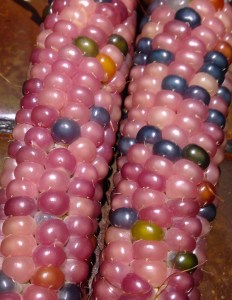
Glass Gem corn colors

Glass Gem corn 6

Glass Gem corn 6

I planted some Glass Gem corn seeds this year from Native Seed Search in AZ and grew them out. For the last 3 years I’ve tried to buy this seed but it was always sold out so I was excited to try them this year. The range of colors is incredible. Opening each ear of corn was like Christmas because you wouldn’t know what colors would be inside.  Many of the colors look like little glass pearls hence the name and some look less pearlized but all are stunningly beautiful. An interesting note is I noticed in the packet that some seeds had color and other seeds less color and it didn’t seem to matter when they grew out but maybe that’s because no one has tried to isolate particular colors yet.

I know the seeds are pure because I didn’t grow any other corn this year and all my neighbors don’t have any veggie gardens for wind cross-pollination. I am saving the seeds and will sell them by the color next spring. Of course there is no guarantee that each kernel of corn will even produce its particular color because of its unique genetics (just because you have blue eyes doesn’t mean you will produce a child with blue eyes-it depends on your genetics and the one you mated with). I’ll let you know next spring how you can buy some of them.

I’m going to take my favorite colors next year and replant the seeds and label them to see if they grow back out to that color. Great project for a Master Gardener, don’t you think? Of course I’ll have to isolate them or cross-pollination will happen for sure. I might call upon a few of my gardener friends to grow one particular color in their garden with no other corn-growing there to see what happens. This will be an interesting endeavor.

There were 15 different color combinations with some producing very limited colors due to just a few ears having those colors and some have a lot of ears with a particular color combo. Some I won’t even sell because there aren’t a lot of seeds with a particular color.  So here are the colors. Check out these beauties!

Different Types of Corn


Glass Gem corn

Pictured above is the Glass Gem corn I grew this year-it came out in many different colors not just these. I’ll write more on the different colors in another post.


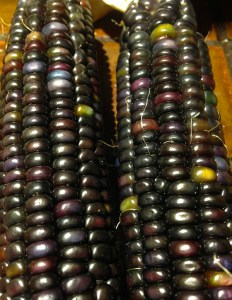
Hopi Blue corn

Here is the Hopi Blue corn that my friend Jody grew. Notice the kernals shrunk.

When they dried they looked very different from each other as shown above. I thought maybe it was the way we dried them. Perhaps we dried them differently. The individual Hopi Blue kernals shrunk while the Glass Gem kernals retained their original shape. All this led me to wonder about the different types of corn I’ve hear about – dent, flint, sweet, flour and popcorn and what makes them different. So here’s what I found out.

Dent (Zea mays indent) – Dent corn is called ‘field’ corn and is used for livestock feed or in processed foods. It is usually white or yellow and contains both hard and soft starch. It becomes indented when mature. Field corn contains 4% sugar.

Flint (Zea mays indurata) – Flint corn is called ‘Indian’ corn and has a hard outer shell and is hard inside as well. The kernals are very hard, sort of like flint stone, hence the name flint. It comes in a wide range of colors. Flint corn is commonly used for decorations.

Popcorn (Zea mays everts) – Popcorn is a type of flint corn. It has a soft starchy center and a very hard exterior shell. When we heat it, the moisture inside the kernal blows up to become popcorn.

Sweet (Zea saccharata or Zea rugosa) – Sweet corn is the fresh ‘corn-the-cob’ type of corn we eat. It is also canned and frozen and contains more sugars than other types of corn. Field corn has 10% sugars in it but will convert to starch quickly if not eaten soon after picking. That’s why my grandmother use to send us kids to pick the corn right before we put it in boiling water before dinner!

Flour (Zea mays amylase) – Flour corn is used for baking. It is easy to grind because of its soft center. It is mostly white, but can come in other colors like blue corn. It is one of the oldest types of corn grown by Native Americans.

So when I looked them up, I discovered the Hopi Blue corn is a flour corn and the Glass Gem corn is a popcorn which is type of Flint corn. That explains why they look so different.  The flour corn kernals are softer so they shrunk more while the flint corn kernals are hard and retained their shapes. Another ‘ah ha’ moment for me!

Fall harvest season is full blast right now!

Harvest season is full blast right now. Started out with our Home Grown New Mexico ‘Jam On’ class where we made a Strawberry-balsamic jam and a terrific Blueberry jam.

Himrod grapes-yum!

Then the grapes ripened-ate lots and dried some into raisins for later.

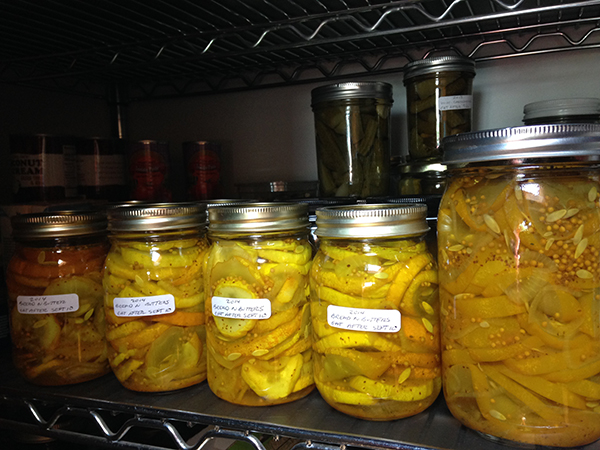
bread n butter pickles

The cucumbers ripened so fast I was making lots of pickles. First I made bread and butter pickles, then cornichon pickles and then dill pickles-crock, refrigerator and canned. Must have about 30 jars+ and now the 5 gallon crock is full where I am fermenting some with salt brine. After I was bored with pickles,  I made some sweet pickle relish which I haven’t tasted yet. Will probably make more of that with the giant cucumbers I miss when looking for little ones. So far I’ve made pickles with Jody, Nick and Elodie.

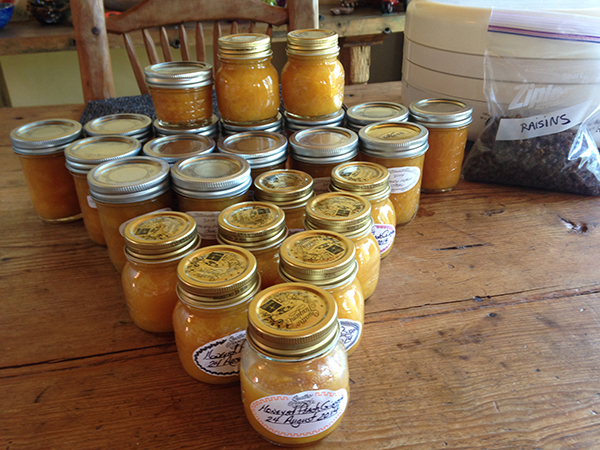
peach jam and raisins

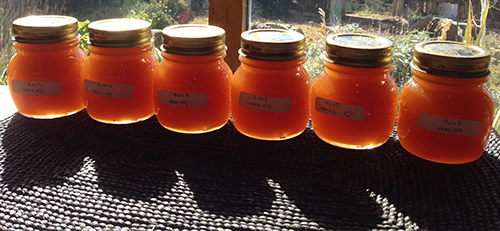
Then I bought 20 lbs of peaches from the Farmer’s Market and Mernie and I made 3 different peach jams.

9tomato sauce-finished in bags

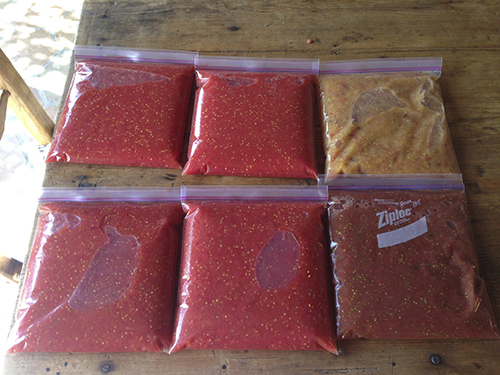
Now the tomatoes are coming in and I’m starting to make the raw tomato sauce that I freeze in gallon plastic freezer bags. Later in November after I recover from harvesting, I will take them out of the freezer and make different pasta sauces like puttenesca, marinara, penne alla vodka and good ole spaghetti sauce.


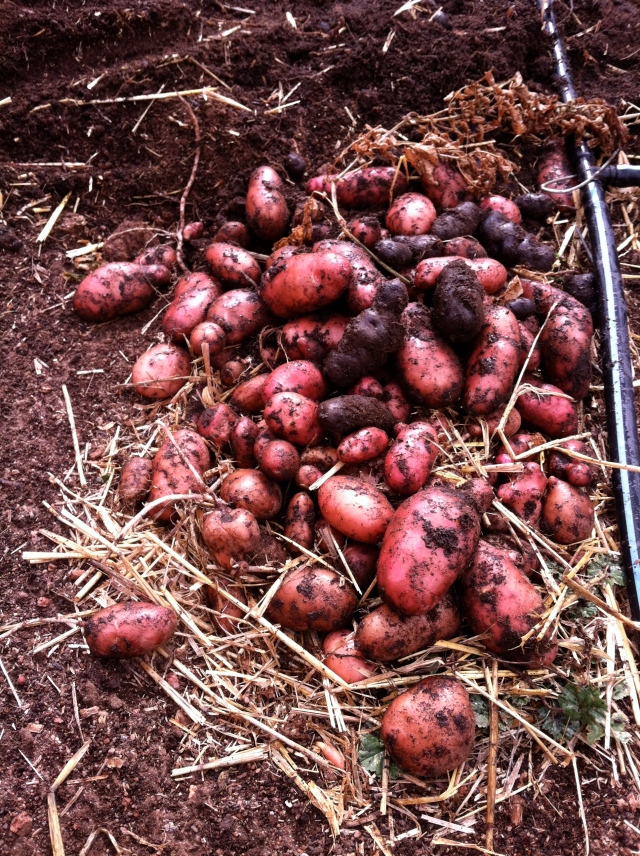
Potatoes dug out just in the nick of time!

Potatoes dug out just in the nick of time!

Soon I will harvest potatoes too.

2013-part of the fall honey harvest

and we will harvest honey from the bee hive.

Of course then there is all I take to the Farmer’s Market that I harvest every week-tomatoes, eggplants, shishito peppers, beans, tomatillos and sometimes rhubarb, kale and chard when I have the room on the tables. Phew! Busy time of year!

The best part of it all is I haven’t bought any vegetables in the store since early July and I’ll have a full pantry for winter when harvest season is done.