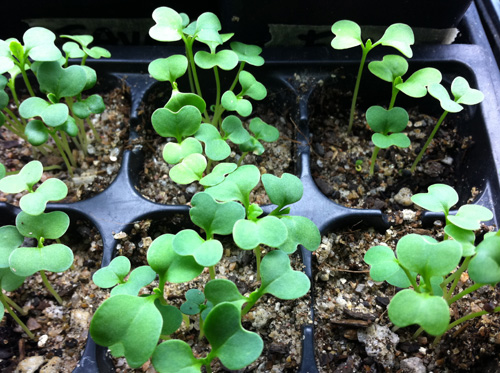
Lettuce bowl ready for first thinning

Here is the lettuce bowl I planted on Mar 7, only 13 days ago. Remember how it was barely coming up where it hung off the seed heat mat-well no more!  It is coming up beautifully. It’s so nice to see a ‘sea of green’ in the house. I will thin the baby seedlings (eating them) to give the rest of the seedlings some room to grow bigger. This is a mesclun lettuce I got from the Homegrown New Mexico seed swap event.  It is about 2 weeks ahead of the the lettuce I just planted outside. All part of trying to keep a continuous supply of lettuce for awhile. A couple more weeks and I think I’ll have a salad!

Garlic coming up nicely


The garlic I planted last fall in November is already 8 inches tall and growing like weeds! I just love planting it in the fall, putting straw over it and watering it maybe once a month in winter. It is the first thing to come up in early spring and will be ready for harvest sometime in late June-early July. Such an easy crop to grow and a must grow for cooks. Nothing like cooking with fresh garlic. Plus a bonus is bugs don’t like it and rabbits don’t like it-nice! This year I grew both hardneck garlic which tastes great and softneck garlic which lasts a long time. Just be sure to save some of the biggest cloves to plant for next fall. Bigger cloves=bigger bulbs the following year!

Seed starting INSIDE

I’ve been planting seeds INSIDE for a couple of weeks now. Here is my update on my seed starting endeavors this spring so far.

PEAS-Not everything is successful-My pea seeds I planted inside have NOT done well as I had hoped. They are barely coming up now inside so I planted more outside and if these make it, I will add to the other seeds that I planted outside on Saturday. I think the heating mat was too hot for them so I put them on a table under the lights but with no heat. We will see..

FAVA BEANS-I’m so excited-I’ve never grown fava beans before but are trying them this year. I sprouted fava beans that I got from that Homegrown seed swap and bought some more that I got from Spanish Table Market here in Santa Fe. The companies would like to say that the ones they sell you to eat are different then the ones they sell you to grow.  If they are treated then that would be true but so far I have not found that to be the case. They are both sprouting just fine. Today I saw three of them breaking ground in their little pots on the heat mat under the lights. Once up I will transplant them outside as they like the cold. I’ll talk about them later.

CHARD, BOK CHOY seeds planted-MAR 13-The chard and bok choy germinated in 2 days!

BORAGE seeds planted-MAR 13-Germinated in 3 days!

MORE LETTUCE-seeds planted-MAR 13-just starting to come up

SPINACH seeds planted inside as well as outside -MAR 13-Not up yet

TOMATOES-seeds planted today-Sunday, MAR 18-planted 27 different varieties! Hope to put them out 8 weeks from now-mid May or sooner. Last year I planted tomato seeds inside on Mar 21.

POTATOES-I’ve been chitting them for a week now. Chitting is getting the potato eyes to sprout.

The next major inside seed starting will be in 2 weeks-Basil, oregano, marjoram, zinnias and probably a lot more.

Time to plant spinach and lettuce

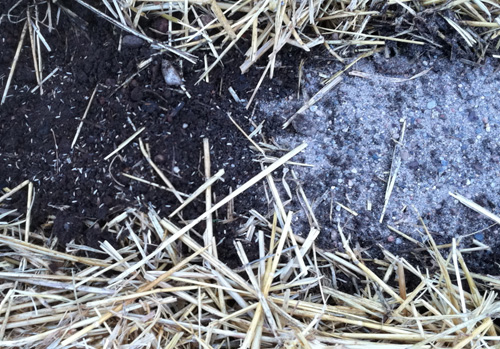
Now is the time to plant spinach and lettuce OUTSIDE as well as peas if you haven’t already done it. This year I am putting them between the rows of garlic I planted last November as APHIDS DO NOT LIKE GARLIC so I’m hoping the garlic will help keep them away from the greens this year. I took the temperature of the soil in the exposed raised bed with my compost thermometer where I want to plant them and it was 60°F. Lettuce seeds germinate best at soil temperatures of 40° to 80°F so I’m in the right range. This will be mesclun so I spread the seeds over the area as shown on the left side of the picture, then put a fine layer of sand over the seeds as shown in the right side of the picture, I planted ‘Provencal Mix’ from Cook’s Gardens and ‘Rocket Arugula’ ‘Tyee’ spinach (which is slow to bolt), and another lettuce mix with Arugula that I got from the Home Grown New Mexico’s seed swapping event we had a couple of weeks ago.

Master Gardener Intern Class-Vegetables

I’ve been totally busy teaching classes lately and the last class I taught was the Santa Fe Master Gardener Intern Class on Vegetables. All I can say to the interns is hang in there. Yes there are some difficult classes to get through but there are some great instructional classes as well that are like a breath of fresh air. It wasn’t till I became a Master Gardener that I really blossomed as a gardener. And now I am a rabid gardener! The knowledge you will continue to gain afterwards, the contacts, camaraderie and friendships you will develop will help you grow as well as the plants you will be growing! Hopefully you enjoyed and learned a lot from the Vegetable class. (Yes it was my favorite class when I was an intern!) So for those of you who couldn’t come to class or aren’t in the program but are interested, here are the information sheets. I want to make them available to all.

VEGETABLE GARDENING IN SANTA FE  gives an overview of vegetable gardening in Santa Fe.

INFORMATION SHEET covers what the differences are  between an Heirloom, Hybrid and GMO plant and explains what mycorrhizae fungi is and how it helps plants grow.

HERBS is a list of perennial and annual herbs we can grow here in Santa Fe.

PLANTING TOMATOES and PLANTING SQUASH both address how to transplant them into the garden and some of the things I add to help grow these beautiful vegetables and also how to help thwart the dreaded squash vine borer and squash bugs.

SEED STARTING DATE CALCULATOR from Johnny’s Seeds is the same one from the previous post but if you didn’t read it, then here it is. A great tool for when to start seeds or transplant them into the garden.

And now if you will excuse me, I will continue starting my seeds inside! Perfect day-cold, windy and snowy!

Seed Heating Mats for Starting Seeds Indoors

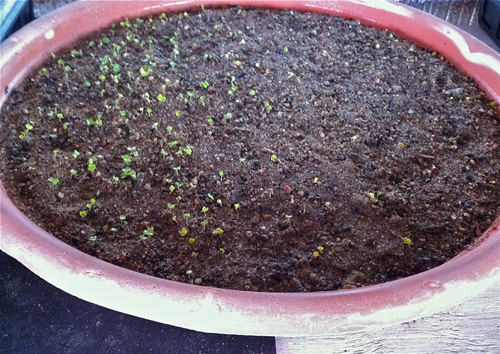
I did a little experiment. I started my lettuce bowl, putting seeds on the ‘bowl’ and lightly covering with sand. I didn’t have enough room to put the whole bowl on my seed heating mat (I’ve ordered another one) so I put half ON my mat and half OFF the mat as in the picture. The heat comes from the bottom. The temperature of half ON the heat mat was 77°F and the half OFF the mat was much cooler at  70°F. The half on the mat germinated in 3 days while the half off the mat had only a few seeds germinate. Amazing how the temperature affects the germination rate. Lesson here? If you plan to start seeds indoors, get a seed heating mat. Next: Review of my Seed Starting Class last Saturday.

Create your own lettuce/mesclun bowl!

What does the cat have to do with the lettuce mesclun bowl?

"Trini" the cat! Photo by Genevieve Russell

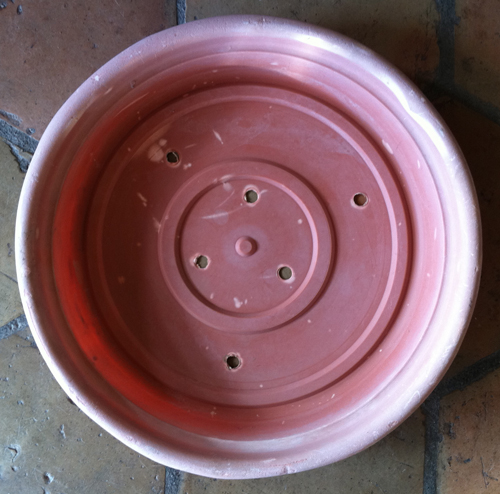
‘Mesclun’ is a term that means a ‘mixture of young salad greens’ in French. Last year I created a lettuce/mesclun bowl inside the house while it was still cold outside. I took the bottom from one of my pots (you know so that your pots don’t leak all over when you water), cleaned it with a bleach solution and drilled some holes in the bottom of it so water can drain out.

Then I filled it with some moist potting soil and sprinkled some lettuce mesclun mix all over it and gently tamped it down so the seeds make good contact with the soil. In this first picture I sprinkled sand over the half of the seeds.

Then I finish sprinkling the sand over the seeds-just enough till they were covered.

Next I sprayed the sand so it became moist with a spray bottle so as not to disturb the seeds. Then I put plastic wrap over it to hold in the moisture until the lettuce germinates. I kept it in a cool place in the house until it germinated and then I moved it by a window.

This is when I got in trouble with the cat…

Trini, "I like salad too" Photo by Genevieve Russell

Here is the lettuce bowl. Coming up nicely. Now if I could just keep the cat from eating it! She loves it! I caught her eating it around the edges by the window. I’ll have to thin it this week without her help! Perhaps I’ll have to make her a salad bowl of her own.  In another couple of weeks it should be pretty big.

Here it is ready to eat for it’s first cutting in 32 days and at $6.99/lb in the stores, it’s a deal! Harvest by the ‘cut and come again’ method and it will grow back for several cuttings. To do this, simply take sharp scissors and cut off a bunch of leaves in the amount you need to fill your salad bowl. Cut the leaves off at 1 to 2 inches above the soil. Don’t cut the crowns of the lettuce or it won’t grow back. Bon Appétit!

Lettuce bowl ready for first cutting-32 days

The Mystery of the Calabacita Squash

Article first published as The Mystery of the Calabacita Squash on Blogcritics. Story by giantveggiegardener.
As a gardener and a cook, I’ve been searching for a particular squash seed-the Mexican Calabacita. It was the original squash used to make the famous ‘Calabacitas’ dish of squash, corn, onions and green chili here in New Mexico. Most of us now use zucchini to make this savory dish because of it’s availability, but here at the Santa Fe Farmers Market, you can buy the Calabacita squashes in early summer and then by mid summer, they are gone. They are little green squashes with soft skin and teeny weenie seeds-too small to harvest. I researched it and found that the squash originally came from Mexico but not a lot of information is out there on it. No seed catalogs have it. None of my gardening friends have any seeds. I couldn’t find it anywhere.

Then two years ago while on vegetable gardening forum here in Santa Fe, I met another gardener and during the course of our conversation after the forum, the mysterious Calabacitas squash came up. I told her of my difficulty finding the seeds. She told me she had gotten some Calabacita seeds from another farmer whose family had been here for generations.  She offered me a few of the seeds. Finally I would get some seeds! So we emailed each other and I sent her an envelope to send me some but they never came. I went by the Farmers Market where she sells produce but we kept missing each other. Another season passed and still no seeds.

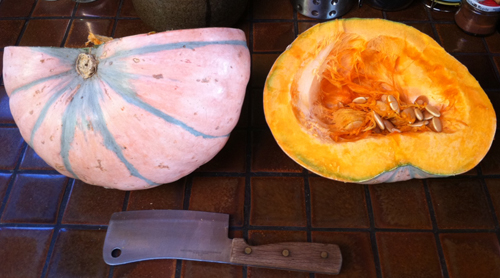
This year, on the last day of my season as ‘The Tomato Lady’ at the Farmers Market where I sell heirloom tomatoes, I went by her booth and mentioned maybe I could get some of those seeds for this upcoming season. She said,” Why not buy one of the squashes now?” When she pointed them out, I said, “That’s one of them? It doesn’t look anything like the ones earlier in the season” and she remarked, “Yes that’s one of them. They are actually a type of WINTER SQUASH. We just pick them when they are really young and immature and have no seeds”. That explains it! Why I could never get any seeds from them. That is why we don’t see them later on in summer-if you let it keep growing; it will become a mature winter squash. There were several there at her booth with different colors. Some were green with orange stripes and some were salmon color with green-grey stripes. She said there really wasn’t any difference in the taste.  I ended up with the salmon-green striped one. It weighed about 15 lbs and has a squat oval shape outside and lovely orange color inside. It smelled like a cross between a cucumber and a melon.
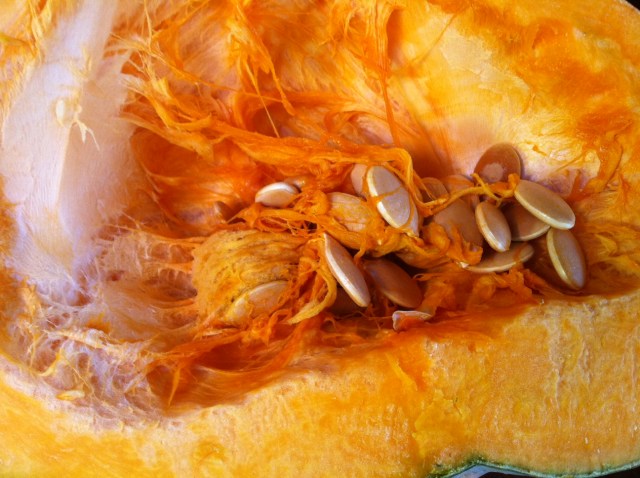
I got the seeds and roasted the squash. To roast it, I quartered it and rubbed some oil on it and put it on a cookie sheet. Then I added a little water in the bottom of the pan so it wouldn’t dry out. I put it in the oven at 350° and placed some aluminum foil loosely over it so it would not burn. It took about an hour to cook. Afterwards, I put the flesh in a freezer Ziploc and will later cook squash lasagna with béchamel sauce.

So Calabacita squash can be used to make Calabacitas in early summer or later in the fall used in winter squash dishes.

Here is a recipe for Calabacitas from New Mexico:

1 lb or more Calabacita squash or any summer squash, cubed

3-4 ears fresh corn cut off the cob or 1 can corn

1 chopped onion

cumin to taste

New Mexico green chili to taste

Sauté the onion, add the squash and corn and sauté till tender.

Add cumin to taste. Add New Mexico green chili to taste.

Winterizing perennial vegetables

Strawberry patch shown here in July need protection now

We should winterized our perennial vegetables and fruits. I have rhubarb, asparagus and strawberries. I already winterized my rhubarb, covering it with some straw and the leaves have died back under it but the roots are protected under the straw. Next I’ve been waiting for the asparagus ferns to turn brown and they just started so now I can cut them back to 3-4 inches high and cover them with straw too. Lastly I have a pretty big strawberry patch (about 8 feet x 40 feet) and was most concerned with it as I almost lost it last year when I did NOTHING to winterize it. So after the -20°F we had last winter, I want to make sure I help it for this winter. I’m going to cover it with about 6-8 inches of straw this year. It’s leaves are still green with the underside of them red. This week I will cover them for the winter. DON’T FORGET TO WATER YOUR PERENNIALS THIS WINTER as well especially if we don’t get any snow.

How to collect heirloom tomato seeds

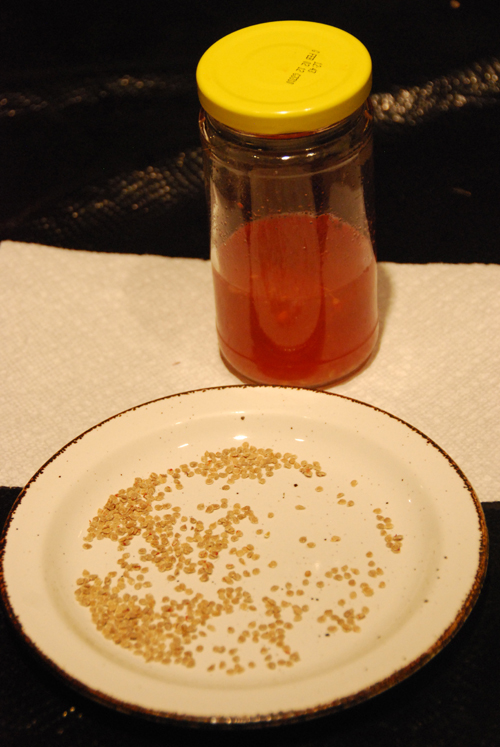
Tomato seeds fermenting in a jar. On the plate are some dried seeds.

I don’t collect hybrid tomato seeds as they may not grow back true.What that means is they may revert back to one parent or the other that they were crossed with. Heirloom tomatoes will grow back true.

The only heirloom tomato seeds I collect are from my giant tomatoes as I’m trying to get some seeds that do well in our high desert and give me some big, really big tomatoes. Last year I got 3 tomato seeds from a giant grower who grew a tomato over 7 lbs in Ohio. This year I got a pretty large tomato from one of those seeds. I kept the tomato which measured 19 inches in diameter and almost weighed 3 lbs and recently got the seeds. I will try some of these seeds next year as well as other big tomato seeds that I got from another grower this week.  Here’s how you can collect your favorite heirloom tomato seeds.

To collect tomato seeds, cut the tomato open, squeeze and scrape out all the seeds and put them in a little jar with some water. Then put the lid on. Try to not get too much pulp in with them. The seed/water mixture will start to ferment in a couple of days and it might bubble a little which is good. The fermentation will remove the slime on the seeds and the seeds will fall to the bottom of the mixture. When almost all the seeds are on the bottom, pour out the liquid, seeds and pulp through a fine sieve, removing the pulp. Keep rinsing until only the seeds are left. Spread them out on a paper towel to drain the excess water and then put them on another paper towel to finish drying. Before the seeds dry completely I move them around so the paper doesn’t stick to them. After they are thoroughly dry, put them in a ziplock baggie, label and store. You can keep any heirloom tomato seeds this way.

My only concern with collecting tomato seeds is if you plant cherry tomatoes too close to the heirloom tomato you want to keep, they may cross-pollinate so think about where they will be in your garden next spring and don’t plant them right next to each other. Tomatoes aren’t pollinated by bees but by the breeze or are self pollinating. Tomatoes originally came from South America and honeybees came from Europe or Africa so tomatoes aren’t native plants to the honeybee hence they aren’t interested which actually makes pollination easier to control.

How We Loaded the Giant Vegetables in a Truck

Mad Max and me looking like a mad hatter with that hair! Last day before cutoff.

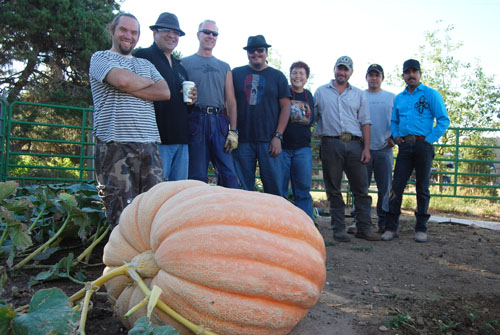
Many of you asked how to I load these giant vegetables. Here are some pictures of the guys loading the giant pumpkins into the truck. If the pumpkins get much bigger, I’ll have to get them in with a hoist.

Many thanks to Janet and Tom Hiron for loaning me their truck, Pepe, for hauling these behemoths up to the weigh-off in Colorado and to the ‘Mad Max’ guys who loaded them. It truly takes a village to get help grow and promote these giants! Tomorrow I will post pics of the weigh-off.

This slideshow requires JavaScript.

4 New Mexico Giant Vegetable State Records Set in 2011!!!!

Giants Unloaded at Studio after the Weigh-Off

Four New Mexico Giant Vegetable State Records Set yesterday!

Yesterday I set 2 NEW New Mexico Records and BROKE 2 New Mexico Records that I set last year! My giant pumpkin, ‘Max’, ended up officially at 448 lbs breaking Kong’s record of 421 lbs last year. My giant marrow, ‘King Zuc II’ (zucchini) was 62 lbs which broke last year record of 43.5 lbs. My giant green squash, ‘Kryptonite’ (greenie) set a new record of 340 lbs and my long gourd, ‘Jake the Snake’, set a new record of 80″ in length. My giant pear gourd, ‘Gourdo’, weighed in at 103 lbs which was one lb more than the one at the State Fair earlier in September but there is no category for it. Sorry it took so long to post this but we had to get back from Colorado and get the guys back to unload all the giants at our studio! The next two posts will show the loading and Weigh-off but I wanted to get this out for all you following!

Weigh-Off time is upon us!

The crew-from left Spooner, Ed, Per, Ira, me, Javier, Daniel, and Beto-THE KONG BOYS!

The weigh-off is almost upon us. Tomorrow the pumpkin/greenie squashes will be cut at 8 am and loaded in the truck on pallets. How do I get all this weight in the bed of a truck? 8 strong men! These guys are the best and nicest guys around and I REALLY appreciate their help. I couldn’t do it without them. Here are last year’s crew with my giant pumpkin, ‘Kong’ at 421 lbs. This year’s giant pumpkin, MAD MAX is 463 lbs and the ‘Greenie’ squash, Jabba the Hut is 347 lbs.!  Hope the guys have been working out! More pics tomorrow of the loading of the giants!

500 lbs of tomatoes..

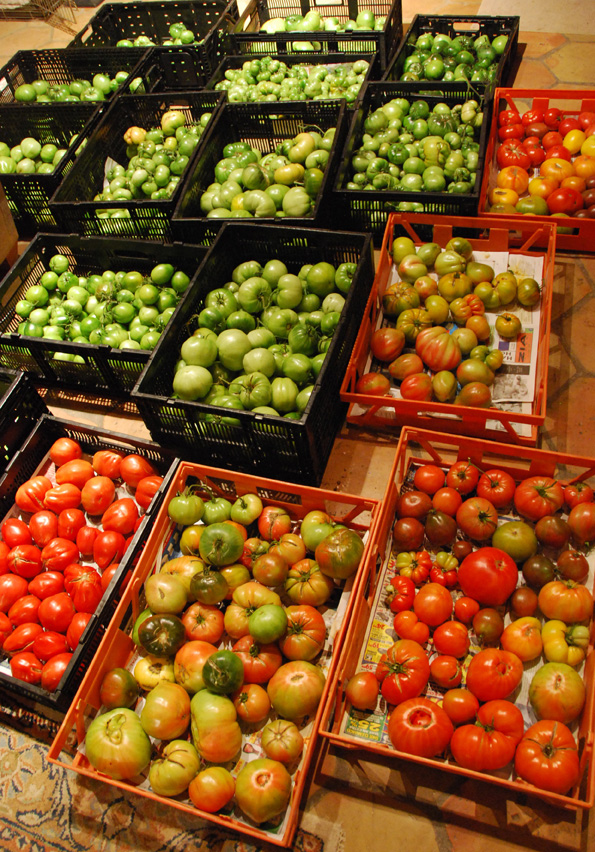
There must be 500 lbs of tomatoes all over the house in different states of ripeness now. Little paths throughout the house to walk around! With all the freeze scares each day for the nights, I went out and picked almost all the tomatoes that can finish ripening. I started picking hard on Wednesday and then my good friend Mernie came over and helped picked the rest on Thursday and Friday. On Saturday I had one of my best days ever at the Farmers Market as “The Tomato Lady’. It has been cold and had rained in Santa Fe and snowing on our mountain and I think everyone started thinking OMG- the tomato season is almost over! It was like a shark frenzy. My patrons didn’t want anything else-only tomatoes. I completely sold out. Now I just have to manage the remaining tomatoes in the house to make sure they ripen nicely. While I’m gone on Saturday at the giant pumpkin weigh-off, Caleb will be ‘The Tomato Lady’ again and then I will be back the following Saturday!

Giant Pumpkin, MAD MAX reaches 463 lbs today-Sunday Oct. 9

Today MAD MAX (according to the tape measurements) reached 463 lbs. That’s 42 lbs over last year’s record of 421 lbs!  Remember it could weigh lighter than the charts, but I feel pretty good that it will now beat the old record. It has to be all the extra water it’s been getting this past week. Over 2.2 inches in the pumpkin patch! Simply wonderful. That plus it’s been getting some extra fertilizer (seaweed and fish emulsion) right now. Pump it up MAXIE! The weather has been challenging but it hasn’t gotten down to 32°F (0°C) yet in the patch . It was suppose to but I’ve truly LUCKED OUT! I have the pumpkin plant covered with row cover and of course MAX has been covered for a month now with blankets at night. Now if it can just get through tonight, I think the rest of the week is suppose to be warmer and then it’s off to the races on Saturday!

Meanwhile the greenies are getting scary! That’s scaary good! Jabba is 349 lbs and Kyrptonite is 341 lbs! They are still battling it out for who gets to go! I hope one of them will actually sit on the mini pallet I picked up!

The other giants going to the weigh-off (if there is space) is a long gourd at 79″. It doesn’t weigh much but may have to hang off the truck. We’ll put a red bandana off the end of it! LOL. There is also a giant marrow (zucchini). I can use as a spacer between the pumpkin and greenie! And a giant pear gourd-ah what’s another 100 lbs! It should fit in the corner!