Four Season Harvest

Four-season Harvest by Eliot Coleman

I am currently reading Four-Season Harvest by Eliot Coleman and am really enjoying it. It is about growing organically vegetables all year long. Great reading!  It has good information from season extensions to winter vegetable gardening and of course summer gardening. I highly recommend it. You can also go their site, fourseasonfarm for more information on all their gardening books and their farm.

Winter gardening

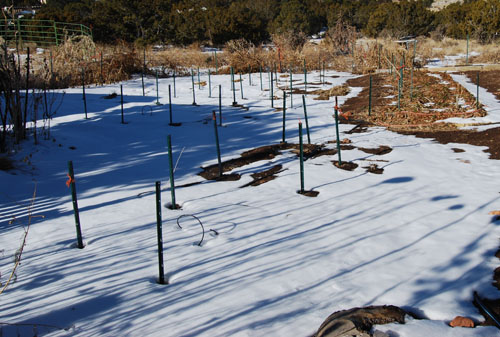
Main garden Jan. 8, 2011

Bri's Pumpkin Patch Jan. 8, 2011

It really looks like old man winter has arrived. Here are pictures of  the main garden and pumpkin patch down by the barn that I took this morning. We’ve had some precipitation (finally) on Dec 31-Jan.1 and some absolutely frigid temperatures last week which is why it is still on the ground.  Another Arctic blast is due here next week. Oh boy, can’t wait..

I went to get some carrots in my small patch protected only by 12 inches of straw up by the house for dinner last night and the carrots (yellow carrots) were looking good but the ground was frozen. All those nights in the single digits made the ground rock hard. Guess I’ll have to wait till spring when it thaws to harvest some.

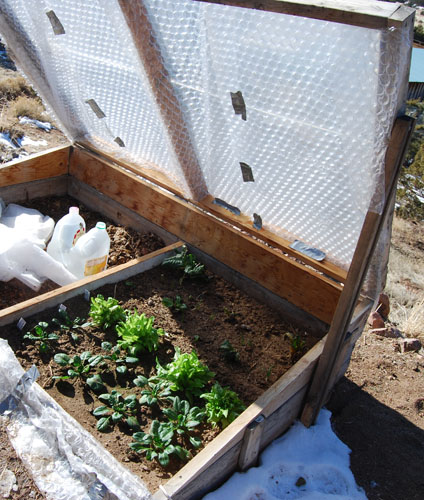
Cold Frame Jan 8, 2011

When I checked the cold frame, the soil is still soft and the plants are doing great!

Winter lettuce damage

A little damage on some of the lettuce leaves from the -4° we had one night but not bad considering I don’t pay any attention to it except for an occasional watering. In the picture notice I have large bubble wrap on my cover to add insulation and you can see the row cover to the left that I have to cover the crop with to also add protection. Guess this is working pretty well. The transplanted chard is holding it’s own and the spinach leaves ARE ACTUALLY GROWING-slowly but growing!  So I watered the cold frame winter veggies before the next big weather front.  I use gallon jugs to water-easier than the frozen hose…

Closeup of cold frame veggies

Bear 2000-2011

Bear, Handsome Bear, as I always called him, was my big male Swiss Alpine wether. Today I  had to have the vet put him down after a battle with severe Arthritis. He’s had it for a long time but had been really struggling for about a month now. He was always very protective of his twin sister, Butch who is still with us. He loved attention and having his pictures taken. If I brought a camera down, he would always ham it up. Here are some pictures of my beloved Bear. He was a great goatie thing.

This slideshow requires JavaScript.

Welcome to a new gardening year

Happy gardening in 2011

Welcome to a new gardening year! Just wanted to give thanks and gratitude to a great gardening year and to all of you who visited this past year. There were approximately 5700 of you from all over the world who visited at one time or another and that isn’t in a full year since I started Jan. 12, 2010. WOW! I’m not alone in my gardening venture! I plan to share more of my information and new gardening adventures this season.

My major gardening goals for 2011 are:
(I call them goals instead of resolutions that way I can’t break them)

1. Grow a 525+ lb giant pumpkin
2. Grow a 75+ lb giant marrow
3. Grow a giant green squash (think green pumpkin-like squash)
4. Grow a 4+ lb giant tomato
5. Build a hoophouse by Spring

The goals are now out to the universe. I’m a firm believer that one must put them out there to make them happen. I better get busy for this huge list!

So I got a lot on my plate this coming year and I hope you follow along, glean some useful info from the posts, AND share any info you may have as well. The more we learn from each other the better gardeners we’ll be. Have a great year!

PUMPKIN PUZZLE CONTEST-WIN A GIANT PUMPKIN SEED!!!!

My Front Steps puzzle on TheJigsawPuzzles.com

CLICK ON ME!!

PUMPKIN PUZZLE CONTEST-WIN A GIANT PUMPKIN SEED!!!!

The other puzzle was a warm up. Now it’s a CONTEST!! Do this 100 piece pumpkin puzzle above and give me your best time (there is a time clock on puzzle) in the LEAVE A REPLY section at bottom of this post. The best time wins a giant pumpkin seed if you want one. Honor system applies. And if you don’t want a pumpkin seed you can get another one of my ‘best’ seeds from any other vegetable seeds I have.

HAPPY NEW YEAR! STUCK INSIDE? DO THIS PUMPKIN PUZZLE!!

Pumpkins puzzle on TheJigsawPuzzles.com

CLICK ON ME!!

Bored in this freezing weather? Stuck inside? Here is a puzzle for you to figure out to help pass the winter away. One of my Master Gardener friends, Peggy Rudberg, found this on line and shared it with me. A pumpkin puzzle-how appropriate! Thanks Peggy! The 50 piece puzzle only took me less than 15 minutes. There are also other puzzles at this site.

Let me know how long it takes you!

What Gardeners Do In January

So what do Gardeners do in January? 20 things to do this month…

1. Unplug your outdoor holiday lights and your ready for next year. (Notice I didn’t say put them away)

2. Drink Martinis (nice warm drink) by the fireplace.

3. Put away holiday stuff. Keep out your gardening gifts all over the house.

4. Read gardening books and catalogs by the fireplace. Leave them out too. Your significant other will love you for this..

5. Watch weather (say isn’t that a cloud-oooh I think it looks like a pumpkin up there-do you see it?)

6. Make snow vegetables instead of a snowman. See if your neighbors can tell what they are..

7. Ogle seed catalogs (by the fireplace). Put stickies all over them.

8. Take dog for a drag (they don’t like to walk in snow).

9. Order more seeds (by the fireplace). As if we don’t have enough.

10. Guess how high your utility bill will be this month. Sit by the fireplace more and turn the thermostat down.

11. Get lots of firewood inside before that next storm. Buy green firewood-lasts longer..

12. Find your growing light boxes (or make them if you haven’t). Use full spectrum fluorescent lights instead of grow lights. Same difference and much cheaper. Drag them inside this month to set up and freak out your significant other.

13. Shovel snow outside (getting in shape for spading next Spring-notice I said getting).

14. Get heating mats for your grow boxes-a must have if you start seeds indoors. Nice to sit on too.

15. Layout next year’s garden on your computer (by the fireplace). I use GrowVeg.com. Really fun. Free for the first 30 days and then you can pay if you like it (not much-small price to pay for so much fun)

16. Insulate your grow boxes so they don’t loose so much heat at night inside. I buy a roll of metallic bubble wrap and wrap it around all 4 sides (one side removable in front so I can get to the plants) and a section for the top that I completely remove in the day and lay back on at night. Wrap your dog or cat in the leftover metallic wrap-you’ll enjoy it-they won’t.

17. Schedule when each veggie can go out (by the fireplace). I use a garden planner from a wonderful blog-Skippy’s Vegetable garden. How’s that for obsessive? Hey you gotta do something inside all those months!

18. Thank your significant other for putting up with your obsession. They might be ok with next growing season (hey at least try)

19. Toss that plant you didn’t plant outside and didn’t have the heart to get rid of last fall that is now full of aphids. (where do they come from anyways?)

20. Make your significant other read your blog. (As if they don’t put up with enough gardening stuff)

BONUS: Look up more gardening/pumpkin info on line. I call it gardening/pumpkin porn. (hey you gotta research this stuff, right?)

Happy New Year to all my obsessive gardening friends!!!

Wind chill on December 31, 2010

Temperature-14° on December 31, 2010 at 12pm noon

Here it is, the last day of the year and the outside temperature is 14° F (-10°C) at 12 NOON! We are having a bitter cold snap here in Santa Fe and that doesn’t include the wind chill factor. What is wind chill? It is a measure of how cold the atmosphere feels, taking not just actual temperature into account, but also wind, which can make the air considerably colder. So I was curious (as I always am) and found a wind chill calculator on line to see what the wind chill temperature was. Image my surprise when it said -3.2° F! (That’s -19.6° C)  Now I can figure out the real temperature when I go feed the barn animals and dread it more for them and me!  You can figure out how cold it is wherever you live too. I always get a little antsy about this time of year to get planting and then I go outside for a reality check. I think it’s a good day to stay home and go through the seed catalogs coming in and dream of what will be…

Xmas day with the goats!

Took a Santa’s hat down to the goats and gave them a special treat-Fritos! They love corn chips and raisins as treats! Still trying to figure out if Wee (small white goat) is pregnant. The friend we got her from said they thought she is but she is still not getting big and we’ve had her since Oct so who knows-there may be a surprise later on in January or Feburary! Wanted to see if the goats would keep a hat on and Bear and Sonny liked wearing it. The girl goats said “no”!

This slideshow requires JavaScript.

Cold Frame Winter Gardening

Growing Spinach and Lettuce in a Cold Frame in December

Checked my cold frame today and my winter greens are coming along. I’m growing spinach in foreground, and oakleaf lettuce behind it and behind the lettuce is some little Swiss chard transplants and a few onions from the summer garden. There is not much to do except give them a little water when the soil dries out which is about once every week. I haven’t been paying much attention to them. I’m not the best winter gardener. I don’t always open up the cold frame in the day or shut it down completely at night. It’s interesting to see how much neglect they can take and still produce in winter but it is nice to see something green.

2011 Baker Heirloom Seed Catalog Arrives!

2011 Baker Heirloom Seeds Catalog

My 2011 Baker Heirloom Seed Catalog arrived and just in time for me to cuddle up by the fireplace with it and a hot Mexican coffee while it snowed outside. If you are a veggie/flower gardener, this catalog is the most beautiful I’ve ever seen and has a wealth of information. It’s pictures inside are big and gorgeous and make me want to buy everything! It is by far my most favorite seed catalog and if you want to order one, it’s free here at Baker Heirloom Seed (www.rareseeds.com). I get many seed catalogs every year but this catalog is always the best one-year after year. Did I say  it snowed? Yes, snow! We haven’t had any measureable snow here in Santa Fe until yesterday. We got 16 inches of snow (that equals 1.6 inches of rain-10 inches of snow = 1 inch of rain) where I live and I’m so glad because we really need the moisture right now. Hasn’t felt like winter here till this weekend. Now we don’t have to water for awhile!

Don’t Forget to Water in the Winter!

2010 winter precipitation forecast

We haven’t been getting a lot of rain in the Southwest–in fact almost nothing for awhile. That’s because we are in the middle of a La Niña weather cycle, which means less precipitation and warmer temperatures this winter. This means we have to remember to WATER MORE. How much more? Well I WATER EVERYTHING EVERY 2 WEEKS: the perennial gardens and trees (not the dead veggies!), and if we do get a decent amount of snow I water less. I actually write down when I water on a calendar otherwise I could never remember. Last winter we had an El Niño which resulted in more rain and snow, but not this year.

So what is La Niña and what does she have to do with weather in New Mexico? Well, La Niña is caused by colder than normal subsurface ocean water temperatures that start in the tropical Pacific. This cold water is pushed by waves and easterly trade winds towards South America, and results in an upwelling of cold water off Peru and Ecuador that travels north off the coast of South America.

2010 winter temperature forecast

La Niña often creates drier than normal conditions in the Southwest in late summer through the next winter, whereas the Pacific Northwest is likely to be wetter than normal in the late fall and early winter. If you watch the weather, you’ll notice the jet stream, which brings in the storms, gets pushed north of us in the winter and thus we get less rain and snow. So don’t forget to water!

Testing Your Garden Soil

Not having great soil is really a problem here in Northern New Mexico and makes growing anything a challenge. Having good soil where you want to plant veggies is the most important thing you can do. People ask me all the time how do I grow such great veggies and the secret is-it’s all about the soil!  So the more we learn about how to improve our soil the better our growing results will be. So read on.

Here is an excerpt from Payne’s Nurseries site here in Santa Fe on ‘How to Build Your Northern New Mexico Soil’ which is worth reading in it’s entirety.”We have three basic types of soil here in Northern New Mexico: caliche, adobe and sand. All are alkaline, with a pH often over 7.0, and tend to contain abundant quantities of sodium, calcium and potassium. Caliche, adobe, and sand all lack organic matter, the nutrients and organisms of which are essential for sustaining high quality plant growth and production. Caliche is made up of sand, gravel and clay. Adobe is essentially fine clay. Neither soil type is easily penetrated by water. Sand, on the other hand, allows water through but has a limited ability to hold nutrients or moisture.” Check out the article. Most of us have some combination of these 3 types.  Fertilitzers feed the plant but not the soil which also needs to be fertile and more and more people are just learning that.

One of the things I mentioned in an earlier post is I’m getting a soil test specifically for growing my giant pumpkins and I will get one for my veggie garden where I grow tomatoes also. I researched where other pumpkin growers are getting their soil analysis done and I will use A & L Western Laboratories in Modesto, Ca for mine as they can test for any crop I specify versus a general soil test. My fellow pumpkin nuts tell me to get the  S3C COMPLETE Analysis package from A & L and to get the recommendations as well. The soil sample collected should be a composite from 10 to 20 locations within a selected area; a sufficient number to “average out” variations. You can learn how to properly take soil samples from them here. Other soil testing companies may have other protocol so check with whoever you use as to how they want you to collect soil samples.

There is nothing wrong with getting a general soil test (instead of for a particular crop) and that is what I would get if I didn’t grow competitively but I want to get the most out of my soil for my pumpkins.

You can also get a general soil analysis from a NMSU laboratory here and you can go to NMSU Soil Test Interpretations site to learn what your test means. Reading the tests isn’t easy but once you get one done you’ll be better able to understand what needs to be added to your garden for next year’s growing season so you can have a wonderful lush, productive garden next year. I’ll post what the results are as soon as I get them back.

Basic Composting 101

I don’t compost at all in the winter here as it is too hard to keep it ‘hot’ in our frigid weather but here is some general information on composting in case you live in a more temperate climate. In Santa Fe, I compost in the Fall and then let it cook all winter and use it in the Spring after it becomes compost. Then I make more in the Spring and Summer.

1. I build my compost bins to hold the materials out of pallets. I just use 3 per bin and wire them together. I line the interior with hardware cloth (1/2 inch wire holes) to keep it from falling through the pallet  slots. I built 3 of them for the various stages the compost goes through.Works great. Easy.

2. When building my compost pile I alternate layers of BROWN and GREEN materials (2-4 inches of each layer) and when you add a food scrap layer, make sure you sprinkle it with soil and then top off with a brown layer to prevent smells. I use a RATIO OF ONE PART BROWN TO ONE PART GREEN materials. In other words-equal amounts of both. I usually turn it once or twice but I should turn it more (like every week). I also need to water the pile to help with the breakdown process. The compost pile should be moist like a sponge but not drowning. That is usually not a problem as the climate is sooo dry here in Santa Fe. In fact we have to water more because it is so dry. In other parts of the world where it rains more, you may have to cover it from getting too wet.

3. Here is the GREEN (NITROGEN) MATERIAL I USE in my compost pile-grass, food scraps (uncooked fruit and vegetables like old lettuce, old tomatoes, potato peelings, eggshells, coffee grounds, tea bags and egg shells), garden trimmings and FRESH horse manure.  If you can’t get fresh horse or other farm animal manure, then use blood meal or alfalfa meal to get your pile HOT. Just sprinkle it on top of  your green layer.

4. Here is the BROWN (CARBON) MATERIAL I USE dry manure, fall leaves, straw and newspaper strips (dry). I usually start at the bottom of the pile with some leaves and then add the green and kitchen scraps and some dirt and then the brown again. The stuff at the bottom of your pile will start to break down first. That is why you need to turn it over-so it cooks evenly. If you don’t turn it over it will take much longer to to break down and that is ok with some of us.

5. Here is what I DON’T USE in the compost pile- any meat products (attracts animals and may carry pathogens),  no dog or cat poo, no woody or branchy stuff  (takes too long to break down) corn cobs, no veggie garden plants (in case they have some disease)

6. Start by layering your brown and green stuff in one of your bins and pile it high. It will start to cook down in a couple of days and you will notice it will be about 1/2 its original size in about a week-if you have enough nitrogen (manure or blood meal or alfalfa meal) to get it cooking.

7. If you want to, get a compost thermometer which is about 24 inches tall to put in the center of the pile. A hot pile may get from 110 degrees- 160 degrees F which is hot enough to kill most pathogens and it is fun to see how hot your pile is. The hotter the pile, the faster it becomes compost. But this requires more turning to get it to decay faster. This is called HOT COMPOSTING.

8. Lastly you could layer all your stuff and just wait (about a year) for it to decay and become compost on its own. This is called COLD COMPOSTING.

Clean up that garden!

New goats-Sonny (brown), Bella (black) and Wee (white) wanting to help in the garden while Butch and Bear eat their food.

By now most of my gardening friends have finished cleaning up their gardens but I basically just finished cleaning up the veggie garden on Saturday. It was a good day to be out there-51 degrees and no wind. I wanted to try to finish before a snow storm hits today and the temperature plummeted. I’m mostly done now in the garden. I pulled all the tomato cages (60 of them) out and threw them over the fence. So now they are on the outside of the garden (all over the place) and I can go out on a nice winter day to clean up the cages and take my time. At least they won’t freeze in the ground inside the garden.  I raked up all the debris into piles that I will bag and dump. I don’t put any of my garden debris in the compost pile because some of it could harbor disease or pests that won’t die if I don’t get my compost pile hot enough. In fact I don’t compost at all in the winter here as it is too hard to keep it ‘hot’ in the frigid weather.  I mostly compost in early Fall and then let it cook all winter and use it in the Spring after it becomes compost for planting. I also make compost in the Spring and Summer too,  just not winter. This is the biggest garden I’ve ever had and was quite a job cleaning it up. Somehow I must train the new goats (who were watching) to do this last and tedious job! I suppose I could let them into it and see it they eat it all! Now wouldn’t that be nice!