2011 Vegetable Lineup

I finished my vegetable list for my main garden. I will grow many heirloom tomatoes, Fairy eggplants, Shishito peppers, Costata Romanesco zucchini, Galeux d’ Eyesines and Red Warty Thing winter squash, Rattlesnake pole beans, and several different cucumbers and some greens. I will have to expand the garden one more time but not before the season starts but sometime this summer. This is so I can get my tomatoes on a 3 year rotation. I’m ok for this year but need a new section for them by next year. I hopefully will be at our Farmers Market this coming year again. We have to apply each year and they have a jury system to get in as it is so popular and has grown so much. Looking forward to a new growing season!

2011 TOMATOES
HEIRLOOMS
PLUM STYLE
(2) Goldsman Italian American-red-BH
(2) San Marzano-red plum/80 days/AFN
BI-COLOR
(4) Striped German-bicolor-SFGH
(2) Gold Medal-bicolor-75-80 days-BH
(1)Ananas Noir
BLACK OR PURPLE
(2) Paul Robeson-black/75-85 days-AFN
(2) Cherokee Purple/80 days-AFN
RED
(1) Pantano Romanesco-red/70-80 days-BH,TOMFEST
(2) Costoluto Genovese-red/78 daysTOMGROWERS
(2) Goldsman Italian American-red-BH
CHERRY TOMATOES
(2) Black Cherry-black/75 days-AFN
(1) Green Grape-green/
(1) yellow/62 days-TOT TOM
HYBRIDS-I grow a few hybrids
(2) Lemon Boy-AFN
(3) Park’s Beefy Boy-red-70 days-AFB

2011 VEGGIE LIST
BEANS-Rattlesnake (remarkably favored pole bean)
PEPPER-Shishito (Japanese non hot pepper)
SUMMER SQUASH-ZUCCHINI-Costata Romanesco (best tasting zuke around)
WINTER SQUASH-Galeux d’ Eyesines and Red Warty Thing (that’s what it’s called!)
EGGPLANT-Fairy (best sweet, no bitter taste and soft skin eggplant I’ve tasted)
CUCUMBERS-Parisian, De Bourbonne, Boothsby Blonde, Poona Kera, Armenian and Parade? I grow cukes for either taste or which variety is best for different types of pickles
CORN-not this year (I’ll get it from our Farmers Market)
LETTUCES-From COOK’S GARDEN-Provencal Mix, Mesclun Mix, Buttercrunch, Yugoslavian Red, Santoro Lettuce, and Little Gem
SPINACH-From COOK’S GARDEN-Bloomsdale
CARROTS-Purple Haze and Scarlet Nantes
ARUGULA-Apollo

2011 HERBS-Following is a list of herbs that will be planted or exist on the property
Basil-new
Lime Basil-new
Thai Basil-new
Oregano-exists
Thyme-exists
Lemon Thyme-exists
Chives-exists
Dill-usually self seeds
Marjoram-new
Mint-exists
Sage-exists
Lavender-exists

New GIANT VEGETABLES To Grow in 2011

My GIANT (competition) VEGGIES for 2011

I’ve expanded my giant varieties this year, adding to my existing list from last year. It’s a obsession inside an obsession! It’s just that it is so much fun to see how BIG some of these varieties can grow. Last year, Kong, my giant pumpkin grew at it’s peak, 18 lbs a day. That’s incredible and one can actually see the difference from morning to evening in growth. This year I also plan to get one of those time lapse cameras that I will set up in the pumpkin patch to see them growing! The big boys who grow giant pumpkins tell me theirs put on 30-40 lbs a day. Imagine! I’m going to plant the same 895 Grande giant pumpkin seed that gave me the New Mexico State Record in 2010, its offspring (mine)-421 Cabossel, and one more-1046 Grande. I like Grande as a grower and his seed did so well here for me in Santa Fe. I think it’s because he’s a grower out of Colorado and we have similar growing conditions and soil.

New varieties for 2011 include giant green squash (looks like green pumpkin), giant green pear gourd (this one was from an 89 lb gourd that looks like a giant pear) and long gourd (this one came from a 96 inch long skinny gourd-I’m going to have to build a tall trellis)!

Also this year I’m going to get serious about growing the giant marrow (last year I sort of ignored it till it started getting big and it was one of the most fun things to see grow) and of course I’ll be trying to break into the 3-4 lb tomato range and I always love my Titan sunflowers (I call them the guardian angels of the garden) with their 20-24 inch heads. It’s going to be an ambitious year and I can’t wait!! Last year was a tough year with so many personal losses but this year feels different! I can’t wait!

2011 GIANT PUMPKINS
895 Grande 08 (1016 Daletas x 1385 Jutras)
421 Cabossel (895 Grande x self )
1046 Grande 10 (901 Hunt x 1385 Jutras)

2011 GIANT GREEN SQUASH
903 Noel 07 (848 McKenzie x self)

GIANT MARROW (like giant Zucchini)
206.5 Wursten 09 or 75.4 Wursten 09
43 Cabossel 10

GIANT TOMATOES
7.18 N. Harp 09n (5.58 Timm x open)
5.416 N, Harp 09 (5.58 Harp x open)
Big Zac (fr Totally Tomato)

GIANT PEAR GOURD
89 Scherber 10

LONG GOURD
96″ Scherber 10

GIANT SUNFLOWERS
Titan

Nyger, niger or thistle bird seed-all the same

Goldfinches at nyjer feeder

I’ve been investigating to see if we can plant Nyjer bird seed from the package seed we buy for birds. Nyger, niger or thistle bird seed are all names for the same bird seed from Africa. The official name, nyjer, was picked in 1988 so as not to offend anyone with the name niger or to confuse anyone about it possibly being a thistle seed. It is not our common thistle that we consider a weed here in the US.  Finches, pine siskins, and goldfinches particularly like it but other birds do not. To prevent any weed seeds that may be in the nyjer  and to prevent the non-native plant (nyjer) themselves from sprouting, all nyjer seed is now sterlized by heat and therefore not able to germinate. Perhaps this is for the best because even though it is not a weed, it spreads like one in it’s native land but does not grow well in the US. This heat sterilization is the reason for its high cost. So unlike the BLACK OIL SUNFLOWER SEED that we CAN plant and harvest for the wild birds, we will NOT be able to grow thistle. Too bad cause it’s so expensive.

Grow Black Oil Sunflower Seeds For Your Wild Birds

I just came back from the bird store where I got some black oil sunflower seeds for my wild birds when I thought why not grow my own for next year? My favorite sunflower up to now has been the Titan sunflower which is a striped seed and is not a black oil seed.  Black oil seeds compared to striped sunflower seeds have a higher oil content and are meatier for birds. They are also easier for small birds to crack open. I already cut off the sunflower heads from sunflowers for birds so why not give them what is really good for them. One variety of black oil sunflower seed that I found is Peredovik Black Oil Sunflower Seed from Russia. In 2016 you can get it at  Southern Exposure Seed Exchange. You can also just plant the black oil seed you get in your birdseed. I read that the sunflowers grow from 3-6 feet tall. So this year I’m going to add them in with my other sunflowers that I grow for a treat for the wild birds.

Hmm, now I wonder if I can grow that real expensive finch seed, Nyger? I’ll have to look into that! It is super expensive but I don’t know if it will grow here. I’ll get back to you on that one..

2014 update: Try to grow some from your birdseed mix but if yours don’t grow from your birdseed, go to the site above to buy some that will germinate. This is the most current seed company to buy from.

The garden is CLEAN.

Finally-done.  It only took 4 months but the garden is finally ALL raked up and I put it in my trailer. Then I  took my trailer that was overflowing with all the garden debris to the dump. I don’t keep any of the dead plants because I don’t want any possible disease or pests harboring in my compost-especially in winter when it doesn’t get so hot. It all came out to 600 lbs! That’s a lot of loading.. and dumping..

More winter greens go in the cold frame

Well I got some more winter greens to plant from ‘The Veggie Man’ from the Santa Fe Farmers Market on Saturday. My good friend Lava, told me she saw him there selling veggie starts and found out where he has his greenhouse and we went over there and picked some up. I got Argula, Endive, Blue Kale, and Baby Bok Choy and Parsley. I will plant them on Wednesday in my Cold Frame (where I already have Swiss Chard, Oakleaf Lettuce and Spinach growing), weather permitting. We are suppose to get cold again on Wednesday so we will see if I or the plants can stand it.

More on winter gardening

Winter gardening is very different than summer gardener. It’s almost not gardening at all. In fact Eliot Coleman, author of Four-Season Harvest which I’m still reading says it’s not winter gardening but winter harvesting which puts it in a whole different light.  The only thing I need to do once in awhile is add water. There are no bugs or disease. I put my whole winter garden in with starts. Makes it really easy that way. He also talks abut eating vegetables when they are in their season so for winter gardening that could include spinach, tatsoi, bok choy, endive, arugula, corn salad, miners lettuce, radicchio, escarole, mesclun, sorrel, mustard, beets and carrots. I always thought that salads were a summer thing but that’s not true because salad crops grow best in the cool seasons and are sweetest then. That’s why we always have trouble with salad crops bolting. We plant them too late in Spring. I’m re-evaluating this whole winter gardening thing.

Yesterday Was 60° F

I was off work yesterday and spent most of the day in the garden. And what a great day it was! It was a glorious day to be outside in the garden-60° F.  I continued  to collect old piles of debris that I had raked up last fall but had not gotten all of them out of the garden. I saw some gopher activity so I’ll have to get busy trapping them soon. Then I moved all of the tomato cages that were tossed over the garden fence and organized them in the now empty round pen. I have 60 totaled! After that I raked any debris just outside the garden as well to keep the area clean. Then I made some goatie toys for my dwarf Nigerian goats.  I stacked some old tires up and screwed them together and then put wooden caps on them (so the goats won’t fall in the holes and then put a plank across the span between the two tires columns. Immediately they jumped up on them and walked the plank! Goats like to play king of the mountain and this will work fine for them. A busy day altogether and I was a little sore last night but it was a good sore. You know, the kind you get when you get things done in the garden.

Don’t forget to feed the birds!

This slideshow requires JavaScript.

Now that winter is here, check bird feeders daily. We still have many feathered friends and more than ever they need our help at this time of year.  Experts recommend giving birds black oil sunflower seeds because of their high fat content in addition to their regular food. Put some in your feeder and don’t forget to put some on the ground so the ground feeding birds can get some too. We have a covey of Scale Quail that have visited us since summer and continue to do so this winter. They can’t get in the feeder so we’re sure to put some out on the ground and even on the snow for them. We were lucky enough to see them bringing their babies for food and water in the fall.

Bluebirds only visit us in the winter getting water every day, flying further north I guess in the summer. Woodpeckers, Flickers and even Magpies will come and visit you if you put out suet for them. Other birds include Robins, Thrashers and of course the Pinon Jays among many others. This is the time of year when birds need more of our help as food and water are more scarce.  Don’t forget fresh water and if it is frozen, put on a teakettle and put the hot water over the ice, melting it just enough for them. Don’t worry about burning the birds, the water cools immediately when it hits the ice water. It is actually harder for birds to find water they can drink in winter.

Veggie Tip-What to look at in seed catalogs

2011 Baker Heirloom Seeds Catalog

Why order from seed catalogs vs getting seeds or plants from the local nurseries? Variety. We have more choices to pick from. Now don’t get me wrong – I buy many of my vegetable plants from our local nurseries as well. I don’t start all mine from seeds but I like to grow some new varieties every year and many of those aren’t sold locally. Besides I really like going over the catalogs. What should we look at when ordering from our seed catalogs? Here is some information that catalogs give to help us make our decisions in choosing which variety to buy.

1. Quite often catalogs will list the particular needs of the variety-i.e. needs cool moist soil, tolerates heat, etc. This is important information to consider because of our cold springs, hot summers and what location we plant them at our houses.

2. They list whether it is a hybrid or heirloom variety. I like to grow mostly heirloom varieties so I look for this.

3. We get specific information on each variety-size, weight, color, flavor,  etc and often the history of where a particular seed came from. I especially find the history interesting. I like knowing where they originate from.

How many days to harvest-this tomato was 72 days

4. Probably the most important thing to consider with each variety is how many ‘days’. This means how many days to harvest. Here in Santa Fe, we have a short growing season. Our last frost is the average date we no longer experience freezing temperatures which is May 15th and the first average frost date is around Oct. 10. Last year was a really cold, windy spring with night time temperatures still at 27° on June 6th. We basically went from Winter to Summer. Every year offers new challenges for us weather wise and the weather has everything to do with how many days to harvest depending on when we can put the transplants or seeds in the soil.


So how many days to harvest? Some vegetables such as summer squash, cucumbers, lettuce, etc don’t take many days to harvest but some vegetables need a longer growing season such as winter squash, watermelon, and tomatoes so buy varieties that won’t go into October to ripen. Let’s take tomatoes for an example.  If we choose a tomato seed that says 72 days, we’ll probably get tomatoes but if we choose one that says 95 days to harvest, the odds are we won’t get any ripe ones before we get that first frost in fall. In Santa Fe, we should be looking to grow varieties that ripen in 60-80 days. Tomatoes come in early, mid and late season varieties so keep that in mind. Early season goes from 52-60 days, midseason goes from 60-75 days and late season goes from around 80-100 days. You certainly can try some late season varieties (I do) but pick more in the early-mid season range especially if you are only planting  a few. Also with tomatoes that ’80 days to harvest or 80 days’ means from transplanting plants outdoors not planting seeds outside. I’ve had people come up to me and complain they only have green tomatoes in October and when I ask what variety, it usually is one of the longer growing ones so pay attention to that day information in the catalogs because you can usually find some varieties with shorter days till harvest in every variety out there.

Purslane-The Edible Weed

Purslane weed


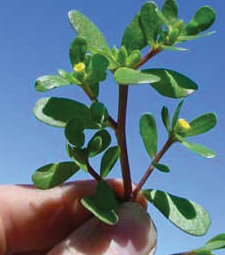
The other Purslane, Portulaca oleracea, is considered a common weed in most of the U.S but did you know it is also edible? Look how different it looks from the cultivated types I just posted about. I want to write about both aspects of it as a food source and also as a weed. Purslane thrives in New Mexico where the dry climate is conducive to its needs. The plant looks like a succulent with its thick reddish, flesh colored stems and milky leaves. It has a long taproot and produces a yellow flower with many seeds.

closeup of purslane weed-photo from gardenguides.com

This purslane is edible (like the cultivated types from Europe) when young and can be used in salads or cooked like greens. It is more and more being discovered as a food source and is rich in Omega-3 fatty acids, Vitamin A, Vitamin C, Vitamin E and antioxidants. In fact it has more Omega-3 fatty acids than many fish. For those of you who are strict vegetarians and don’t want to eat fish, this might be a good source of Omega-3 fatty acids for you. For more information on health benefits, go here or here. So next time you pull it,  you might try it in a salad or steamed.  The stems, leaves and flowers are edible so maybe next time  I see it flowering (before it seeds) I will pick them and put them in a salad. The plant just doesn’t look that appealing to me, but more and more people are eating it.

Now as a weed, it IS considered a nuisance here in NM. It does produce a deep taproot but I find if I just take my hoe and chop it off at the ground when it first germinates, or pull it before it seeds, I can control it. If you let it go to seed, it can be invasive. The older the plant, the harder it is to pull that taproot out and you will need a shovel to completely remove it. Make sure you pick up all stem pieces as it can reproduce itself from them as well. Don’t put in your compost because of this.

So is it a weed or a food source? Depends on who you talk to!

Winter Purslane (Miners Lettuce) and Mache (Corn Salad)

I was doing some research on Winter Purslane and Mache for including them in my cold frame for next fall/winter gardening and found a seed company in (of all places) New Mexico.  It is called www.gourmetseed.com and hails out of Tatum, NM and you can purchase these items and more from them.  Mache is pretty common but I haven’t heard about Purslane (except the wild kind that grows here). So let me talk a little about these two winter crops that have been grown in Europe for centuries.

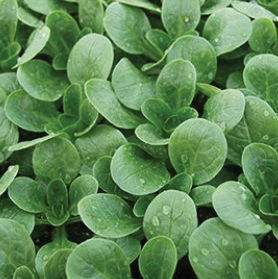
Mache (French Corn Salad)-picture from gourmetseed.com

Mache-(Valerianella locusta)

This gourmet green is also known as corn salad and lamb’s lettuce. It has been cultivated from France since the 17th century. Mache was named because it’s leaf resembles the shape and size of a lamb’s tongue!  It is one of the few greens that can handle our winters (like spinach). It grows in a rosette if you plant individually but most just broadcast the seeds (like you would for mesclun) in an area to make a carpet of leaves as they are very small. Growing low to the ground, it is harder to harvest but it has a nutty, sweet flavor worth the effort. To harvest it, just take a knife and cut it off below the leaf level being careful not to injure the delicate leaves and wash well. You can eat it alone or put it in with other salad greens but use a light vinaigrette or even lemon juice and a little oil-it is too delicate for heavy dressings. They say you can steam it like spinach but it is too small for me to do that. I grew this many years ago under row cover in raised boxes and it did well but grew very slow in our winter but when Spring came it was ready and I went out one day only to find the chickens had escaped and raided the garden and they ate all but a few leaves of my Mache! The few leaves left tasted wonderful so I hope they enjoyed it! It like colder weather so I may try again this early spring as it takes 6-12 weeks till harvest but much longer if it goes into winter. Mache doesn’t like to be warm. Maybe I’ll try it when I plant more spinach in early March and again next fall.

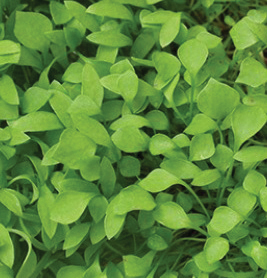
Winter Purslane (Miner's Lettuce)--picture from gourmetseed.com

Winter-Purslane-(Montia perfoliata)

This is not to be confused with the purslane weed that grows wild in New Mexico and throughout the U.S. I will write the next post on that one (Portulaca oleracea) because it is interesting too but for now I want to focus on this variety. This winter green is also known as Miner’s Lettuce or Indian Lettuce and is rich in Vitamin C. It was eaten by early miners to avoid Scurvy. This wonderful wild green is used in Germany and other European countries for it’s tender young leaves. It is used as an addition to mesclun and other salads or steamed like spinach. You pick the leaves when they are young and tender. Most people plant this in fall because it handles the winter so well. I think I will try this in my cold frame next fall. I haven’t done a cold frame in years until this year, but am enjoying seeing the spinach, oakleaf lettuce and chard in it. It’s nice seeing something green in the dead of winter and hopefully if they survive this winter, I will get an early crop of some wonderful greens and now that I’m excited again about fall/winter gardening, I will definitely plant some Mache and Purslane next year. You might consider it too.

2011 Seed Catalogs

2011 Seed Catalogs

Now’s a great time to look at all those new seed catalogs we’ve been receiving. I’ve gotten a few new ones (for me) as well. I am now going over them and deciding which seeds I can’t live without! So many choices! I’m only adding a few new tomatoes as I par down the list from the past 2 years. That and I am not going to grow as many as last year because I need to rotate them to new areas. I’m planning on growing more flowers down in the main garden as well. For more information on all my favorite seed catalogs, go to my catalog page at the top of the blog (also on the right sidebar)

two new seed catalogs for me for 2011

I also got 2 new seed catalogs-One’s called ‘bbbseed’, which features heirloom vegetables and wildflower seeds. It’s veggie section is little but what interested me in the catalog is it comes out of the Denver area and seems to be a good resource for wildflowers for our areas.  You can order a catalog at www.bbbseed.com. The other catalog is John Scheeper’s Kitchen Garden Seeds. It looks interesting with it’s larger veggie and flower section. You can order one from www.kichengardenseeds.

Veggies I will and won’t grow this year and why in 2011

Here is my veggie list from last year. I thought it important to go through it and tell you what I will and won’t grow again and why before I forget. Look at my SEED LIST PAGE next week (as it could always change) to see exactly what I am growing in 2011

TOMATO-HEIRLOOMS
San Marzano-red plum tomato-YES-I will try again even though ALL 4 died. I hear too many good things about this tomato

Striped German-bicolor tomato-YES-I WILL grow it again for my third straight year-One of my favorites even though it takes a little longer to develop

Black CherryYES– I will grow this for my third straight year-another favorite

Paul Robeson-black tomato-YES-A Farmers Market favorite although I prefer others.

Cherokee Purple-purple tomato-NO-I missed this one last year but it is wonderful. As good as Brandywine.

Cherokee ChocolateYES-Just as good as Cherokee purple but a little brownish color. I will choose between one of the Cherokees due to space.

Prudens Purple-purple tomato-NO-not as good as the Cherokees nor as prolific but planted it because it was suppose to ripen sooner-not true for me last year.

Black Krim-black tomato-NO I didn’t do this one last year but had it in the lineup because it is only 69 days to ripen. Never had good luck in previous years.

Pantano Romanesco-red classic tomato-YES-wonderful tomato from Italy

Great WhiteNO– novelty-lost both plants

Costoluto Genovese-red tomato-YES fantastic looking-fluted and great taste

Goldsman Italian American-large red plum-YES even though I lost 3 out of 4, and it took forever to ripen, it makes the BEST tasting tomato sauce I’ve ever made

Aunt Ruby’s German GreenNO-Novelty-lost 2 plants

Gold Medal-bicolor tomato-MAYBE-took longer to ripen than Striped German but great taste

TOMATOES-HYBRID-I grow a few hybrids
Lemon BoyMAYBE-didn’t get any in last year but it is a sweet terrific tomato

Park’s Beefy Boy-red tomato-70 days-YES-only 70 days and great taste

Sun Sugar-yellow cherry-NO-kinda like a lot of yellow cherry tomatoes but super sweet.Want to try something different.

Original Goliath-red tomato-NO– nice size, early ripener but can’t remember the flavor

TOMATO-COMPETITION (biggest)
Big Zac-red/80 days-YES-takes the longest to ripen but taste is great and chance to grow a huge one.

2010 VEGGIE LIST
BEANS-Rattlesnake-YES-great tasting pole bean over my arbor and Tavera-NO average tasting bush bean

PEPPER-Shishito-YES-I love these-not hot but full of flavor

SUMMER SQUASH-ZUCCHINI-Costata Romanesco –YES wonderful taste and Lungo Bianco-NO-it was good and more prolific than Romanesco but not as flavorful. Sticking to one kind this year.

SUMMER SQUASH-SCALLOPED-Yellow Custard and Bennings Green Tint-NO on both. I’m only growing Costata Romanesco

WINTER SQUASH-Marina di ChioggiaNO-powdery mildew problem and not many squashes and Galeux d’EyesinesYES-prolific-great taste-3rd yr.

EGGPLANT-Little Fairy-YES-prolific tender skin and great taste, third year in a row. Thai Yellow EggNO-took all season to develop and then froze at first frost. What a disappointment.

CUCUMBERS-Parisian, Boothsby Blonde, Poona Kera, and ParadeYES TO ALL-Third straight season

CORN-not sure if I’m growing. Might just pick it up at Farmers Market

LETTUCES-from COOK’S GARDEN-Provencal Mix, Mesclun Mix, Buttercrunch, Yugoslavian Red, Santoro Lettuce, and Little Gem-YES

SPINACH-from COOK’S GARDEN-Indian Summer and Double Choice-NO-will look for bigger leaf variety.Too puny.

CARROTS-from COOK’S GARDEN-Kaleidoscope (mix of red, purple, orange and yellow)-NO want only orange and purple ones this year.

BROCCOLI-Brocolli Romanesco-NOtakes too long to develop.

ARUGULA-ApolloYES

BOK CHOY-Extra Dwarf Pak Choy-YES

CHARD-5 Color SilverbeetYES TO ANY CHARD

PEAS-DWARF SUGAR, OREGON SPRING IIYES

2010 GIANT PUMPKINS
895 Grande (1016 Daletas x 1385 Jutras)-YES-grew the 2010 NM State Record Pumpkin-421 lbs + 3 other new ones

GIANT MARROW (like a giant Zucchini)
206.5 Wursten 09YESdidn’t grow last year but will this year

75.4 Wursten 09YESgrew the 2010 NM State Record-43 lbs

GIANT TOMATOES
7.18 N. Harp 09 (5.58 Timm x open) YESgrew a 2 lb 11 oz tomato in 2010

5.416 N. Harp 09 (5.58 Harp x openYES

Big Zac (from Totally Tomato)-YES

GIANT SUNFLOWERS
TitansYES

Christmas Cactus blooming!

Closeup of a Christmas Cactus Flower-Jan 2011

I have a Christmas cactus which isn’t exactly a vegetable (what’s it doing here) and isn’t exactly a cactus. It is a Zygo-cactus that looks more like a succulent. With care it can bloom around this time of year. I noticed my flower buds in early December and it was blooming by Christmas. I got to admit, I’ve never had much luck in getting them to bloom so I did some research this year (after it bloomed)  It is amazing it bloomed at all this year considering I did almost everything wrong.

Christmas Cactus plant-Jan 2011

There is actually 3 hybrids of this cacti-Thanksgiving, Christmas, and Easter Cactus so maybe you don’t have the Christmas type if you didn’t get it to bloom around that time. It is native from Central and South America and is a member in the Zygo-cactus family (that’s not Zydeco-it won’t dance). They are tropical cacti and have different care requirements than the standard cacti. So here is what you should do and what I did..

1. Your suppose to keep them in a cool room starting around Sept-Oct, in indirect light and where the temperature is around 50°. I had it in my main great room, in indirect light but in a part of the room where it was right by the floor heater. I have to admit temperatures were certainly much higher as I’m not going to be in that cold of a room! Around Thanksgiving I noticed the leaves burning from the heaters so I moved it further away.

2. They also say to keep it in total darkness at night. That didn’t happen either as their are big windows that let the moonlight in and there are many sleepless nights where I go out into the great room (meaning lights on).

3. We’re suppose to water less when you want them to bloom which I always do anyways. Less meaning I really let it dried out between waterings but not to the point of wilting.

4. Christmas cactus require 50-60 % humidity. Good luck on that one in high desert. I coulda put a pan of water by it but like I said put it by the heater instead. Opps..

5. It likes to be pot bound-no problem there.

Fertilome Geranium, Hanging Basket & Pansy fertilizer

6. The best fertilizer is 0-10-10 but they say no higher than 10 on the nitrogen which would be a 10-10-10 fertilizer. I blew it there too. I started giving it a 20-20-20 around the beginning of November  which I have never done before. Suppose to fertilize around 3 times (that sounds about right)  But the plant  By December 15th or so it started getting little flower buds! It seem to really liked it. The fertilizer was  ‘Fertilome Geranium, Hanging Basket & Pansy’, all purpose fertilizer -20-20-20 (non organic-only in house)

So here’s what I got right (and evidently it was enough): the indirect light, didn’t overwater, let it be pot bound, and did give it some fertilizer (although the wrong ratio). It is still flowering beautifully. Evidently it’s not as picky as they say. Good thing plants are so forgiving at times..