Spring Maintenance for Fruit Trees

Spring apple tree maintenance-pruned, well expanded and mulched, sprayed and watered.

Speaking of fruit trees, let’s talk about what else we should do besides pruning before the end of winter or at the beginning of spring.

-SPRAY DORMANT OR HORTICULTURAL OIL ON YOUR TREES NOWDid you ever notice the leaves curling up on some of the apricots or peach trees in the summer? This could be one of two things that cause it. The first one is peach leaf curl disease. It usually comes in wet springs-no problem here with that! We rarely have wet springs here in Santa Fe. The second one is aphid damage which is more likely here. This appears on the trees as curling or shriveling of the leaves in the summer. Aphids lay their eggs on the trunk and limbs and the eggs will hatch when it gets warmer this summer.  To kill the eggs, spray horticultural or dormant oil on the trunk, branches and buds (especially in the crooks where the branches join the trunk BEFORE the blossoms bloom). That basically means now. Spraying will also work on a multitude of other pests that overwinter on the trees. The oil works by smothering the eggs and is organic.

-CLEAN UP THE MULCH IN YOUR WELLSI usually pull aside the mulch that I put on the previous year but don’t get rid of it because you are going to…

-DIG YOUR WELLS OUT TO THE DRIP LINE.I know your tree is getting bigger but until it is full grown, it will really help when you water the well to get it out to the roots where it needs it

-INSPECT YOUR DRIP LINES TO TREESDrip lines are great for the trees for awhile especially while they are small. So turn on the drip line on a warm day and test it. Replace emitters that are clogged. Then add more emitters if your tree has grown during the past year.

-PUT YOUR MULCH BACK ON AND PUT MORE MULCH IN THE WELL (ABOUT 2 INCHES)
Don’t cover the base of the trunk. Trunks of trees don’t like to be buried so put the mulch up to it.

-WATER THAT NEW WELL-
Fill it up a few times each time you water. If we don’t get any substantial water this spring be sure you water more especially with our spring winds. Your trees will thank you.

-HANG UP YOUR CODDLING MOTH TRAPS ON YOUR APPLE TREES
Do this before the trees leaf out because fruit blossoms will follow (probably in March-just watch your trees).

Time to Trim Fruit Trees Now in February

If you haven’t trimmed your fruit trees yet you’re not alone. I haven’t done mine but plan on doing them by this weekend. You should trim soon before the buds swell or you’ll miss your opportunity this spring. Below is picture illustrating where to prune an apple tree.

Picture courtesy of http://www.weekendgardener.net

Last year I trimmed the fruit trees heavily so I shouldn’t have to trim too much this year. I just have to take off the water sprouts and small branches that have crossed and are touching in the interior. I didn’t get ANY fruit last year, not even an apple (and I always get those) because of the bitter cold winter we had.

Different winter this year-much warmer with little bits of snow. Not enough snow to quit watering once a month but certainly enough to help. Hell, any moisture helps out here. One more thing to check off my to-do list.

Where Have I bean??

In case you were wondering if I left the planet, I did!  Well sorta. I’ve bean in Philadelphia for the last 6 days on our annual Big Ass Glass Show. On the Road again.. Now this is coming at ya from 34,000 feet high (see I told you I left the planet) and I got some photos to share while flying home (home-ahhh!) Then it will back to that greenhouse and new garden area and glass shop.

Here’s Elodie with our art that just arrived in the booth. Everything arrived safely! Yea!

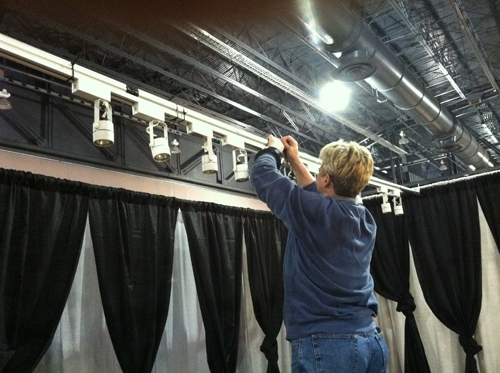
Here we are hanging lights except I stopped to take this picture! To get more in-depth pics of us at the Buyer’s Market of America Craft Show in Philadelphia, you really should check out her blog at http://liquidlightglassblog.wordpress.com but not until tomorrow because she hasn’t done it yet.

Now I’m gonna show some pics of other stuff at Philly.

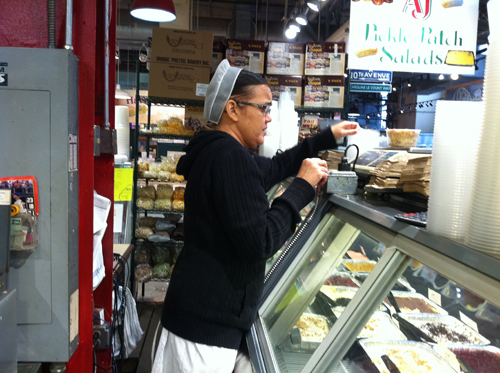
The Philadelphia Convention Center is right across the street from Redding Market-best place to get all sorts of food and goodies. Here is an Amish woman  in the market weighing some CHEESE they made.

Here are some GIANT SHRIMP each one being the size of your hand! No kidding! I wish I could of had my hand in there to show how big they are (and to take a few).

We set up the show in record time. Only a day an a half. So we had enough time to go see the Vincent Van Gogh Show at the Philadelphia Art Museum on Friday. It’s called ‘Vincent Van Gogh- Up Close’. This art museum always gets some terrific shows-this is one of them. I took this photo before the guard came over and told us,”‘No pictures”. Otherwise I would show you more.

There was also the biggest collection of COMPLETE dinosaur skeletons at The Franklin Institute. It was open till 8 pm on Friday night so after the Van Gogh show we walked to it.We weren’t allowed to take pictures here either-shh don’t tell anyone! The show was donated by just one collector from Philly who has been collecting them for years. I wonder how big his house is?!

This is one that was 60 feet long. Glad they aren’t roaming the world now!

I thinks this one’s hungry..

Going home now-‘Room with a View’

Here we are over the Mississippi River (I think) What other river could look so large from 34,000 feet up?

Here we are in the plane-Can’t wait to breathe that CLEAN New Mexico air again!

How to Make a Rain Barrel

I went to a Master Gardener workshop where we learned how to make a rain barrel and how to figure out how much rain we could collect off our roofs. The formula for figuring out how much rain comes off our roofs is easy-take your sq footage of roof x .623 gallon x how many inches of rain. For example: 2000 sq ft roof x .623 gal=1246 x  ½” (.5) of rain=623 gallons of collectible rain. It’s amazing how much rain we could gather assuming of course we get some rain!

 Here’s how we build a rain barrel. First we started with some food grade 55 gallon rain barrels.

Here is the list of what you will need:
MATERIALS
Rain barrel
¾ “ bronze or brass water faucet
(1) ¾ inch plastic hose to pipe fitting
(2)- ¾ inch flat rubber washers
(2)- ¾ inch galvanized metal washers
short hose for the overflow

TOOLS
3” hole saw (optional)
Drill
7/8” drill bit/router
pliers
waterproof sealant

1. Put barrel on its side and measure about 3 inches up from the bottom.

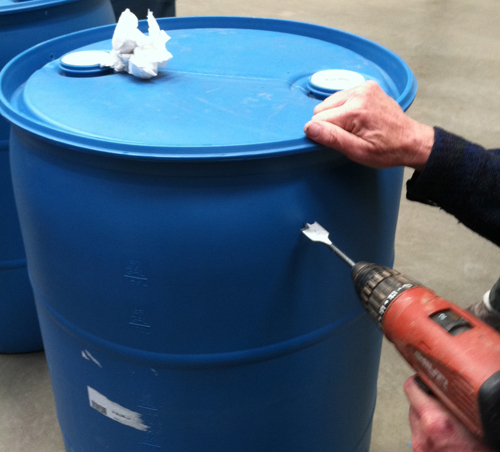
2. Drill a hole with your 7/8” bit. Making sure you are drilling straight up and down (no angle). When the faucet is attached to the bottom of the barrel, you should have enough room to attach a hose and still have the barrel sit flat.

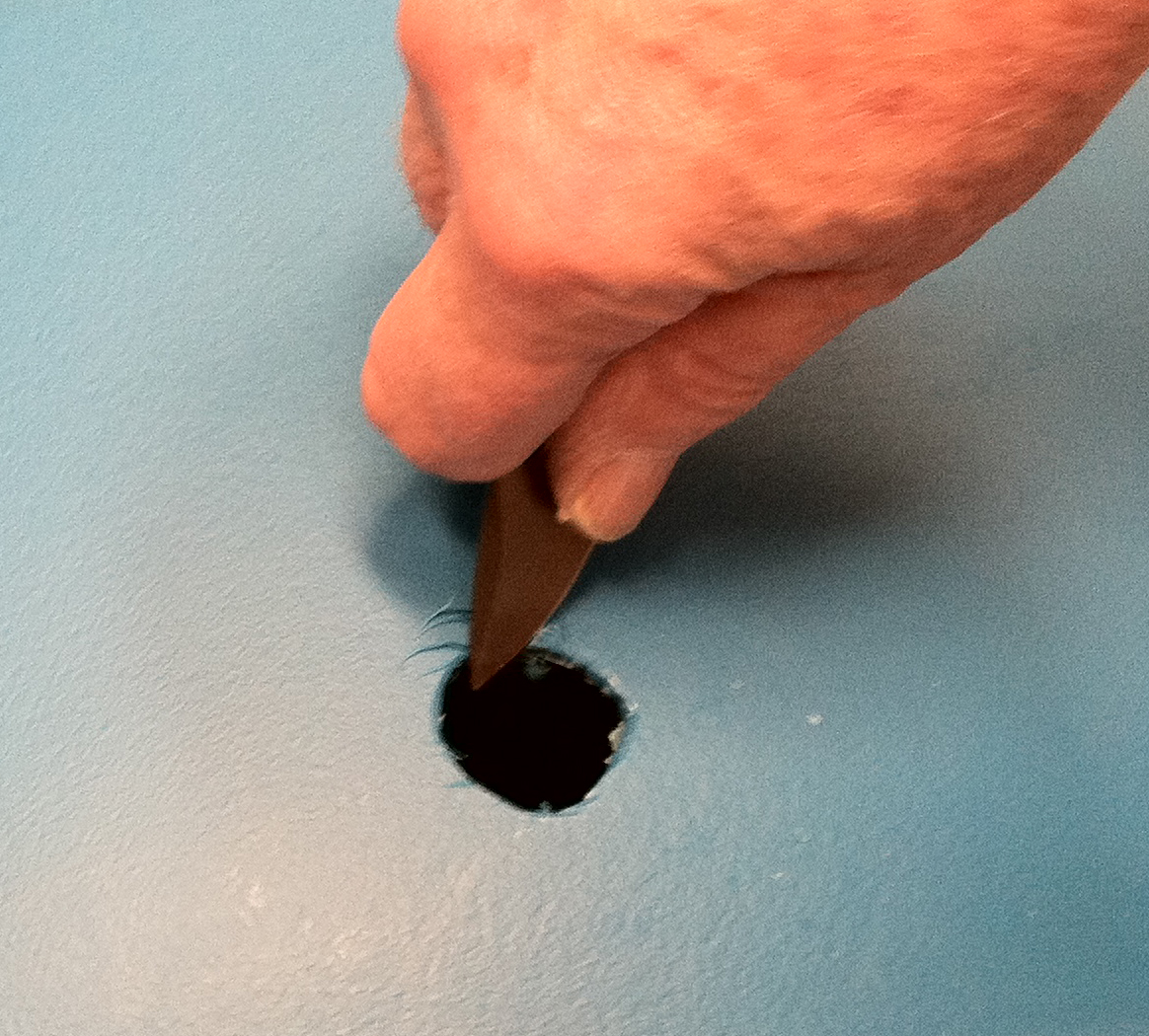
3. You may want to take a knife and ream out the hole beveling it a little wider on the top so you can start to screw the faucet into the hole more easily as it is a tight fit.

4. Now screw the faucet into the hole to start the threads then back it out. This makes it easier to screw back in after you put the washers on the barrel.

5. Put marine glue around the hole.

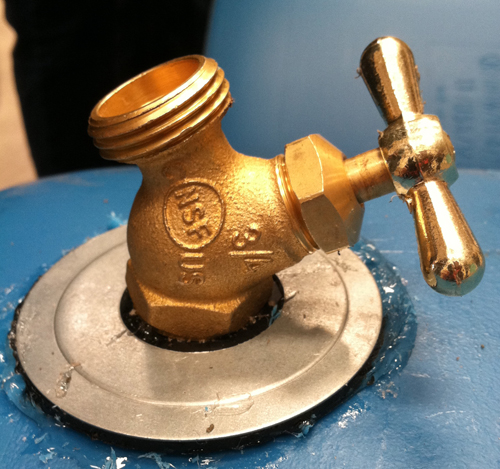
6. Then put the ¾ inch black rubber washer and the metal washer on top of the hole. Make sure the black rubber washer is the washer that goes against the barrel first. Take the faucet and screw it back into the hole. The faucet will cinch down on the metal gasket and tighten the rubber gasket against the barrel. The hole should be very snug or it will leak. You may have to use pliers to get it screwed in all the way.

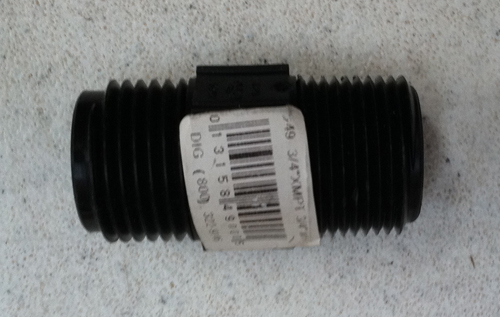
7. Afterwards drill a 7/8” hole 2 inches from the top and as shown for the overflow hose to attach. Repeat steps above but insert the black plastic pipe-to-hose fitting through this hole.

8. It has small threads on one side and large threads on the other side for the hose to attach. In this picture the large threads are on the left and the small threads are on the right. Screw the small threads into the hole. The large threads fit a hose for the overflow.

9. There are several ways to drain water into the barrel.
a. Position it under a downspout or canale where the water flow can be directed into the barrel.
b. Use a rain chain to direct water into the barrel
c. Use downspout adapters like the black one above. The top of the barrel will most likely have a small covered hole that can accommodate the downspout adapter but if not you can drill a 3” hole on the top.
d. You can also cut holes to fit a basket that fits in the barrel like the one above.

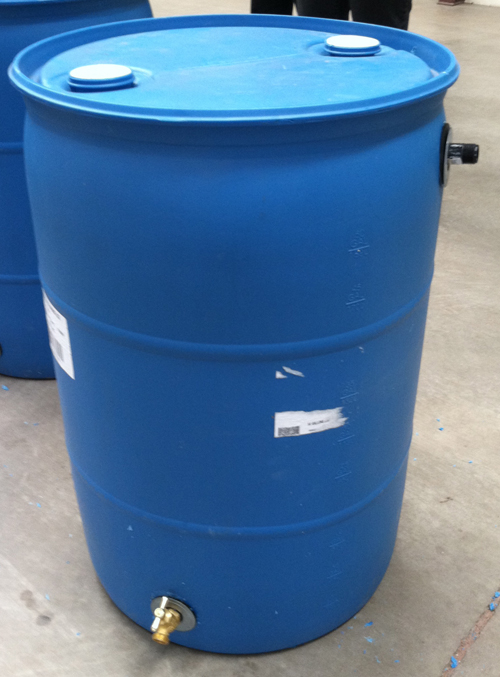
10. Here is the rain barrel ready to be put under a downspout.

Put the rain barrel onto a base or cinder blocks where it will be level. It should be high enough to accommodate a pail or you can attach a hose to the end.

Lastly be sure you empty the barrel at the end of season and leave the faucet open so water will not freeze in it.

Rocks, Rocks, Rocks..

 I live on a rock. No, not in a rock but on a rock!

Creating the new garden area out here is tough. There are tons (literally) of rocks on the property. I’ve known this for some time from all my other outdoor projects. I guess I forgot.  And I’m not getting any younger either (I keep saying that a lot lately). I swear these 2 projects will be my last ground breaking ones. (Remind me of that next year).

Project number one is the greenhouse which is on hold for a few days now that I bonked my nose and we are in February.

Project number two is what I want to talk about today. The new vegetable garden addition. Why am I putting in MORE garden you say? Isn’t 2000 sq ft enough? Apparently not. The truth is I need to put my tomato plants on a 3 year rotation to help prevent diseases and I’ve used up the whole garden the last two years. So I’m adding 890 sq ft more. That will handle the third year (this year) in the rotation.

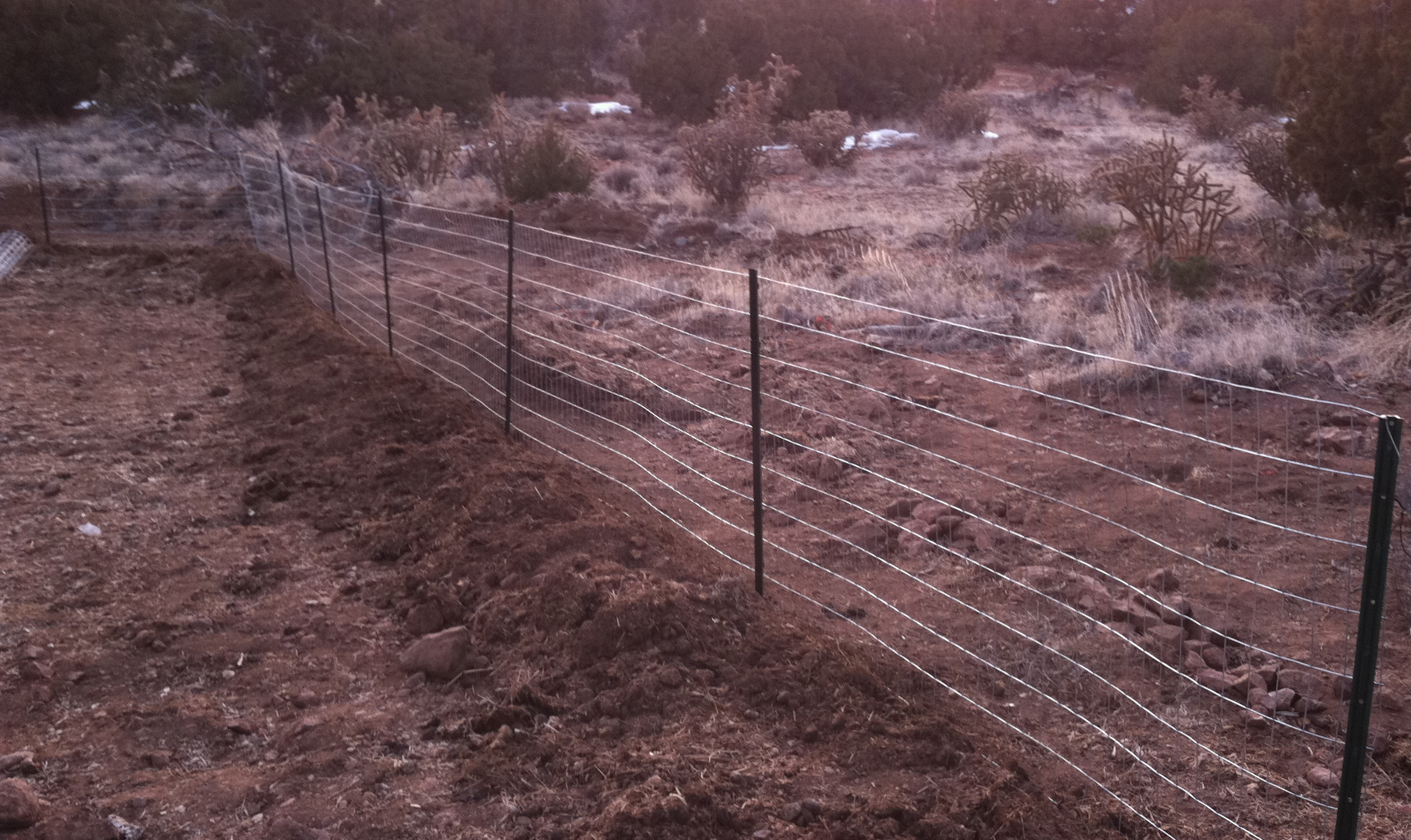
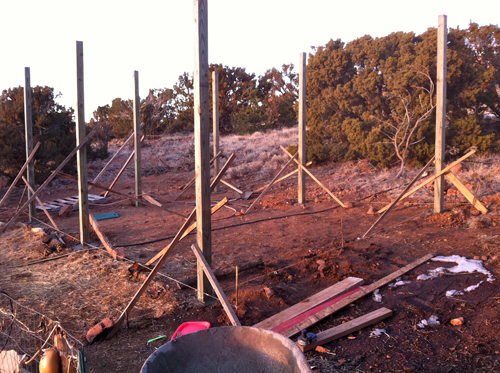
First I cleared the land last October with that Bobcat I rented. Thank god I had a Bobcat. Here is a picture of it then AFTER I scraped the ground of cactus and rocks.  Look at all the lovely raw ground! LOL!  The green t-post in the right side of the picture is…

the same t-post in the right side of this picture. Now it is starting to come along a little. I rototilled it in November to loosen up the soil  (if possible) and kick out many rocks. I think I’ll make an Andy Goldsworthy style of rock sculpture from all the rocks I will have taken out when I’m done. Today I put part of some fencing up after I raked up a ton of dirt and dragged it into what will be the garden area. I had to quit because it got sooo cold. I thought it was suppose to be 53°F today. Liars! It was 27°F at 4:45 pm. Notice all the rocks on the outside of the fence! Now I know how the pioneers must have felt breaking ground… I’ll have to update you with more pictures later when I can get out and do more work on it.

Create your own lettuce/mesclun bowl!

What does the cat have to do with the lettuce mesclun bowl?

"Trini" the cat! Photo by Genevieve Russell

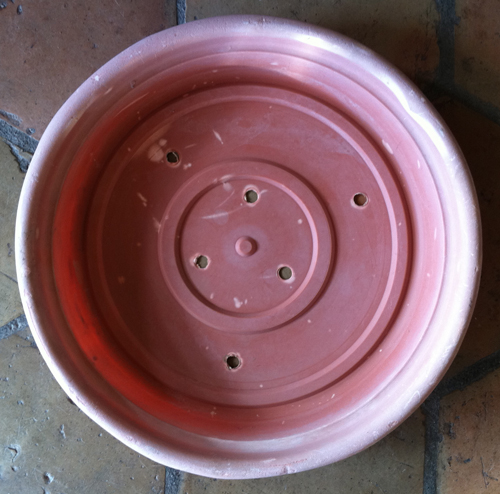
‘Mesclun’ is a term that means a ‘mixture of young salad greens’ in French. Last year I created a lettuce/mesclun bowl inside the house while it was still cold outside. I took the bottom from one of my pots (you know so that your pots don’t leak all over when you water), cleaned it with a bleach solution and drilled some holes in the bottom of it so water can drain out.

Then I filled it with some moist potting soil and sprinkled some lettuce mesclun mix all over it and gently tamped it down so the seeds make good contact with the soil. In this first picture I sprinkled sand over the half of the seeds.

Then I finish sprinkling the sand over the seeds-just enough till they were covered.

Next I sprayed the sand so it became moist with a spray bottle so as not to disturb the seeds. Then I put plastic wrap over it to hold in the moisture until the lettuce germinates. I kept it in a cool place in the house until it germinated and then I moved it by a window.

This is when I got in trouble with the cat…

Trini, "I like salad too" Photo by Genevieve Russell

Here is the lettuce bowl. Coming up nicely. Now if I could just keep the cat from eating it! She loves it! I caught her eating it around the edges by the window. I’ll have to thin it this week without her help! Perhaps I’ll have to make her a salad bowl of her own.  In another couple of weeks it should be pretty big.

Here it is ready to eat for it’s first cutting in 32 days and at $6.99/lb in the stores, it’s a deal! Harvest by the ‘cut and come again’ method and it will grow back for several cuttings. To do this, simply take sharp scissors and cut off a bunch of leaves in the amount you need to fill your salad bowl. Cut the leaves off at 1 to 2 inches above the soil. Don’t cut the crowns of the lettuce or it won’t grow back. Bon Appétit!

Lettuce bowl ready for first cutting-32 days

Garden Seed Catalogs for 2012

You should have a bunch of seed catalogs by now. More come in everyday and brighten my evenings. So far I have Johnny’s, Seed Saver’s Exchange, Tomato Growers, Totally Tomatoes, The Cook’s Garden, John Scheeper’s Kitchen Garden and Baker Heirloom Seeds. Below are my top 4 favorites. I like many other catalogs but this year these are my favs. If you don’t have any of these you can just click on their name below to be taken to their site. There, you can order one-they are all free.

1. Baker Creek Heirloom Seeds

My number one favorite catalog of all time-Baker’s Heirloom Seeds has the most fantastic photos of all their heirloom vegetables and flowers (and they only sell heirlooms). The photos are so beautiful, they make me want to buy all their seeds! Wonderful selection of hard to find vegetable seeds. A must have!

2. Seed Savers Exchange

This is my number 2 favorite. I absolutely support what they do for all vegetable gardeners. They collect heirloom seeds and make them available to us. If you become a member (and I highly suggest you do), besides getting their catalog, you will also get another huge catalog for members only.  In it are members who are offering seeds, many of which have been kept in families for years and unavailable on a commercial level. Well worth it and besides I want to support all seed companies promoting heirlooms and seed saving. A close second for me.

3. The Cook’s Garden

Number 3 and number 4 are really tied for me. I like this catalog particularly because it has the most fantastic mesclun and lettuce mixes that I’ve seen. You don’t have to mix your own with them. In addition, they have many other varieties of vegetables and flowers that are coveted by gourmet gardeners.

4. John Scheeper’s Kitchen Garden Seeds

I also love this seed catalog because I get many unusual varieties of vegetables that aren’t necessarily carried here in the US. Since I like to cook, I want to try some of these varieties that cooks’ from other countries have available to them and this catalog is good for that. John Scheeper’s Kitchen Garden Seeds doesn’t have photos but lovely hand drawn pictures of their items. Another must have.

New vegetables I will try in 2012

I’m starting to make my list of what to grow 2012. Every year I refine my vegetable list to exclude ones that didn’t work out or I didn’t like and try some new ones. I’m keeping many of my varieties that I normally have but here are some new things I want to try: tomatillos, Atomic red carrots,  Di Firenze fennel, Argentata chard, Jerusalem artichokes, and a really ugly french beet called ‘Rouge Crapaudine’ that is supposed to be divinely sweet (the seeds come from France).  Some new tomatoes I want to try are: Southern Nights, Carbon, Woodle Orange, Flamme, Lollipop and Cour Di Bue. Oh yea, I want some small fingerling potatoes (I’m not sure of which type). I’m still looking for a good catalog for great potatoes-not just your ordinary potatoes. Anyone know of one?

10 things to do in February for the garden

Well February is upon us and although for most of us gardeners it is a quieter time of year, there are still things we can start to do to prepare for this coming season. Here are 10 things you can do in February.

1. We haven’t gotten a lot of moisture, so on a nice warm day, water your trees and bushes this February. Don’t forget to empty your hose of the water so it will be ready to water again. (Nothing worse than a frozen hose). If we don’t get significant moisture, we should water once a month for established trees and plants and more for those we planted last fall. Of course if the ground is frozen where they are-don’t worry about watering frozen ground.

2. Go over your seed catalogs, make your lists of what you want to plant this coming season (go ahead-go wild-order more than you need-I do!))

3. Last chance to order seeds so you will be ready to start planting.

4. You can start some seeds inside-spinach, chard, peas and arugula to be ready to transplant outside next month.

5. How about cleaning, sharpening, and oiling your garden tools (after you find them)

6. If you do start seeds inside, clean all your containers with 10% bleach/water to disinfect them.

7. Turn your compost pile if it isn’t frozen.

8. Check your vermicomposting red wrigglers. Have you fed them recently?

9. If you haven’t cleaned up your old garden be sure you do. Bad bugs hang out in dead leaves and plants and diseases can stay on your soil in dead leaves.

10. Read some good books-gardening and otherwise!

Easy Chevre Cheese!

I want to learn to make more cheeses so I decided to try Chevre (pronounced chev) which is a creamy white soft cheese made from goat’s milk. It’s been made in France and Italy for centuries but only since the 1980’s has it become popularized here in the states. It was introduced by Laura Chenel to Alice Waters of the famous Chez Panisse restaurant. She had a creamy version that became very popular in the restaurant and the rest is history. Goat farms sprang up in America and a new era of cheese was introduced. I never use to like goat cheese until I bought some from our local Farmers Market. The ones at the market were so mild. Not that strong ‘goaty’ taste which I later found out comes from what you feed the goats. So here is what I did last week. It was easy and turned out good for my first try.

I bought a gallon of whole goats milk and pulled it out of the refrigerator till it was room temperature.

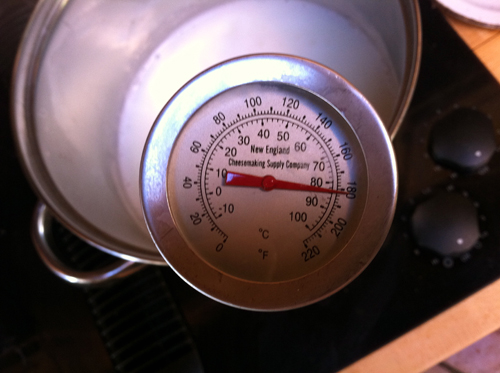
I put it in a pot and slowly heated it to 72° in some warm water in the sink. You have to use a thermometer to check the temperature. Here is the thermometer I used but in this picture, it is 180°F because this was when I used it for making the mozarella afterwards. (Again you want it at 72°F for the Chevre).

I got  my starter, rennet, calcium chloride, cheese thermometer, cheesecloth and molds from www.cheesemaking.com. I stirred in one packet of Chevre starter. Then I put one drop of rennet in 5 tablespoons of water and took 1 tsp of the diluted rennet and mix it well into the milk with an up and down motion. I also added calcium chloride because the milk was store-bought pasteurized milk and sometimes won’t form curds-so this helps. I put 1/8 tsp of calcium chloride into 1/4 cup water and put the whole amount into the milk, stirring well.
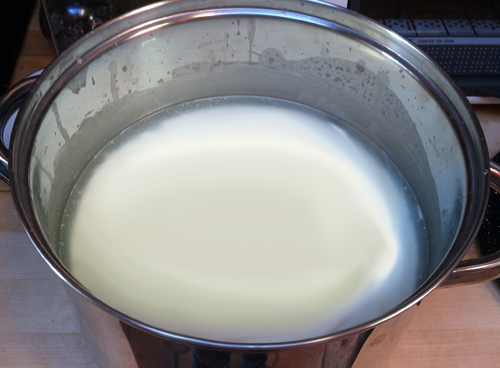
Then I let it sit out for 12-14 hours at room temp. I covered it after this picture. People think it will spoil but it doesn’t. You want the milk to separate into curds and whey. Curds are the butterfat in milk and whey is the liquid which is mostly protein. Don’t touch it during this time and it will set up and become firm like very soft tofu with the liquid whey on top. I let it set all night while I slept and in the late morning it was perfect.

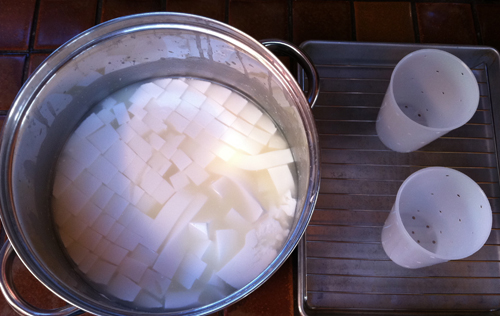
I then took a knife and cut it one way into 1/2 inch slices and then at a right angle to make 1/2 inch pieces. This releases more whey. Wait about 5 more minutes.

Here it is ready to go into some molds.

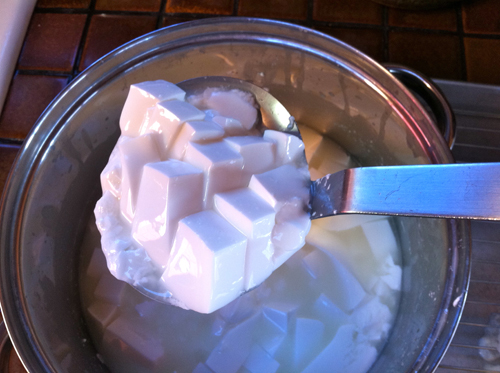
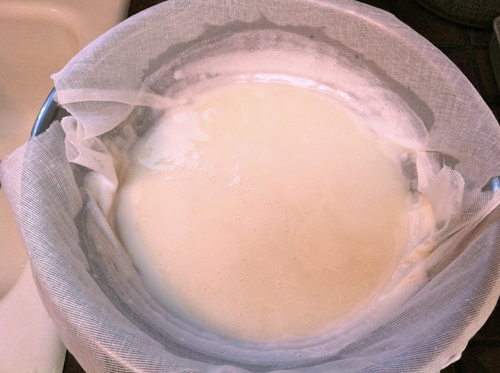
Use a slotted ladle to drain the curds, I put it into molds or superfine cheescloth muslin where it will drain all the whey out. I saved all the whey because you can make ricotta cheese from it but it must be done within 3 hours of first separating it.

Here it is right after filling the molds

Here it is 2 hours later. Notice it is draining on a rack over a pan where the whey and a few of the curds come out of holes on the sides of the molds. The one on the left is already more compressed just by letting it drain. In the molds it needs to drain for 2 days on a counter to release all the whey!
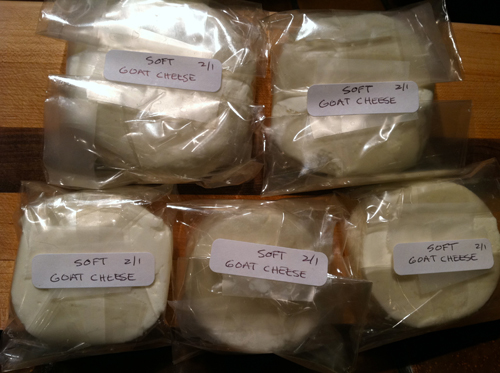
Here is the chevre packaged into servings after the molds.
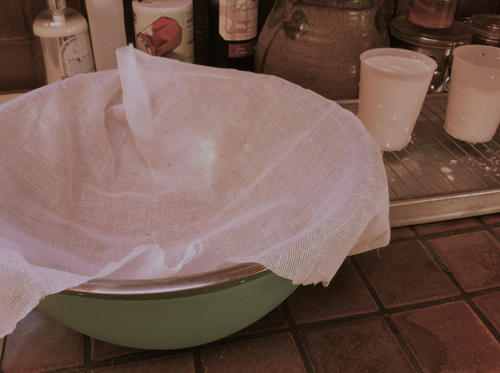
If you choose to drain it in muslin, place the muslin in a colander, over a big bowl and gently scoop out most of the curds and then pour the rest through the muslin.
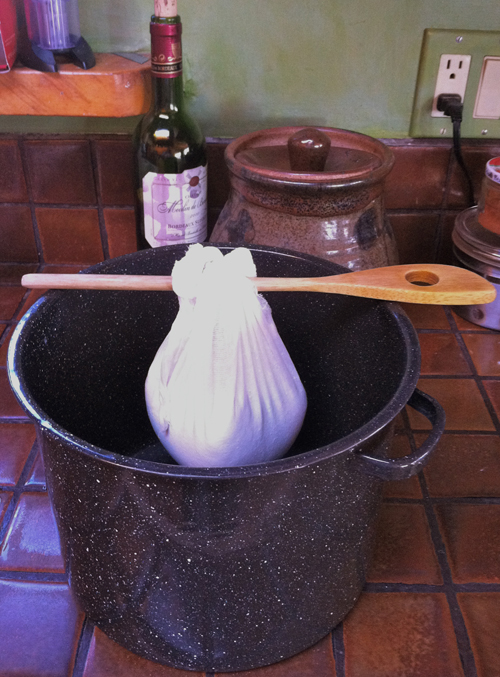
Take the opposite corners of the cheesecloth and tie them and do the same for the other side. Then hang it up on a spoon over a pot to drain the whey. This version will be very spreadable vs the molds which will hold their shape and can be cut into pieces. I had enough to do it both ways. I put the one in the cheesecloth in a container and into the refrigerator.

Afterwards I sprinkled a little salt on the surface and refrigerated. You can also roll it in herbs if you like. Yum!

Now here is how to make ricotta cheese from all that leftover whey. It’s super easy. Heat the whey on the stove till it foams which is almost boiling but not quite. Do not let it boil. Here is that picture with the thermometer again. This time the temp got up to about 187°F although here is about 180°F .This separates the superfine particles of curds which aren’t captured the first time when I made the chevre.
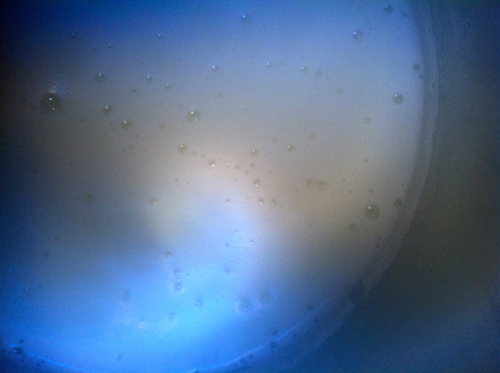
Here is a closeup of the foam. Skim off the foam and discard.

Pour the whey through the superfine cheesecloth and let the curds drain for 15 minutes.
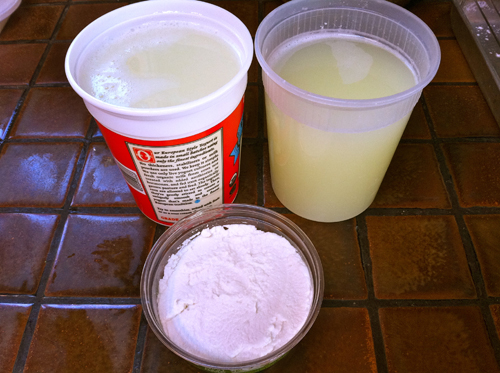
Then scrape the curds off the cheesecloth and put them in a container. You’ll  get much less than when you first get the curds for the Chevre but this is also very good. Now you have 2 cheeses! Now there still will be lots of  leftover whey which I give to the chickens. They love it and it’s really good for them.

New Gardens-new bruises!

I love hearing about someone putting in a new garden or adding on to their existing one or adding another big feature in their gardens. Are any of you doing something new and exciting in your gardens this year? I would love to hear about your projects!

For me, I’ve bitten off a lot. Between putting in a new greenhouse and adding on a huge new section, I have my hands full. And I forget I’m not 30 yrs old anymore (tell that to my brain) and my body let’s me know it too after a hard day building, hauling, shoveling, digging-you get the picture. Today I dropped a 2 x 6 on my nose while 8 feet on a ladder while working on the greenhouse. Luckily, I didn’t break it! I should own stock in Advil…

Greenhouse progress

Finally progress on the greenhouse! I finished digging out 6 of the 8 holes over the last 2 weeks when we had some warm days and Caleb came by last Sunday (a week ago) and we finished digging the last 2 holes with his jack hammer. Yesterday (Friday), I set all 8 posts by myself. After consulting with a contractor friend to see if I could set the posts in cement, he told me yes but bury them in dirt afterwards to insulate them-brilliant! Boy was it a long day but nothing a warm Epsom Salt bath can’t help. I’m really happy as I can work on framing it when we have a nice day this winter-especially since I came down with a nasty cold today…

I ordered my bees!

I ordered my honeybees! They’ll be the Italian variety. Benissimo! They say the Italian bees are very docile and gentle and great honey producers. They will arrive on April 27-overnited from Honeybee Genetics in California. I will get a topbar style of hive.

What do bees have to do with vegetable gardening? Everything! With out pollinators we would have no produce. We have many pollinators-hummingbirds, moths, butterflies, native bees, some beetles and of course the honeybee.

I already have some bees on the property but they belong to a friend of mine. I have learned from him about them and excited to get some of my own. Last year I put in some bee flower gardens to provide more food for them (I will continue putting in more this year as well) and of course they have the vegetable and pumpkin gardens to get pollen and nectar from as well. I was amazed how well the bees did out here considering we did not have a good year as we only got 2 rainstorms all summer and they were late in the season as well. But after we got the rain, lots of native plants blossomed and they were ‘busy as bees’ collecting their food in the fall until winter came. Now they are mostly holing up in their hive-much like we are.

French Red Shallots

Here are some French red shallots (on the left ) and a few Dutch shallots (on the right) that I have left from summer. I grew both last year and harvested them in July. I replanted the largest bulbs of each variety this November and had these teenie French red shallots leftover. So instead of tossing them I decided to skin them,chop and freeze them for later use. The French say their shallots are the best in flavor. I read the French Gray shallots are the absolute best flavor of all shallots but I couldn’t get any this past fall-all the seed companies were sold out. I do know they did not make me cry while the Dutch ones do, almost like onions but not as strong.

Ugh! What a lot of work! I don’t know if planting the largest ones will produce larger ones than these. We will see. I know with garlic, you plant the largest cloves to get still larger cloves each year but am not sure with shallots. Here they are all skinned and chopped.

All that work for this-a mere 1/3 cup of chopped shallots. Let’s hope they will be bigger this year or I’ll stick with the Dutch shallots which are much bigger and easier to skin for my main shallots although I will try the gray shallots if I can get some. I do love growing shallots-they are so easy when planted in the fall and are delicious!

Just label it-GMO products

I am not very political but as an organic gardener and consumer, I feel this is important. I just received an email from an organization, Just Label It asking me to sign a petition being sent to the FDA to make food corps label their food IF it has GMOs in them. We are not just talking about labeling the fruits and vegetables we buy in the store (fruits and vegetables are non GMO in the US right now) but to label ALL products that have GMO products in them. If you are interested in signing it, go here. I did.

There is also a group, TRUE FOOD NETWORK, that has a GMO shoppers guide that you can download on your computer or get a free phone app to use when you are in the grocery store. I was amazed at what foods and which companies do and don’t have GMO products in them. I’m only promoting this because 1. it’s interesting and 2. we should want to know.

Genetically engineered foods are required to be labeled in 15 European Union nations, Russia, Japan, China, Australia, New Zealand, and many other countries around the world. I think we should also have the right to know if our foods have been genetically engineered. I’m not talking about making a judgement about whether it is good or bad, but just label it and let us decide for ourselves. After all if I wanted to know if a product has artificial sugar in it all I’d have to do would be to look at the label. I want the same done for any GMO food products sold here in the US.

When asked why Europe has been so successful at generally keeping out GMO foods, it has been said that the Europeans are closer to their food sources. They don’t have the big grocery stores which tend to remove the consumer from the process. They go shopping at the local markets in the streets to get their foods and don’t use as many processed foods as we do and as such are much closer in knowing where it comes from.
Now the number one way to go around this is buy everything ORGANIC but not everyone CAN (too expensive) or will so I appreciate True Food Network getting the information together to educate us. Of course what do you expect from me- an ORGANIC  gardener?

P.S.  Remember that Minnesota ruling I wrote about where I mentioned an organic California farm also won a ruling against its non organic neighboring farms for contamination of its organic crops? Well, the organic farm is Del Cabo-you know, the one that sells those small cherry tomatoes in Trader Joes and other stores. Now it becomes more personal. I see the Del Cabo brand everywhere in the grocery stores. So the next time I see the organic variety of Del Cabo tomatoes in the store (they also have non-organic) I will be reminded of the fight some of the big organic farmers (as well as the little organic farmer) are going through to give us organic produce. It all becomes more personal when you know what’s going on.

Ok, I’ll get off my box now…