Wall of Waters for tomatoes

tomatoes in wall of waters-2010

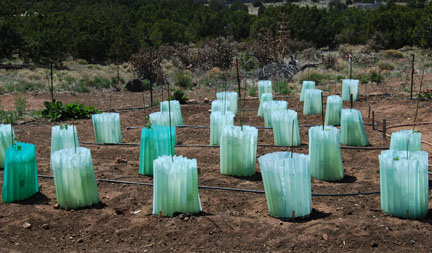
Here are the 35 tomatoes in wall of waters. You can buy them at your local nursery or order them through the internet. They are an invaluable tool for Spring as they act like little greenhouses or cloches to help protect your tender plants from cold nights and the wind.Be sure you fill them up in the morning so they have all day to heat up. Then they will give off the heat at night and keep the plant warm.

To set them up, put a 5 gallon bucket over the tomato (the tomato must fit inside the bucket) then slide the wall of water over the bucket and take a hose and fill up each cell in the wall of waters. When done slide the bucket out and the wall of waters support themselves. If your plant is taller than the wall of water, you can still use it but will need a friend to hold the wall of water as you fill up each cell. Sometimes the wall of water (WOW) can partially collapse under heavy wind. In that case put some bamboo posts inside the edges of WOW to help support it. In a few years, you might get some leaky cells. I take one of my leaky WOW and cut off a good cell and insert it into the leaky cell and fill it up and it works. I only use wall of waters in early spring when it is still cold at night. Be sure to take them off when the plant starts to get crowded inside of the wall of waters, usually in late May or early June.

giant tomato megablossoms

Single blossom on left and double megablossom on right

GIANT TOMATOES-I got my first 2 megablossoms off my Big Zac tomato plants and they are not even in the ground yet. All giant tomato growers are looking for megablossoms. Some varieties tend to produce more than others. Since megablossoms usually come earlier on a plant I will leave these on as I don’t know if I will get more off each plant. A megablossom is at least 2 or more blossoms that fuse together to make one big tomato.  That is why giant tomatoes are so knarley and bumpy. It is kind of like twins, triplets or quadruplets that are all conjoined together. Recognizing these megablossoms is the key to growing giant tomatoes. It doesn’t happen all the time so it is exciting when we get some megablossoms and the potential for a BIG TOMATO.  Since they are made up of many blossoms, oftentimes they abort if they don’t pollinate well.  Most tomatoes are self-pollinating so you don’t have to worry about pollinating them unless you get a megablossom. That is when we should hand pollinate them although I didn’t on these. Using a small soft paintbrush, you can take some pollen off of the stamen part of one blossom and paint it onto the megablossom pistils. Kind of sounds like Luther Burbank doesn’t it?

The top picture has two blossoms-the one on the left is a normal single tomato blossom and the one on the right is a megablossom made up of two flowers. Notice how big it is.

megablossom with three blossoms fused

This second picture  has even more blossoms fusing together. Looks like maybe three blossoms. Starting to look knarley! I’ll see if it aborts or starts to grow into a giant tomato on it’s own as I didn’t hand pollinate them. I will pick off all the normal blossom off of each plant. I might grow 2-4 tomatoes from megablossoms off of one plant. You don’t let all of the normal tomatoes grow so all the energy goes into these potential giant tomatoes. Obviously I am growing these for size and I have other varieties where I let every blossom become a tomato to grow for food.

planted 35 tomatoes today

Yep-went ahead and planted tomatoes with the help of Beto, Mernie, Lava and her friend Mo. Together we planted 35 tomatoes, added amendments, put up wall of waters for every tomato we planted, placed the drip system around each tomato and gave them a drink of seaweed/thrive mix. Hope they make it as it was sooo blasted windy (no pun intended) here today and it is suppose to get cold but not freezing tonight. Many were wind thrashed but we did the best we could. I guess the hardy will survive. Many thanks to all of you good friends! Then I went into the house and planted up to the gallon size all my giant tomatoes that will go in the ground in a couple of weeks. I also planted up the rest of my 4 inch pots into gallon sizes that I will give to friends. Phew, what a power out day…I’m fried.

It’s official!

It’s official! I finally got my acceptance letter from the Santa Fe Farmer’s Market. The Farmer’s Market has become so popular here in Santa Fe that you have to be juried in to sell there in the summers, not just send some money and automatically get in. I will be there this summer on Saturdays from 7am-12pm as soon as I have some crops to sell-got to get them in the ground first and with this late cold weather it hasn’t happened yet. I’m hoping to be there in late June with something but not the tomatoes-they won’t be ready till late July at the earliest. I have made room for 60 tomato plants and many more crops in my 1000 square foot main garden. So keep you eye out at the farmer’s market for ‘The Tomato Lady’-Heirloom tomatoes & exotic veggies for the discriminating cook.

my lettuce patch

lettuce patch in early spring

Here are my cool season crops coming up by the house in my lettuce patch. I like the idea of walking out the front door and picking salad stuff without going down to the main garden by the barn (which isn’t in yet anyway-way too cold at night) In the picture, from the back to forward-peas are back by the fence, then little cauliflower (they are soo slow to grow) is next closest, then romaine lettuce next, then 3 types of butter lettuce, and in the front row is spinach on the left, arugula in the middle and provencal mesclun on the right. I need to start thinning everything to give them room to grow. They are loving the cold nights. Still haven’t planted tomatoes though! I am waiting for the last of the freezing nights to end. Last night was 28 degrees F (-4 degrees C). Looks like we might go right up to the May 15 average last freeze date here in Santa Fe before getting any warm season crops in..

starting giant pumpkins!!

Today I am planting giant pumpkin seeds. I will put them in 4″peat pots so that I can peel the pots away later without disturbing the roots when I transplant them. They grow really fast once they come up, so I will have to put them in the soil perhaps in 2 weeks from starting the seeds. I will transplant them once the first true leaf comes out. You can tell which way the vine will grow as it will grow in the opposite direction of the firs true leaf. This way I can place it in the soil in the direction I want it to grow. I am growing 4 giant pumpkins this year. They are: 817.9 Schieder 09, 1166 Mohr 09, 949.5 Harp 09, and the 895 Grande 08. They will go in my new pumpkin patch and I am growing another one: 352 Cabossel 09 (that’s me!) for the community pumpkin patch here in Santa Fe that I will plant when I teach a workshop May 15th. To understand what this means is the first number is the weight of the pumpkin the seed is coming from, the name is the grower’s name, and the last number is the year of the seed. So mine was a 352 lb pumpkin, my last name is Cabossel, and it was grown in 2009. That is how we giant pumpkin growers know what seed we are planting. We also look at the parents of the seeds we choose to see who they were as most of the time they come from very good “stock”. You can also just grow generic varieties that you can get from places like Amazon.com which is what I did when I started this hobby before I got serious. I grew a 225 lber from the generic variety which is fine for most people! I will try to break the state record here in NM this year. Have to beat 404 lbs…

Santa Fe’s Farmer’s Market

For the Discriminating Cook

This year the Santa Fe’s Farmer’s Market, which was recently rated as one of the best in  the nation, was a juried-in only market for farmers. Well, I went in the their office and they said I got accepted but I haven’t received their acceptance letter yet which makes me nervous as it’s been 2 weeks. I need to know for sure because it will determine whether I plant more tomatoes or not. We’ll see…

Last year at the Santa Fe Farmer’s Market

I am known as ‘The Tomato Lady-Heirloom Tomatoes & Exotic Veggies’ for the discriminating cook. I grow varieties that you don’t get at the grocery stores or at our farmer’s market. See you there this summer!  I’ll keep you posted when I start going to sell my produce on SATURDAY mornings this year-probably late June since I sell warm season crops…

arugula and peas are up

My arugula and peas just popped up this week from my cool season crop raised bed up by the house.

oregon spring peas and golden peas

Rocket arugula just up

My lettuce bowl-chickens love it!

I put the lettuce bowl outside under heavy rowcover cloth (.09) as it wasn’t getting enough light inside. Yesterday I thinned it so the baby lettuce have room to grow and gave the seedlings to my chickens.

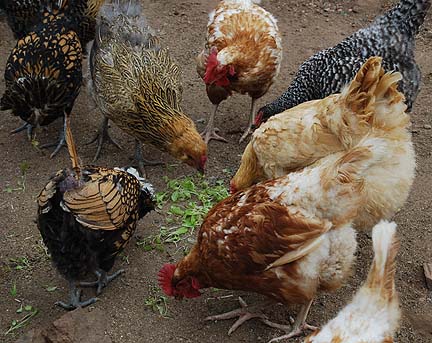
The girls eating the lettuce seedlings

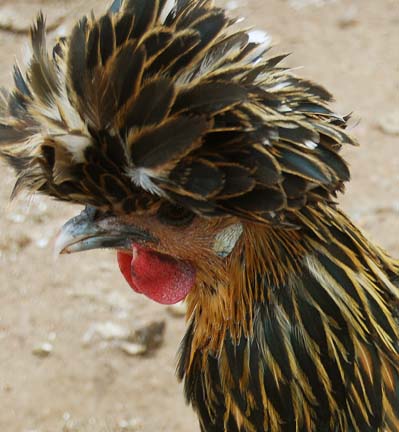
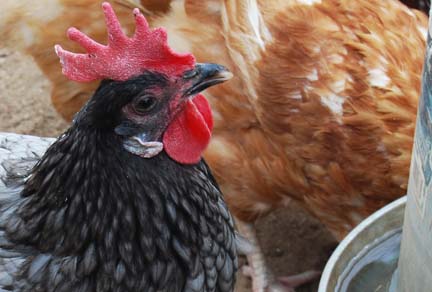
They are nuts for lettuce anyways but fresh baby seedlings? yum! Here are some pictures of the chickens eating it and some closeups some of them as well. Speaking of chickens,besides providing wonderful eggs they help make compost with their manure.

Chickens eating lettuce seedlings

They are pets which each having a name so I don’t eat them, just their eggs. I feed them lots of scraps from the kitchen which  is what makes their egg yolks so orange. The rest of the kitchen scraps goes into the compost pile. Their manured compost is great for the veggie garden but don’t put it on fruit trees-it has too much nitrogen.

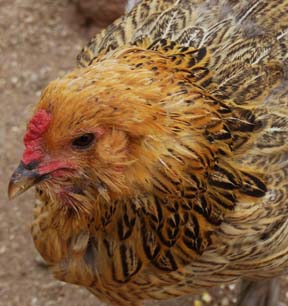
closeup of 'Chimay'-a Belgium Campine chicken-hence the name!

closeup of 'Kielbasa'-a Polish chicken

'Grayhawk' drinking water-an Andalusian chicken

'Ari'- an Auracana chicken-lays green eggs!

What is the difference between heirloom and hybrid tomatoes?

Heirloom tomato-Paul Robeson

So I researched the difference between heirloom and hybrid tomatoes because I wanted to be really clear about those differences and found some interesting information I would like to share. In fact this should apply to all heirloom vs hybrid veggies not just tomatoes but since I sort of specialize in tomatoes (and pumpkins) I’ll address it from that viewpoint.

HEIRLOOMS

Heirloom tomatoes are seeds that have been  grown for a number of years, saved and passed down for generations.  All heirloom plants are open pollinated (OP) which means it is able to produce seedlings with all its attributes just like its parent plant. Why should we grow heirlooms? Simply put because they taste better. They might not look as pretty as they tend to crack or get catface scratches because of their thin skin and they can be more disease prone but it’s hard to beat the flavor of a heirloom tomato!  This is why you don’t see a lot of them in supermarkets as they don’t transport well  and might not be pretty-in otherwords they are not as marketable on a commercial level. Last year I picked mine the day before going to our Santa Fe Farmers Market to ensure the best flavor and many of them I had to handled very carefully so as not to crack them but oh what flavor. And you know the patrons of Farmers Markets don’t care how they look-they care how they taste.

HYBRIDS

Gardeners, farmers and plant breeders have been cross-pollinating varieties to get certain desirable traits they are looking for such as color, texture, disease resistance and taste, etc. for years. They try to get the best features of both parent tomatoes.  These are called hybrid tomatoes. Hybrids also occur naturally as well in nature but hybrids whether man made or by nature are not as stable in that they may not reproduce plants with identical traits.

Hybrids should not be confused with GMOs (genetically modified organisms)  which can be any plant, animal or microorganism which has been genetically altered using genetic engineering techniques. Hybrids are not potentially harmful to us and in fact have been popular since the early 50s’. True to American nature,  it became how they looked-not how they taste on a commercial level. Now don’t get me wrong, I grow a few hybrids every year because they generally tend to be more disease resistant and the actual tomato looks good but I only grow some in case I have a disasterous year with my heirloom tomatoes. And some hybrids taste as good as heirlooms, some look better too but overall give me a heirloom tomato anytime.

What is a GMO vegetable?

Now I mentioned  in the previous post, most giant pumpkins are hybrids and not GMOs. So what is a GMO vegetable? GMO stands for Genetically Modified Organisms, which means any food product that has been altered at the gene level.

Now farmers and gardeners have been crossbreeding different species of plants since Luther Burbank pollinated one flower of a plant with another flower of another plant to create a plant or vegetable with certain desirable traits that produce heartier, better tasting, or more beautiful crops. These are called hybrids.

The concern here is with modern genetic engineering, genes from an animal, plant, bacteria, or virus are inserted into a different plant, altering irreversibly, the genetic code, (blueprint) of the organism that received the gene. What a scary thought! This would be like taking a flounder gene and inserting it into a tomato gene to create a tomato with a longer shelf life (this is true-they are doing this)!

Franken food pumpkin head

To think that we are crossing different species (think animal with a plant or virus with a plant) is outrageous. I don’t want to worry if some vegetable I’m growing will rise up and bite me on the butt while I’m working in the garden! No wonder they have the nickname of “Franken Foods”!

We should all be demanding to know what foods in our store are GMOs or contain GMOs and demand the stores remove them. Who knows what the hell these vegetables  and products will do to us in years to come…

GIANT VEGGIES!

GIANT VEGGIES!

Finally, I can start to talk about giant veggies as I will start the pumpkins this month inside. Here is some background information on some giant vegetables so you will understand them. Later in another post, I will get more specific on which giant veggies I am growing.

All or most of the giant pumpkins, giant squash, giant marrow (look like BIG zucchini) and  giant tomatoes where people want to BREAK RECORDS AND GET THEM OFFICIALLY WEIGHED are listed by the weight/grower’s name and year. So for example: the new world record pumpkin holder is held by a woman named Christy Harp who broke the record last year-so her pumpkin is listed as 1725 C. Harp 09. This means her pumpkin weighed 1725 lbs, her name is C.Harp and 09 is the year it was grown.

Here is a pic of her with her world record pumpkin. This pumpkin came from a genetic line of very big pumpkins, so those of us after records look at the parentage of each seed to give us what we think are the best odds of growing certain traits-ie size, shape, or color and weight. Now you don’t have to go to  any special weigh-offs or buy any specific seed from a grower unless you want it recorded.

There are some varieties of these vegetables that are  known to grow very BIG. If you plant these, you will grow some very big vegetables maybe not  a world record but big.  None of these are GMOs but almost all are hybrids.
Here are some varieties of  giant vegetables  to get you started that will give you the potential to grow em BIG!

GIANT PUMPKINS-If you don’t want too big, try Big Max pumpkins where you have the potential to grow a 100 lb pumpkin but hands down the Atlantic Giant  Pumpkin variety is the one most grown-you can get it generically like I did my first year from amazon.com (I grew a 225lb pumpkin that year) or you can join some giant pumpkin clubs and/or organizations and buy or ask to get some specific seed that has been grown by one of the big growers. It’s a whole different thing or as Christy Harp said about giant pumpkin growing, “It’s a hobby gone mad”! The interesting thing is many giant pumpkin growers are growing them organically. Now isn’t that cool! One of the most important things I learned from some growers is to create really healthy soil.

GIANT TOMATOES-Some varieties you can purchase through the catalogs are:
Big Zacs, Giant Belgiums, Delicious and many more to grow 3 lb plus maters.

MARROWS-They aren’t generally grown here in the states but are big in Europe and I’m not sure why. Their seeds are harder to get here. I got one seed from a grower in the Netherland that I will try this year. It was 76 lbs. We’ll see how big it’s off spring gets or if it will even do well here.

more cool season crops in!

Well the weather is going to be beautiful here this weekend. YEA! It’s going to be in the 70’s temperature wise in the daytime. Both the veggie plants indoors and me are anxious to get in the garden!  They are taking over the house! It’s still too early to get the warm season plants in the ground as the nights are still cold but now ALL the cool season crops are now in my raised beds outside up by the house.  Lettuce, spinach, arugula, mesclun, orach (mountain spinach), cauliflower, broccoli, kale, chard, bunching onions, carrots and beets.

transplanted tomatoes again

On  April 4 I transplanted some tomatoes in my 4″ pots up to gallon size. They went  “shocky” as I didn’t have room to keep them under the lights even though I gave them Thrive. So I had to build another lightbox on Tuesday to house them and now they are good again. I guess they got a little cold.  Here is a picture of them in the gallon size now. Notice I put some bamboo supports for the stems that I tied with garbage bag twist ties. That way I can relax the twist ties as the stems get bigger.

April 4-tomatoes transplanted to gallon size-doing well

I still have 36 more tomatoes to transplant by this weekend up to gallon size!  This will be the last transplant before putting them in the soil. With about 75 plants, I will give some away to my friends who grow tomatoes! I also changed my planting soil now for the gallon size. Now it is Sungro 702. See picture here.

Sun Gro Metro Mix 702 growing medium

Here is a pic of the ones I will transplant this weekend. I still have some tomatoes left in 4″ pots that won’t need transplanting before going into the ground as I started them later. Notice in the picture below that I raised up the smaller plants on the right side of the pic by putting them on another upside down container. I do this so the smaller plants are at the  same level of the higher ones so they are the same distance away from the lights. Otherwise they would be further away from the lights and could get spindly. Keep your plants within 2 ” of the lights to keep this from happening.

tomatoes in 4″ pots need transplanting

Learn from my mistakes when starting tomatoes!

UGH!  I made 2 mistakes with my newly transplanted tomatoes last week. So I want to share the mistakes and how I luckily remedied them.
MISTAKE #1- After I watered the tomatoes from the bottom tray where they sit in, (which is a good thing), I forgot to drain the water from the pan all day and all night (too much standing water can suffocate the plants)

MISTAKE #2- Secondly I forgot to cover them with the reflective insulation at night to keep them warm while the house cools down. So not only did they sit in the water all day and all night but they got cold as well. In the morning they were slightly wilted and turned a little purple (turning purple means they can’t access the phosphorus from the cold soil.) Last year I had this problem with the tomatoes turning purple, being stunted and being too cold and have really paid attention this year except this one time. I didn’t get a picture of them purple..

rock phosphate powder

So I drained the water away and read if tomatoes turn purple that we should water some rock phosphate in (which is a good organic source of phosphorus) and put them under the lights to get warm.  This happened a week ago and they have snapped out of it and look good, I lucked out! So now I have given all the baby tomatoes some rock phosphate and they are doing really well. I think I’m going to need to transplant them again before I put them in the ground.

tomato plants after the rock phosphate

Here they are now after the rock phosphate- they have really grown since planting them on March 1. I’m hoping weather permitting, I will sneak them in the ground by April 15th, which is a month before the last frost date like last year. This really gives them a head start on the season, especially for those 80+ days tomato plants.

Another tip to not have those skinny, thin stems on your baby plants is to lightly brush them with your hand everyday and it will stimulate them to make stockier stems.