Have you ordered your vegetable seeds?

seed catalogs 2011Looking through all the seed catalogs and planning what you’re growing next year is fun to do in winter. Now is the time to order your vegetable seeds if you haven’t already done so. Seed starting will soon be upon us! Many cool season crops can be started inside soon (some now) and put out in March and warm season crops can be started from seeds inside 6-8 weeks before the first frost-free date. Hard to think about starting any seeds when the weather is cold, windy and ugly but it is almost here. I have ordered some seeds but still have to get some and already feel a little behind.

If you are not one to start seeds inside, that’s ok-just wait till the nurseries get their transplants out later this spring and let them do the work for you. And don’t be afraid to buy transplants. I once was told you’re not a real gardener unless you grow everything from seed. Bull@#$%! Out here we need all the help we can get so I’m not against buying plants from nurseries at all. Besides I like supporting our local economy as well. So I grow some vegetables from seeds and buy some from the nurseries. What matters is that you get out in your garden and enjoy yourself and the fruits (or vegetables) of your labor.

Ground Hog Day 2013—Phil the Ground Hog predicts global warming-no more winters ever!!

Phil predicts an early Spring amid turmoil

Phil the ground hog predicts global warming

Phil the Ground Hog predicts global warming-no more winters ever!! But did you know..

Phil the Ground Hog, as we all know, has a little bro, Bobbi, who two years ago was involved in a big riot on Ground Hog’s Day when Phil was coming out (yes he’s gay and single Jody) of his ground hole to predict the weather for 8 weeks. Since then, after the repression of the Da La Lamba (turns out Da La Lamba was actually interested in Phil), things had been quiet until this year.

Phil's little brother Bobbi

Phil’s little bro-Bobbi

This year it was discovered that Bobbi who is originally from Ireland and recently moved back there, is actually the son of Wayne La Pier-cee! Rumors have swirled for years that Phil was gay (born of royal descent) and now this about Bobbi! Wayne came over years ago to Ireland to help the IRA (Irish Republic Army) get their guns and had an affair with Bobbi’s mother. No wonder Wayne is against extensive background checks! He doesn’t want anyone to know his background! Now this explains why Bobbi loves his guns so much and unwilling to give up his assault weapons! Bobbi has meanwhile been storing up a huge arsenal of guns, assault weapons and ammo because he knows that there is a big movement to ban them in America and is afraid it will move across the big pond. He can’t swim but knows those crazy Americans are always trying to set some new record swimming across the big pond and knows they will someday secede (opps I mean succeed). And some (notice I said some) of them just might secede like those gun toting Texans! Maybe they’ll go join up with Bobbi. Meanwhile Bobbi has installed armed guards in every ground hog school to protect his kind from those crazy varmits in America who know it is their god given right (really? I don’t remember reading that in the bible) to bear arms (legs and tails too). Opps, I’m wrong-it’s their Constitutional Right! But that’s ok, cause they’re always getting religion mixed up with their politics in America. And did you know that before ground hogs predicted the weather, hedgehogs predicted it? Yes, it’s true! But that’s another story for another day…

PS—Every winter I get delirious from lack of gardening and write these whimsical stories on Ground Hog’s Day when I really rather be out digging (like a ground hog). Still gotcha? Wanna read more? To read more on Phil the Ground Hog and his little bro Bobbi, go to my previous posts from the beginning of my delirium-The real story of Phil the groundhog! , Phil the groundhog continued..Possible Coup Coming on Ground Hog Day in 2011 and Ground Hog Day 2011-Phil Predicts an Early Spring -Fierce Battle Takes Place Before Ceremony .

For more interesting and maybe factual reading on the ground hog go to ‘What’s Your Ground Hog Day IQ’

DISCLAIMER: All names have been changed to protect my innocence.

10 more things to Do in February For the Garden

We may not be able to get out in our gardens now but it is time to get busy with things to do to get ready for the garden. March will be seed starting time and there will be lots to do before for that. I will be elaborating on some of these items over the next few posts as I see there is more info I can offer.

1. Go over your current seed supply. Organize it. Get rid of any seeds over 3 years old unless you froze them. Fresh seeds are essential for good germination. Older seeds have less success of germinating.

2. Decide which vegetables you want for this year and order any seeds you may need to get from seed catalogs.

3. Talk to your local nursery to see what they might be growing this year. I give a list to mine and they tell me what they are growing so I don’t duplicate. I prefer to let them do the growing, it’s just that I want to grow so many varieties that they might not have so I have  to start some by seed.

4. Stock up on any fertilizers, amendments, compost, nutrients, mycorizzial, and biomicrobes you may need for veggies. i.e- tomatoes, giant pumpkins

5. Check your grow light boxes to make sure they work. Get new bulbs if necessary.

6. Check grow heating mats to make sure they work and get more if necessary. Last year I had one and ordered another as my seed growing expanded.

7. Consider purchasing a seed mat thermostat. Last year I had to get one because the seed heating mats were running too hot and burning up the seeds before they have a chance to germinate. The mats stay 10° F hotter than the ambient temperature of the room so if we are having a really warm spring and the temperature is 80° F inside than the temperature would run 90°F in the seed flats-way too hot. The thermostat will keep the temperatures in the pots at whatever is best germinating temperature.

7. Purchase soil seed starting mix. I use Metro Mix 100 to start seeds. This stuff is great. The water doesn’t roll off the ‘dirt’ like many seed starting soils

8. Clean and sterilize any containers you plan to reuse for seed starting or transplanting seedlings. Use a 10% bleach to water ratio to rinse off the containers.

9. Buy any containers you may need for seed starting/transplanting. Most gardening stores sell up to 3″ in the peat pots. If you want a 4″ peat pot, go to Territorial Seeds. They are the only ones that have that size. I need them for my giant varieties cause they grow so fast. I also like the flats that have a raised lid. good for germination.

10. Read at least one good gardening book your interested in each month during the winter. I’m almost finished with ‘Four Season Gardening’ by Eric Coleman and just ordered ‘The Compost Tea Brewing Manual’ by Elaine R. Ingham.

Growing Tomatillos

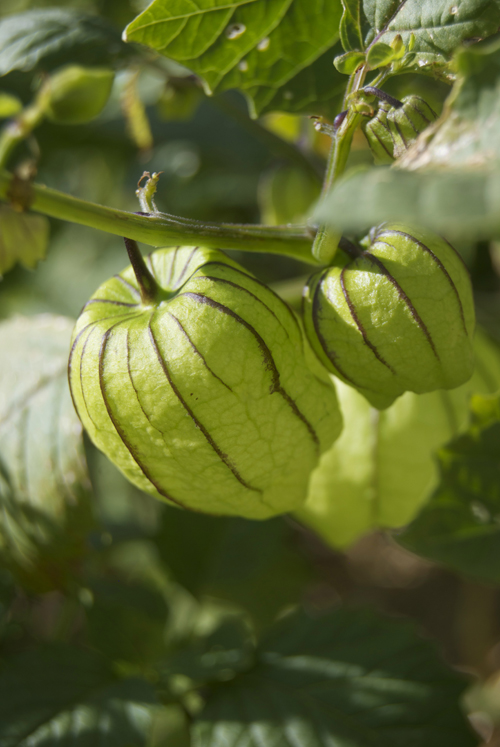
tomatillo husksTomatillos originated in Mexico and are a staple food there. They are part of the nightshade family. Growing tomatillos was new to me this year but thought I’d try them as I like green tomatillo salsa.  It has an almost citrusy flavor-kinda zingy on the tongue. When I first researched them, I read all kinds of things like, you need two plants for pollination, you only need one plant for pollination, they attract bugs, they don’t attract bugs and so on. For every thing someone would say about them, there seem to be the opposite said as well. The one thing everyone seemed to agree on is they take up some space-about 3 feet.  So here’s my one experience with them. In early June I bought one tomatillo transplant and put it in the ground outside after the chance of frost here. I grew the green tomatillo variety but I think there are several other varieties including a purple one.  I didn’t have any trouble with pollination and didn’t do anything to encourage it-it just happened. I really like the papery husks they grow in-they are beautiful with their bright green color and purple veins. Once they self pollinate, they start to grow inside the husk and eventually the fruit fills the husk. I picked it just after the husks split revealing the hard green fruit inside (about the size of a ping pong ball), but some people wait till the husks dry out and turns brown before picking. I will grow only one plant again because it was soo prolific. Also it is an easy keeper in that nothing seemed to bother it much. I had so many fruit from that one plant that I took a bunch of them to the Farmers Market and sold them. I agree they do take up about 3 square foot space per plant and I did have it staked for a while but then I just let it sprawl on the ground a little. It tastes great chopped up in a guacamole sauce for chips as well as in a tomatillo salsa. They refrigerate well for weeks before using them. I enjoyed them and will grow the again!

Tomato Porn

This slideshow requires JavaScript.

Feast for the eyes!

Gardening in the Winter

squirreleating nut

It’s always good to get a GMO rant going and it’s such an appropriate subject for gardeners and just about anyone who eats-but now back to gardening! My gardening in the winter basically consists of looking over my seed catalogs by the fireplace. I’m an armchair gardener in the cold winter months-storing up gardening info like a squirrel and juicing up energy for the next season! Visualizing the coming year’s garden in my mind’s eye is a favorite activity I like to do along with reflecting on last year’s garden and what I might do differently. I got a garden planning application which is fun to start placing next year’s veggies in the garden.

I actually went down this week (while it was in the 50’s) and swept out the garden shed and put away a few garden tools that I found out and about and I found my compost thermometer! Ah ha! I’ve been looking for it since last fall and there it was hiding above the door frame of the garden shed-why would I ever put it there?!

Oh yea, I finished watering the fruit trees so everything is watered for a month, went on a 3 mile hike with some friends and I can’t forget we’ve been getting ready at work for our big art show in Philly in February. I guess I’m not a complete sluggo!

GMO Foods in the Grocery Stores/Labeling Issue-Part 2

This is the second part on GMO foods in grocery stores. The first part can be found here. Another big deal in regards to GMOs is lack of labeling. The companies that sell GE produce or use GE foods in their products are not required to label their products that may contain some GE foods in them. Pharmaceutical drugs must have labeling, artificial sweeteners have labeling, cigarette companies have labeling but GE or GMO foods do not have to have labeling. Depressing isn’t it. What can you do?

If you want to sign a petition requiring GE labeling mandatory, sign this petition and it will get to our NM legislature. There is currently a bill in the NM legislature (SB 18-an amendment to the NM Food Act) that is being brought up in this session to have mandatory food labeling of all GE food items in New Mexico. The proposed amendment was introduced by Senator Peter Wirth. Come out this Friday, January 25, in Rm 326 of the Round House building where there will be the hearing for the first senate committee. Starts at 2:30 pm. This event just got cancelled tomorrow! Go to the Food and Water Watch facebook page here for rescheduled time.

Here are some examples of products that may contain GMO’s in them but don’t have labeling:

Anything that has SUGAR BEET sugar in it-because sugar beets can now be grown ‘Round Up Ready’. Sugar cane is safe (Look to see if your sugar says ‘sugar cane’ on it). If not then it comes from sugar beets. Some process food that may be affected are:

-sugar-If it doesn’t say sugar cane, then it is from sugar beet.

-sugar beet sweetener- Sucrose from sugar beets can include raw sugar, granulated sugar, brown sugar, confectioner’s sugar, and turbinado sugar. It is made up of glucose and fructose. Again look at the label if it says made from sugar cane it’s ok.

-cereals, cake mixes, frozen prepared foods, candy, breads, canned goods that have sweeteners in them-spaghetti sauce, etc

Anything that has corn or a corn by-products in it

-corn syrup

-cereals, cake mixes, frozen prepared foods, candy, breads, canned goods that have corn sweeteners in them-spaghetti sauce, etc+ corn meal

Any livestock that was fed with GE corn

-Meat-beef, chicken, pig that you eat.There are no GE livestock being sold in US but they can be feed GE corn grain which might be a concern.

Milk products-because  the cow/goat could be fed GE corn grain-same as above or is fed.

Eggs-because that chicken could be fed GE corn grain-same as above

Anything that has soy in itthis includes all edamame, soy sauce, tofu, tamari, miso or anything with soy

Anything with cottonseed oil or canola oil-these crops are mainly now GE grown.

3 TIPS TO AVOID GMO FOODS IN THE GROCERY STORE

1. Buy organic fruits and vegetables and organic processed foods. All organic foods are safe. For now…

2. Look for ‘Non-GMO’ labels-companies may label this voluntarily.

3. Avoid ‘At Risk’ ingredients in processed foods-corn, corn oil, corn sweeteners, soybeans, canola oil and cottonseed oil

Here are some interesting articles you might want to read: Read the first one for sure..

** TrueFoodNow.org-they have a great shoppers guide-quite extensive and list BY BRAND AND STORE and you can get an app for your phone while shopping.

http://en.wikipedia.org/wiki/Genetically_modified_food

USDA Approves Genetically Engineered Sugar Beets

GM soybean

GMO Foods in the Grocery Stores-Part 1

Last week I posted about how to tell if your produce is GE, organic or conventional by looking at the PLU labels. This week I want to talk about GE foods and labeling of them. Some might ask, what is the big deal about genetically modified food and the labeling issue that so many people want in the grocery stores? For your information, genetically modified foods are sometimes also called GE (genetically engineered), GM (genetically modified) and GMO (genetically modified organism) and are sometimes used interchangeably.

Well, there are several big deals. For the first one we have to go back to the beginning. No GE crops that are grown for the production of food have ever been tested in long term studies to see if they are harmful to people.  No testing required-no regulation whatever. Why? Because the USDA doesn’t require them? Why? Good question! I wouldn’t be as concerned if the manufacturers of these seeds were required to run tests to make sure their products/produce were safe for humans before putting them on the market. That could prove whether they are actually harmful or not. These corporations are certainly making enough money to do the research required for safety but don’t. I don’t think they care as long as they are not required to care. Here’s my opinion-Profits first! Money for these corporations, money for congress people (not all congress people) who won’t pass laws protecting the consumer, money for USDA to turn their heads. Sad isn’t it but if it isn’t true, than why are we not being protected?

Here is some information on current GE foods in America:

‘Round Up Ready’ corn seeds – What does that mean? Well, it means that the gene that makes ‘Round Up’ work (kill weeds) has been spliced genetically with corn genes. Round Up is the same herbicide you may be using to kill weeds in your gardens. So when a farmer gets ‘Round Up Ready’ seeds, they can spray Round Up on their crops without killing them but it kills the weeds. The crops will not die but the weeds will.  Also the manufacturers of these seeds just happen to sell Round Up as well-hmm!! In the beginning it worked. Now I read recently that a whole slew of ‘super’ weeds have developed (evolved) that Round Up doesn’t work on anymore.

Bt corn’ seed (to control corn worms). Bt is an organic pesticide that is being sliced into the corn gene. Unfortunately (or fortunately if you’re the worm), the worms are starting to become resistant to this. Now, one could argue Bt is an organic pesticide. This is true, but do I want to ingest it in genetically altered food I eat? No.

Round Up Ready’ sugar beet seed which has been approved by USDA. Of all the sugar produced in the US, 54% comes from sugar beets and 90% of all sugar beets out there are GE grown. This will greatly increase GE sugar in the American food chain. Great! But there is a way out of this-use sugar cane products-sugar cane is safe-NON-GMO.

‘Round Up Ready’ alfalfa is also fed to our livestock that we eat or drink their milk. Again we don’t ingest it first hand but don’t you want to make that choice?

GE herbicide-resistant soybeans95% of soybeans grown in the US are GM!

The second part will be on the next post-GMO Foods in the Grocery Stores-Part 2

Here are some interesting articles you might want to read: Read the first one for sure..

** TrueFoodNow.org-they have a great shoppers guide-quite extensive and list BY BRAND AND STORE and you can get an app for your phone while shopping.

http://en.wikipedia.org/wiki/Genetically_modified_food

USDA Approves Genetically Engineered Sugar Beets

GM soybean


Water your plants NOW

apple tree-granny prunedJust checked the weather for the next few days and it looks good for us-FINALLY warming up from the frigid days and nights we’ve had. Ahhh, my little goatie things are so happy down at the barn! I always feel bad for them but they are hardy creatures with very warm coats (I daresay warmer than the ones I’ve worn lately)!

But on to the title of this post-Now is the time to water during this ‘warm’ spell. What should we water? Water ALL your plants and trees EXCEPT the ones in the shade with the snow around them. Don’t bother with them as they are frozen and we don’t need to water frozen ground as it won’t sink in anyways (but when the snow melts around them, include them too). We have had some precipitation but not enough for them. They need some water in the winter too.

How much should we be watering in the winter? WATER ONCE A MONTH during a warm spell unless we get a substantial amount of precipitation that month. And don’t forget to mark it on your calendars so you can see back when you watered last. Your trees and plants will thank you for it and you will thank them come spring when they wake up from sleeping in all their glory!

Grocery store produce—is it GMO, organic or conventionally produced?

orange conventional

Is this orange conventional, organic or GMO?

A friend ask me the other day if there is produce out in the supermarkets that are GMO’s. I did some research and I found out that those tags we see on the fruits and vegetables in the produce section of your grocery store actually give us more information than the price. The tags are called PLU numbers-PLU stands for ‘Price Look Up’. So I went to all the grocery stores here in Santa Fe and did some detective work! I snooped around the produce section with my iphone taking pictures of the tags on the produce looking for GMO produce. Luckily no one from the stores asked me what the hell I was doing! The good news is that I didn’t find any GMO produce (fruits/veggies) here in Santa Fe in the supermarkets. Now that doesn’t mean there aren’t any GMO foods in the grocery store (I’ll talk about that in a later post), just not any fresh produce (veggies/fruits) that are on the shelves right now. Notice I said right now because there are a few items in the produce section that could show up as GMOs in the future—namely corn and some papayas. I  only saw them now as conventionally grown.

So here is the info you’ll need to tell if your fruit or veggie is a GMO. All the stores but Trader Joes use similar PLU tags on their produce. TJ’s has their own tagging system so this info won’t apply to them.

banana 4011

If your tag is a 4-digit number, then it is CONVENTIONALLY GROWN which means the grower could use chemical pesticides and fertilizers on it but it is not a GMO so the orange at the top of the post and the banana above are examples of conventionally grown produce.

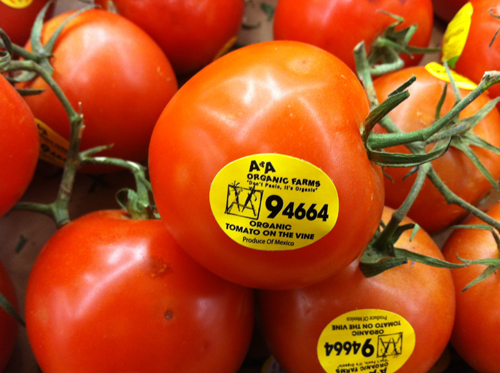
tomatoes94664

If your tag is a 5-digit number, and it starts with a 9, then it is ORGANICALLY GROWN and if it is organically grown than it is not a GMO. In fact ALL organic foods are not GMO’s.

Now if your tag is a 5-digit number, and it starts with an 8, then it is a GMO. Like I said above, I couldn’t find any produce in Santa Fe with a 5 digit number starting with an 8 to take a picture of. Well, that’s a relief!

When I go to the grocery store I can never remember which number the GMO starts with while I’m there so I made up this little diddy to help me remember:

If it’s 8, than it’s not great. If it’s 9, then you’ll be fine!

100,000+ visits!!

Me and Hercules 166lbToday is a landmark for my blog, giantveggiegardener.com. I now have over 100,000 visits to this website-100,045 to be exact as of this post! And I also hit another landmark today-500 posts!  Hard to believe that I started this blog 3 years ago and never thought I’d get so many visitors. Glad to know you are ‘listening’.  If you build it, they will come. Many thanks to all of you!

2012 Tomatoes Reviewed

Costuluto Genevese tomato

Costuluto Genevese tomatoes

So now that I have the rest of the vegetables reviewed, I want to review my most favorite vegetable in 2012-TOMATOES!! There were many I would keep BUT also a LOT I would dump!

ALL-STAR TOMATO LIST!


RED

-Pantano Romanesco-good producer-medium size, excellent old-fashioned flavor

-Costoluto Genovese-good producer-smaller but such a beautiful tomato and excellent old-fashioned flavor

-Goldsman Italian American-big pear shape-my all time favorite for sauce-takes all season to ripen though
 but worth it

-Fireworks-good early producer-smaller is better for some people and great taste-old fashion flavor

-Beefy Boy-good producer, medium size-good taste

-Matina– smaller earlier tomato-good flavor

-Original Goliath-medium size, few cracks-good taste

-Big Zacs-huge tomato-huge taste! A favorite!

BI-COLOR

-Striped German-supersweet med to large tomato

-Ananas Noir-wonderful complex sweet flavor-green with a blush-need to plant more

-Virginia Sweet-super super sweet-the sweetest of all tomatoes I grow! One of my favorites!

BLACK OR PURPLE

-Paul Robeson-sweet, complex flavor
-Cherokee Purple-sweet, complex flavor

-Cherokee Purple-great sweet complex flavor

-Black Pear-sweet, complex flavor

-Southern Nights-sweet, complex flavor

-Brown Sugar-sweet, complex flavor

ORANGE/YELLOW

-Jaune Flamme-smaller tomato, few cracks-a favorite at the Farmers market

-Lemon Boy-supersweet medium tomato

CHERRY TOMATOES

-Black Cherry-excellent complex flavor-one of my favorites

-Green Grape-sweet fruity flavor

-Sun Sugar-the sweetest flavor of these cherry tomatoes

-Golden Pearl-sweet flavor-very prolific

TOMATO DUMP LIST!

-Beauty Queen-looks great but very bland taste-takes all season to mature

-Gold Medal-looks great but very bland taste, takes all season to mature

-Woodle Orange-not a great producer took all season for a few and taste bland

-Aunt Gertie’s Gold-disappointing flavor

-Honey hybrid-not a great producer-flavor just ok

-Juliet-cherry tomato-some people love it but for me it tasted like grocery store tomatoes

The Holy Grail of Beans

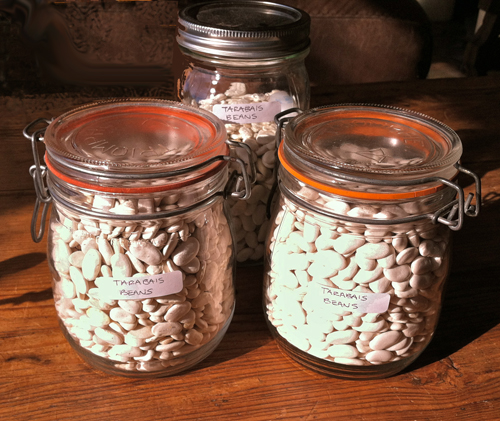
tarabais beans

The holy grail of dried beans are Tarabais beans. They are a runner bean (Phaeseolus coccineus). Haricots Tarabais (as they are called in France), have been grown for centuries in Tarbes, at the foot of the French Pyrénées in the southwestern region of France close to the Spanish border. This white bean, which is larger than a navy bean, is thin-skinned, sweet and has creamy flesh and doesn’t fall apart when cooked. They are commonly used in a classic french dish called cassoulet, a rich and savory casserole baked with these beans, duck confit, sausage, pork, sometimes lamb, and topped with crispy breadcrumbs. This is a great winter dish. Different cities in France have different ingredients in their cassoulets, but all of them start with these beans. They are also perfect for any bean salads or bean soups.

I had a hard time finding them last year in the states. When I went online to get them from France they were very expensive- $34 an ounce! I had a friend who was in Germany try to get some for me but they were still $15 an ounce. Too rich for my blood and to think these were originally used as a peasant casserole! I was about to give up when I saw them in my 2012 Seed Saver’s Exchange members book last year. There were 4 people offering them in the US. It cost $5 (for postage) to get them. So I spent $20 and got some from all four members. Enough for 2 years. Well this year you’ll be in luck if you want to try these beans-they are in Baker Heirloom Seeds for the first time and are easily available this year in the states.

haricot tarabais  bean pods in summer

haricot tarabais bean pods in summer

In growing these beans, I found it tough to get them started having to replant the seeds 3 times before I got them to germinate on my 8 ft long fence. They grew up over the 3 foot tall fence and curled back on the other side which was fine. Once up they are up, they are an easy keeper. You don’t have to do anything special except to be sure to give them adequate water. They did get a little rust on some of the leaves but regrew new leaves  (like all my beans) without it reoccurring again. You’ll need to get them in the ground as early as possible as soon as the ground warms up because it takes all season for the pods to mature. Then I picked them after the pods dried. After I picked them, I brought them inside, shelled them and placed the beans on a cookie sheet until they were really dry. You can tell if they are dry enough to put away by biting one and if it is rock hard and no give, then it is ready. After that I put them in some mason type jars where they are ready for me to start the cassoulet adventure this winter!

Review of 2012 vegetables

fall harvest

2012 VEGGIE LIST

Here is my review of what I will and won’t grow again from last year’s vegetables that I tried and why. I will put tomatoes in another list since there are so many of them!

WILL GROW AGAIN
ARUGULA
-Apollo-nice leaf size and flavor

BEANS
-Rattlesnake bean/pole-remarkably flavored pole bean-grows very tall-great for trellises or arbor
-Tarbais bean/pole-dry bean-after much work FINDING IT last year in the states, you can now get this wonderful bean from Baker Creek Heirloom Seeds this year. I will make a french dish called cassoulet with it.
-Fava Bean/bush-wonderful flavor and 2 crops last year. A little work shelling it twice but worth it. Also is a good cover crop replenishing the soil with nitrogen.
-Golden Scarlet Runner/pole-I grow runners for their flowers/foliage-the foliage on this one is a striking chartreuse color against the scarlet flowers-simply beautiful

BEETS
– Craupadine-BEST tasting (but ugly) beet around
-Cylindra-long cylinder shape, great taste, easy cutting into slices

BOK CHOY
-Extra Dwarf Pak Choy-wonderful flavor-I like to cut one in half, saute it in olive oil, and add tamari when you flip it

CARROTS
-Atomic Red-great color and flavor
-Cosmic Purple-one of my favorites

CHARD
-Bright Lights-adds great color tucked into the garden and good flavor
-Argentata-thick juicy stalks with huge leaves-very cold tolerant
-Ruby Red-one of the prettiest and tasty chards out there

CUCUMBERS
-Parisian Pickling-used for making cornichon pickles
-Boothsby Blonde-used for making bread and butter pickles
-Poona Kheera-best flavor for eating
-Armenian– fun to grow, good flavor, few seeds

EGGPLANT
-Fairy Tale-sweet, no bitter taste and tender (not tough) skin

LETTUCES
–Provencal Mix, Mesclun Mix, Buttercrunch, Yugoslavian Red, Santoro Lettuce

PEAS
-Dwarf Sugar Gray-great in salads or steamed, grows about 3 ft tall

PEPPER–want to try some different varieties from Europe this year as well
-Shishito (Japanese non-hot pepper)-one of my favorites
-Poblanos-mildly hot (I call it warm), great for chile rellanos or scrambled eggs, wonderful smoky flavor

POTATOES–first year grower and I’m hooked!
-French Fingerling-OMG, the best flavor!
-Peruvian Purple-I loved the flavor of these as well

SPINACH
-Bloomsdale and Tyee

SUMMER SQUASH
ZUCCHINI
-Costata Romanesco-best tasting zuke around

SUNFLOWERS-technically a flower but they are veggies for the birds!
-will grow another huge patch of different varieties-beautiful and the birds love them
-Russian Mammoth AND Titan– for us/birds to eat
-Black Oil-for the birds only

TOMATILLO-Green-good for tomatillo salsa-only need one plant as they are so prolific.

WON’T GROW AGAIN
BEAN-Emerite bean/pole bean- great flavor but didn’t grow high enough to cover my teepee and I will grow others this year.

CARROTS
-Paris Market-too small, bland flavor, not impressed

CALABICITAS SQUASH
-seed from local grower-turns out it was a native winter squash, not calabacitas squash.

CORN-again not this year (I’ll get it from our Farmers Market)

FENNEL/FINOCCHIO
-Di Firenze-might grow one or two but not 25 plants like last year!

PEPPER
-Jalapeno-I don’t use them enough to call for space in the garden. I’ll just buy the few I use throughout the year.

POTATOES
-Russian Banana-too crunchy and watery

My favorite sauce tomato to grow-Goldman’s Italian American tomato

Goldmans Italian American tomato

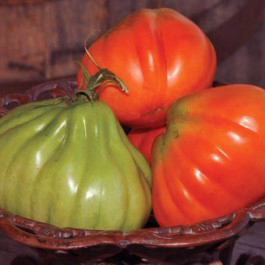
Psst, I’ve got to let you in on a big secret of mine-Goldman’s Italian American Tomato. I think it’s the best heirloom tomato to grow for sauce bar none. It’s a big, meaty, ribbed, pear-shaped red tomato with exceptional flavor. Not too acidic, not too sweet.

Every year I grow a couple of plants of this tomato but never sell it at the Santa Fe Farmers Market as ‘The Tomato Lady’ because I’m too selfish! I want all of them for making the various pasta sauces I make. I sell all my other varieties of tomatoes, but not this one. A friend of mine said, ‘Well why don’t you grow more to sell?” A novel idea I should consider! It’s only downside is it does take 80 days to mature so you’ll get some of them sun-ripened and have to bring the rest in before it freezes. No matter-they ripen in the house just as well as outside. The plant gets big about 6-7 foot tall so you’ll need some space but it will be well worth it.

The Heirloom Tomato book

Amy Goldman found it at a roadside stand in Italy, and named it after her father’s grocery store in Brooklyn. Amy Goldman wrote the book, “The Heirloom Tomato” and I use it as the gospel for helping me pick my tomatoes to grow each year.

I start the seeds inside sometime around the beginning of April each year under lights and on a heating mat. You’ll have to get the seeds online as no one sells either the seeds or the starts around here. I get my seeds from Baker Creek Heirloom Seeds here.