More produce/cheese from Mercado Centrale in Florence

Tomatoes, dry beans, truffles, cheese and onions. So much to see!

Florence, Italy farmers market


I’m in Florence, Italy right now. Here’s Mercado Centrale by San Lorenzo this morning where produce, meats, fish, pasta and more are sold every morning. Felt right at home! Those are mushrooms in the last photo.

Tomatoes in on May 6th!

tomatoes 05 24 16

Tomatoes went in on May 6 with the help of Linda, Janet, Mike and myself. Many thanks! Planted 27 plants for me and 9 for the dwarf tomato trials. Plus this week I planted peppers and eggplants transplants in wall of waters and cucumber and bean seeds directly in ground. A bit early, as I always say to wait but I’m currently on my way to Venice, Italy and am typing this on my phone which is a pain! I didn’t want to wait till June. I’ll still have to plant squash, watermelons and flowers when I return. But this year because of the warm nites, I think I will be ok.  Ciao!

TONITE: BIG FREEZE WARNING for Santa Fe!!!

One day it’s 78° for a high this week-warm and windy and tonite it will be very cold and windy with the temperature dropping to 24°. Of course this will wipe out the fruit tree blossoms (for me the apple blossoms are just starting) and there goes another fruit crop for this year. This will be the second year in a row that we may not get apples. Waaa! And forget about the apricot trees. I haven’t seen a crop in 7 years. You know what you call an apricot tree? A nice shade tree-as we usually get a freeze that wipes out their blossoms.

So cover up any plants that you may have put out early with winter weight row cover or 2 of the mid-weight row covers for the next two nights even if they are cold hardy crops. The plants are actually affected by the wind chill, just like us. Then it warms up in the 40’s on Sunday and Monday except for next Tuesday when the night-time temp will drop again to 30° and then warms up again at nite to above freezing temperatures. And so it goes with the ‘shoulder season’ where the weather doesn’t know if it’s still winter or spring and the winds are ferocious. But what we need most is precipitation. I’ll take it in any form.

Root Trainers-unique propagating trays

Fava beans in Root Trainer

I started using ‘Deep Root trainers’ last year for my fava beans and other bean crops that need deep cells or for plants that don’t want the roots disturbed when planting. The cool thing about them is that the cells are 5 inches deep and shaped like a clamshell, with two sides that open up like a book.  There are 8 sections total that fit snugly in a tray to hold them upright that comes with the kit. They are great as they have grooves that keep the roots growing straight instead of circling in the cell and strangling the plant. They also air prune when they hit the bottom of the cell.  No need to transplant into another pot, just plant them out in the garden. You just put seed starting soil in each cell, pat it down and put the seeds in. The only drawback is the plastic clamshells are very fragile and must be handled super carefully to keep from cracking but knowing that, I am careful and have them for three years so far. You can get them through Amazon. Get the 5″ deep ones, NOT the 3″ ones.

Pictured above are fava beans in their cells, 6 are already planted in the ground. Just carefully open the clamshell and slide them out into your hole in the ground with no root disturbance for those sensitive plants that hate to be transplanted.

Craupadine beets started in Root Trainer

I also used root trainers with a hard to germinate french variety of beet called ‘Craupadine’. It is probably the oldest beet in existence. I have not had much luck with germination when planting these seeds directly in the ground so I decided to try them in the rootrrainers this year and have much better germination although still spotty. I thought being a root vegetable, they probably would not like to have that main root disturbed. I think they will do well. I won’t wait till the plants are too big.  I am planting them outside after the first true leaves (cotyledon leaves) come out. So far 27 have germinated which is more than I have ever grown at one time.  They are ready for transplant above. I am so excited as these are the sweetest beets I’ve ever eaten. The french farmer markets cook them over a smokey fire in foil and serve them still warm.

Dwarf Tomatoes started!

Dwarf tomatoes in foreground and on right side in background. The two taller ones in background are Lucky Cross tomatoes which are regular size indeterminate tomatoes


Since I’m involved in growing dwarf tomatoes for Craig Lehouiller in his project, I decided to grow some of his varieties of open pollinated dwarf tomatoes that have been released to the public. I got the seeds from Victory Seeds. I’ve never grown dwarf tomatoes before. All the dwarf tomatoes will get between 3-4 feet tall and are stockier than regular tomato plants. They are indeterminate variety so the they will grow like all other indeterminate tomatoes only slower throughout the season and will be shorter. Indeterminate tomatoes keep producing fruit till it freezes. The actual tomatoes on dwarf tomatoes aren’t necessarily smaller just because the plants are. The days to harvest can go from 65-80 days depending on the dwarf variety. I am trying 10 released dwarfs plus 6 more unreleased in trials for Craig. So I am heavily invested in the dwarfs this year but I am growing some of my all-time favorites as well.

I noticed right away that the dwarf tomatoes pictured above are shorter and stockier even just after germination. I start all my tomatoes in shallow seed propagation trays on heat mats with a thermostat and under lights inside the house. Because of their shallowness, the soil heats up faster so germination is faster but you must water them 2x a day.  The two taller tomato plants in the background on the left side are regular indeterminate tomatoes called Lucky Cross, which is one of my favorites but notice the height difference with the dwarfs being much shorter and stockier. For earlier post on dwarf tomatoes, go here.

Major changes in the garden!

Adding new wood framing for my existing garden beds this spring

Major changes are happening in my 3000 square foot vegetable garden this spring. I have changed my low free-formed rectangle raised beds without edging into raised beds with redwood board edging to help retain the soil and compost inside each bed. The majority of the beds are made but now I must site them over my existing free-formed beds, digging out the edges of the bed so the forms can fit over the existing bed without losing any soil. Then I will level the soil out and add compost to each of the framed beds.

Sections 1 and 2 will pretty much be done and section 3 will be partially done as well. Each section is 1000 square feet. The beds are 12 feet by 4 feet and there is enough room between the beds to get a wheelbarrow through. I know some people put their beds closer together with little tiny paths between the beds but being able to get a wheelbarrow of compost through to the beds is really helpful. Then I will put wood chips on the path which help keep the paths from washing away should we ever get rain again! The wood chips will help with the erosion since I live on a hill. So I will finally have a nice tidy garden where the soil will be retained by the frames. All very exciting for an obsessed gardener!

Meanwhile, I can hardly wait till I can plant the cool season crops I have growing inside the house out into some of my other raised beds by the house. They need to get outside so I have room for my baby tomato plants just coming up inside, under lights, on heat mats. I need more room as the tomato plants can’t go outside yet-way too cold at night for them.

The only thing holding me back is the dang wind-just horrible right. Ugly horrible and not nice for gardening with 40 mph winds. I’m not that obsessed! Hopefully it will be better in a few days and I can get the cool season crops out and the framed beds all straightened out and then I will be ready to rock n roll in the garden!

UGLY WIND!! UGH!

I hate this wind we have been having the last few days. Typical spring weather here in Santa Fe. Today winds sustained at 25-30 mph and tomorrow projected to be 40 mph! Just terrible for a gardener chomping at the bit to get out in the garden. But I refuse to go out in it (I’m not that nuts!) so I have to be content to stay inside and dream about what my garden will look like this summer. They say the spring winds wake up the trees from winter and if this is so, they should be wide awake by now.

I did start my tomato seeds 2 weeks ago and they are mostly up inside, under lights on heat mats. I keep moving forward towards the garden even though the wind wants to move me backwards. Ugly Wind-Ugh!!!

Santa Fe Garden Club Lecture


Today I did a 2 hour lecture on starting tomatoes from seeds for the Santa Fe Garden Club. I explained how to start the seeds, how to transplant them into bigger pots, what ingredients I use in each potting hole when planting outside and much more. Then they planted some of their own seeds. Nice class. Nice people. I am going to start my tomatoes inside on March 25.

Attached are the lecture handouts from the class for those who requested them:

STARTING TOMATO SEEDS INSIDE

2018 TOMATO INFORMATION SHEET

2018 Tomato Growing 101 Class

Not much time left before the first class!

TOMATO GROWING 101-Season Long Course—starts Mar 25-Aug 5

Do you want to learn how to grow great heirloom tomatoes organically from start to finish? Think of the money you can save by learning to grow your own heirloom tomatoes from seed. Plus you can try new varieties that are not sold in the nurseries.

These hands-on classes will emphasis learning how to grow tomatoes successfully throughout the season. Participants will learn how to grow tomatoes from their seeds, what starting mix to use, what soil to transplant in, how to handle the delicate seedlings when transplanting up, how to produce sturdy plants. Lighting systems will be discussed and your seedlings will stay under lights at my farm under my care until time to plant outside when you will take your plants home to plant outside in your garden.

All planting materials, seeds, soil, amendments and pots supplied while growing them at the farm. Class participants will get a workbook with printed material added at each class to help them be successful throughout this growing season and as a reference for years to come. Students will get hands-on experience by planting to gain confidence and will come back to learn how to prune them, make compost tea, how to identify diseases and pests and how to control them.

Participants must sign up for all classes at once. Course payable at sign up for a total of $150. Class size is limited-10 students max. This takes a commitment. No partial classes.

____________________________________________

To register for the class is an easy two-step process:

1. Fill out the CONTACT FORM below and hit the submit button. Then to pay:

2. TO PAY: click the PAY PAL button (below the contact form). You don’t need to have a paypal account.  They will process credit cards too.

Step 1: Fill out this CONTACT FORM:

Name(required)
(required)
Phone(required)

Step 2: TO PAY: Purchase all 6 classes for $150 here

Buy Now Button
____________________________________________

HERE IS A PDF OF THE SCHEDULE BELOW. PUT THIS SCHEDULE IN YOUR CALENDAR AND PRINT IT SO YOUR DON’T FORGET!

2018_TOMATO GROWING 101 CLASS SCHEDULE

____________________________________________

Review the class schedule:

2018 TOMATO GROWING 101 CLASS SCHEDULE

Section 1
HANDS-ON LEARNING OF HOW TO START TOMATO SEEDS/CARING OF THE YOUNG SEEDLINGS AND TRANSPLANTING UP/PREPARING SOIL IN GARDEN

Class 1 
Sunday, March 25nd—10 am to 12 noon

Learn how and why to plant tomato seeds/how to pick your varieties, what soil medium to use, learn about germination troubles and how to avoid them/hands-on planting your seeds

Class 2
Sunday, April 15th—10 am to 12 noon

Transplanting up to 4” pots/changing the type of soil, adding amendments for great the sturdiest stems, how to deal with transplant shock and learning how to maintain your plants.

______________

Section 2
LEARN HOW TO TRANSPLANT THE TOMATO PLANTS OUTSIDE IN THE GARDEN /LEARNING ABOUT SOIL AMENDMENTS/TAKING YOUR PLANTS HOME

Class 3
Sunday, May 6th—10 am to 12 noon

Participants will learn how to transplant their tomato plants out in the garden, how to prepare planting hole and what amendments to add when planting for better growth of tomatoes. Discussion and demo of how to use wall-of-waters (WOW) and how to set them up properly. After learning how to do all this, students will take home their plants to be planted in their own garden.

___________________

Section 3
THEY’RE IN THE GROUND, NOW WHAT?
THE NEXT STEPS FOR TOMATO GROWING SUCCESS

Class 4
Sunday, June 3th—10 am to 12 noon

HANDS-ON: Participants will learn how and when to remove wall of waters, how to control leafhoppers, learn about tomato cages-what works and doesn’t work, saving water by mulching and using a drip system, using organic fertilizers, using row cover as protection.

Class 5
Sunday, July 15—10 am to 12 noon

Removing row cover. Trimming and pruning your tomato plants, the pros and cons of sucker control and how to remove them. Learn to make compost tea. Identifying beginning problems, which organic fungicides and insecticides to use as the season goes on if needed.

__________________

Section 4
MAINTAINING YOUR PLANTS-PRUNING TECHNIQUES, IDENTIFYING AND CONTROLLING DISEASES AND PESTS AND HARVESTING

Class 6
Sunday, August 5th—10 am to 12 noon

Participants will continue learning how to maintain their plants, more pruning techniques, harvest techniques, and identify tomato diseases and pests and how to control them organically.

Dwarf Tomato Project Trials

One of the things I’ll do in the garden this year is I’ve been invited to become involved in the Dwarf Tomato Project trials. They needed some tomato growers in the US to grow out some of their tomatoes from seeds from their project and keep detailed info on how they do in our short growing season. These are open-pollinated tomatoes that are not released to the public yet as they need to stabilize these new tomato varieties before they get released.

I became interested because  Craig Lehouiller, a tomato grower who wrote the book, Epic Tomato and created the Purple Cherokee tomato, is in charge of the project here in the Northern Hemisphere. Someone else is in charge of the Southern Hemisphere down in Australia. They gave me 3 different cherry tomato seed packets to grow for this season.

Dwarf tomatoes are not determinate tomato plants but are indeterminate tomato plants that stay shorter but the tomatoes are not necessarily smaller, just the plant. I thought this would be a good for people who have a limited space or maybe just a patio. They can be grown in the ground or even in five gallon pots. And you won’t need a huge cage. Many are created with crosses from tomatoes I love, like Brandywine with another variety.

In addition to trialing these tomatoes,  I also got some of his already released dwarf tomato seeds (about 20 varieties have been released so far) that I bought from Victory Seeds. I am anxious how they will grow and taste too. Stayed tuned when I report back about how this project develops. Very excited!

Watering in early spring- how much in a greenhouse, hoop tunnel, or cold frame?

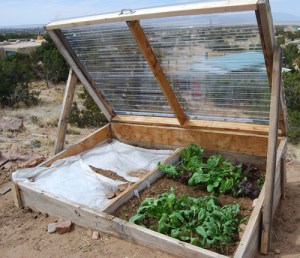
Just got a great question from the earlier post. How much do I water in winter-early spring in my greenhouse? Not very much. Since I don’t have the drip systems on and I don’t want to empty hoses that might freeze, I fill up 5 gal buckets, leave them inside the GH and then fill up my watering can from them and water the plants. Five gal buckets are kinda heavy for me (40 lbs) so I prefer to transfer the water to a watering can. Or just fill up a watering can from your house and refill as needed. The only problem is my greenhouse is too far from my house to keep refilling a watering can from the house. Notice the white row cover on the side, ready to go back on the greens tonight when it gets cold.

This time of year is called the ‘shoulder season’—not quite winter and not quite spring-with extreme temperature swings from day to night. There is no set formula for watering because one day the temperature can be 60°F and the next day in the 40’s°F or even 30’s°F. Same with nighttime temperatures.  Or you structure might really heat up in the day if you forget to open the doors or plastic on the ends or open the cold frame. So there are lots of variables that will affect how much to water. I really watch the plants and the soil in regards to watering when I have to do it by hand. Does the soil appear damp after your last watering even though its been maybe 4-5 days? Don’t water. Do the plants look like they need water? Are they looking stressed? Wilted? Water! The cooler it is, the less you have to water. I don’t water till the soil FEELS dry when I put my finger in it around a plant. But I can tell you this, you will be watering much less than in the heat of summer.


Greens in the Green House!

So my greens made it through the worst of winter (I hope) and have really started to kick in growing. They went on hold (stopped growing) from around Thanksgiving to mid-January when we had less than 10 hours of daylight. But since then the daylight hours keep increasing daily which is a signal for the plants to grow again in earnest. In case you are wondering when I planted all this, I planted the carrots, arugula and spinach last September inside the greenhouse, and the red and green lettuces I started from seed under grow lights inside my house on January 2nd and then were put out in the greenhouse in early February.

To keep the greens from freezing in the dead of winter in the greenhouse which is unheated, I’ve cover them with one layer of winter weight row cover every night and on some really cold nights (when temperatures got down to 14-17° F), I put two rows of row cover over them. One night the lettuce actually froze. But I read in Elliot Coleman’s Winter Harvest Handbook that if you don’t harvest it when it’s frozen, it may be fine by the afternoon when it warms up and sure enuf, it thawed out and is still growing great. You just can’t harvest it when it’s in a frozen state.

My Greenhouse a few summers ago

In the greenhouse are some carrots which aren’t very big yet (about the size of a pencil in circumference) some green and red lettuces, arugula and spinach, all of which will be harvested before the Green House (a play on the word greenhouse since my greenhouse was painted green) gets too hot. In fact when the day temperatures reach the 50’s, I put fans on to blow the heat out of the greenhouse.


Pray for heat, girls!

You see, I don’t worry about it being too cold but worry about it getting too HOT which will cause the lettuces and spinach to bolt (make flowers) which will cause it all to go bitter and then it is only good for our chickens who don’t seem to mind the bitterness at all. In fact I think they pray for the heat!

Looks like some of the lettuce and spinach are now big enough to pick the outer leaves while leaving the inner leaves to continue to grow. And a big bonus for me is to see so much green now already at the start of March! I love going into the greenhouse right now. Refreshing when the outdoor plants are still sleeping…

Vegetables I’m trying in 2018

Here is a list of the vegetables AND tomatoes (underneath) I want to grow this year. Some I’ve grown before and really like and some are new.

Also this year I will try 11 new varieties of Dwarf Tomatoes that have been released to the public that are not on this list.

I will also be involved in the Dwarf Tomato Project,  growing 3 new varieties of cherry tomatoes (that are not released yet to the public but are in trials). I will write about the Dwarf Tomato Project in another post coming soon.

______________________________

Vegetables I’m Growing in 2018

BEANS
Borlotti Lamon-vining-dry multi color pods
Emerite-vining-green French haricot
NEW! Rossa di Lucca-bush beans-dry-get at Farmers Market at Zulu’s Petals Organic Farm booth
NEW! Di Casalbuono Panzariedd-vining-get at Farmers Market at Zulu’s Petals Organic Farm booth

SUMMER SQUASH
Costata Romanesco-wonderful italian zucchini
Zuchetta Rugosa Friulana-These produce an abundance of light yellow, “warty” fruit. They aren’t beautiful, but they’re suppose to taste great. This is the most common zucchini in the markets of Venice in summer.

WINTER SQUASH
NEW! Tahiti Butternut-Sweeter than most other squashes, and suppose to get better with age! Large fruits shaped like butternuts with elongated necks and light golden orange skin.
Waltham Butternut

WATERMELON
NEW! Bradford-90 days-heirloom that was almost extinct until the Bradford family brought it back

EGGPLANT
Fairy
Rossa di Bianca

PEPPERS
Jimmy Nardello
Shishito
Poblanos

CUCUMBERS
EATING-
Poona Kheera-from India, wonderful flavor-yellow

PICKLING-
Parisian-used for cornichon pickles
Bothsby Blonde-used for bread and butter pickles
National OR Russian-used for dill pickles

PEAS
Dwarf Grey
Sugar Snap

LETTUCES
Marvel of Four Seasons
Rouge d’ Hiver
Marshall Red Romaine
Santoro
Mesclun mix

ARUGULA
Wasabi-spicy- tastes like wasabi used in Japanese sushi

OTHER GREENS
Pac Choi
Cilantro
Tatsoi

RADISHES
French Breakfast
Cherry Belle

SPINACH
Carmel

CHARD
Rainbow or 5 color beetroot
Argentata-white stems-most cold hardy

KALE
Toscana
Vates Scotch Curley Leaf

FENNEL
Florence bulb

CARROTS
Cosmic Purple
Atomic Red

BEETS
Cylindra
Detroit Red
Yellow or Touchstone

RASBERRY
Polana
Heritage

GIANT PUMPKINS

_________________________________

Tomatoes I’m Growing in 2018 (partial list)

YELLOW
Virginia Sweet– 80 days-outstanding large yellow with red blush inside-super sweet

PINK
Brandywine (Sudduth)-90 days-(aka Pink Brandywine) This strain was obtained by tomato collector Ben Quisenberry of Big Tomato Gardens from Dorris Sudduth Hill whose family grew it for over 100 years. Large pink beefsteak fruits to 2 pounds. Incredibly rich, delightfully intense tomato flavor.

BI-COLOR
Ananas Noire-80 days

Lover’s Lunch-MID-SEASON-A very beautiful and tasty yellow with red stripes with bi-colored flesh.  This large, meaty, fruity and sweet tomato has stand-out flavor.

NEW!-Summer of Love-MID-SEASON-16 oz. fruit, Mid-season indeterminate. This improved Berkeley Tye-Die produces a larger yield and ripens earlier. It has all the great colors and flavor of the original BTD. A good improvement to an excellent tomato.

Afternoon Delight-MID-LATE SEASON-8-16 oz. fruit-Large and very meaty yellow /red blush bi-color beefsteak with purple anthocyanin splashes on the shoulder. This was an accidental cross between Big Rainbow and an unknown anthocyanin line. Large, beautiful, solid and meaty. Good ability to hang on the vine ripe and maintains flavor and texture. Stores well post harvest.

Pink Berkley Tie Dye-65-75 days-Early to mid-early, 8-12 oz. fruit, Beautiful, early, and very sweet rich flavor. 10 out of 10 people liked it better then Cherokee Purple in a farmers market taste off. Regular leaf. Port wine colored beefsteak with metallic green stripes. Excellent sweet, rich dark tomato flavor.

PURPLE/BLACK
Purple Cherokee-80 days-dusty rose-brown fruits-12 ounces. Delicious sweet

Paul Robeson-80 days-Brick red, 8 to 12 ounce fruits have dark green shoulders and red flesh. Flavor is exceptional with a nice balance of sweetness and acidity.

RED
NEW!-Shasha’s Altai-59 days-hearty tomato plant that produces very good yields of 4-6 oz., thinned-skinned, bright-red, slightly flattened, round tomatoes with an award-winning complex flavor. Fruit sets well in cooler coastal climates and high altitudes.

Goldman’s Italian American-80 days-Unique, beautiful and large tomatoes have a squat, pear shape, being ribbed and pleated. These have a bloody, intense red color when ripe. Thick, red flesh is perfect for delicious sauces and preserves.

Goliath-65 days. (F1) Early maturing plant produces high yields of 10 to 15 oz bright red tomatoes. This beautiful tomato has a blemish-free exterior. One of the best early varieties on.

Marmande Garnier Rouge-70 days-A medium to large dark-red slightly fluted tomato from France-excellent old-fashion tomato flavor.

Big Zac-80 days-This variety was bred by Minnie Zaccaria, a home gardener who crossed two heirloom tomatoes to create Big Zac. True to its name, it bears enormous 4 to 6 lb. fruit, and is a high quality tomato in every respect—meaty and delicious as well as disease resistant.

CHERRY TOMATOES
Black Cherry-70 days-Beautiful black cherries look like large, dusky purple-brown grapes; they have that rich flavor that makes black tomatoes famous.