Phenology

Forysthia-Photo courtesy of Monrovia.com

Forysthia-Photo courtesy of Monrovia.com

Phenology:

‘The study of cyclic and seasonal natural phenomena in relation to climate and plant and animal life.’

Phenology is an interesting science that has never been officially proven but ascribes to what I believe-paying attention to what is going on outside in nature at certain times of the year can sometimes serve as cues for the gardener for when to plant. Is it fool proof? Na, but neither is weather forecasting and I pay attention to that too.

Here is a list of tips I’ve compiled from many sources. Are they all true? Probably not, but wouldn’t it be interesting if we pay attention, write down our observations and make our own phenology for our local conditions in our gardens. I’m going to give it a try for a few years and see if I SEE any similarities to these tips below. Some of them are sort of humorous so I hope you enjoy them.

  • Plant lettuce, spinach, beets and carrots when dandelions are blooming. (what? we allow weeds to be in our gardens?)
  • Plant lettuce, spinach, and peas when the lilacs show their first true leaves or when the daffodils bloom.
  • Plant spinach, radishes and broad beans as soon as frost is out of the ground. (how does frost get out of the ground?)
  • Plant peas when the daffodils begin to bloom.
  • Plant beans when lilacs are in full bloom. (not sure of this one around here-seems early)
  • Plant cucumbers and squash when the lilacs fade.
  • Grasshopper eggs hatch when the lilac blooms.
  • Plant tomatoes, peppers, and early corn when daylilies start to bloom (I’m going to watch this one closely as I have daylilies)
  • Set tomatoes out when lily-of-the-valley is in full bloom. (Do any of you have this one?)
  • Plant corn when elm leaves are the size of a squirrel’s ear or when oak leaves are the size of a mouse’s. (Ok, I’ll just get out the ruler and measure those ears and compare)
  • Plant perennials when maple leaves begin to unfurl
  • Prune roses when the forsythia blooms (this one makes sense)
  • Plant pansies, snapdragons, and other hardy annuals after the aspens and chokecherry trees are leafed out. This indicates no more hard frosts.
  • Plant annuals when you see new growth on green ash, grapes, and bur oaks.
  • Plant annuals when peaches and plums are in full bloom.
  • Plant morning glory seeds when maples are fully leafed out.
  • When Morning Glories start to climb, Japanese Beetles arrive.
  • When Foxgloves open, Mexican bean beetles appear.
  • When the locusts bloom in May, it will turn cold and rainy (I wish)
  • Corn-“Knee high by the Fourth of July” (yes, yes!)
  • Plant peppers and eggplant outside when bearded iris is in bloom. (I’ll be watching closely on this one too)
  • When lilac plants have leafed out, plant lettuce, peas and other cool weather varieties. When it’s flowers are in full bloom plant beans and squash. When its’ flowers have faded plant cucumbers and squash.
  • When yellow forsythia and crocus bloom, prune roses and fertilize the lawn.

‘Legendary Locals of Santa Fe’

2me and kong b4 cutting

Last year, Anna Pacheco, who is a writer for the new Mexican, called up to ask me if I would be interested in being in her next book, Legendary Locals of Santa Fe. She said she wanted me in it for my giant pumpkins and giant vegetables that I grow. I asked her if I was old enough and she said yes (you don’t have to be dead)! The book will be available for purchase at the book signing this Sunday, March 17 and I will be there to sign my page for anyone interested. I wonder who else will be in it. The mayor will be there and there will refreshments and music too! Such a festive event! Amazing-so many people are interested in this odd hobby of mine. Hope you can come and check it out.  As I have not seen the book yet, I wonder what category I fall under? Entertainment? Art? LOL!

Here is the press release:

“The City of Santa Fe Arts Commission will sponsor the book signing-launch of:

Legendary Locals of Santa Fe

on Sunday, March 17th from 2:00 to 4:00 PM.

The event will be held in the community room at the Genoveva Chavez Community Center

located at 3221 W. Rodeo Road.

Mayor David Coss will be there to read the proclamation, “Legendary Locals of Santa Fe Day.” Entertainment will be provided by Grupo Zia and refreshments will be served.”

*The book will be available on amazon.com and as a Kindle book in early March.

*The 128-page book features 200 profiles with accompanying photos and has an index.

*Both historical and contemporary people are profiled in the following chapters:

History

Literature

Art

Entertainment

Sports

Military Service

Public Service

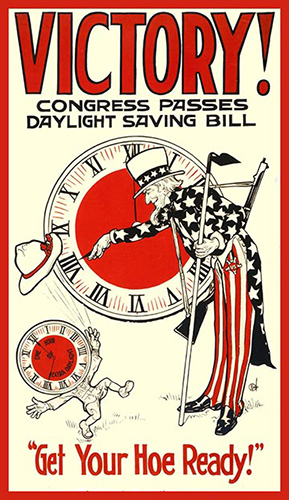
Daylight Savings

Uncle-Sam-Daylight-Savings-Time

So what is this daylight savings time (DST) that went into effect last Saturday? Simply put, as the days start get longer, we set our clocks one hour forward in the spring and set them back one hour in the fall. But we didn’t always have daylight savings time here in the US and in fact it has a pretty controversial history.

In 1784 Benjamin Franklin came up with an idea as a way to save money on candles only he didn’t want to change the time but the time people wake up. His idea? By firing cannons to wake people up! How’s that for a wake up call!

Actually the first implemented DST was done by the Germans in World War I as an energy saving measure. The US followed soon with its own version of DST but was it met with stiff resistance being repealed by Congress within a year of it being put into practice. For the next 5 decades it was up to the individual states to decide if they would practice Daylight Saving which became rather confusing for travelers.

In 1966 Congress passed a bill called the  ‘Uniform Time Act’ which tried to make it unanimous but there were a few state holdouts that refused to participate so in 2005 Congress revisited the law and moved the start date of Daylight Savings Time from the first Sunday in April to the second Sunday in March. There are still some state holdouts such as Arizona, Indiana and Hawaii that don’t observe Daylight Savings Time but overall there is no more controversy over it except in my house where everyone complains of losing an hour’s worth of sleep in spring-except me. I’m happy to have more sunlight at the end of the day so can get off work and still go out in my garden and dream of what will be this gardening season.

2013 SEED LISTS

2013 SEED LIST

Below is the final list for 2013. But first-

Here is the legend where I buy the seeds or plants listed below and their links (I’ve put their initials at the end of each plant listed so you may know which seed company or Santa Fe nursery to purchase them from):
AFN-Agua Fria Nursery (plants)
BHBaker Heirloom (seeds)
SSESeed Saver Exchange (seeds)
TSTerritorial Seeds (seeds)
JSKGJohn Scheepers Kitchen Garden  (seeds)
KSKitazawa Seed (seeds)
WCSWest Coast Seeds (seeds)
CGCooks Garden (seeds)
TFTomato Fest (seeds)
TGTomato Growers (seeds)
TTTotally Tomatoes (seeds)
WBF-Wild Boar Farms  (seeds)
B-Burpee (seeds)

– If you see AG in front of the variety-recommended by Amy Goldman’s Heirloom Tomatoes book
– If you see D at the end of the variety (as in 78D)-that represents 78 Days till harvest
* means NEW VARIETY I’m trying this year

——————————————————————————————–

2013 TOMATOES

REDS
AG/Costoluto Genevese-TG, TF-78 D
AG/Pantano Romanesco-BH-78D
AG/Goldman’s Italian American-BH-80-90 D
Matina-Agua Fria/TG-58D
Original Goliath/pio -TT-65 D
*French Carmello-JS, TF-70-75D
*Marmande-BH-60-80D
*Bloody Butcher-TF,TT-55D

PINK
*Brandy Boy/Burbees-MS BOBBS Recommended-75-80D
*Pink Berkley Tie Dye/BH-65-75 D
*Anna Russian-BH-69-80D
*Pink Boar-WBF-70-80D

YELLOW
*Big Sungold Select-WBF-
*Porkchop-WBF-75-85D

ORANGE
Juane Flamme
-TT-80D
*Orange Wellington-Burbee-MS BOBBS Recommended

BI-COLOR-yellow and red blush
Virginia Sweet-Agua Fria-80D
AG/Gold Medal-BH-75-80D
Galon De Melon (cherry tomato)

PURPLE or BLACK
Paul Robeson-AFN-75-85D
Cherokee Chocolate OR Cherokee Purple-AFN-80D
Black Pear-AFN-70D
Brown Sugar-BH-?D
Black Cherry-75D-AFN
Southern Nites-BH -?D
*Indigo Apple-WBF-
*Black and Brown Boar-WBF-65-75D

GREEN
Green Grape-Agua Fria-70 D
Ananas Noire-Agua Fria-80-85 D (actually a bi-color with green and red blush inside)

CHERRY TOMATOES
Sungold-yellow-AFN-
AG/Black Cherry/ AFN-75D
AG/Green Grape-green/AFN, SSE

——————————————————————————————–

2013 VEGETABLE LIST

ARUGULA-Apollo-SSE (seeds)

BEANS-
Rattlesnake-BH
Tarabais-BH
Fava-BH
Golden Sunshine Scarlet Runner-BH

BEETS-
Craupdine-BH
Cylindra-BH
Touchstone Gold Beet-JS-55D
CHIOGGA-JS-45-55D

BOK CHOY-Extra Dwarf Pak Choy-BH (seeds)

CARROTS
Cosmic Purple-BH
Atomic Red-BH

CHARD5 Color Silverbeet-SSE, Ruby, and Argentata Swiss Chard-JSKG

JAPONICA CORN-Ornamental corn only-beautiful magenta and white stripes on green-beautiful mixed with flowers

PEPPERShishito (Japanese non hot pepper)-AFN (plants) or KS(seeds)

SUMMER SQUASH-ZUCCHINICostata Romanesco (best tasting zuke around)-BH (seeds)

EGGPLANTFairy Tale (best sweet, no bitter taste and soft skin eggplant I’ve tasted)-AFN (plants) or TS (seeds)

CUCUMBERS
Armenian
Lemon Boy-AFN
Poona Kheera-BH
Boothsby Blonde-BH
Bourbonne-BH-50-60 D (I grow cukes for either taste or which variety is best for different types of pickles-all BH)

JAPONICA CORN-Ornamental corn only-beautiful magenta and white stripes on green-beautiful mixed with flowers

LETTUCESProvencal Mix, Mesclun Mix, Buttercrunch, Yugoslavian Red, Santoro Lettuce-CG (seeds)

PEAS
Sugar Snap
Blausschokker Alauws-purple pea-JSKG

SPINACHBloomsdale-CG (seeds) and Tyee

TOMATILLO-Green-AFN (plants) 70-80 days-

JERUSALEM ARTICHOKE

POTATOES-fingerlings also at AFN
French Fingerlings-Irish Eyes
La Ratte-Irish Eyes

————————————————————————————–

2012 GIANT PUMPKINS

To be Announced…
All will come from private growers

————————————————————————————–

OTHER GIANT VEGETABLES

GIANT GREEN SQUASH-all came from private grower-
340 Cabossel 11 which came from 903 Noel 07 (848 McKenzie x self)

GIANT MARROW-(like giant Zucchini)-all came from private growers
75.4 Wursten 09
62 Cabossel 11

GIANT TOMATOES
-7.18 N. Harp 09 (5.58 Timm x open)-private grower
5.416 N, Harp 09 (5.58 Harp x open)-private grower
Big Zac/TT (seeds)

GIANT PEAR GOURD-private grower-
103 Cabossel 11 which came from 89 Scherber 10

LONG GOURD-private grower
-135 Jacobus 10

GIANT SUNFLOWERS
-Titan-SSE, BH (seeds)

—————————————————————————————-

2013 HERBS

Following is a list of herbs that will be planted or exist on the property
Basil (Genevese)-new SHGH (plants), 
Lime Basil-new-SFGH (plants), 
Thai Basil-new-SFGH (plants)
Oregano-must replant rabbits ate it this winter
Thyme-exists
Lemon Thyme-exists
Chives-exists
Dill-usually self seeds
Marjoram-new-SFGH (plants)
Mint-exists
Sage-exists
Lavender-exists
Winter Savory-exists
Lemon Verbena-exists

————————————————————————————–

2013 EDIBLE FLOWER LIST

Following is the list of edible flowers that will be planted or are on the property:
Borage-great honeybee plant
Calendula-Orange King-BH (seeds)
Chives-AFN (plants)
Cilantro-AFN (plants)
Dill-AFN (plants)
Lavender (in existing different area)
Marigold-Lemon Gem-TS (seeds) this is the only edible marigold
Nasturtiums-Tip Top -CG (seeds)-prettiest nasturiums
Pansies-get them anywhere
Violas-get them anywhere
Roses (in different existing area)
Black Oil Seed sunflower (for the birds!)-WCS (seeds)


Soil Testing For Your Garden

Gardeners should consider getting their soil tested to see where their soil is at-if it has adequate organic matter, what the Nitrogen, Phosphorus and Potassium levels are at, what the pH is of their soil, how high the salt content is, and calcium, sulpher, iron, magnesium levels and much more. The problem is we use to be able to give soil samples to our county extension agent and he would send it off to the state lab for analysis but that service is no longer available to us here in New Mexico. You can still get a soil analysis done but will have to send it away.

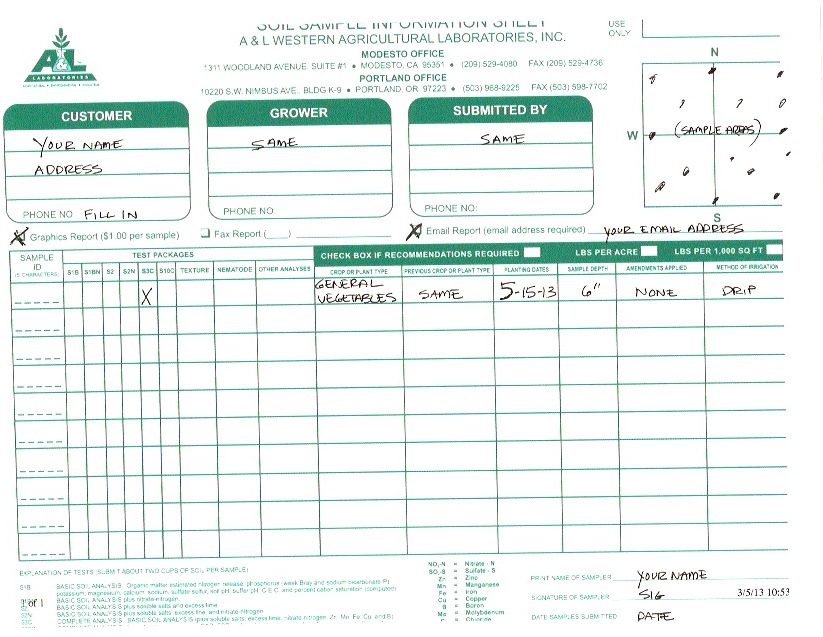
I like A & L Labs in California and have used them before. It was well worth it as I found out a lot about my soil. The first time I submitted samples and the form, I had someone walk me through it as it seems complicated but is not. So here’s how to submit your soil samples to A & L labs. This one is in California but there is another one back east if you like. They offer many different kinds of tests but you only need a soil test.

1. Go to their site http://www.al-labs-west.com/

2. Click on ‘Analytical Services’ . They have many different services but you want the  ‘Soil Analysis’ section.

3. Click on ‘Sampling’ to see how to collect the soil specimens. Follow their procedures and send the samples (I put mine in a big ziploc baggie) to the address listed along at the bottom of the ‘Sampling’ section with the money $35.00. The price may seem a little steep but when you consider how much money we spend on gardening, it is not a lot to find out about your soil.

soil analysis report

SAMPLE-Soil Analysis Report-say what??! I didn’t understand this!

Graphical Soil Analysis Report

SAMPLE-Graphical Soil Analysis Report-I can understand this much better!

4. Then go back and look at ‘Example Reports’. See examples above. I got the ‘Standard Soil Report’ and be sure to get the ‘Graphical Soil Report’I didn’t understand everything in the standard soil test but you have to get it to get the graphical soil test which is easy to read and understand.

Scan

5, Next print out the ‘Submittal Form’ and fill it out.  See example above. Put what crops you are growing and other information they ask for. I just put in general vegetables. Check off  SC3 report (complete analysis-$35.00) and check off Graphical Soil Report-additional-$1.00. (The ‘soil analysis fees’ are in the blue column on the left side of the web page if you are wondering where I got these)

6. Mail soil samples, money and form back to them. Be sure to check off email return on the form as you will get it sooner than snail mail. It takes about a week to get the results after they receive it.

Master Gardener Interns

tomatoes on table

Tonight I taught the Vegetable Class section to the aspiring Master Gardener interns of 2013 and tomorrow will be the second group of interns in the morning. A total of 63 students for both groups which is inspiring to me to see so many people interested in becoming Master Gardeners. To every one of you-hang in there! There are many more interesting classes to come.

I promised to put the class handouts on my blog for anyone interested so here they are:

VEGETABLE GARDENING IN SANTA FE

INFORMATION SHEET

PLANTING SQUASH

PLANTING TOMATOES

I also said I would put a couple of extra handouts on the blog which were not given out in the class but have very useful information on them:

TOMATO DISEASES

COOL-WARM SEASON CROPS

HERBS

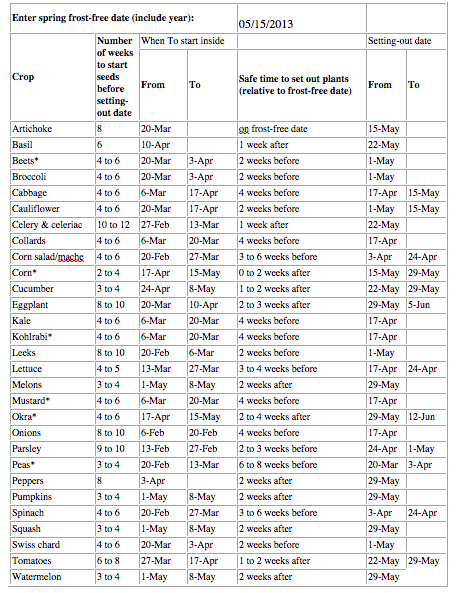
Seed Starting Date Calculator

Below is a seed starting date calculator from Johnny’s Seeds. I downloaded it from the interactive tools section on their home page. I put the date of our spring frost-free date (May 15 in the Santa Fe area) and it automatically put in all the dates from when to start seeds inside to when we can safely put the plants out in our gardens. I just copied the vegetable section here for you to see but it also has many flower planting dates as well-it was just too big to capture it all. If you live in another area or want to capture the flower information as well, then be sure to go to the interactive tool section at Johnny’s to get your own. But here it is for those of you who live in Santa Fe, NM for all the vegetables they list. If you click on the image it will show up clearer and you can print it.

2013 Johnny's seedstarting chart

USDA Plant Hardiness Zones and ‘average first frost free dates’ explained

NMSo what are USDA Plant Hardiness Zones? And what is this ‘first frost free date’ we hear about as gardeners so often?

The Plant Hardiness Zone is a standard set by the USDA (United States Department of Agriculture) and is calculated by accumulating many years of data. Zones are used by gardeners to help determine which plants will most likely thrive in their area. “The maps are based on the average annual minimum winter temperature, divided into 10 degree-F Zones”. There are 13 Zones, the coldest being Zone 1 and the warmest is Zone 13.

In Santa Fe, we used to be in USDA Plant Hardiness Zone 5 but now Santa Fe is in Zone 6b (-5 to 0°F). The reason our Zone has been changed according to the USDA is because it has better models to follow with more information gathered throughout the years- not necessarily because it’s getting warmer (although I do believe that too). Some areas in our county could be Zone 6a (-10 to -5°F) if they are closer to the mountainous areas. If you are not sure what zone you live in (where ever you live) go to the USDA plant hardiness site and type in your zip code and it will tell you what zone you are in-it’s as simple as that. So when you go to a nursery and the plant tag says zone 7-forget about it—it won’t survive our winters but any tag with Zone 6 or lower number should survive.

The average first frost free date is the date that we can safely put plants outside in our gardens. Notice I said average because some years we are colder and some years warmer. You’ll just have to watch the weather closely in spring for deciding if you want to try to sneak them out earlier in your area if spring appears to be a warm one. In Santa Fe our first average frost free date is May 15. So plant away outside after May 15, unless you hear we are getting a hard freeze! Of course if you are starting them in a hoophouse or greenhouse, you can start seedlings much earlier.

Now, once you know your planting zone and first frost free date, you can use the many tools available on the web for calculating all kinds of things from seed starting to succession planting to harvest times. Many seed companies have web tools to help you calculate the dates. In my next post I will show one such tool I use.

Why start vegetable seeds inside?

transplanted tomatoes

Why would any of us bother to start seeds when we can go to nurseries to buy the plants. Well, I do both. I can only speak for myself but I have grown all kinds of unusual vegetables that I couldn’t find at the nursery and I like to try something new and different every year. Besides being ‘The Tomato Lady’ here at the Santa Farmers Market, I really like to try some new heirloom tomatoes every year along with my tried and true varieties. Every year some new variety gets on my ‘all-star’ list at the end of the season while others don’t make the cut. In fact in some years, many don’t make the cut-I’m picky as hell about my tomatoes. If I don’t like them I don’t grow them again. Luckily, I like many tomatoes but they’ve got to taste good!

Some of the unusual varieties I have tried and loved eating are Atomic Red carrots, Cosmic Purple carrots, Craupadine Beets, Tarabais beans, Rattlesnake beans, Emerite beans, Fava beans, Parisian cucumbers, Poona Kheera cucumbers, and about 25 different varieties of heirloom tomatoes (too many to mention). None of these are sold as plant starts in the nurseries but you can buy some of the seeds at the nurseries and some seeds you have to order online.

Have you ordered your vegetable seeds?

seed catalogs 2011Looking through all the seed catalogs and planning what you’re growing next year is fun to do in winter. Now is the time to order your vegetable seeds if you haven’t already done so. Seed starting will soon be upon us! Many cool season crops can be started inside soon (some now) and put out in March and warm season crops can be started from seeds inside 6-8 weeks before the first frost-free date. Hard to think about starting any seeds when the weather is cold, windy and ugly but it is almost here. I have ordered some seeds but still have to get some and already feel a little behind.

If you are not one to start seeds inside, that’s ok-just wait till the nurseries get their transplants out later this spring and let them do the work for you. And don’t be afraid to buy transplants. I once was told you’re not a real gardener unless you grow everything from seed. Bull@#$%! Out here we need all the help we can get so I’m not against buying plants from nurseries at all. Besides I like supporting our local economy as well. So I grow some vegetables from seeds and buy some from the nurseries. What matters is that you get out in your garden and enjoy yourself and the fruits (or vegetables) of your labor.

Ground Hog Day 2013—Phil the Ground Hog predicts global warming-no more winters ever!!

Phil predicts an early Spring amid turmoil

Phil the ground hog predicts global warming

Phil the Ground Hog predicts global warming-no more winters ever!! But did you know..

Phil the Ground Hog, as we all know, has a little bro, Bobbi, who two years ago was involved in a big riot on Ground Hog’s Day when Phil was coming out (yes he’s gay and single Jody) of his ground hole to predict the weather for 8 weeks. Since then, after the repression of the Da La Lamba (turns out Da La Lamba was actually interested in Phil), things had been quiet until this year.

Phil's little brother Bobbi

Phil’s little bro-Bobbi

This year it was discovered that Bobbi who is originally from Ireland and recently moved back there, is actually the son of Wayne La Pier-cee! Rumors have swirled for years that Phil was gay (born of royal descent) and now this about Bobbi! Wayne came over years ago to Ireland to help the IRA (Irish Republic Army) get their guns and had an affair with Bobbi’s mother. No wonder Wayne is against extensive background checks! He doesn’t want anyone to know his background! Now this explains why Bobbi loves his guns so much and unwilling to give up his assault weapons! Bobbi has meanwhile been storing up a huge arsenal of guns, assault weapons and ammo because he knows that there is a big movement to ban them in America and is afraid it will move across the big pond. He can’t swim but knows those crazy Americans are always trying to set some new record swimming across the big pond and knows they will someday secede (opps I mean succeed). And some (notice I said some) of them just might secede like those gun toting Texans! Maybe they’ll go join up with Bobbi. Meanwhile Bobbi has installed armed guards in every ground hog school to protect his kind from those crazy varmits in America who know it is their god given right (really? I don’t remember reading that in the bible) to bear arms (legs and tails too). Opps, I’m wrong-it’s their Constitutional Right! But that’s ok, cause they’re always getting religion mixed up with their politics in America. And did you know that before ground hogs predicted the weather, hedgehogs predicted it? Yes, it’s true! But that’s another story for another day…

PS—Every winter I get delirious from lack of gardening and write these whimsical stories on Ground Hog’s Day when I really rather be out digging (like a ground hog). Still gotcha? Wanna read more? To read more on Phil the Ground Hog and his little bro Bobbi, go to my previous posts from the beginning of my delirium-The real story of Phil the groundhog! , Phil the groundhog continued..Possible Coup Coming on Ground Hog Day in 2011 and Ground Hog Day 2011-Phil Predicts an Early Spring -Fierce Battle Takes Place Before Ceremony .

For more interesting and maybe factual reading on the ground hog go to ‘What’s Your Ground Hog Day IQ’

DISCLAIMER: All names have been changed to protect my innocence.

10 more things to Do in February For the Garden

We may not be able to get out in our gardens now but it is time to get busy with things to do to get ready for the garden. March will be seed starting time and there will be lots to do before for that. I will be elaborating on some of these items over the next few posts as I see there is more info I can offer.

1. Go over your current seed supply. Organize it. Get rid of any seeds over 3 years old unless you froze them. Fresh seeds are essential for good germination. Older seeds have less success of germinating.

2. Decide which vegetables you want for this year and order any seeds you may need to get from seed catalogs.

3. Talk to your local nursery to see what they might be growing this year. I give a list to mine and they tell me what they are growing so I don’t duplicate. I prefer to let them do the growing, it’s just that I want to grow so many varieties that they might not have so I have  to start some by seed.

4. Stock up on any fertilizers, amendments, compost, nutrients, mycorizzial, and biomicrobes you may need for veggies. i.e- tomatoes, giant pumpkins

5. Check your grow light boxes to make sure they work. Get new bulbs if necessary.

6. Check grow heating mats to make sure they work and get more if necessary. Last year I had one and ordered another as my seed growing expanded.

7. Consider purchasing a seed mat thermostat. Last year I had to get one because the seed heating mats were running too hot and burning up the seeds before they have a chance to germinate. The mats stay 10° F hotter than the ambient temperature of the room so if we are having a really warm spring and the temperature is 80° F inside than the temperature would run 90°F in the seed flats-way too hot. The thermostat will keep the temperatures in the pots at whatever is best germinating temperature.

7. Purchase soil seed starting mix. I use Metro Mix 100 to start seeds. This stuff is great. The water doesn’t roll off the ‘dirt’ like many seed starting soils

8. Clean and sterilize any containers you plan to reuse for seed starting or transplanting seedlings. Use a 10% bleach to water ratio to rinse off the containers.

9. Buy any containers you may need for seed starting/transplanting. Most gardening stores sell up to 3″ in the peat pots. If you want a 4″ peat pot, go to Territorial Seeds. They are the only ones that have that size. I need them for my giant varieties cause they grow so fast. I also like the flats that have a raised lid. good for germination.

10. Read at least one good gardening book your interested in each month during the winter. I’m almost finished with ‘Four Season Gardening’ by Eric Coleman and just ordered ‘The Compost Tea Brewing Manual’ by Elaine R. Ingham.

Growing Tomatillos

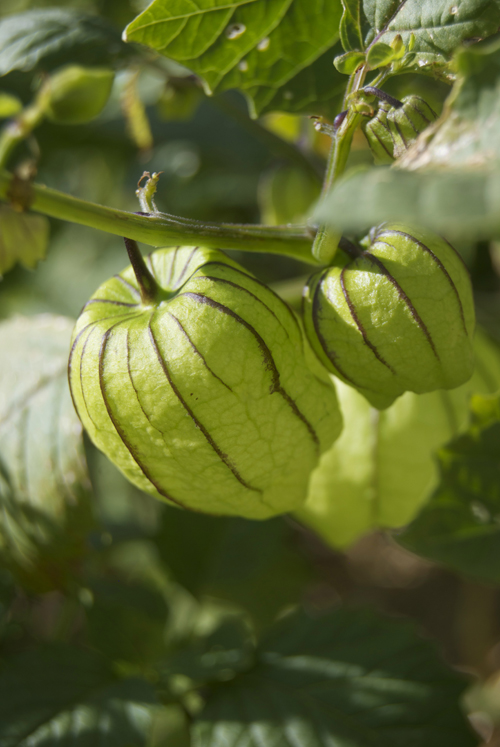
tomatillo husksTomatillos originated in Mexico and are a staple food there. They are part of the nightshade family. Growing tomatillos was new to me this year but thought I’d try them as I like green tomatillo salsa.  It has an almost citrusy flavor-kinda zingy on the tongue. When I first researched them, I read all kinds of things like, you need two plants for pollination, you only need one plant for pollination, they attract bugs, they don’t attract bugs and so on. For every thing someone would say about them, there seem to be the opposite said as well. The one thing everyone seemed to agree on is they take up some space-about 3 feet.  So here’s my one experience with them. In early June I bought one tomatillo transplant and put it in the ground outside after the chance of frost here. I grew the green tomatillo variety but I think there are several other varieties including a purple one.  I didn’t have any trouble with pollination and didn’t do anything to encourage it-it just happened. I really like the papery husks they grow in-they are beautiful with their bright green color and purple veins. Once they self pollinate, they start to grow inside the husk and eventually the fruit fills the husk. I picked it just after the husks split revealing the hard green fruit inside (about the size of a ping pong ball), but some people wait till the husks dry out and turns brown before picking. I will grow only one plant again because it was soo prolific. Also it is an easy keeper in that nothing seemed to bother it much. I had so many fruit from that one plant that I took a bunch of them to the Farmers Market and sold them. I agree they do take up about 3 square foot space per plant and I did have it staked for a while but then I just let it sprawl on the ground a little. It tastes great chopped up in a guacamole sauce for chips as well as in a tomatillo salsa. They refrigerate well for weeks before using them. I enjoyed them and will grow the again!

Tomato Porn

This slideshow requires JavaScript.

Feast for the eyes!

Gardening in the Winter

squirreleating nut

It’s always good to get a GMO rant going and it’s such an appropriate subject for gardeners and just about anyone who eats-but now back to gardening! My gardening in the winter basically consists of looking over my seed catalogs by the fireplace. I’m an armchair gardener in the cold winter months-storing up gardening info like a squirrel and juicing up energy for the next season! Visualizing the coming year’s garden in my mind’s eye is a favorite activity I like to do along with reflecting on last year’s garden and what I might do differently. I got a garden planning application which is fun to start placing next year’s veggies in the garden.

I actually went down this week (while it was in the 50’s) and swept out the garden shed and put away a few garden tools that I found out and about and I found my compost thermometer! Ah ha! I’ve been looking for it since last fall and there it was hiding above the door frame of the garden shed-why would I ever put it there?!

Oh yea, I finished watering the fruit trees so everything is watered for a month, went on a 3 mile hike with some friends and I can’t forget we’ve been getting ready at work for our big art show in Philly in February. I guess I’m not a complete sluggo!