Seed Starting For Early Spring Crops-Class handouts

The Seed Starting For Early Spring Crops class that I taught today was sponsored by one of the organizations I’m a member of called Home Grown New Mexico. Home Grown New Mexico puts on many classes about growing, raising, making and preserving your food throughout the year. They are about sustainability, urban farming and growing organically which is right up my alley and the classes are open to the public. If you’d like to see what other classes/workshop Home Grown New Mexico is putting on, check out their website homegrownnewmexico.org.

Now, here are the handouts if you weren’t able to make the class or if you didn’t get them as we ran out of them during the class today-it was definitely a full house with about 35 people attending. It was a good mix of Master Gardeners, Interns and the public that attended. I really like to teach when you all show up! Hope you learned something and enjoyed it!

Starting Cold Hardy Plants in Early Spring Inside-2014

seed germination chart

PRESPOUTING SEEDS

Cold hardy crops for early spring in March-April

COOL-WARM SEASON CROPS

Seed Starting For Early Spring Crops-Sat. March 15

coldframe crops

Saturday, March 15
Seed Starting For Early Spring Crops presented by Home Grown New Mexico
How to start seeds early for cool season crops
Time: 12:30 pm-2:30 pm
Instructor: Jannine Cabossel
Location: 3229 Rodeo Road (Rodeo Grounds/Large Annex building classroom)

Jannine Cabossel, a Master Gardener and ‘The Tomato Lady’ at the Santa Fe Farmers Market will teach a class on the basics of seed starting in spring for early crops: indoor seed starting for your spring garden, outdoor requirements for successful seed germination and basic indoor/outdoor seedling care. By starting seeds indoors in early spring you not only get a head-start on your year’s food production by protecting your crops from Santa Fe’s finicky spring climate, but you also get more time with your hands in the dirt. Many new tips this year plus learn varieties that do well in our cold climate.

Jannine has extensive experience in growing vegetables on her 3000 square foot garden using all organic methods. Follow her blog at giantveggiegardener.com. This class free! Become a 2014 Member for $35—includes all classes, potlucks and tour.

Spring has sprung! (well almost)

lettuce_greenhouse germinating

This lettuce is from Johnny’s called All-Star Gourmet Lettuce mix coming in the greenhouse.

In celebration of my FIRST CROPS coming up in the greenhouse, I’ve changed the background color on my blog back to green from winter blue. In my mind, winter is over although not officially – that won’t take place till the first day of spring on Spring Equinox on March 20 and of course we can still (will) get snow. No matter. I’m ready! I’m moving on and planting stuff (in the greenhouse). What kind of stuff? Read on to find out!

bok choy_yellow green

These are a golden yellow pak choi (shakushina) from Kitazawa. They’re already a great yellow-green color and will make a wonderful contrast to the tatsoi.

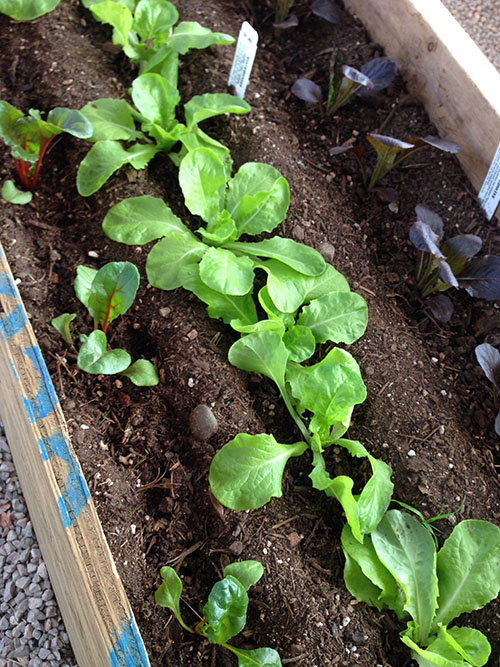
These first crops took about 12 days to germinate-they actually came up on March 1 so they were planted on Feb 17th. They are all still tiny but coming up nicely. The top picture is a lettuce mix from Johnny’s called All Star Lettuce Mix that’s suppose to grow out evenly. The second picture is a golden-yellow pak choi (shakushina) from Kitazawa. Also from Kitazawa are Pak Choi rosette (tatsoi) and white stem dwarf pak choi (both not shown). These were all recommended in Elliot Coleman’s book, Four Season Harvest (except the golden-yellow pak choi which I couldn’t resist because of the color). According to Elliot Coleman they all do well in cold greenhouses.   I have winter weight row cover over them now to protect them at night. I also planted Winter Bloomsdale spinach from Southern Exposure Seed Exchange at the same time and it’s coming up way slower but the first 2 seedlings broke ground yesterday, on March 3.

Ah, spring has sprung-and we got rain this week! What could be better?! I’m also going to plant transplants this week to see how they do in comparison to the seedlings. I’ll get pics later on that one.

What unusual vegetable seeds are you trying this year?

seeds

I’m always interested in what unusual seeds people are trying (or have had success with).  So I’m sharing what seeds I will try, where I got them and I hope some of you will do the same. For a complete list of all my crops for 2014 go here.

2014 unusual seeds that I will try:

African Bushel gourd-big round gourds the size of a bushel basket! Suppose to be good to use as containers after they dry out. You know me and giant things!

White Egg gourds-from Southern Exposure Seed Exchange-small egg gourd-looks like white chicken eggs-sounds like fun! Now I can pretend my old girls are still laying!

Tarbais beans-from Baker Creek Heirloom Seeds-a pole bean that you dry out and cook for bean stews, soups and cassoulets. More delicate flavor than navy beans. These use to be hard to find in the states but thankfully Baker Heiloom Seeds has carried them for 2 years now.

Eyesines de Galeux-from Baker Creek Heirloom Seeds-a salmon warty winter squash that tastes divine. The more ‘worts’ the sweeter it tastes. More worts=more sugar in it.

Sweet Meat-Another great winter squash-so sweet you don’t have to add anything to it to sweeten it. Also a great keeper-I just finished eating our last one in February.

Peredovik sunflower seed– from Southern Exposure Seed Exchange-this is the black oil sunflower seed that your birds eat in bird seed food.

Jimmy Nardello pepper-a red ‘chili’ looking pepper but sweet-from Southern Exposure Seed Exchange-a sweet long red pepper delicious when sautéed.

Bullshorn (Corno Di Toro) pepper-a red ‘chili’ looking pepper but sweet-from Southern Exposure Seed Exchange-another sweet long red pepper delicious when roasted or sautéed.

‘Canoncito’ landrace red hot chili pepper-This one I got from the Santa Fe Farmer’s Market and is a local seed from north of Espanola.

Charentais melon-from Baker Heirloom Seeds-one of the most flavorful melons from France or so they say.

Purple Bumblebee tomatoes-from Baker Heirloom-small purple and green striped larger cherry tomato. Part of the new Artisan tomatoes out this year.

Round Black Spanish radish-from Baker Heirloom Seeds-I got one from our local organic market and it was delicious so I’m gonna try them this year.

Craupadine beets-from Baker Heirloom Seeds-one of the ugliest but sweetest tasting beets ever-from France.

Winter greens for the greenhouse or early planting outside

I can’t wait anymore! I got this newly completed greenhouse and am antsy to try it out. I’ve done a lot of research on which plants might do well in the winter and am ready to rock n’ roll! So I am planting cold hardy seeds this week inside the house. I will transplant them into my new greenhouse when they are bigger. I’m also going to try some direct seeding in the greenhouse in the raised beds like arugula, spinach, kale, baby bok choi and mache in mid-February-all of which can handle some pretty cold weather. How cold? We will see soon although you wouldn’t know it by this week. I will also plant other greens like some winter hardy lettuces, peas, and a winter hardy variety of chard called Argentata at the end of February-beginning of March. Everything planted in the greenhouse will have to have row cover over it even in the greenhouse at this early date because of our cold nights. For those of you who do not have a hoophouse, or cold frame, the seeds in the list below will do well outside only you have to wait a little longer.

Here is my list of cold hardy crops to try in the greenhouse. You can also plant these outside in March once the soil is not frozen and cover them with row cover:

From Johnny’s Seeds:
‘5-star greenhouse’ lettuce mix
‘Space’ Spinach

From Southern Exposure Seed Exchange:
‘Even’ Star’ Winter Arugula
‘Winter Bloomsdale’ spinach

From Kitazawa Seed Co:
‘Mei Qing Choi’ (dwarf pak choi)-recommended in ‘Four Season Harvest’ by Eliot Coleman
‘Tatsoi’ (pak choi)-recommended in ‘Four Season Harvest’ by Eliot Coleman
‘Golden Yellow’ pak choi
‘Astro’ arugula

From The Cooks’ Garden:
‘Red Grenoble’ lettuce
‘Forellenschluss'(speckled trout) lettuce
‘Rouge D’Hiver’ lettuce-recommended in ‘Four Season Harvest’ by Eliot Coleman

From John scheepers Kitchen Garden:
‘Argentata’ Chard-recommended in ‘Four Season Harvest’ by Eliot Coleman

From Agua Fria Nursery: transplants ready to plant
mache (corn salad)-recommended in ‘Four Season Harvest’ by Eliot Coleman
endive-recommended in ‘Four Season Harvest’ by Eliot Coleman
‘Winter Wonder’ lettuce
‘Marshall Red’ romaine lettuce

It took a village to build my greenhouse!

final greenhouse

I haven’t posted much about the greenhouse I’ve been building but now that it is basically done (I still have a few more things to do) I want to share the greenhouse raising from the ground up and give thanks to those who contributed with their time, labor and knowledge. It has truly taken a village to build it! It all started in January of 2010 and has taken 3 years to complete it. Many, many thanks to the following people:

First, thanks to Caleb for coming out in January 2010 and jackhammering the holes out to set the posts. I was hoping to get it done back them by spring of 2010 so I wanted to get an early start-what a dreamer I was… 3 years passed because of everyone being sooo busy with other things (including me) and then this year in 2013 the magic happened.

Thanks Lava for helping me make it gopher proof, mouse proof, putting down the weed cloth, unloading the gravel for the floor and much more I’m sure I forgot about. Thanks Jacob, (Lava’s son) who generously put in 2 days of work on it when he was here visiting his mom earlier this year.

Thanks Elodie for helping in various tasks including putting the headers up in the framing, window framing, gopher proofing the raised beds, putting the sink in and much more as well.

And a big thanks to Tom Rivers. Without him I still would be at the beginning stages. What can I say about Tom? He is a great friend who came over week after week every Friday on his day off this year and with his constructions skills actually made it happen. Together we were able to build it or I should say I helped him build it. Both him and I are a lot alike-we became obsessive about building it, like dogs with their bones and we wouldn’t let go of it till it was completed. Truly a labor of love. Thank you thank you Tom!

I am now putting on the finishing touches and buttoning it up for winter to see how warm I can get it inside at night using passive methods-more on that later…But for now here is a pictorial on building it.

This slideshow requires JavaScript.

Curly Top Tomato Virus and Beet Leaf Hoppers

Photo credits: curly top disease - photo courtesy of http://ucanr.org/blogs/blogcore/postdetail.cfm?postnum=3352

Photo credits:
curly top disease – photo courtesy of http://ucanr.org/blogs/blogcore/postdetail.cfm?postnum=3352

Curly Top Tomato Virus
Last year, the Beet Leafhopper which transmits ‘Curly Top Tomato Virus’ was rampant in our gardens and devastated many tomato plants. I lost 50% of my tomato plants. The Beet Leafhopper flies in on the winds in early June through July, jump on the tomato plants and taste them. They don’t even like to eat tomato plants but sample them, transmitting the disease in the process.

Identifying Beet Leafhoppers
You will know if they are here as they come in waves and when you walk around your garden, you’ll see a lot of jumping  little green bugs that fly off when you walk by. Then they leave—flying to the next garden. Because of this, you can’t really spray anything to get them—here today, gone tomorrow. By the time you notice something is wrong with your plant, they are long gone. It takes about 2 weeks for symptoms to show up.

Symptomscurly top virus_helthy plant
Your tomato plant leaves will start to curl and the underside of the leaves will turn a purplish color The leaves then start to wilt and the plant will look stunted. You might think it needs water but it doesn’t, it is sick and won’t recover. ‘Curly-Top’ is only transmitted from bug to plant is NOT transmitted from plant to plant hence you will see a healthy plant next to a sick plant.

Remedies
There is NO CURE for this virus and if your tomato (or pepper for that matter) shows signs of the disease, you should pull the plant. You could leave the plant in BUT if another wave of leafhoppers come by and a healthy leafhopper bites your sick plant, it only takes 10 minutes in 90°F weather for it to be able to transmit the disease to one of your healthy plants. The best thing to do is pull any sick plant and dispose of it.

Leafhoppers do not like shade and if your plants are partially shaded, that may help keep them off but since most of us grow tomatoes in full sun that might be difficult.

Create a physical barrier with row cover

Row cover over the tomato plants in my garden

Another thing you can do is create a physical barrier between the bugs and your plants. This year, I’m covering my tomato plants with row cover until the bugs pass. Wrap the row cover around your tomato cage and put a piece on top of the cage BEFORE they come.

Lastly you could put out some tomatoes later in the season after the bugs leave. Last year when I was out at the Santa Fe Community Garden I noticed many rows of sick tomato plants but one row of perfectly healthy plants and when I asked about them, it turned out they were put out about a month later than the rest of them and by then the leafhoppers were gone.

Dry, sunny, windy weather are perfect conditions for the leafhoppers so look out this summer-conditions are ripe again!

The importance of mycorrhizal fungi in the garden

photo courtesy of Mycorrhizal Applications, Inc.

photo courtesy of Mycorrhizal Applications, Inc.©. They have more inf on it.

I first heard about mycorrhizal (pronounced my-cor-hi-zal) fungi through my giant pumpkin grower friends. They started using it before most people in the community knew what it is. When I was becoming a Master Gardener, I asked one of my instructors about it and was told it he didn’t know much about it and that it wasn’t proven. So what is this ‘fungi’ that is proving so helpful for plants?

Mycorrhizal fungi are important components of soil life and can be found naturally in undisturbed soil. But when we till, or dig up the soil to garden, we disturb this soil life. Mycorrhizal fungi live on the roots of plants and have a mutualistic relationship with the plant’s roots. To explain it simply, the plant says, “I need water, I need phosphorus, I need resistance to diseases” to the fungi and the Mycorrhizal fungi says, “Ok, I can bring that stuff to you through my hyphae but I need sugars to survive” and the plant feeds it sugars. So they benefit each other. Mycorrhizal fungi cannot live without the plant’s roots so we should be sure to use it close to the roots where it will colonize.

When I had some problems a couple of years ago with some tomato plants, I send off  two plants to our state lab see if there was anything wrong with them. The guy at the state lab called me to tell me there wasn’t anything wrong with the plant except they had been exposed to some herbicide (Roundup) an were showing some damage but he did tell me my root systems were huge and asked what did I do and I told him I added mycorrhizal to the soil at the root zone.

We can inoculate the soil with Mycorrhizal fungi by two ways:

1. I put Mycorrhizal fungi granules (RTI brand) from ExtremePumpkinstore.com in the bottom of the hole lightly mixed up with some soil when transplanting. Make sure the granules come in contact with the plant’s roots. I use this on all my giant pumpkins and squash but have also used it with my tomatoes. It is expensive though.

2. I drench the soil after transplanting with a solution of Fox’s Bushdoctor Microbe Brew which contains different kinds of Mycorrhizal and beneficial soil bacteria as well. This stuff works great as you only have to water it in once when you plant to get it down to the root zone. It is much cheaper too. Both of these ingredients can be purchased through the internet and Microbe Brew can be purchased locally at a hydroponics gardening store called All Seasons Gardening ((505) 438-4769) located off Rufina at 1228 Parkway Dr.  here in Santa Fe. Call for availability.

You can find more detailed info and other mycorrhizal products online at Mycorrhizal Applications, Inc.©

Wall of Waters 101

I think Wall of Waters are one of the best early season aids for tomatoes and peppers in cooler areas of the country acting like little greenhouses keeping the plants warm at night, protecting them from our ferocious winds in spring and for getting a great head start for growth but they can be hard to put up around the plants especially if you are trying to do it yourself. I have another post addressing what amendments I use when planting  and how to plant tomatoes  but this primer is about wall of waters. You can still use wall of waters right now as the nights are still very cool for tomatoes and peppers.
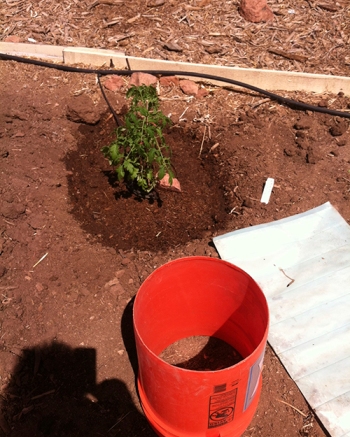
1wow begin by watering

Here is the planted tomato with a big well around it. If the well isn’t big enough than the wall of water will sit lopsided. (I still had to put the drip line around the plant BEFORE I put the wall of water on it). Notice the green wall of water on the ground and the 5 gallon bucket. Some tomatoes are too tall for the bucket so I cut off the bottom of this 5 gallon bucket, first using a drill bit to drill a hole big enough so my sawzall tool could get inside and cut off the circular bottom. The bucket can go over the plant without smashing it over tall tomatoes.
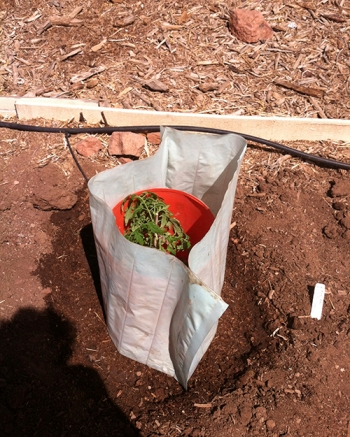
2wow placing over bucketPut the bucket over the plant and then slide the wall of water (henceforth known as WOW) over the bucket.
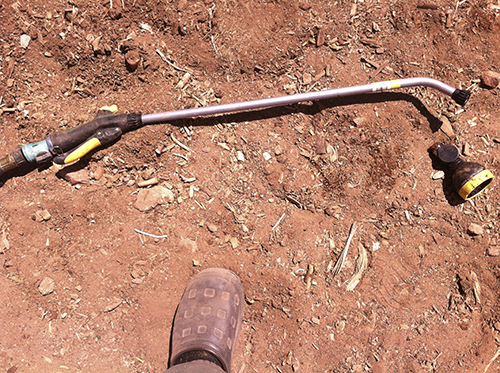
3wow waterer

Another great tool for filling the WOWs is this watering wand. I like this one because it has an on-off switch and a lever for control of how fast the water comes out. Here I took off the end so it will fit easily inside each cell. (this is my favorite gardening shoe-can you tell-well worn?!!)
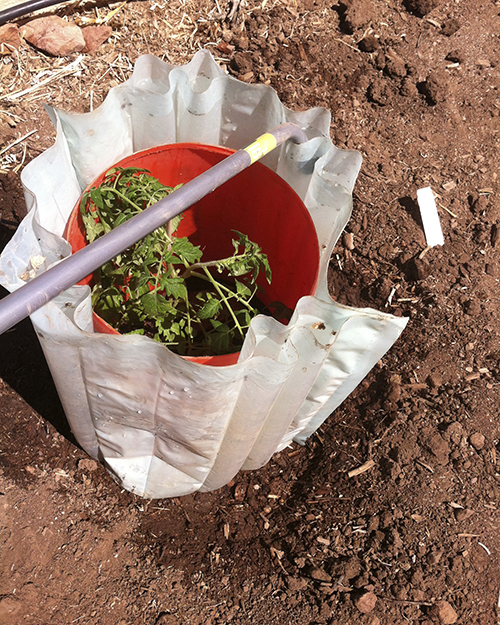
4wow-begin filling

Now put the wand into each ‘cell’ and fill with water. The 5 gallon bucket will keep the WOW from falling on the plant.
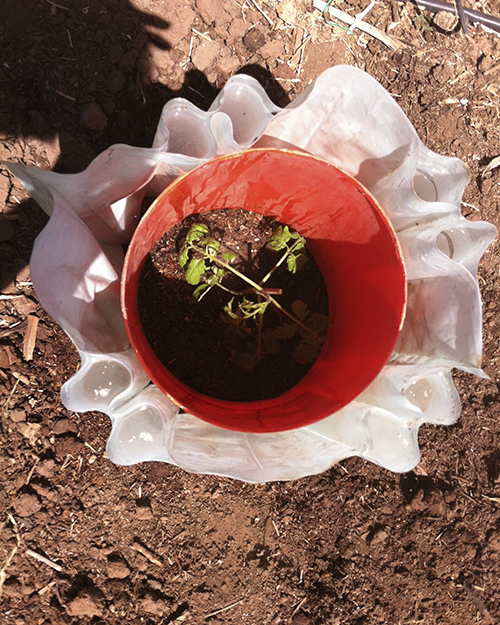
5fill cells each side

Fill a couple of cells, then go to the OPPOSITE side and fill a couple of cells and do this on all 4 sides instead of starting on one cell and going around where it will have a tendency to collapse. This will help the WOW to stand up better as you fill up the cells.
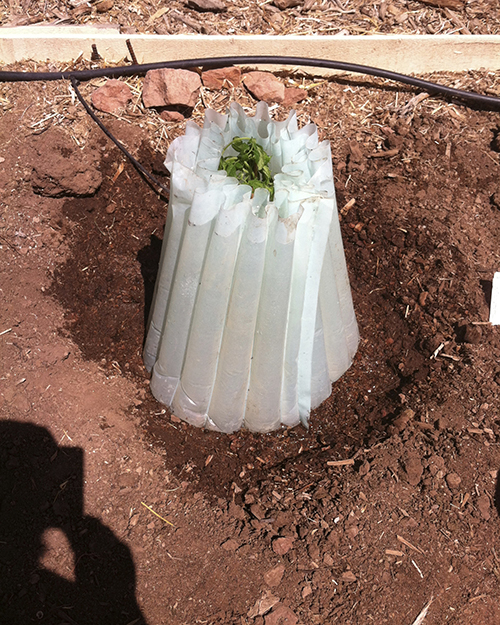
6wow finished

After filling all the cells, reach in a pull the 5 gallon bucket out and the WOW will now support itself. A perfect little greenhouse. But sometimes…
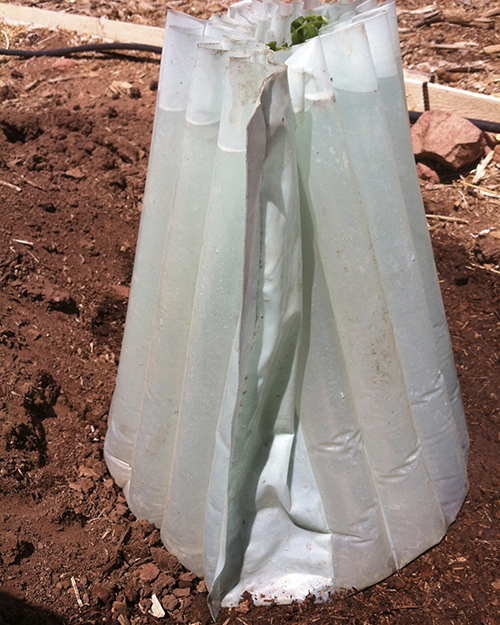
7wow REPAIRED

a cell will get a hole and leak after the WOW is a few years old. This is a problem as the WOW needs every cell  full to support itself, so…
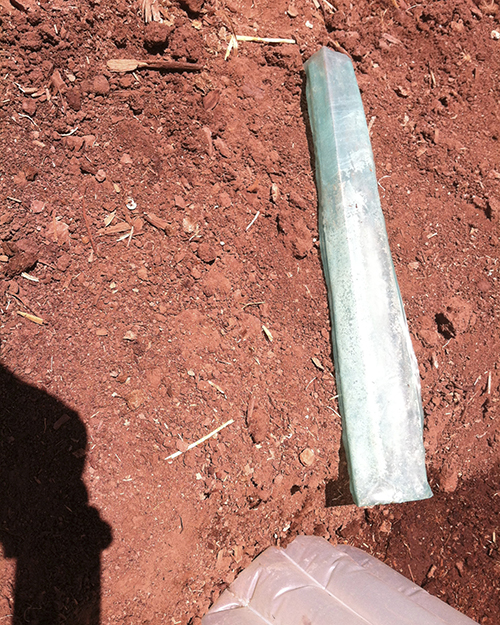
8wow replacement cell

So you can buy replacement cells or make your own. Just take that leaky WOW and cut some good cells out of it for use as replacement cells for other leaky WOWs.
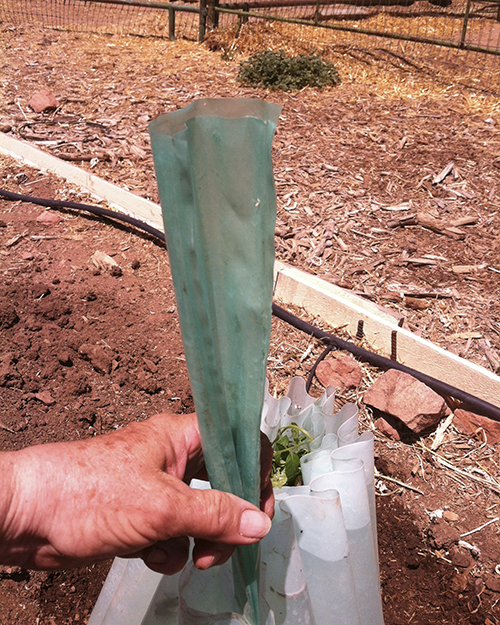
9wow installing rep cell

Take your replacement cell and fold it lengthwise in half as shown and slide it into the cell where the water leaked out.
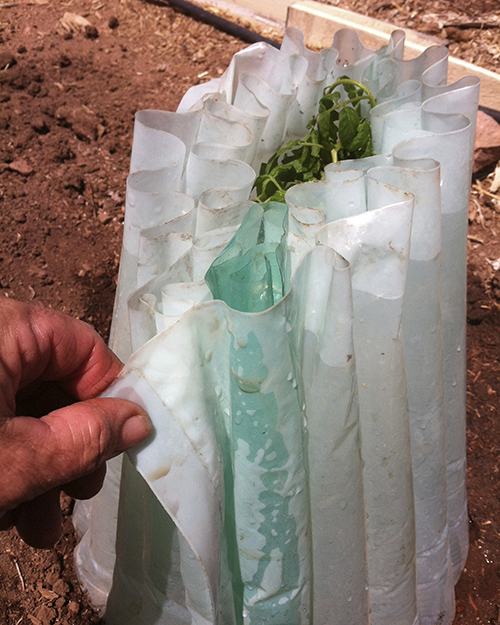
10wow w replacement cell

Then fill up the replacement cell with water and it will hold up that cell. Now one last thing…
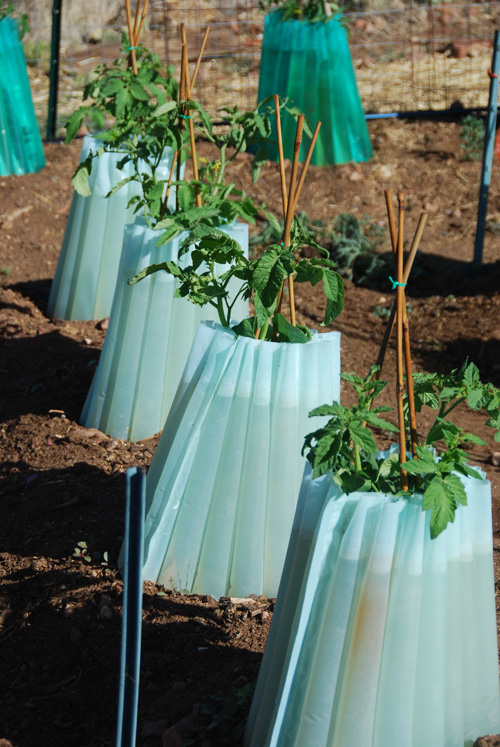
11wow finished with stakes

I put 3 bamboo stakes inside the WOW’s right next to the walls and make a tee-pee out of them and tie them together at the top in case the WOW wants to collapse from the wind, the tee-pee will hold the WOW up so it doesn’t crush the plant. These plants have been inside the WOWs for a while and I will take off the WOWs now. Just grab the WOW on opposite sides and pull them off the plant and dump the water back in the wells.
44 tomatoes planted today!

This slideshow requires JavaScript.

Phew! What a day. Three of my friends came over this morning and all together we planted 44 tomato plants from 8:30-12:30! What a bunch of busy beavers! Janet started out the morning before the others came and screened all my vermicompost and filled three-5 gallon containers. Then Lava showed up and Janet and her put in all my amendments in each hole (I had previously dug out most of the holes and Bob Z came by yesterday and finished digging them for me-another great friend)! Then today, I could barely keep ahead of the girls, me setting out plants, making sure each plant had a drip to it, name tags, map of all the tomatoes, providing stakes and wall of waters while Lava planted them and Mernie and Janet followed up behind putting the wall of waters on all of them. Then we all had other things to do and off we all went.  A wonderful day to plant- not too windy and not too hot-it was overcast! A huge thanks to Lava, Mernie and Janet for helping me today and to Bob for helping me yesterday-would of taken me days to get that far. It takes a village to do this much! Mucho gracias!

Giant pumpkin seeds planted inside-It has begun!

JC and MAX

This year I’m planting 4 seeds for me and 2 for my giant pumpkin/squash class later this month. I planted them in 4″ peat pots and they are on a heat mat set at 80°F  under grow lights until they germinate. Here is the 2013 lineup:

895 Grande 08 – 1016 Daletas x 1385 Jutras-this seed became the 2011 NM State Record
1011 Hoffman 10 – 1446.5 Werner 06 x 1180.5 Pukos 07
1111 Sawtelle 08 – 1556 Werner x sibb
1308 Todd 10 – 50 Todd x 901 Hunt- 2010 CO State Record
Three of these seeds are from Colorado and one seed from Wyoming.

So let me explain what each name means for those of you interested in giant pumpkin growing as each seed name gives important information.

Let’s take the 895 Grande 08. This seed came from an 895 LB pumpkin and the grower’s last name is Grande and was grown in 2008. The rest of the information is the genealogy of the 895 Grande that I’ve provided. So 1016 Daletas was the mother plant and was a 1016 LB pumpkin and the grower was Daletas and no year given. The father plant (pollinator) was 1385 Jutras. So this pumpkin weighed 1385 LBS and the grower was Jutras with no year given.The reason you should go back and look at the parents is you can see that the 895 came from some huge pumpkins.

The 895 Grande produced my NM Giant Pumpkin State Record of 448 LBS back in 2011. Last year I grew the 448 Cabossel 11 (nicknamed MAX) but didn’t break my previous record so I’m going back to the parent 895 Grande to try again. My record gotten broken last year. The current record is 530 LBS  so I’ll try to regain the State Record this year! Notice I’m also growing seeds from much bigger pumpkins as well but with our short growing it is very hard as I lose about a month of time other growers get. Wish me luck!

Soil temperature is Important When Planting Tomatoes

TOMATO COSTOLUTO

Now is the time to start planting our tomatoes and other warm season veggies outside in our gardens. So often we concentrate on only the air temperature to decide when to plant these crops but the soil temperature is actually just as important. Tomatoes should be planted when the soil temperature reaches a minimum of 60°F in the daytime. If you plant too early in cold soil, tomato (and pepper) seedlings sulk and will not be happy. Root development is very slow and the roots have difficulty absorbing nutrients. The plants could show phosphorus deficiency which shows up as stunted plants with purple leaves on the underside. If your plants get this, top dress them with some powdered rock phosphate and water in.  Nothing is gained from planting too early in the ground. This may account for why we always seem to get the bulk of our tomatoes in August and not earlier when planted outside no matter when we plant. The tomatoes will just sit there until the soil temperature is optimum.

To measure the soil temperature, use a soil thermometer. I prefer using a compost thermometer because they are much longer, usually around 24″ and can be used to check both the temperature of my compost pile and the soil in my vegetable bed before I plant tomatoes. Remember to push it in deeper into your bed as the tomato plant won’t be in the top 3″ but more likely planted deeper where the soil is cooler. I find the short soil thermometers just aren’t long enough to measure the soil temperatures more than about 5 inches and quite often I plant tomatoes much deeper. I got my compost thermometer online but I recently saw some at Payne’s Nursery here in Santa Fe.

To warm up soil sooner, you can put black plastic over the bed to pre-warm the soil. I use black plastic garbage bags that I tack down with rocks. That way I can reuse the bags later instead of buying a roll of black plastic. Leave it on for 1-2 weeks and take the temperature to see when the soil warms up to the optimum temperature. Many warm season vegetables could benefit from planting in warmer soil.

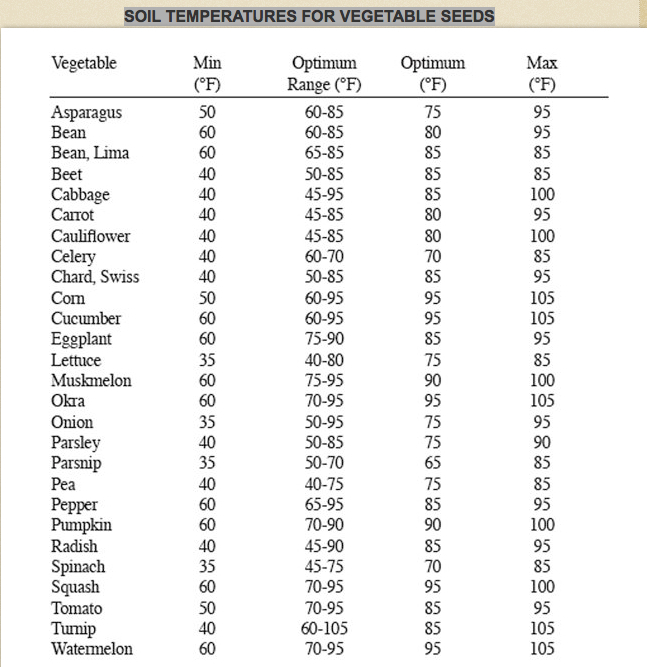
Here is a chart I found from Farmerfredrant giving the optimum soil temperatures for planting vegetables. I’m showing it here but also listed it as a pdf (soil temperatures for veggie seeds ) so you can print it out as well.

soil temperatures for veggie seeds

Santa Fe Spring Garden Fair this Saturday April 27

SFMGA_SpringFair13_Flyer_02

This year’s theme is Food for Thought, with speakers, exhibits, clinics, and demonstrations all tied to the idea of nourishing ourselves, our land, and the creatures that share the land with us. There are 3 speakers this year.  I will be one of the guest speakers and talk on tips for growing tomatoes and other vegetables. Anne Schmauss will talk about providing habitat and food for birds and Les Crowder will talk about bees, how we can help them and what we can plant to support them. Here is the speaker schedule:

Jannine Cabossel       10:45am
Tips for Terrific Tomatoes, Making the Most of Your Vegetable Garden

Anne Schmauss         12:00 noon
How to Attract Birds to Your Backyard Year-ound

Les Crowder               1:15pm
Honeybees: Landscaping with Bee friendly Gardening Practices

You don’t want to miss this event if you are a gardener here in the greater Santa Fe area!

Chitting Potatoes

Chitting Potatoes

Chitting Potatoes

Chitting Potatoes in Egg Cartons

Picked up some French Fingerling potatoes last week and am chitting them for the next 1-2 weeks. Chitting potatoes is basically growing out the eyes a little in indirect light, giving them a head start before planting them. I’m using egg cartons to keep them from rolling and breaking the eyes. Also I got the vegetable bed ready, picking a rich, loamy and deep bed (but not the same one as last year) added more manure, dug it in, and dug the trenches 8 inches deep. As soon as they are ready, I will plant them in the bottom of the trench covering them with 3 inches of soil and after the plants are 6″ tall I will start to mound up the dirt around the plants. Last year was my first year growing potatoes and they were fabulous–so much better than store-bought ones.

Seed Starting Class

tomatoes 4_17_11

Today I taught a Seed Starting Class at the Rail Yard classroom here in Santa Fe. We ran out of the handouts because so many people showed up. It was a great class with lots of ideas shared by both me and the participants. I promised to put the all the handouts on my blog for those of you who didn’t get them.

HERE ARE THE HANDOUTS FROM CLASS:

COOL-WARM SEASON CROPS/JOHNNY’S SEEDSTARTING CHART

DIRECT SEEDING:TRANSPLANTING

PRESPOUTING SEEDS

STARTING SEEDS INSIDE

LIGHT TABLES:SEED STARTING

ALSO! Here are some of my posts that might be helpful on things we talked about today:

BUILDING A LIGHT BOX –   https://giantveggiegardener.com/category/gardening-tips/building-a-light-box-gardening-tips/

SEED STARTING TIPS –  https://giantveggiegardener.com/category/gardening-tips/starting-seeds-tips/

GOPHERS PROBLEMS/TRAPS –  https://giantveggiegardener.com/2011/01/20/gopher-problems/

DETERRING SQUIRRELS –  https://giantveggiegardener.com/2011/08/16/deterring-squirrels-from-eating-your-garden/

TOMATO SEEDS PLANTING INSIDE – https://giantveggiegardener.com/2011/03/22/tomato-seeds-planted-inside-march-21/

Finally, there is a ton of information on this site. All you have to do is look at the right hand column and go down to ‘Garden Topics’ and go to the subject that interests you. That way you will only get my posts on that subject and you don’t have to scroll through 4 years of posts.