Shhh! Don’t Tell Anyone..

tea cups soaking seeds and pots with dirt-EEEEEK!

As a gardener, I try to do some things when I’m alone. Not that I don’t like company but planting seeds and transplanting seedlings up in new containers in the kitchen is dirty business. I mean literally.

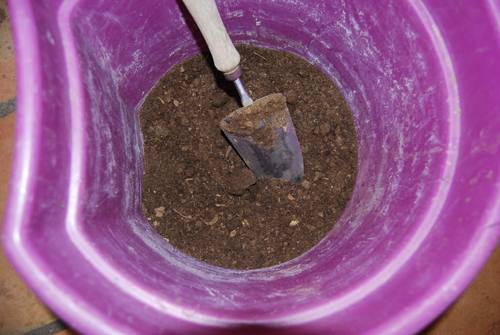
Dirt in bucket in house

Yesterday was one of those days. The kitchen counters got potting soil all over them, dirt got tracked on the floor, there was a bucket of dirt in the house (for my soil sample test!), the kitchen table was full of pots and seeds and the kitchen sink had dirt in it (which I carefully scoop out so it didn’t go down the drain). I would of just died if the doorbell rang and some friend ‘popped’ in to visit and saw what a disaster I was in the middle of! But I always clean it up (with bleach!) before anyone comes and sees what a mess I made all day in the kitchen!

OMG! There's dirt in that sink!

By the time evening rolls around, it is spotless and nobody know any better! Shhh! Don’t tell anyone!

Tips for Growing Tomato Seeds

Tomato seedlings with thermometer

Lately I’ve been getting some questions about tomato seeds not germinating from more than one grower and thought I should address some of the problems and offer some helpful tips. If you haven’t started your tomato seedlings yet, you should start now. You have 6 weeks until May 15th which is the last average freeze date here in Santa Fe. You can still get a good head start if you plant soon.

1. Tomatoes do not like cool soil. Soil temperature in the 60’s is too cold for tomatoes. Tomatoes, peppers, eggplants like it very warm to germinate (in the 70-80°F).  Some people put them on top of a refrigerator where it is warmer. Even if your days get warm where ever you live, if your nights still get chilly (i.e. in the 60’s), they shouldn’t be outside. Period.

Plant Germination Heating Mat

2. Get a plant germination heating mat. The best thing you can do if you plan to germinate some of your own seeds is get an electric plant germination heating mat. Amazon has a lot different sizes on the internet here.  You may be able to find them at one of your local nurseries (but not at a big box store). It will keep the soil evenly warm-in the 70-80’s°F range. My tomato seeds germinated in less than a week with them sitting on it inside the house.

3. Plant tomato seeds 1/4 inch deep and put sand on top of them instead of the ‘soil’ (like play sand from Home depot or Lowes). This makes it easier for the seed to push through to the top.

4. Make a solution of Chamomile tea to ward off dampening disease. Dampening disease is a soil borne disease that sometimes attack seedlings right after they come up. You’ll know if if you get it because the new seedling wilts and dies. This usually happens when the first 2 leaves (called cotyledon leaves) pop up.

Closeup of two baby tomato seedlings each with their first 2 leaves called cotleydon leaves

I put one tea bag in a cup of hot water (like you would drink) and then when it is cool, transfer it to a little sprayer (like what you might use for your hair) and spray those new leaves. There are some properties in Chamomile tea that thwart off this disease-try it-it really works. After 4 of the true leaves, (they are the next leaves that come up that look like tomato leaves) I stop using the Chamomile tea.

5. Water from the bottom. This helps avoid getting ‘dampening off’ disease and also keeps the little seed from washing away when you water from the top. Put them in a sink or tray with some water and when the soil absorbs the water, it will look damp in top.
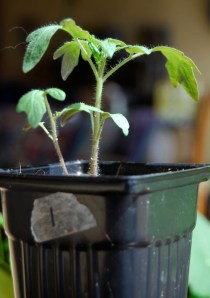
Tomato seedling with true leaves-transplanted up to a 2 inch pot

6. Transplant after you get 4 true leaves to the next bigger container. I’m assuming you start with small containers. Plant them deep-up to their first true leaves. They will root along the stem and become stronger. Every time you transplant up, bury your stems deeper. Always use disinfected pots-use 10% bleach solution to water to rinse your pots in.

7. Give them light. They need light and lots of it. If you don’t have a light box then put them in a south facing window and rotate them daily as they will lean toward the light.  Be careful you don’t fry them with too much heat from a hot window. For those of you that have them under lights keep the lights about 2 inches above the seedlings and raise the lights as the plants grow. This will help keep them from getting ‘leggy’.

8. Give them dark. Yes that’s right. Plants need a period of darkness for photosynthesis to take place. I give mine 8 hours of darkness at night. Photosynthesis is the process where the plant takes the energy it gets from light in daytime and converts it into sugars as plant food. I have my lights plugged into a strip plug and the strip plug into a timer so I don’t have to think about it.

9. Use rock phosphate if your tomato leaves turn purple. Purple leaves means your plant is too cold. If your little tomato leaves start to turn purple (just look at the underneath side of a leaf), then they are cold and your soil is cold. They can’t access the phosphorus in the soil when the soil is cold. Get them to a warmer place and get some rock phosphate (which is a powder) and sprinkle some on top of the soil and water in. They will green up again within a couple of days.

10. Fertilize lightly. I only use thrive and diluted seaweed when I first transplant up and then only after the plant is doing well will I fertilize lightly with diluted fish emulsion. Don’t overdo it.

11. Grow thicker stems by brushing the plants. Make your tomato plants strong not leggy. You can make your plant produce stronger thicker stems by either brushing your plants with your hand when you walk by once or twice a day or put a fan on them (low speed). This mimics being outside where a breeze gives the plant a ‘work out’.

12. Keep planting up. Don’t let them stay in the same pot where they can get leggy. Once they outgrow their pot, plant up to the next size. I start with a little 6 pack and then plant up to a 2 inch pot then to a 3-4 inch pot and then to a gallon size pot if needed. I don’t use Mycorrhizal until I do the final transplanting into the ground.

I will give more tips when we are ready to transplant outside.

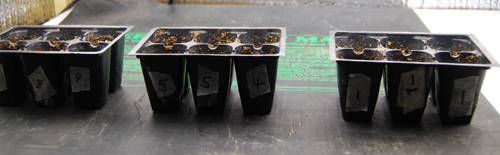
Tomato seeds planted inside-March 21

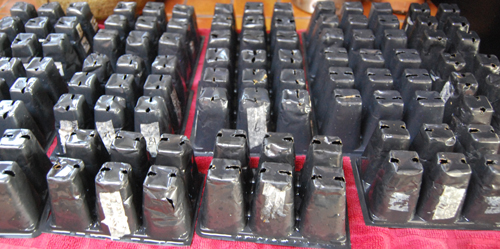
Bleaching pots before use

drying on an OLD towel

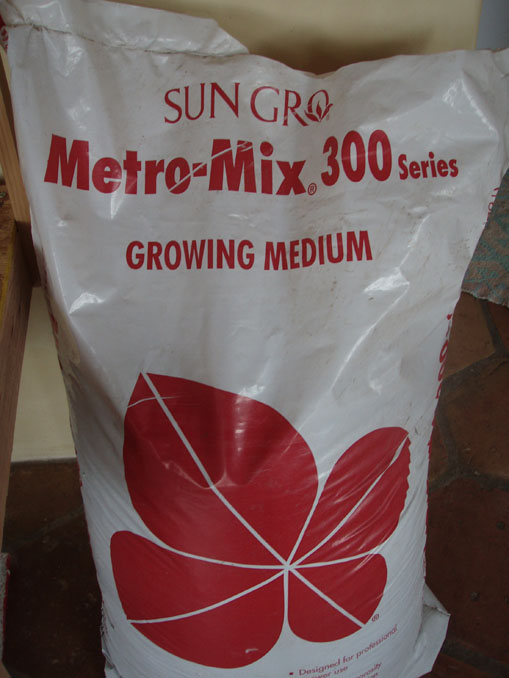
Last evening I planted my tomato seeds-both heirloom and hybrid seeds. I brought out and set up the light boxes and heating mats last week. Before planting my seeds, I always clean the little pots with some bleach water that I use for starting tomato seedlings. It’s important to disinfect the pots because you don’t want your plants to pick up any soil borne diseases. I use about a 10%  bleach to water ratio.  I use the kitchen sink and try to not get dirt everywhere from the used pots. The trick is to convince your partner that it is ok! Just tell them you are disinfecting the sinks out (which is true)! I picked up the seed starting soil-Metro mix 300 from Agua Fria Nursery last week. It comes in a big bag but you will be planting up into larger containers in a few days after the second set of true leaves appear and besides if you have any left over, you can use it for next year. I’ve bought many seed starting soil mixes (usually at the big box stores) and hate the way the water rolls off of the soil when you first go to use it. With this soil mix (Metro Mix 300) I just plant the tomato seeds about 1/4 inch deep and water it all at once. It saves time and anything that saves time I like!

Metro Mix 300

After I water the seeds, I put them under my lights and on top of a heating mat which is great for warming the soil for the seeds to germinate. I’m starting the tomatoes later this year because last year I started the first week of March and they got too big-about 3-4 feet tall because I couldn’t put them out with the cold spring we had.  This year I’m hoping to get them transplanted into the garden around mid April (with protection) weather permitting. Why do I think I might be able to get them in early this year? We are in a La Nina which generally means warmer weather in spring but less rain. By planting them later if I have to, they shouldn’t be as big as last year.

seeds on heat mat

Lights for Growing Your Own Seeds

Use a daylight florscent bub

I use a full spectrum florescent light bulbs (called daylight) instead of a plant ‘gro’ light for the shop lights I use in my light boxes to start my seedlings.  Full spectrum lights were originally designed for people who get SAD (Seasonal affective disorder, also known as winter depression or winter blues and live and work under regular florescent lights. Full spectrum lights are a little more expensive than regular cool white florescent lights, but cheaper than the ‘gro lights’ marketed to the gardener and provide basically the same lighting as a ‘gro light’. You can get them at the hardware stores. One thing, be sure to buy a high lumen output bulb (6500k), not the energy saver bulbs that are more common now. They produce less “leggy” seedlings.

How to build a light box to start your vegetable seedlings inside

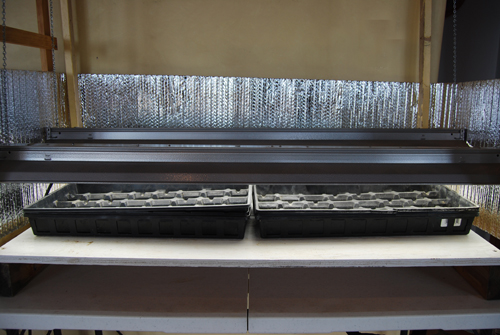
Finished opened light box-front is off

You can buy light boxes to start your seedlings in or you can make it. This is nothing fancy but works like a charm. Here is my simple light box I built myself with some scrap lumber I had around the house.  It will fit between 2-4 big trays under the lights. See pictures for details of construction. I had already built them (I have two) or I would have done a step by step but I think you’ll be able to follow.

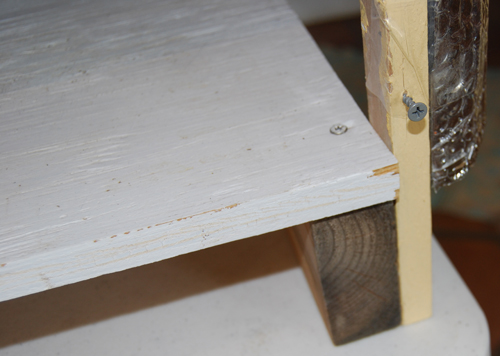
Close up of corner of base-plywood screwed into 2" x 4"/Vertical piece attached to outside

1. BASE: I use plywood – 2′ x4′ by 1/2 inch thick piece for the base of the box that I attach with screws to 2″ x 4″x 2′ on the short sides (depth). The base is now done.

Close up of top corner connection

2. TALL VERTICAL SIDES: I  attached 1″ x 2″ x 45″ pieces to each corner with screws. I connect with screws on the short sides (depth) another piece of 1″ x 2″ x 2′ to hold them together.

Close up of cross beams

3. CROSSPIECES LENGTHWISE: To connect the top pieces for stability and to also hang the lights, I attach (2) 2″ x 2″ x 4′ across the width.

Close up of the top corner from the outside-inside crosspiece is attached 6" from corners

I screwed them in from the outside. They are set 6″ in from the front and back so the lights can hang and not touch each other.
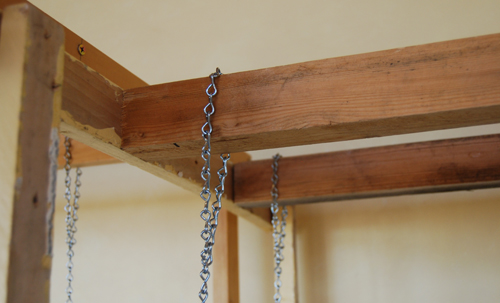
I buy around 40" of light weight chain to hang lights from

4. CHAIN TO HANG SHOP LIGHTS: I buy around 40″ on light chain and get some hooks to go into the light slots to hang the lights. Each light will have 2 chains. The chains can be raised as the plants get taller.

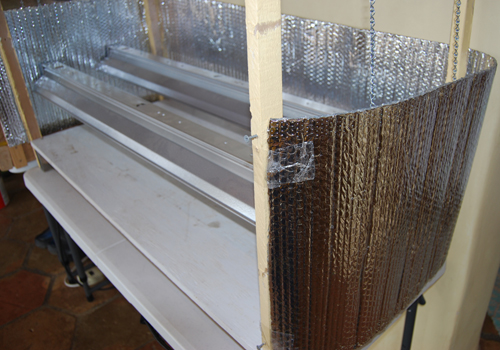
I attach the insulation with clear packing tape to corners

4. FOIL INSULATION: I buy a roll of foil insulation (looks like foil bubble wrap) from Home Depot or Lowes to wrap the outside of the light box on three sides.  I attach it with wrapping tape to the corners. I left the front piece separate so I can take it on and off. Notice the screws in the front of the wood so I can hang the front piece of insulation off them.  I made some holes in the foil (I reinforced the area where the holes will be with more packing tape so the holes won’t stretch too much).

Here it is with the front section of foil insulation on

Here it is with the front piece on. I leave this on all the time as it makes it warmer except if I need to get to the plants for watering. I also like the reflection of light from the insulation when the lights are on providing more light to the plants.

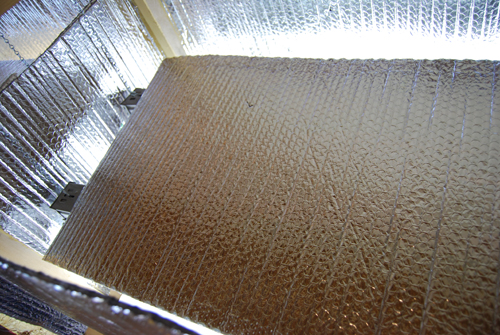
Here the lid is resting on top of the lights at night (the lights should be OFF not on like in this picture)

I also have an extra piece to put on top of the lights at night. I keep my house pretty cool at night (64°F) and find having a top keeps some of the heat in. I don’t put the top piece of insulation on top of the lights until I turn off the lights at night and I take it off in the morning when the lights go back on.

Ready!

Here it is ready to start seeds inside.

Next: What kind of inside lights to use for starting seedlings

Master Gardener Tomato Disease Sheet

Hey Master Gardener Interns! I want to let you know you all were awesome with some great questions and suggestions. I really enjoyed the classes. I thought I’d put it in my post below so others can read it as well as the pdf here TOMATO DISEASES in case some of you didn’t get one.  (It’s easier to print off the pdf than the post). This is not a complete list of tomato diseases in New Mexico but some of the most common. Also the HERB SHEET is two posts back for you to get.

TOMATO DISEASES/PROBLEMS

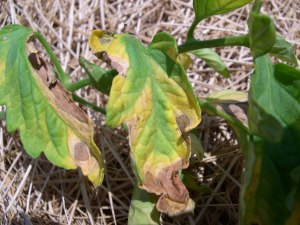
EARLY BLIGHT (Alternaria solon) SOILBORNE FUNGAL DISEASE
Most tomatoes are susceptible to Early Blight which usually develops in early summer, after heavy rains or when it is humid and warm.
SYMPTOMS: Leaves at the base of the plant near the ground develop dry looking, irregularly shaped brown patches surrounded by concentric
rings. The best prevention is prune off the affected leaves as soon as you see them. I prune off all branches and leaves within 18 inches of the ground to try to prevent this as it is a soilborne disease. Early Blight overwinters in the soil. Remove affected plants and clean up fall garden debris as it overwinters in plant residue. Wet weather increase likelihood of getting this disease.
CONTROL: Protectant fungicides-Copper or sulpher can prevent further development of it, Green Cure (potassium bicarbonate), and Serenade (QST 713 strain of Bacillus subtilis), a biofungicide helps more to prevent
disease and is not a cure. Also spacing plants farther apart for good air circulation may help. Good sanitation and disposal of plants at end of season are important.

SEPTORIA LEAF SPOT

SEPTORIA LEAF SPOT (Septoria lycopersici) NOT SOILBOURNE-FUNGAL DISEASE
Septoria leaf spot can occur and any stage of a tomato plant development especially after heavy rains or when it is wet and warm. Spores are spread by windburn rain, insects, splashing rain
SYMPTOMS: It’s usually observed first on the lower leaves. Leaves that are heavily infected have small circular brown spots, turn yellow, dry up and drop off. The fungus is not soil inhabitant but can persist from one season to the next if the debris from the diseased plant is not removed and ends up in the soil.
CONTROL: Copper fungicides, Green Cure (potassium bicarbonate), Serenade (QST 713 strain of Bacillus subtilis), a biofungicide, helps more to prevent disease.

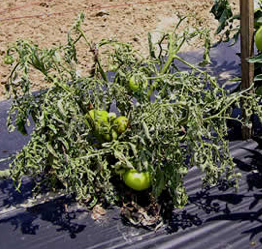
Bacterial Wilt

BACTERIAL WILT-SOILBORNE DISEASE
Soil borne and waterborne pathogens that causes leaves to wilt in day only to recover at night and then complete sudden wilting of plant.
TEST: Cut a four inch long section from low down on the stem and suspend this cutting in a jar of water. If a cloudy, milky ooze comes out, this in an indication of bacterial wilt. Dried leaves may remain green.
CONTROL: Dispose of plants. Plant in different location. 3-4 year rotation
of crops

BEET CURLY TOP VIRUS DISEASE
Transmitted by the beet leafhopper which build up high numbers on tumbleweeds and survive the winters on mustard plants.
SYMPTOMS: upward curling leaves that become thick, stiff and twisted. May stay green or become yellow with purple veins, plants become stunted. Plant next to them may be virus free.
CONTROL: Provide partial shade is beneficial as leafhoppers prefer to eat in the sun. Possibly use row cover/shade cloth to cover plants.

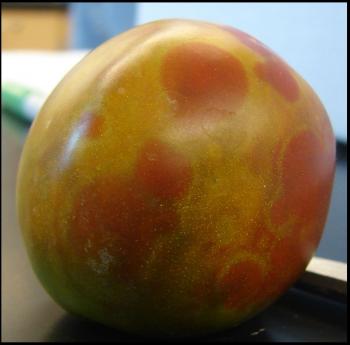
Tomato Spotted Wilt in tomato

Tomato Spotted Wilt

TOMATO SPOTTED WILT

This virus is caused by thrips that transmit the virus from infected tomato plants to other healthy tomato plants.

SYMPTOMS: Two symptoms are dominant- young leaves turn bronze and develop small brown spots. Second, the leaves wilt and tips die-back. Infected plants produce poor quality fruit and less yield. Pull plants and dispose of them.
CONTROL: Elimination difficult. Using reflective mulches may help reduce
infection, physical barriers like covering plant with row cover when it is young.

BLOSSOM-END ROT DEFICIENCY
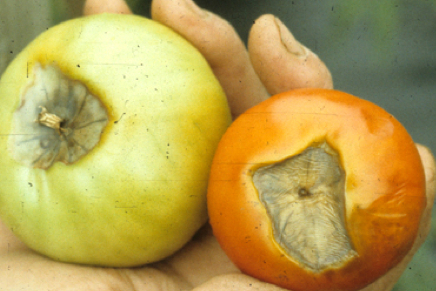
Hard brown or black leathery patches on the blossom ends of ripening tomatoes indicate blossom-end rot. It is more common in large fruited varieties. This is generally caused by a calcium deficiency at fruit set or uneven watering and is prevented by planting tomatoes in compost enriched soil and mulched with straw to keep moisture levels more constant. I put a tablespoon or two of dry milk in the bottom of each hole when first planting tomatoes. In the fall dig in some gypsum which is a good source of calcium without raising the ph of the soil here in Santa Fe.

Still Time to Order Seeds if You Haven’t Already

Still time to order seeds if you haven’t already. I need to order my seeds Monday, now that I’m home from the show so I get them in time to plant in March. Probably most of you have already order your seeds. I only need to order a few as I still have many seeds that I will regrow this year. It feels late but it is what it is. Last year I started the seeds the first week of March. Because it was such a cold spring, I couldn’t get them out till late May and even June last year They got too tall in the house, but what was I to do? Stick them out in 27°F weather? I’m still going to plant seeds from March 1 -15,  inside, under the lights and hope with this La Nina we have that all of us will be able to sneak out some of our warm season crops early—think April 15th! It’s always a crap shoot when trying to decide when to plant seeds but I’m going early! Bring out the gro lights! (I hear, “oh no” in the background!) I do have ‘plant envy’ for those of you have greenhouses or hoophouses!

How to Make a Coldframe

My coldframe

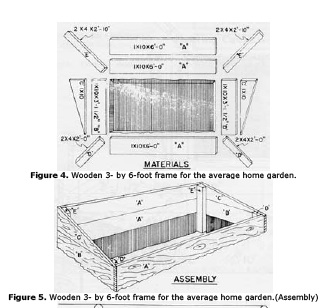
A dear friend of mine, Kim, asked me if I would explain how to build a coldframe while there is still time before planting time in early Spring. There are many designs available online to make a coldframe or hot bed. Here is the coldframe plan (as a pdf) that I basically used when building my coldframe with a few small exceptions. Now mine isn’t super refined as you can see in the photo but seems to be working! (Be sure you look at the pdf because there is a lot more information in it). As you look at the plan, it’s pretty self explanatory but here is what I did for the sides and the bottom inside.

one page of the coldframe plan

I used 2 inch x 10 inch lumber for the bottom section all around and another 2″x10″ section for the top side slanted pieces. Cutting the diagonal piece is easy, I drew a line from one corner across diagonally to the other corner and cut on the line then I used one piece for each side on top of the bottom piece. The only thing I did differently is I put one more 1 x 2 inch piece vertically in the middle on each side  (screwed in-see photo not diagram) and in the back to join the top and bottom piece together. I added a 2 x 4  (long) piece on the lid that I screwed in (not tightly) so I can raise and lower the lid and prop it up vertically (see the piece holding up the lid on the right side). In the photo you notice I taped BIG bubble wrap (not small bubbles) with duct tape on on the inside of the plexiglass lid to add extra insulation in the dead of winter. I also divided mine into two sections.This isn’t in the plan but in the left section I started with hardwire cloth on the bottom to keep out gophers. Then I added dirt and compost on top of the hardwire so I could plant in it but the soil isn’t heated. The right side has a garden heating cable. I attached the cable with twist ties to the hardwire cloth that is cut out to fit the bottom. Then I turned over the hardwire cloth so now it is on top and place it on the bottom. I did this so I can’t put a spade through the cables while digging around in the dirt when planting. Then I put dirt on top like the other side. So the right side is a contemporary hot house when I plug in the heating cable (which I haven’t done yet). I will use it to heat the soil to a temperature so the seeds will sprout. A traditional hot house has a dug out area where ‘hot’ green manure is placed into. Then on top of that is the dirt that you would put your plants or seeds in. The manure gives off heat as it composts, heating the soil just like the heating cable. Now I love the idea of the manure and doing it naturally but I don’t want to have to replace it every year so I chose the heating cable. I will use an extension cord to bring power from the house. I’m experimenting with the non-heated and heated side to see if it really makes a difference in early Spring. If it does, I’ll heat the left side too next year.

Last time I reported, the right side which I planted with transplants in November, is still doing well while the left side where I planted transplants in January all died in the -20°F we had one night (except the parsley which survived) which is interesting cause I don’t even like parsley! I think the left side all died while the right side didn’t because they did not have any time to grow roots while the right side planted in November did. Remember I haven’t heated the right side yet so I know that wasn’t a factor. Anyways I’m sure the plans will help you more than my description!

Chart for Seed Starting and Transplanting

Our first frost free day this year is Sunday May 15, 2011.

For those of us who start seeds indoors, here is a seed starting calculator from Johnny’s Select Seeds that I found online. It is on the upper right corner of the site. Once you open it, plug in the first frost free date for your area and it generate all kinds of useful information in a chart form from when to plant seeds for all kinds of common vegetables to when to set out the transplants into the garden. Then you can print it out and refer back to it as needed. So it is good for those of us who grow from seed and ALSO good for those of us who prefer to put out transplants we buy from the nurseries.

Here is Santa Fe’s (ZONE 5) Seed Starting Chart that I generated using May 15 as a date. To see the whole chart click this pdf- Johnny’s Selected Seeds – Superior Seeds & Gardening Tools . PDFs don’t show up on this  blog only connections to them so you’ll have to click to see it.

HELPFUL HINT:  If you have something that is longer than a page that you want to save from the internet on your computer. Go to FILE and then PRINT as if you were going to print it . Somewhere on your menu screen it says PDF. Go to that and then go to SAVE AS PDF. Click yes and now you have your document saved in it’s entirety on your computer desktop. You can also print it as well. This has been a very useful tip for me ins aving long documents.

I actually make several different seed starting charts-one based on the actual frost free date and one where I ‘push’ the date a little earlier to see if I can plant my tomato transplants early.  For most other veggies I go by the frost free date but the tomatoes I try to sneak in the ground as early as possible because I grow some varieties that ripen very late in the season and I want them to ripen before the first frost. Two years ago I got my tomatoes in the ground on April 15th because we had such a mild Spring but last year some plants didn’t even make it in till June-so it depends on the year and what the weather is like in Spring… So play with this chart to see when to plant your seeds or transplant you plants and then watch the weather!

Growing Heirloom Tomatoes From Seeds

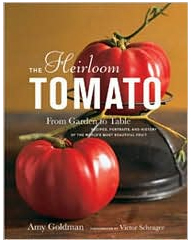
The Heirloom Tomato by Amy Goldman

I just read an article online by Mother Earth News,  56 Heirloom Tomatoes Rated Excellent for Flavor‘ that lists tomatoes from Amy Goldman‘s book, ‘The Heirloom Tomato: from Garden to Table’ which I got last year.  The article lists and describes 56 excellent heirloom tomatoes from her book. After reading this excellent article, if you want to know more, her book- The Heirloom Tomato: from Garden to Tableis a must have for those of us who want to grow heirloom tomatoes from seeds and get some idea of what we are growing. It’s a beautiful book with wonderful photos of many heirloom tomatoes that Amy has rated for flavor, texture, color, type, history, where you can get the seeds, etc. I use it to help me decide which heirloom tomatoes to try each year now.

Interior of 'Gold Medal' Tomato

Last year, my favorite tomato from her book that I tried was Gold Medal, a bi-colored (red and yellow interior) tomato that took most of the season to ripen but was worth the wait. Check out the picture on the right to see the beautiful interior of these tomatoes. The plants were loaded and these beefstake type of tomatoes (about 1 lb) are firm, beautiful, and sweet with low acid.  I started these inside under a light box around the first week of March (10 weeks before our first frost free day-May 15) but I try to sneak my tomatoes out early (third week of April inside Wall of Waters) which is why I grow them 10 weeks instead of the customary 8 weeks for tomatoes. I will explain more on growing tomatoes from seeds in future posts as we get closer to planting time. You can buy the seeds at Baker Heirloom Seeds (rareseeds.com).

Keeping a Vegetable Gardening Journal for Each Year

Pumpkin Journal (left), and Vegetable Journal (right)

You might consider keeping a fruit and vegetable journal for 2011. I actually have 2-one for giant veggies and one for the regular veggies. In this you could put the date you start your seeds outdoors, in your greenhouse, and inside with information like temperature of soil, air, temperature inside what day you started, how long it took to germinate, what the weather was like during this time period, what varieties you started, how much water you supplied, if you presoaked any seeds, etc and then continue this journal throughout the season as to how the varieties do,  when they blossom or when you get your first fruit, what pests or diseases appeared and when, what you did to rectify the issues, what varieties were your favorites and why, etc. I bought a nice notebook (something you will want to keep-not just loose sheets of paper that get lost) that I have kept for the last 3 years and add to it for each new year. Every few days I put down what is happening in the garden in the evening when I have some time. I have found it invaluable in future years to look back (in winter) to help me determine what I would do the same and what I would change for the new season. You’ll be amazed at what you will read the next year.

Closeup of Vegetable Journal

I’ve been trying to tweak out my timetable for starting my seeds inside and have referred back to the journals. For instance, 2 years ago I started seeds inside in February and found for me that was too soon-just too cold and I had to replant a lot of seeds in March. Especially tomatoes-they don’t like cold nights (or days) and get stunted and the leaves turn purple. This is because of a phosphorus deficiency where it is not available to plants when the soil and air temp is too cold. Read my post, ‘Learn from my mistakes when starting tomatoes!’ on how to remedy this. Also for you greenhouse people read this forum from Organic Gardening. Luckily that year, I was able to sneak a lot of the ones I had restarted out in mid April with protection because of the mild winter we had even though the plants were smaller- but they were not leggy.

In contrast, last year I planted seeds inside under lights in early March (thinking I had waited long enough to start). But we had such a harsh cold spring that the plants (which looked great) had to stay inside too long and got too tall because I couldn’t put them out till much later (many plants in June) because of really cold nights (27° F till June 6th). How would I have remembered this and what I did differently without a journal. Every year is brings new challenges to us growers in Santa Fe, NM so having a journal that I can refer back to is helpful. Besides it’s fun..

More winter greens go in the cold frame

Well I got some more winter greens to plant from ‘The Veggie Man’ from the Santa Fe Farmers Market on Saturday. My good friend Lava, told me she saw him there selling veggie starts and found out where he has his greenhouse and we went over there and picked some up. I got Argula, Endive, Blue Kale, and Baby Bok Choy and Parsley. I will plant them on Wednesday in my Cold Frame (where I already have Swiss Chard, Oakleaf Lettuce and Spinach growing), weather permitting. We are suppose to get cold again on Wednesday so we will see if I or the plants can stand it.

More on winter gardening

Winter gardening is very different than summer gardener. It’s almost not gardening at all. In fact Eliot Coleman, author of Four-Season Harvest which I’m still reading says it’s not winter gardening but winter harvesting which puts it in a whole different light.  The only thing I need to do once in awhile is add water. There are no bugs or disease. I put my whole winter garden in with starts. Makes it really easy that way. He also talks abut eating vegetables when they are in their season so for winter gardening that could include spinach, tatsoi, bok choy, endive, arugula, corn salad, miners lettuce, radicchio, escarole, mesclun, sorrel, mustard, beets and carrots. I always thought that salads were a summer thing but that’s not true because salad crops grow best in the cool seasons and are sweetest then. That’s why we always have trouble with salad crops bolting. We plant them too late in Spring. I’m re-evaluating this whole winter gardening thing.

Veggie Tip-What to look at in seed catalogs

2011 Baker Heirloom Seeds Catalog

Why order from seed catalogs vs getting seeds or plants from the local nurseries? Variety. We have more choices to pick from. Now don’t get me wrong – I buy many of my vegetable plants from our local nurseries as well. I don’t start all mine from seeds but I like to grow some new varieties every year and many of those aren’t sold locally. Besides I really like going over the catalogs. What should we look at when ordering from our seed catalogs? Here is some information that catalogs give to help us make our decisions in choosing which variety to buy.

1. Quite often catalogs will list the particular needs of the variety-i.e. needs cool moist soil, tolerates heat, etc. This is important information to consider because of our cold springs, hot summers and what location we plant them at our houses.

2. They list whether it is a hybrid or heirloom variety. I like to grow mostly heirloom varieties so I look for this.

3. We get specific information on each variety-size, weight, color, flavor,  etc and often the history of where a particular seed came from. I especially find the history interesting. I like knowing where they originate from.

How many days to harvest-this tomato was 72 days

4. Probably the most important thing to consider with each variety is how many ‘days’. This means how many days to harvest. Here in Santa Fe, we have a short growing season. Our last frost is the average date we no longer experience freezing temperatures which is May 15th and the first average frost date is around Oct. 10. Last year was a really cold, windy spring with night time temperatures still at 27° on June 6th. We basically went from Winter to Summer. Every year offers new challenges for us weather wise and the weather has everything to do with how many days to harvest depending on when we can put the transplants or seeds in the soil.


So how many days to harvest? Some vegetables such as summer squash, cucumbers, lettuce, etc don’t take many days to harvest but some vegetables need a longer growing season such as winter squash, watermelon, and tomatoes so buy varieties that won’t go into October to ripen. Let’s take tomatoes for an example.  If we choose a tomato seed that says 72 days, we’ll probably get tomatoes but if we choose one that says 95 days to harvest, the odds are we won’t get any ripe ones before we get that first frost in fall. In Santa Fe, we should be looking to grow varieties that ripen in 60-80 days. Tomatoes come in early, mid and late season varieties so keep that in mind. Early season goes from 52-60 days, midseason goes from 60-75 days and late season goes from around 80-100 days. You certainly can try some late season varieties (I do) but pick more in the early-mid season range especially if you are only planting  a few. Also with tomatoes that ’80 days to harvest or 80 days’ means from transplanting plants outdoors not planting seeds outside. I’ve had people come up to me and complain they only have green tomatoes in October and when I ask what variety, it usually is one of the longer growing ones so pay attention to that day information in the catalogs because you can usually find some varieties with shorter days till harvest in every variety out there.
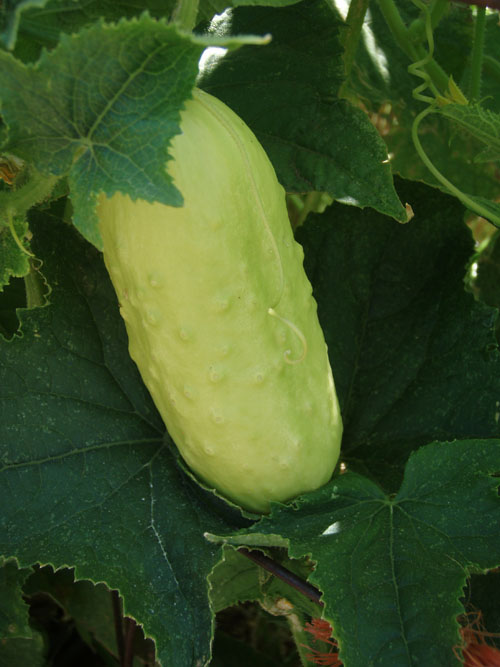
Winter Purslane (Miners Lettuce) and Mache (Corn Salad)

I was doing some research on Winter Purslane and Mache for including them in my cold frame for next fall/winter gardening and found a seed company in (of all places) New Mexico.  It is called www.gourmetseed.com and hails out of Tatum, NM and you can purchase these items and more from them.  Mache is pretty common but I haven’t heard about Purslane (except the wild kind that grows here). So let me talk a little about these two winter crops that have been grown in Europe for centuries.
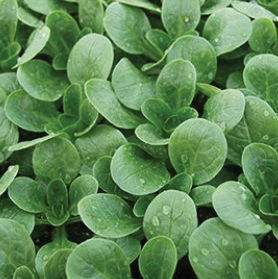
Mache (French Corn Salad)-picture from gourmetseed.com

Mache-(Valerianella locusta)

This gourmet green is also known as corn salad and lamb’s lettuce. It has been cultivated from France since the 17th century. Mache was named because it’s leaf resembles the shape and size of a lamb’s tongue!  It is one of the few greens that can handle our winters (like spinach). It grows in a rosette if you plant individually but most just broadcast the seeds (like you would for mesclun) in an area to make a carpet of leaves as they are very small. Growing low to the ground, it is harder to harvest but it has a nutty, sweet flavor worth the effort. To harvest it, just take a knife and cut it off below the leaf level being careful not to injure the delicate leaves and wash well. You can eat it alone or put it in with other salad greens but use a light vinaigrette or even lemon juice and a little oil-it is too delicate for heavy dressings. They say you can steam it like spinach but it is too small for me to do that. I grew this many years ago under row cover in raised boxes and it did well but grew very slow in our winter but when Spring came it was ready and I went out one day only to find the chickens had escaped and raided the garden and they ate all but a few leaves of my Mache! The few leaves left tasted wonderful so I hope they enjoyed it! It like colder weather so I may try again this early spring as it takes 6-12 weeks till harvest but much longer if it goes into winter. Mache doesn’t like to be warm. Maybe I’ll try it when I plant more spinach in early March and again next fall.

Winter Purslane (Miner's Lettuce)--picture from gourmetseed.com

Winter-Purslane-(Montia perfoliata)

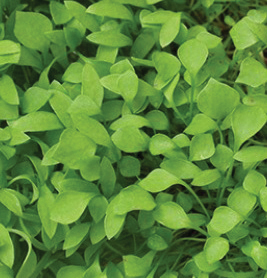
This is not to be confused with the purslane weed that grows wild in New Mexico and throughout the U.S. I will write the next post on that one (Portulaca oleracea) because it is interesting too but for now I want to focus on this variety. This winter green is also known as Miner’s Lettuce or Indian Lettuce and is rich in Vitamin C. It was eaten by early miners to avoid Scurvy. This wonderful wild green is used in Germany and other European countries for it’s tender young leaves. It is used as an addition to mesclun and other salads or steamed like spinach. You pick the leaves when they are young and tender. Most people plant this in fall because it handles the winter so well. I think I will try this in my cold frame next fall. I haven’t done a cold frame in years until this year, but am enjoying seeing the spinach, oakleaf lettuce and chard in it. It’s nice seeing something green in the dead of winter and hopefully if they survive this winter, I will get an early crop of some wonderful greens and now that I’m excited again about fall/winter gardening, I will definitely plant some Mache and Purslane next year. You might consider it too.