warm season veggies-here we come!

May 15th is fast approaching and is the average last frost date for Santa Fe and the time for putting your warm season vegetables in the ground. I sneaked some of mine in earlier but that is still a gamble in case we get one of those late frosts (we did) that plus the spring winds have been horrible this year. Never the less, I do grow some late season tomatoes that take 80-90 days to get fruit so I take the gamble on them and stick those transplants in early with the help of wall of waters and row cover. And of course my giant pumpkins take 5-6 months to grow so they need all the time they can get in the ground before that first fall frost hits even though I start them inside!  So that takes care of the ones I sneak in early but what about the main vegetables crops?

For all summer squash, winter squash, cucumbers, beans, corn, I plant seeds directly in the ground (following directions on the package) as they will germinate quickly in the warm soil and will grow very quickly barring the birds from eating the seedlings. To prevent that, I put some LIGHTWEIGHT row cover (you can get it at the nurseries) over them until they are over the seedling stage and the birds aren’t interested anymore. It comes in big sheets but you can cut it up for smaller areas or it can cover the whole raised bed. Tack it down with some rocks so the wind doesn’t carry it away! Lightweight row cover is from -.01 to .03 in thickness. The handy thing is you can water right through it and it keeps bugs out.

For the majority of my tomatoes and all peppers and eggplants, I will transplant my plants that I started earlier inside or buy plants from the nurseries. When I plant them put them in a hole where I add some compost and maybe Yum-yum mix to get them going and create a well around them so the water is collected instead of running off.

So let’s talk tomatoes for a minute. Why? Well what is a vegetable garden without those homegrown, sweet tomatoes? Let’s face it, it is the main reason most of us have a vegetable garden. You want to put in tomatoes that are decent size plants. The reason being that they take a long time to grow to produce fruit and our season  here is Santa Fe is so short that we need all the help we can get. Plus they take a long time to get them to a decent size which is very important to get that head start. So I started some in March and I also buy some. So as a rule of thumb, if I’m growing say an Oregon Spring tomato that takes 65 days to produce fruit, I might buy them in 4 inch pots but if I’m growing a Brandywine tomato that takes 80 days I will definitely spend the money and buy the gallon size. When deciding which tomatoes you want to grow, look at the amount of days it will take to get some fruit. When the tag or description says 80 days, that means it will take 80 days to become a mature plant that produces blossoms, and then it takes another 70 -80 days to produce mature fruit depending on pollination date. So let’s say a Brandywine plant is planted on May 15th outside, blossoms sometime in June-July, you should get some tomatoes 70-80 days later which puts us sometime in September!  Why try to grow a tomato that takes that long? Flavor. The longer it takes, the better the flavor! They have more time to develop those sugars needed for great flavor. If I had a normal size garden (which I don’t but most of you do), I might try one or two of those longer varieties and I would try a few 65 day varieties and would have the bulk of my tomato varieties in the 70-80 day range. That way I hopefully will get some tomatoes early, mid and late season. That’s the thinking anyways!

So now you have everything up and growing what else can you do to help yourself get the best veggies? For one, I became a believer of drip systems a few years back after being a hand waterer for years. I put a simple drip system in and saw my yield at least double and it saves on water because it puts the water in the root zone. Another good reason for doing drip is that if you water from overhead, you could be encouraging some diseases from splashing the soil on them (there are soil borne diseases) or powdery mildew later in the season.

Next I would put  a couple of inches thick of mulch in my wells (not in May when the soil is colder and your plants are trying to get warm) but by late June when it really heats up around here. Just put it over your drip system. This will help keep your water from evaporating. I like straw (not hay-it produces too many seeds) as it is lightweight and if you turn your soil over in the fall after harvest, it will break down for the next season. When you first put straw down, I do water it  from the top so it won’t blow away and then let the drip work underneath it (so make sure it works before you cover it with straw).

So let’s talk fertilizer. I stay away from chemical fertilizers as they can hurt or kill your beneficial microbes that keep your soil healthy and help your plants grow and stay healthy. So stay away from Miracle Gro and the likes of that. I use more natural fertilizers-both organic fish emulsion and organic seaweed fertilizer together. The reason I use both is the fish emulsion is a general all purpose fertilizer but the seaweed has very little fertilizer but trace elements our veggies need to grow big and healthy. I put them together in a 5 gallon container and use it as a drench in my wells around the plants. Sometimes I also just spray the seaweed on the leaves for a foliar feeding. I fertilize once or twice a season except for giant pumpkins which get fed once a week. Believe it or not, as a giant pumpkin grower, they are the only fertilizers I use.

So what are you waiting for? Get busy and happy gardening!
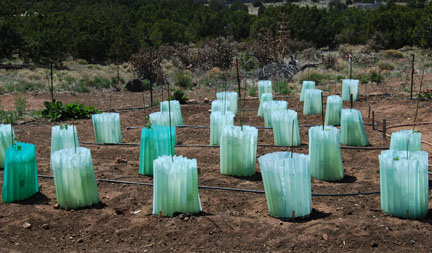
Wall of Waters for tomatoes

tomatoes in wall of waters-2010

Here are the 35 tomatoes in wall of waters. You can buy them at your local nursery or order them through the internet. They are an invaluable tool for Spring as they act like little greenhouses or cloches to help protect your tender plants from cold nights and the wind.Be sure you fill them up in the morning so they have all day to heat up. Then they will give off the heat at night and keep the plant warm.

To set them up, put a 5 gallon bucket over the tomato (the tomato must fit inside the bucket) then slide the wall of water over the bucket and take a hose and fill up each cell in the wall of waters. When done slide the bucket out and the wall of waters support themselves. If your plant is taller than the wall of water, you can still use it but will need a friend to hold the wall of water as you fill up each cell. Sometimes the wall of water (WOW) can partially collapse under heavy wind. In that case put some bamboo posts inside the edges of WOW to help support it. In a few years, you might get some leaky cells. I take one of my leaky WOW and cut off a good cell and insert it into the leaky cell and fill it up and it works. I only use wall of waters in early spring when it is still cold at night. Be sure to take them off when the plant starts to get crowded inside of the wall of waters, usually in late May or early June.

It’s official!

It’s official! I finally got my acceptance letter from the Santa Fe Farmer’s Market. The Farmer’s Market has become so popular here in Santa Fe that you have to be juried in to sell there in the summers, not just send some money and automatically get in. I will be there this summer on Saturdays from 7am-12pm as soon as I have some crops to sell-got to get them in the ground first and with this late cold weather it hasn’t happened yet. I’m hoping to be there in late June with something but not the tomatoes-they won’t be ready till late July at the earliest. I have made room for 60 tomato plants and many more crops in my 1000 square foot main garden. So keep you eye out at the farmer’s market for ‘The Tomato Lady’-Heirloom tomatoes & exotic veggies for the discriminating cook.

Santa Fe’s Farmer’s Market

For the Discriminating Cook

This year the Santa Fe’s Farmer’s Market, which was recently rated as one of the best in  the nation, was a juried-in only market for farmers. Well, I went in the their office and they said I got accepted but I haven’t received their acceptance letter yet which makes me nervous as it’s been 2 weeks. I need to know for sure because it will determine whether I plant more tomatoes or not. We’ll see…

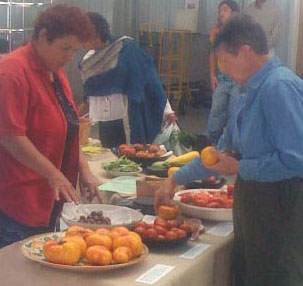
Last year at the Santa Fe Farmer’s Market

I am known as ‘The Tomato Lady-Heirloom Tomatoes & Exotic Veggies’ for the discriminating cook. I grow varieties that you don’t get at the grocery stores or at our farmer’s market. See you there this summer!  I’ll keep you posted when I start going to sell my produce on SATURDAY mornings this year-probably late June since I sell warm season crops…

What is the difference between heirloom and hybrid tomatoes?

Heirloom tomato-Paul Robeson

So I researched the difference between heirloom and hybrid tomatoes because I wanted to be really clear about those differences and found some interesting information I would like to share. In fact this should apply to all heirloom vs hybrid veggies not just tomatoes but since I sort of specialize in tomatoes (and pumpkins) I’ll address it from that viewpoint.

HEIRLOOMS

Heirloom tomatoes are seeds that have been  grown for a number of years, saved and passed down for generations.  All heirloom plants are open pollinated (OP) which means it is able to produce seedlings with all its attributes just like its parent plant. Why should we grow heirlooms? Simply put because they taste better. They might not look as pretty as they tend to crack or get catface scratches because of their thin skin and they can be more disease prone but it’s hard to beat the flavor of a heirloom tomato!  This is why you don’t see a lot of them in supermarkets as they don’t transport well  and might not be pretty-in otherwords they are not as marketable on a commercial level. Last year I picked mine the day before going to our Santa Fe Farmers Market to ensure the best flavor and many of them I had to handled very carefully so as not to crack them but oh what flavor. And you know the patrons of Farmers Markets don’t care how they look-they care how they taste.

HYBRIDS

Gardeners, farmers and plant breeders have been cross-pollinating varieties to get certain desirable traits they are looking for such as color, texture, disease resistance and taste, etc. for years. They try to get the best features of both parent tomatoes.  These are called hybrid tomatoes. Hybrids also occur naturally as well in nature but hybrids whether man made or by nature are not as stable in that they may not reproduce plants with identical traits.

Hybrids should not be confused with GMOs (genetically modified organisms)  which can be any plant, animal or microorganism which has been genetically altered using genetic engineering techniques. Hybrids are not potentially harmful to us and in fact have been popular since the early 50s’. True to American nature,  it became how they looked-not how they taste on a commercial level. Now don’t get me wrong, I grow a few hybrids every year because they generally tend to be more disease resistant and the actual tomato looks good but I only grow some in case I have a disasterous year with my heirloom tomatoes. And some hybrids taste as good as heirlooms, some look better too but overall give me a heirloom tomato anytime.

transplanted tomatoes again

On  April 4 I transplanted some tomatoes in my 4″ pots up to gallon size. They went  “shocky” as I didn’t have room to keep them under the lights even though I gave them Thrive. So I had to build another lightbox on Tuesday to house them and now they are good again. I guess they got a little cold.  Here is a picture of them in the gallon size now. Notice I put some bamboo supports for the stems that I tied with garbage bag twist ties. That way I can relax the twist ties as the stems get bigger.

April 4-tomatoes transplanted to gallon size-doing well

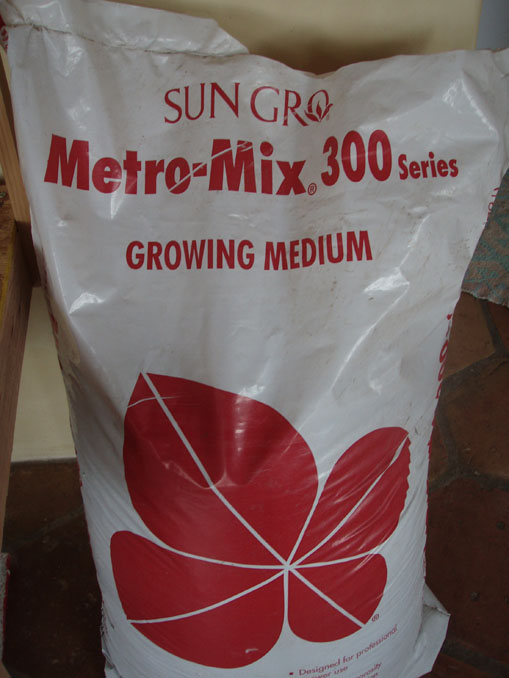
I still have 36 more tomatoes to transplant by this weekend up to gallon size!  This will be the last transplant before putting them in the soil. With about 75 plants, I will give some away to my friends who grow tomatoes! I also changed my planting soil now for the gallon size. Now it is Sungro 702. See picture here.

Sun Gro Metro Mix 702 growing medium

Here is a pic of the ones I will transplant this weekend. I still have some tomatoes left in 4″ pots that won’t need transplanting before going into the ground as I started them later. Notice in the picture below that I raised up the smaller plants on the right side of the pic by putting them on another upside down container. I do this so the smaller plants are at the  same level of the higher ones so they are the same distance away from the lights. Otherwise they would be further away from the lights and could get spindly. Keep your plants within 2 ” of the lights to keep this from happening.

tomatoes in 4″ pots need transplanting

Learn from my mistakes when starting tomatoes!

UGH!  I made 2 mistakes with my newly transplanted tomatoes last week. So I want to share the mistakes and how I luckily remedied them.
MISTAKE #1- After I watered the tomatoes from the bottom tray where they sit in, (which is a good thing), I forgot to drain the water from the pan all day and all night (too much standing water can suffocate the plants)

MISTAKE #2- Secondly I forgot to cover them with the reflective insulation at night to keep them warm while the house cools down. So not only did they sit in the water all day and all night but they got cold as well. In the morning they were slightly wilted and turned a little purple (turning purple means they can’t access the phosphorus from the cold soil.) Last year I had this problem with the tomatoes turning purple, being stunted and being too cold and have really paid attention this year except this one time. I didn’t get a picture of them purple..

rock phosphate powder

So I drained the water away and read if tomatoes turn purple that we should water some rock phosphate in (which is a good organic source of phosphorus) and put them under the lights to get warm.  This happened a week ago and they have snapped out of it and look good, I lucked out! So now I have given all the baby tomatoes some rock phosphate and they are doing really well. I think I’m going to need to transplant them again before I put them in the ground.

tomato plants after the rock phosphate

Here they are now after the rock phosphate- they have really grown since planting them on March 1. I’m hoping weather permitting, I will sneak them in the ground by April 15th, which is a month before the last frost date like last year. This really gives them a head start on the season, especially for those 80+ days tomato plants.

Another tip to not have those skinny, thin stems on your baby plants is to lightly brush them with your hand everyday and it will stimulate them to make stockier stems.

Just transplanted tomatoes

Last year was my first try at growing tomatoes from seeds and I really struggled with them. They were small, stunted and turned purple. So I have done some things different this year. First I didn’t start them so early. I waited until the first week of March to plant them instead of Feburary. Second, I put the lights within 2″ of the plants at all times. Third I put up some reflective insulation which looks like silver bubble wrap all around the lightbox to keep the heat in during the day and for reflection. Fourth, I put some sheets of the insulation on top of the light box at night to keep more heat in. Fifth, I put aluminum foil on the base of the light box where the tomatoes sit on. Both the reflective insulation and the foil really make the light bounce around and give the plants more light. Sixth, the tomatoes are on a timer so the lights go off at 10:30 pm and back on at 6:30 am so they get 16 hours of light and 8 hrs of darkness. I learned in my MG class that plants need darkness to help with photosynthesis. So last year’s tomatoes turned purple as they got cold and couldn’t absorb phosphorus.  But not this year. I transplanted  about a week ago my first batch of tomato seedlings out of their small cell into 3″ pots. These are some pics of the first batch.

So far they are doing well. Today I transplanted the second batch that was ready. I read somewhere that you should transplant tomatoes when their first true set of leaves come out (the very first baby leaves when it germinates are called cotyledon leaves but these are not the first true leaves-the next set is) but I waited until the second set of true leaves came out and I think they’ll do better.

I buried the stems up to the cotyledon leaves and gave them some Thrive to help with the transplanting. Look how much they have grown already!

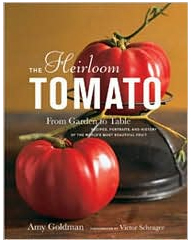
‘The Heirloom Tomato’ by Amy Goldman

The Heirloom Tomato by Amy Goldman

This winter I got a beautiful book called “The Heirloom Tomato” by Amy Goldman in which she tested and rated many heirloom tomatoes. I am going to grow some of the tomatoes that got rated really high by her for flavor. So I’m trying ‘Aunt Ruby’s German Green’ -suppose to be one of the best (sweet) green tomatoes and a tomato called ‘Great White’ (one of the best white tomatoes) which is suppose to taste like angel food cake!-that plus a bunch more that she rated highly. Since getting into our Farmer’s Market last year as ‘The Tomato Lady’-“Heirloom Tomatoes and Exotic Veggies for the Discriminating Cook”, I did more research this year and picked varieties with different attributes. Some with good old fashioned tomato flavor, some that are really sweet, some great for sauces, some beautifully fluted and some different colors. Besides I like to educate my buyers as to the history of each type of tomato and there is lots of info in her book on this. You can go to my 2010 seed list page and see all of the varieties that I want to grow, including a few hybrids. I’ve put AG next to all the ones I picked from her book, although I grew black cherry tomatoes last year before I got her book and am growing this fabulous tomato again.

PS-I get nothing for promoting her book, I just love the info and pictures.

Baby tomatoes are just up!

Here are the tomatoes seedlings just up!

I had trouble with the tomatoes being too cold last year at night so I put some insulation around the lightbox this year and last night with the natural flourescent lights the temperature stayed at 72 degrees. Here is a pic of the light box with insulation. The pic shows the seedlings with the plastic cover off but I will leave it on until most of them germinate..

Picture of seedlings and insulation around the light box.

Growers lightbox tips for starting seedlings

Hey- I did I mention that the site where I did my plans for my garden this year is also a good source of other info on growing veggies. I just found a great article which you may want to check out which addresses pretty much how I use my “lightbox” to get my seedlings started that I just planted on Mar.1.  I use a lightbox instead of a greenhouse or hoophouse. Here is the link for the article at www.growveg.com.  I made my own lightbox as seen in my previous entry but of course you can buy one at considerably higher cost. Your choice.

TIPS FOR STARTING SEEDS UNDER A LIGHTBOX

I’m waiting for my seeds to germinate. They are on a heat mat to help with germination and I cover them with a clear top which keeps the moisture in. After the seedlings germinate, I will move the lights down within 2″  of the baby seedlings and take them off the heat mat and take off the cover so they don’t stay too moist as that is a condition for a fungal disease called damping-off which kills seedlings. To help prevent this besides taking off the clear cover, I spray the little seedlings every few days with Chamoille tea which I just make up a pot of it  (cool it) and put it in a little hand held sprayer and spray the seedlings AND soil every few days-it really works-no dead seedlings!

Starting some of my seeds!

Time to start some of my seeds! So here is how I do it:


Yesterday I got out the light fixture I made last year and brought it in the house. This year I’m going to try some natural light bulbs (instead of the flourescents I had last year). I also washed all the pots and containers in a 10% bleach solution to disinfect them in case there was anything to deter the baby seedlings growth. Then I number the pots with some masking tape and waterproof marker so that they correlate with my seed list of plants I want to grow (so I know what I planted in each pot). I put tape on the pots with the number instead of stakes with the name  in the pots as sometimes the stakes fall out. Nothing like a mystery plant where the tag falls off!


Today I got the soil in the pots, watered the soil and then planted some of my seeds to their proper depth and put a little sand over them (the sand seems to stay moister and the seedlings can push through it easier). Then I mist the sand. That way the seeds don’t get disturbed or washed away. Afterwards they go on a plant heat mat to keep warm till they germinate. I will put the lights on a timer after they germinate. Some plants need light to germinate and some don’t. I’m still learning about this. I believe I read somewhere that tomatoes don’t need light to initally germinate but do right afterwards and of course thereafter.

I planted some tomato seeds, some pepper seeds and some eggplants. All these plants seem to take the longest to get growing to decent size before transplanting, so I like to start them early. I still have more tomato seeds to start but are waiting for the seeds to come in.


Last year I used Jiffy Soil starter  and wasn’t happy when I first watered the seeds as the water rolled off the soil-so this year I got this new soil (Sun Gro Metro Mix 300) and the water immediately soaks in-much nicer! I am also going to put some insulation around the light fixture to keep the plants warmer at night as my tomatoes struggled last year when the house was cooler at night. I hope this will help. Tomatoes and peppers hate to be cold as I learned last year.

Also last year I was able to “sneak” my tomatoes, peppers, and eggplants in early- April 23 (our last freeze date is May 15th) in wall of waters and they did really well (look at my slide show to see them) so that is another reason I start them this early but we will see what this year brings. We’ve had a very cold and wet winter so far (it was snowing again today)..sigh. But it was nice to be in and doing something gardening wise!

striped german tomatoes

Striped German TomatoHere is a picture from August 17th of last year of one of my giant tomatoes-an unriped Striped German tomato that was approximately 18″ circumference and weighed 2.5 lbs at this stage. It got to 3 lbs-but way before the State Fair here in New Mexico so we had to eat it! I did take first place for largest tomato at the NM State Fair but it was only 2.5 lbs at its ripest.

2010 tomato list

Here is my list of tomatoes I want to grow this year. I grow tomatoes for either excellent flavor, or gourmet or for size (competition). I try to pick some new ones I haven’t tried.

2010 TOMATOES

HEIRLOOMS

San Marzano-red plum/80 days/AFN

Striped German-bicolor-SFGH

Black Cherry-black/75 days-AFN

Paul Robeson-black/75-85 days-AFN

Cherokee Purple/80 days-AFN

Cherokee Chocolate/80 days-AFN

Prudens Purple-purple/70 days-BH,TOMFEST

Black Krim-black-69 daysAFN

Pantano Romanesco-red/70-80 days-BH,TOMFEST

Great White/80-85 days-BH,TOMGROWERS

Costoluto Genovese-red/78 daysTOMGROWERS

Goldsman Italian American-red-BH

Aunt Ruby’s German Green-85 days-BH

Gold Medal-bicolor-75-80 days-BH

HYBRIDS

Lemon Boy-AFN

Park’s Beefy Boy-red-70 days-AFB

Big Beef-red/73 days-TOT TOMATO

Bella Rosa-red/75 days-TOT TOMATO

COMPETITION (biggest)

Big Zac-red/80 days-TOT TOMATO/AFN

Church-red/85 days-TOMFEST

Timms-red/80 days-dif growers