When to plant peppers


Here's a shishito pepper that was put out too early and got stunted

Here’s a Shishito pepper that was put out too early and got stunted-never grew anymore

Now that we are past freezes at night, you may think you should put out those pepper plants that you have inside your house. Not so fast! Peppers are heat loving plants (even more so than tomatoes) and our nights are still too cold for them to be put out. I’m holding mine inside for another week or so because if you put them out now they will just sit there and sulk. In fact I’ve had to replant some in years past because they stall out and never recover. I’ll be putting mine out AFTER JUNE 1st and in wall of waters to add some protection with our cold nights. Peppers don’t like temperatures below 60°F at night so for now they can sit and bask in the sun in front of a window. Don’t be in a rush with them or you may have to start over!


Flowers in the vegetable garden

FLOWERS IN GARDEN 2012

What are flowers doing in my vegetable garden? Lots of things! They attract beneficial insects that eat the bad bugs, they attract pollinators for pollinating my vegetables, they can repel insects and nematodes, they can be great companions to some plants by growing them near vegetables and best of all they add beauty to a garden and bring me joy! Tuck them in around vegetables. So the next time someone pooh-pooh growing flowers in a vegetable garden give them the low-down on why they should add them.

Below are some annual flowers that will add much more than just beauty in your garden. So don’t forget to plant flowers this year!

zinnias-attracts butterflies (particularly Monarch butterflies)

calendula-repels aphids and other ‘bad’ insects

marigolds-repels bad insects/nematodes

sunflowers-attracts bees/pollen and nectar

nasturtiums-repels aphids, squash bugs, and striped pumpkin beetles

alyssum-attracts pollinators/pollen and nectar

borage-attracts bees/pollen and nectar. Edible, cucumber flavored flowers. Attractive to over 100 beneficial insects.

golden marguerite-attracts five kinds of beneficials—ladybugs, lacewings, flower flies, tachinid flies and mini-wasps.

Queen Anne’s Lace-attracts beneficial wasps (no not the kind that sting us) that eat the bad bugs

fennel-nectar-attracts beneficial wasps that eat the bad bugs

cosmos-attracts pollinators/pollen and nectar

dill-attracts beneficial insects plus pollen and nectar

bachelor button-attracts pollinators/pollen and nectar

Enough!

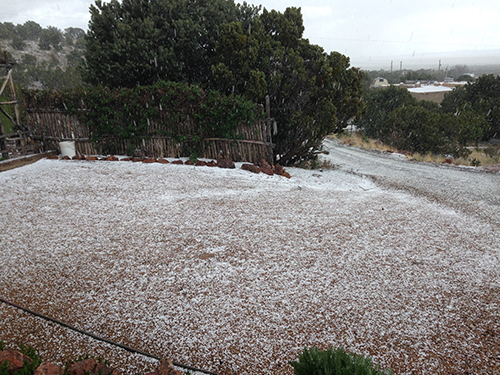
hail_may 09 2014

May 09. 2014

Wow! This weather is ugly. I for one am very tired of all this WIND and COLD COLD nights for us vegetable gardeners. Come on! I want to start planting in earnest!  I can hardly believe it’s still getting below freezing at night. Looks like mother nature is going to take us right up to the May 15th date of ‘first frost free date’ before we get out of danger of freezes at night and maybe not even then. Unbelievable! We’re expected to get up to 1 foot of snow up in our local mountains but just a trace down here in Santa Fe. Still, Colorado has it worse tonight! What are all those giant pumpkin friends gonna do to protect their babies tonight?!

I need to wait to plant warm season veggies like corn, gourds, squash, cucumbers, beans, eggplants, peppers, and of course my beloved tomatoes and giant pumpkins. So there they sit in the house, under their lights, getting huge, staying warm just waiting for their time to shine. I hope it’s soon. I don’t think I’ve ever planted my tomatoes so late-I always am able to sneak them in earlier with wall of waters which I still could do but every time I wanted to plant them this spring, I knew we were going to have freezing weather that night. I just keep telling myself-patience, patience.

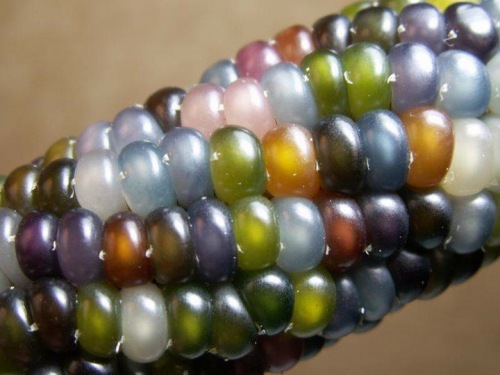
‘Glass Gem’ corn

glass gem_corn

Glass Gem corn seed courtesy of Nativeseeds.org

Wow I’ve scored big time in my mind. I just received some ‘Glass Gem’ corn seeds from Native Seeds in Arizona. They are not cheap but usually rare seeds aren’t cheap. This corn is so beautiful with it’s stunning translucent colors. Looks like glass to me. How fitting for a glass blower to grow this corn!

It is actually a popcorn but too beautiful to use it that way so I’m growing it as an ornamental this year so I can save the seeds-and I’m only growing this one corn so I know it won’t cross-pollinate with other corn so I’ll know the seeds will be pure next year. Two years ago I tried to find some of this corn but it was sold out everywhere. One year ago I tried again and still sold out. Marcy mentioned it to me on Facebook this year and I got some-thanks for the reminder Marcy!  To read the story of it go to: Nativeseeds.org

Can’t wait to get it in the ground (but I will) as it is still too soon to start growing here in Santa Fe.

Giant Pumpkins are UP!

giant pumpkins_050514Here is my final lineup for my giant pumpkins for 2014

HOW TO READ THE LINEUP BELOW:
The first number is how many lbs the pumpkin parent was, the next is the name of the grower, then the date it was grown, after that is it’s genealogy below it (it’s grandparents). It’s important to see who they were because they could have been bigger than the plant the seed came from. The genealogy can go back several generations further.

556 TODD 2011
-comes from: male: 1725 Harp 10/female: 50 Todd

856 Hoffman 2010
-comes from: male: 1544 Revier 09/ female: 1180 Pukos 09

1104 Wallace 2012
-comes from male: 1409.5 Miller/female: 1789 Wallace

1579 Wallace 2012
-comes from: male: 1381/female: 1789 Wallace

This slideshow requires JavaScript.

Here is the germination pics. They were planted on April 14th.

Here is my germination process: You need to start them inside the house where it is WARM. An unheated greenhouse or hoophouse will not work very well.

1. I first filed the edges lightly avoiding the tip until I see a little color change on the edge. Do not file too much.

2. I then soaked them for 12 hours in warm water with a few drops of seaweed emulsion.

3. I take a 4 or 5 inch peat pot and cut it in half on the sides only (not the bottom of it) and re-tape it so I can remove the plant more easily later if I need to plant up or if I can plant outside.

4. I planted them into 5 inch peat pots this year (I got the 5 inchers from Lowes here in town) with a good seed starting mix. (Some people put them on damp paper towels in plastic bags on heat mats until the root germinates but I prefer to direct seed them in the pots.

4. I then put them on a seed heating mat and cranked up the heat to 90-95°F. This is important as giant pumpkin seeds germinate faster when the heat is this high. So move other plants off this mat if they can’t handle the heat. If you don’t have a thermostat on your heating mat, you will need one to control the temperature.

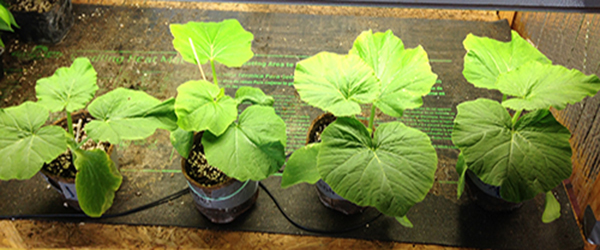
5. Check them twice a day and keep moist until they germinate. Sometimes one of the first leaves that germinate (called cotyledon leaves) will push up with the seed shell still attached as in the picture above. I waited a day and gently pulled it off without damaging the leaf.

6. Once they germinate,  you can turn down the heat to about 80° F. They like heat-no they love heat.

7 . I water with a weak solution of seaweed, fish emulsion and microbe brew from Fox Farms (it has mycorrhizal in it to help produce more roots) every week in between their normal watering.

FOR MORE INFO ON HOW TO GROW GIANT PUMPKINS GO GROWING GIANT PUMPKINS


Spring-More cold weather forecasted this week

Another cold snap has come into Santa Fe which is really unfortunate as all my apple trees are in full bloom. They are the last fruit trees to bloom on my property and usually escape the random freezing night this late in spring. But it was 32°F last nite and will be colder tonight and tomorrow night so we probably  won’t get any fruit again this year. When the apricots, peaches and plums were blooming this year, we had freezing weather and now the apple trees are hit. If this becomes true and we lose all the blossoms, it will be 2 years in a row where we will not get ANY fruit. Bummer.

Amy Hetager’s Memorial today-April 27

Today Amy’s life will be celebrated with a memorial. The memorial will be at:

LOCATION: Lutheran Church of the Servant

TIME: 1 pm

DIRECTIONS: 2481 Legacy Court Santa Fe NM (right off Rodeo Road behind Sam’s Club and Kingston retirement home on Legacy Court).

This is the Church that owns the Milagro Community Garden. This is the garden that was pivotal in Amy’s Santa Fe adventure.  After the Memorial, around 2pm we will walk across the parking lot to the community garden where we will share stories and touch the soil that brought so much happiness to Amy’s life.  So please join the celebration of Amy’s perfect life! Dress warmly and we all hope to see you there to celebrate this very special person who touched many lives.

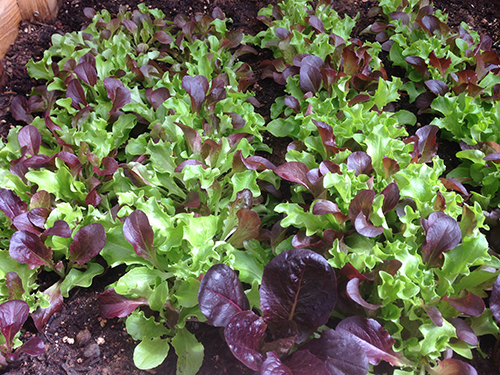
Green House Lettuce, Bok Choy & Chard on 3-31-14

GH lettuce 03-31-14

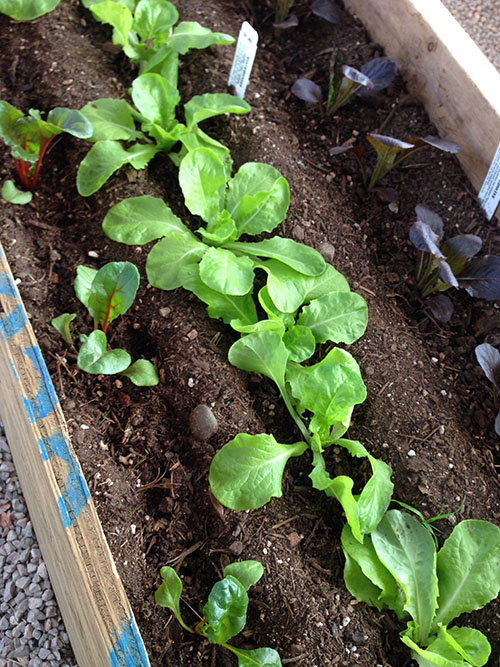
Holy Schmole! My lettuce, in the picture above was planted as transplants back on February 17th and look at it at the end of March. Fantastic! So excited to not have to buy lettuce and greens for a while. I’ve been experimenting in the greenhouse planting some seeds and some as transplants. I got these transplants as little tiny plants in pony packs from Agua Fria Nursery in town in February. On the left is Marshall Red Romaine. In the middle is ‘Winter Wunderland’ leaf lettuce and on the right is Bright Lights Chard.  They are growing in the middle raised bed where I had horse manure composting in January to try to add heat to the greenhouse but in mid February I took out as it cooled down and took all but the top 6 inches and added soil and compost and waa lah! You can see how big they got since March 21 here.

mesclun

Here is a pic of the lettuce I planted by seeds. It is a mesclun mix from Johnny’s called, 5-star lettuce mix. It’s not quite tall enough to ‘cut and come again’ but will be soon-probably in the next week.


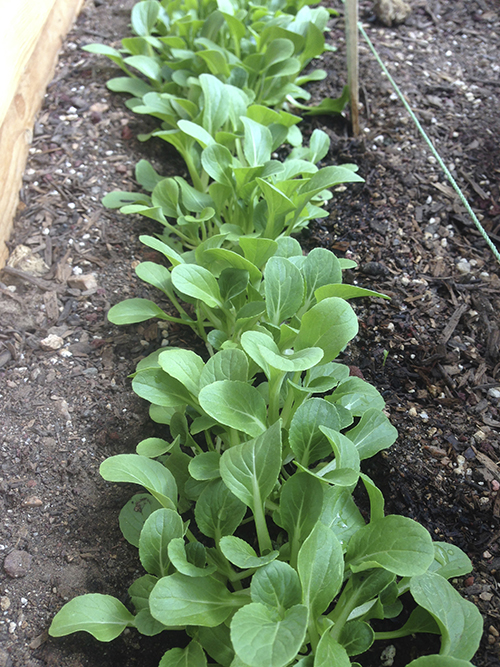
dwarf bok choi

Here is a variety of dwarf bok choy (choi) I planted from seed. I will transplant some of these to sell a little later and the rest will have room to really get bigger. They are doing really well.

yellow green bok choi

I love the color of this yellow-green bok choi – chartreuse! Such a great contrast to the other ‘greens’.

tatsoi

Here is a variety called tatsoi-the hardiest of the bok choi family. It grows in little clusters.

I planted all of them on the edge of the raised bed as I’m going to put in some tomatoes soon  in the middle of the bed as another experiment to see how they do. My thinking is by the time the tomatoes need more room, the cold hardy greens will be done (eaten)  🙂

Cold Weather Protection for Vegetable Gardens Class-this Saturday

Here’s the flyer info for my class this Saturday April 5th-Hope many of you can come-it should be good!


WOW pic for blog


Saturday, April 5
Cold Weather Protection for Vegetable Gardens
Protecting your crops in spring
Time: 10 am-12 pm
Instructor: Jannine Cabossel
Location: Whole Food’s Community Room (St. Francis location)
Please RSVP to 505-983-9706 or email: homegrownnewmexico1@gmail.com

Jannine Cabossel, a Master Gardener and ‘The Tomato Lady’ at the Santa Fe Farmers Market will teach a class about how to use row cover, cloches, hoop houses, wall of waters, and other items to get your garden in earlier with protection.

Jannine has extensive experience in growing vegetables on her 3000 square foot garden using all organic methods. Follow her blog at giantveggiegardener.com. Suggested $10 donation. Become a 2014 Member for $35 with $250 value-includes all classes, potlucks and tour.

The nicest people always seem to go first

PINK CLOUDS

This week I went to visit my good gardening friend, Amy Hetager on Wednesday afternoon. Her dad, John had emailed me that she went into home hospice care on Monday and I knew I wanted to visit her. Little did I know it would be the last time I would see her. She slept while I was there and I knew she was on her journey and she seemed peaceful. It seemed so sudden when I heard from her dad that she had passed away the next day on Thursday mourning and yet it was not really sudden.

Amy Hetager, leader of Home Grown New Mexico and whom I had gotten to know through working with her in both Home Grown and Master Gardeners organizations had been battling brain cancer for 5 years and had beat it back many times. Not many people knew she was sick as she was a very private person and I could respect that.  I saw at many of our events she would not be feeling well-maybe she had chemo that day or the day before and yet she always showed up at the events. She was so strong internally. It seemed like in the 4 years that I knew her she had to go every week to put those chemicals into her body. They would save her for a while but they also wrecked her. One of those ways was that she had many joint replacements during that 5 years as the steroids the doctors gave her to counter the side effects of the many different chemos she had also destroyed her joints. Many people knew that she had some joint replacements because it’s hard to hide a cast. This was no secret.

I use to tease her and called her the bionic woman and actually she was now that I think of it in several ways, the most obvious way being those new metal joints but there was another way she was bionic in that she could do so much. Running her baby, Home Grown New Mexico and being involved in so many other gardening associations and organizations in our community took a bionic effort as well and it was something she really enjoyed and I’m sure it kept her going too.

Amy was a kind, gentle person with a passion for vegetable gardening and especially growing tomatoes which we both shared. She loved to grow vegetables, harvest them and process or cook them and she was an excellent cook as well. She wanted to be more sustainable which is also why she started Home Grown.

It seems like the nicest people always go first to the other side. When Amy got obviously physically sick late last year, I took on her responsibilities in running Home Grown to help her out and am continuing it forward now. Many of us will miss her and hopefully those of us in Home Grown can carry her vision forward as she would have wanted it. I know I’m sure going to try.

Beets to try: Chiogga, Touchstone Gold, Detroit Dark Red, Cylindra and Craupaudine

getimage

Detroit dark red beets

Beets – Also known as ‘Beetroot’, they have many health benefits with antioxidants in them. Both the leaves and the roots can be eaten.

I never liked them when I was a kid because I only had them pickled. I didn’t like them that way then and still don’t like beets pickled. Then I discovered them steamed and roasted. Wow-What a difference in flavor! This year, I’m growing more beets than I ever have. They have a fantastic shelf life if stored in the refrigerator. I love beets now in a lettuce salad with a dab of goat cheese with sunflower seeds and a lite vinaigrette—divine. Also slow roasted in the oven-more divine. Now I love beets! Here’s what I’m growing this year and why.

Chiogga beets hail from Chiogga, Italy and are beautiful with red and white concentric circles inside when you cut them. I like them because of their beauty and they are sweet. They make a nice contrast to other beets.

Touchstone Gold beets– OP variety. New to me this year, I wanted a yellow beet to compliment the red beets. This has a fine, buttery texture, very sweet, and does not bleed like red varieties do. Can’t wait to try it.

Heirloom Detroit Dark Red beets are an old standby. This is not the hybrid variety of ‘Detroit Red’ but a heirloom variety so don’t be confused. It has very good sweet flavor and does well here. You can get the seeds from Baker Creek Heirloom Seed Co.

Cylindra beets come from Denmark and are excellent. The are long cylinder shaped instead of round and slice more uniformly than the round type. They grew well here. Very sweet-they are my second favorite. You can get the seeds from Baker Creek Heirloom Seed Co.

Craupaudine beets are my favorite beet of all time. Oldest beet variety in existence. Incredibly ugly and incredibly delicious. Very sweet beet and fantastic when wrapped in foil after you rinse it, (leaving the water on the beet) and placed over a BBQ where you add a few wood chips and smoke it slightly as it cooks till tender. The water on the beet helps to steam them a little too. To cook it like the French do go to my other article, ‘Rouge Crapaudine’ Beets-say what?!! They are a little harder to germinate so plant more seeds then you think you need. They are only available in the states from Baker Creek Heirloom Seed Co.

The last three are harder to find so I gave the source for getting seeds. Chiogga and Touchstone Gold are commonly available through many seed companies.

Swiss Chard-Argentata, Ruby and Bright Lights

chard_argentata

Argentata Chard is not only delicious but cold hardy too.

This past year I grew several varieties of chard—Ruby, Bright Lights and Argentata (shown above).

ruby chard with flowers

Ruby chard has the most brilliant red veins-grown with flowers it is stunning

For looks in the garden I would pick Ruby chard and Bright Lights (whose stalks come in lovely shades of red, pink, salmon and yellow) and grow them around my flowers inside my vegetable garden because they are soo beautiful (Ruby chard-above last year).

chard_chopped

Argentata chard loosely cut and ready to steam

But to eat and for flavor I would pick Argentata chard hands down. This heirloom chard, also known as Bionda da Costa, is revered by Italian cooks and for good reason. Argentata produces large, deep green leaves with juicy white stalks. The stalks are never stringy or tough like some other chards but soft and tender when steamed. I eat both the leaves and stems. Chard reminds me of steamed spinach only better.

chard_cooked

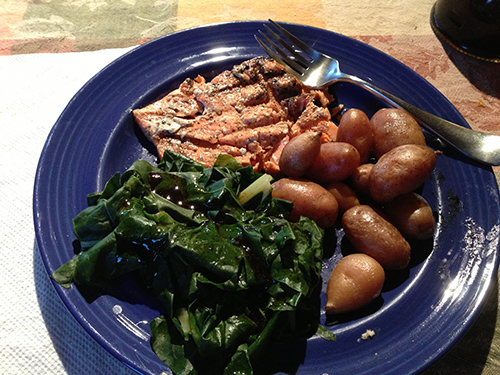
Here is the steamed Argentata chard with a little balsamic salad dressing on it with my french fingerling potatoes I grew and salmon (which I did not grow!)

And a bonus of Argentata is that it is one of the most cold hardy varieties. It won’t make it through the whole winter here in Santa Fe but will survive longer in the fall than the others with our cold winters. I got my seeds from John Scheppers Kitchen Garden Seeds.

🙂 We can plant chard seeds inside right now in March and early April and transplant them to the garden in late-April or plants seeds then too but not now as it is still too cold at night.

Spring has Sprung! Boing!

lettuce

Chard (left), WinterWunderland lettuce (center) and Mashal lRed Romaine (right) have doubled in size since planting in February in the greenhouse

Well, now that spring has sprung it’s time to get busy-really busy!  We vegetable gardeners will generally be headless from now on from pre-starting seeds to planting in the garden all those vegetables you’ve been dreaming of trying since January. And some of us are still cleaning up our gardens including me. Now is the time in our area, to continue seed planting or start seeds inside under lights or in a cold frame or a hoophouse. Just about any cold hardy veggies like Asian greens, lettuce, spinach, mesclun and many others can be started inside and some of those can also be started outside right now like arugula, bok choy, spinach and peas. Also if your space is warm enough, you can plant beets inside but DON’T plant beet and carrot seeds outside till April (right around the corner). The reason is the soil is still pretty cold outside in our gardens and they will just sit and sulk until the soil warms up. 😦

Spring Equinox

Yesterday,  March 20 was Spring Equinox, (or Vernal Equinox as it is sometimes called) where the sun passed directly over the earth’s equator and spring was official here in the Northern Hemisphere at 12:57 pm. ‘Down under’ they were having Fall Equinox. The word Equinox means ‘equal nights’ which translates to equal days and equal nights. It’s the first day of Spring. Many past people have celebrated spring equinox as they knew that soon their food sources would be renewed. Here’s one more interesting fact: The early Egyptians built the Great Sphinx pointing directly towards the rising morning sun on the day of the vernal equinox. Pretty cool.

What a beautiful day it was – unlike the day before with cold temperatures and cold winds.  Thanks you universe for that!

Seed Starting For Early Spring Crops-Class handouts

The Seed Starting For Early Spring Crops class that I taught today was sponsored by one of the organizations I’m a member of called Home Grown New Mexico. Home Grown New Mexico puts on many classes about growing, raising, making and preserving your food throughout the year. They are about sustainability, urban farming and growing organically which is right up my alley and the classes are open to the public. If you’d like to see what other classes/workshop Home Grown New Mexico is putting on, check out their website homegrownnewmexico.org.

Now, here are the handouts if you weren’t able to make the class or if you didn’t get them as we ran out of them during the class today-it was definitely a full house with about 35 people attending. It was a good mix of Master Gardeners, Interns and the public that attended. I really like to teach when you all show up! Hope you learned something and enjoyed it!

Starting Cold Hardy Plants in Early Spring Inside-2014

seed germination chart

PRESPOUTING SEEDS

Cold hardy crops for early spring in March-April

COOL-WARM SEASON CROPS