Cold Damage on Winter Crops

garden dec 9 2014

Well  here it is in early December and not surprisingly, most of the outside crops in the main garden, ‘bit the dust’ as they say—died. A few are still alive. It is warmer now—here are the results of those cold snaps we had.


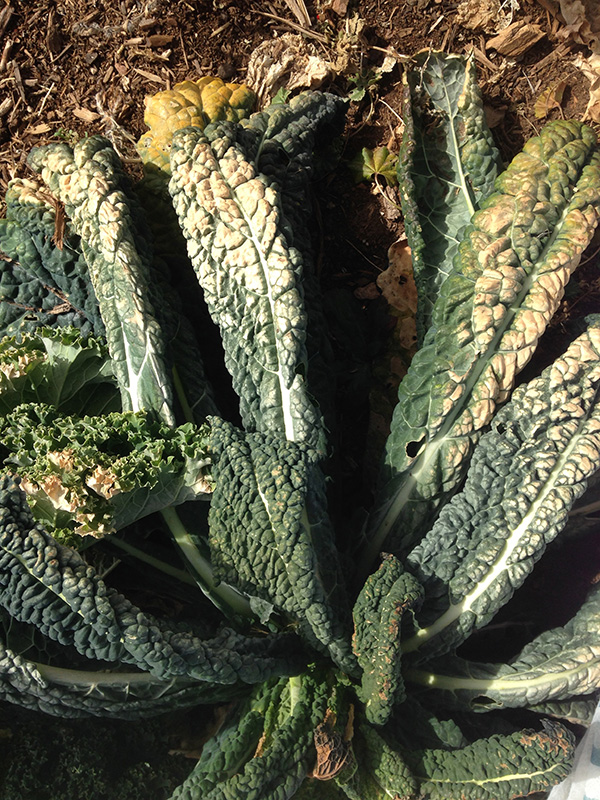
The Toscano Kale with freeze burn. It is more sensitive to cold temperatures  than other kales

Toscano Kale

The Toscana (aka Lacinato or dinosaur) kale got severely damaged. It is cold sensitive and although it’s not completely dead, it is unharvestable. Here it is with the leaves burned from the cold.


Russian Red kale is still alive

Russian Red kale


The Russian Red and Curly Leaf kale are still going and have some damage as well but the new growth is doing well. I haven’t watered them at all-nature has with a little snow and a nice rain the other day- almost an inch. I do have them covered with 2 layers of winter weight row cover.

gourds in field

The gourds are still drying in the field. Some are starting to get lighter in weight so I will put those in the garden shed to finish drying. The rest will stay outside until they dry more.

bubble wrap down on windowsThe green house is button up fairly tight now with just a little venting at the top panels. I’ve put the bubble wrap on all the windows (bubbles faced to the window) for extra insulation. I’ve also put the 4 barrels with water in them on the north wall for them to absorb heat in the daytime (I took them out during the summer), releasing the heat at night (the theory is that the sun which is lower and further to the south will hit them on the north wall and warm up in the daytime). I’m not sure I have enough barrels to do much good but even one degree will be helpful once it gets cold again.

winter lettuces

I’ve planted 2 winter lettuce varieties in the green house as transplants back in early November. The cold hard varieties are a green variety-Winter Wunder and a red variety-Marshall Red Romaine. They both have made it so far through those cold snaps although they have slowed down in growth because of the shorter daylight hours. They will stop growing until sometime in January when the daylight hours start to get longer.  Winter Wunder is my favorite lettuce but only grows well during the cold months. When it starts to get even a little warm, it will bolt. The lettuces have 2 layers of row cover over them at night and have some protection from the unheated greenhouse (at least from the winds). I’ve also noticed that the lettuces don’t need a lot of water now (about once every 2 weeks). It will be interesting to see if they make it Dec-February. Don’t they look wonderful in the winter!

There has been about a 4-7°F difference between the greenhouse temperature and the outside temperature at 7 am in the morning when I check everything. When I add the row cover at night I get about 4-6 degrees more protection. I’m not sure what to expect this winter since this is my first December-January  in the greenhouse. Last year when we finished up the greenhouse I start planting on February 17th so now I will see if these established greens can survive Dec-Jan.

Nov. 4, 2014-First HARD freeze in the garden

cold-clip-art-clipart-coldthermometerUnbelievably I haven’t had a HARD freeze here until last night. In October I had 2 nights where it was barely freezing and those did do some damage (nothing too severe) in the garden but we haven’t had a really HARD freeze till now.

The temperatures will be from the mid 30’s to high 20’s the next few nights here in Santa Fe so I guess old man winter is right around the corner. No matter, I picked my tomatoes just before the the first light frosts in October (not knowing how cold it would get that night).

I can’t ever remember having this warm of a fall. It’s been great for harvesting as I could take my time instead of rushing to get everything out. We usually get a hard freeze by mid-October so it’s been a wonderful fall for all us gardeners! Now it’s time to put the garden beds to rest.

Enough!

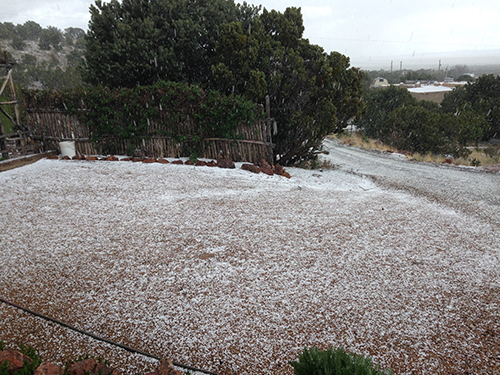
hail_may 09 2014

May 09. 2014

Wow! This weather is ugly. I for one am very tired of all this WIND and COLD COLD nights for us vegetable gardeners. Come on! I want to start planting in earnest!  I can hardly believe it’s still getting below freezing at night. Looks like mother nature is going to take us right up to the May 15th date of ‘first frost free date’ before we get out of danger of freezes at night and maybe not even then. Unbelievable! We’re expected to get up to 1 foot of snow up in our local mountains but just a trace down here in Santa Fe. Still, Colorado has it worse tonight! What are all those giant pumpkin friends gonna do to protect their babies tonight?!

I need to wait to plant warm season veggies like corn, gourds, squash, cucumbers, beans, eggplants, peppers, and of course my beloved tomatoes and giant pumpkins. So there they sit in the house, under their lights, getting huge, staying warm just waiting for their time to shine. I hope it’s soon. I don’t think I’ve ever planted my tomatoes so late-I always am able to sneak them in earlier with wall of waters which I still could do but every time I wanted to plant them this spring, I knew we were going to have freezing weather that night. I just keep telling myself-patience, patience.

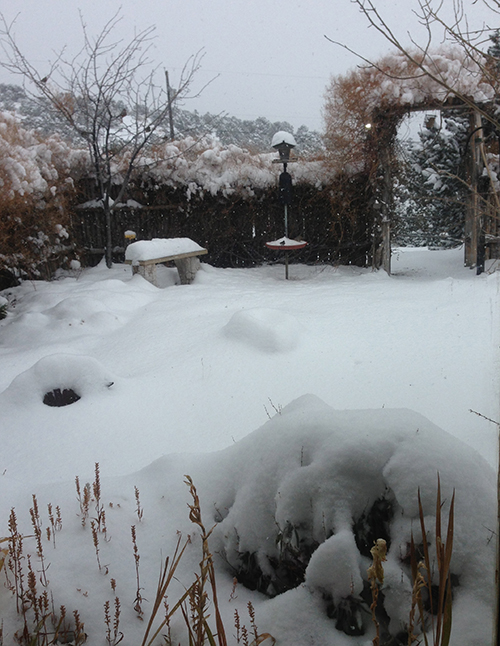
Snow photos from December 5

view of front yard from house

view of front yard from house

Looks like we are off the hook for watering our trees for December due to a big storm that came in this week and dumped 10-11 inches. Very beautiful. They say another one is on the way for Sunday. And if the ground froze around the trees don’t bother to water them until it thaws as it has been very cold and another storm is due in tomorrow. Here are some snow photos around the property.

This slideshow requires JavaScript.

July 7, 2013—1.25 inches of rain! Woo Hoo!!

RAIN-July 2011

The storm today must have been like the one above we got in July 2011

We have a terrible drought going on for the last 3 years here in Santa Fe. Came home from a movie this evening to discover in my rain gauge, we got 1.25 inches of rain! Many little rivulets in the driveway and the arroyo we cross to get to the house had been flowing. Of course this is huge news considering we haven’t had any appreciable rain in months and months and months. I wish I had been here to see it come down! Gonna turn off all the drip system for a few days! YEA!!!

Anyone else get any appreciable rain today?

BATTEN DOWN THE HATCHES!

windy atreeJust when I was emailing my friend Lava in Germany telling her how nice it has been here this spring, in come the gale force winds! What a horrible windy day. Almost blew the screen door off when I open the door. UGLY! Good day to stay inside!

Phenology

Forysthia-Photo courtesy of Monrovia.com

Forysthia-Photo courtesy of Monrovia.com

Phenology:

‘The study of cyclic and seasonal natural phenomena in relation to climate and plant and animal life.’

Phenology is an interesting science that has never been officially proven but ascribes to what I believe-paying attention to what is going on outside in nature at certain times of the year can sometimes serve as cues for the gardener for when to plant. Is it fool proof? Na, but neither is weather forecasting and I pay attention to that too.

Here is a list of tips I’ve compiled from many sources. Are they all true? Probably not, but wouldn’t it be interesting if we pay attention, write down our observations and make our own phenology for our local conditions in our gardens. I’m going to give it a try for a few years and see if I SEE any similarities to these tips below. Some of them are sort of humorous so I hope you enjoy them.

  • Plant lettuce, spinach, beets and carrots when dandelions are blooming. (what? we allow weeds to be in our gardens?)
  • Plant lettuce, spinach, and peas when the lilacs show their first true leaves or when the daffodils bloom.
  • Plant spinach, radishes and broad beans as soon as frost is out of the ground. (how does frost get out of the ground?)
  • Plant peas when the daffodils begin to bloom.
  • Plant beans when lilacs are in full bloom. (not sure of this one around here-seems early)
  • Plant cucumbers and squash when the lilacs fade.
  • Grasshopper eggs hatch when the lilac blooms.
  • Plant tomatoes, peppers, and early corn when daylilies start to bloom (I’m going to watch this one closely as I have daylilies)
  • Set tomatoes out when lily-of-the-valley is in full bloom. (Do any of you have this one?)
  • Plant corn when elm leaves are the size of a squirrel’s ear or when oak leaves are the size of a mouse’s. (Ok, I’ll just get out the ruler and measure those ears and compare)
  • Plant perennials when maple leaves begin to unfurl
  • Prune roses when the forsythia blooms (this one makes sense)
  • Plant pansies, snapdragons, and other hardy annuals after the aspens and chokecherry trees are leafed out. This indicates no more hard frosts.
  • Plant annuals when you see new growth on green ash, grapes, and bur oaks.
  • Plant annuals when peaches and plums are in full bloom.
  • Plant morning glory seeds when maples are fully leafed out.
  • When Morning Glories start to climb, Japanese Beetles arrive.
  • When Foxgloves open, Mexican bean beetles appear.
  • When the locusts bloom in May, it will turn cold and rainy (I wish)
  • Corn-“Knee high by the Fourth of July” (yes, yes!)
  • Plant peppers and eggplant outside when bearded iris is in bloom. (I’ll be watching closely on this one too)
  • When lilac plants have leafed out, plant lettuce, peas and other cool weather varieties. When it’s flowers are in full bloom plant beans and squash. When its’ flowers have faded plant cucumbers and squash.
  • When yellow forsythia and crocus bloom, prune roses and fertilize the lawn.

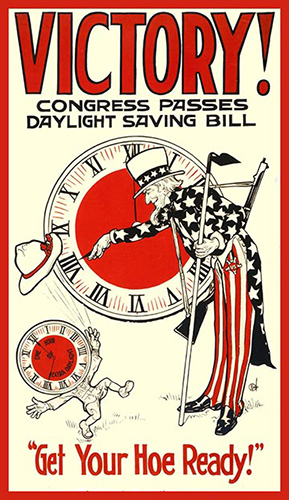
Daylight Savings

Uncle-Sam-Daylight-Savings-Time

So what is this daylight savings time (DST) that went into effect last Saturday? Simply put, as the days start get longer, we set our clocks one hour forward in the spring and set them back one hour in the fall. But we didn’t always have daylight savings time here in the US and in fact it has a pretty controversial history.

In 1784 Benjamin Franklin came up with an idea as a way to save money on candles only he didn’t want to change the time but the time people wake up. His idea? By firing cannons to wake people up! How’s that for a wake up call!

Actually the first implemented DST was done by the Germans in World War I as an energy saving measure. The US followed soon with its own version of DST but was it met with stiff resistance being repealed by Congress within a year of it being put into practice. For the next 5 decades it was up to the individual states to decide if they would practice Daylight Saving which became rather confusing for travelers.

In 1966 Congress passed a bill called the  ‘Uniform Time Act’ which tried to make it unanimous but there were a few state holdouts that refused to participate so in 2005 Congress revisited the law and moved the start date of Daylight Savings Time from the first Sunday in April to the second Sunday in March. There are still some state holdouts such as Arizona, Indiana and Hawaii that don’t observe Daylight Savings Time but overall there is no more controversy over it except in my house where everyone complains of losing an hour’s worth of sleep in spring-except me. I’m happy to have more sunlight at the end of the day so can get off work and still go out in my garden and dream of what will be this gardening season.

USDA Plant Hardiness Zones and ‘average first frost free dates’ explained

NMSo what are USDA Plant Hardiness Zones? And what is this ‘first frost free date’ we hear about as gardeners so often?

The Plant Hardiness Zone is a standard set by the USDA (United States Department of Agriculture) and is calculated by accumulating many years of data. Zones are used by gardeners to help determine which plants will most likely thrive in their area. “The maps are based on the average annual minimum winter temperature, divided into 10 degree-F Zones”. There are 13 Zones, the coldest being Zone 1 and the warmest is Zone 13.

In Santa Fe, we used to be in USDA Plant Hardiness Zone 5 but now Santa Fe is in Zone 6b (-5 to 0°F). The reason our Zone has been changed according to the USDA is because it has better models to follow with more information gathered throughout the years- not necessarily because it’s getting warmer (although I do believe that too). Some areas in our county could be Zone 6a (-10 to -5°F) if they are closer to the mountainous areas. If you are not sure what zone you live in (where ever you live) go to the USDA plant hardiness site and type in your zip code and it will tell you what zone you are in-it’s as simple as that. So when you go to a nursery and the plant tag says zone 7-forget about it—it won’t survive our winters but any tag with Zone 6 or lower number should survive.

The average first frost free date is the date that we can safely put plants outside in our gardens. Notice I said average because some years we are colder and some years warmer. You’ll just have to watch the weather closely in spring for deciding if you want to try to sneak them out earlier in your area if spring appears to be a warm one. In Santa Fe our first average frost free date is May 15. So plant away outside after May 15, unless you hear we are getting a hard freeze! Of course if you are starting them in a hoophouse or greenhouse, you can start seedlings much earlier.

Now, once you know your planting zone and first frost free date, you can use the many tools available on the web for calculating all kinds of things from seed starting to succession planting to harvest times. Many seed companies have web tools to help you calculate the dates. In my next post I will show one such tool I use.

Rain!!

Woo Hoo! FINALLY we got some decent rain here. Haven’t had ANY rain since early July and the soil is so parched. Now if we only get another 30 days of this we might get rid of our terrible drought. Tomorrow I’m gonna turn off the drip system to the vegetable patch!

El Nino is here! Beautiful rain!!

El Nino Pattern

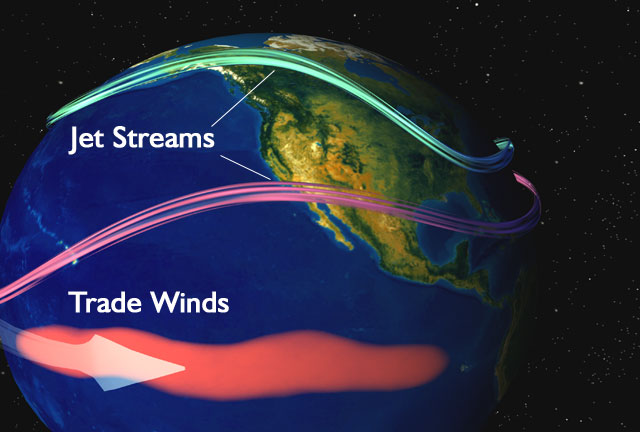
Looks like El Nino is back! After having his evil little sister here (La Nina) for the last 2 years, it looks like she is finally gone. La Nina weather pattern in New Mexico basically mean we have droughts while El Nino weather pattern means we get our normal or above normal precipitation in the form of the monsoon rains in the summer and snow in the winter-much needed moisture after 2 years of an extreme drought. All this because the jet stream which has been missing us and going above New Mexico will be coming back down and bringing storms and moisture to us. Hallelujah!

So I was happy today being stuck inside from 10am -4pm with this FANTASTIC RAIN!! And it looks like it’s not over for today. Incredible! It poured! Incredible! Rained almost continuously! Fantastic! We have been so parched here in Santa Fe greater area that this was truly a blessing from the universe that we desperately need.

Looks like I’ll turn off the drip systems for a few days! YEA! To read more on the El Nino, go to Chance of El Nino Conditions Just Went Up

Wind Wind Go Away…

It’s suppose to rain (LOL) this week-maybe. At least this is the best shot for some moisture since late winter. Of course with the possible storms come the WINDS again. Winds are about 20 mph. Not pretty. But we really need some moisture so we all endure-like we have a say. And it’s been such a nice spring, sigh.

And no I didn’t plant tomatoes this past weekend. Ran out of time..Good thing.

Fire very near the house!

The fire at our neighbor's house last Thursday. Those little vertical squares in this photo are the windows in the house. Fire reached 20 feet high a few times.

A fire broke out on Thursday late afternoon in our neighborhood. It was less than 1/2 mile away which is basically 3 houses down the road and the way the wind was blowing with 45 mile hour winds, it could of taken out some of my neighbor’s houses or shifted and gotten ours. Luckily it went right in between 2 houses and missed everyone. I figure about 1/2 mile burned. Many of us neighbors were on the back line putting out hot spots and hosing down the land closest to the homes. The fire got within 30 feet of one home. I shoveled the hot spots and saved 3 trees from going up in flames. After the firefighters got there (3 fire engines) they made us get out of the hot zone after about an hour. Actually this was good because my throat was killing me the rest of the night from the smoke inhalation-it went away by morning. We had most of our valuables at the front door in case we were evacuated and several friends lined up to get our animals out but it wasn’t needed thank god…The next morning I was still shakey from the adrenaline rush/crash afterwards. We were all very, very lucky..

Finally RAIN!!

This slideshow requires JavaScript.

Finally been getting rain in Santa Fe. Here are some photos of the storms from the house. All photos by Elodie Holmes.

Las Conchas Fire Grows to 43,000 Acres this Morning June 27 2011

Las Conchas fire view from house overlooking Santa Fe at night June 26

So I know this is a gardening blog but want to share some pictures of the newest fire up by Los Alamos that is affecting all of us here in Santa Fe even though we are in no danger.  It is now BURNED OVER 43,000 ACRES and is within one mile of the lab.  Yesteday it was at 3000 acres. You can see it from the house. The view last night was spectacular. When I woke up this morning, there is lots of ash on my cars and a gray shroud of smoke over us. All photos taken by Elodie Holmes.

Las Conchas fire yesterday June 26 at about 8 pm driving back to the house.

Las Conchas fire from tea house area at house

Las Conchas smoke sitting heavy over Santa Fe this morning June 27

Las Conchas ash on cars this morning June 27