May 21-ALL TOMATO PLANTS IN

growfood,not lawns

It’s time to get growing!

Now is the time to seriously get into your garden. This is the busiest time of the gardening season with everybody wanting to get everything in their gardens. The day temperatures are now in the mid-high 70’s and the evenings are in the mid-high 40’s. PERFECT PLANTING WEATHER! Here is what’s been going on at my place. I feel I’m ahead so I actually have time to post something.

May 21-I waited to plant till after that last snow right after the May 15 date. All 120 tomato plants were in the gardens by May 21 with the help of Elodie Holmes, Lava Ewersmeyer, Mernie Ellessner and Janet Hirons and of course me! Many thanks to all my friends for their help! Boy, was I tired by the end of last week. This is the most tomato plants I’ve ever planted-hopefully it will be a great year and I will have many tomatoes to sell at the Farmer’s Market later this summer! I have 31 varieties this year. My favorites plus many new varieties. They are all in Wall of Waters (WOW) and I wouldn’t attempt to plant them at this date at our 7000 ft high altitude without them. Later the WOWs will be removed once the tomato plants reach the tops of them which will be sometime in June.

May 24-Meanwhile I’ve already put SEEDS in for Atomic Red carrots, Cosmic Purple carrots, Cylindra beets and Craupadine beets, transplanted broccoli-raab, Lacinto kale, Ruby chard, Argentata chard, Burgundy Amaranth and Zino fennel bulbs as of this week. All got row cover over them to give the transplants time to adjust in their new environment.

May 25-The peppers and eggplants are still inside, the little finicky darlings, basking in the windows as the nights are still too cold to plant them yet. If it stays warm I will put them in by the end of the first week of June.

May 26-I will NOW plant bean, corn, cucumber seeds, many flower seeds AND my giant pumpkins. I will also put row cover over them till they come up about 4 inches to keep the birds from eating them.

HAPPY GARDENING!!

Great Weather! Time to Plant?

RAIN5

Wow! Great weather this weekend with no wind, warm temperatures and wonderful rain today. I hear tomorrow brings more rain. Today we had some great rain and boy is it welcomed. The native plants and trees and all of our plants are sucking it up. I can’t remember getting this much rain at this time of year in May. A great big plus is the night temperatures are starting to warm up too with the next 10 nights suppose to be from 35°F- mid 40’s. Pretty cold but above freezing.

So can we plant tomatoes? Is it time? Well that depends on whether the nighttime temperatures remain above freezing. Of course the first frost-free date is officially May 15th historically speaking, but back in 2011, we had a very warm May and many of us planted early as it never got below freezing that May. Is this one of those Mays? Who knows, unless you have a magic ball. By the way, I waited to plant my giant pumpkins till later in 2011 (as they are so frost tender) and my 2010 State Record got broken that year by someone who went for it early. I guess I should have put them in but I just didn’t want to chance it. You have to be a bit of a gambler to put your plants in now.

tomatoes in wall of waters 1

But if you are a gambler and want to plant your tomatoes early, be sure you plant using wall of waters (WOW) as shown above.  If you use them, and the temperatures dip below freezing, they will protect your new tender plants. I always use them even when the nighttime temps are in the 40’s as I feel they provide more heat at night and keep them from setbacks. The cells of water warm up all day and give back the warmth at night to the plants like little greenhouses or cloches. Once they outgrow the WOW’s  (like in the photo above), take them off  the tomatoes, which will probably be late May. Do not leave them on all summer.

Are you chitting those potatoes?

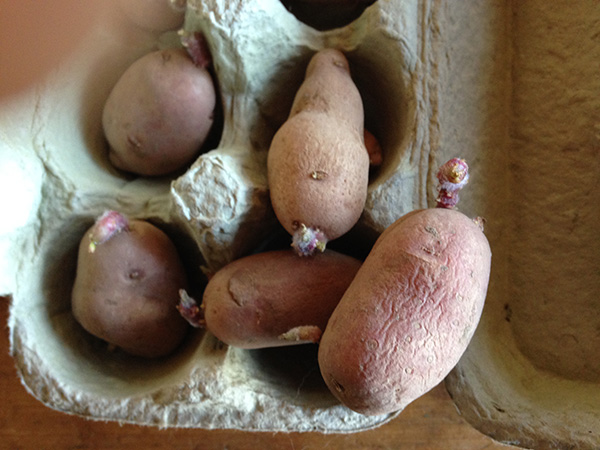
chitting potatoes_closeup

Are you chitting your potato seeds yet? Careful how you say that! You can get potato seeds at the local nurseries now if you plan to grow them this year. Potato seeds are actually smaller potatoes that you plant. Don’t use grocery store potatoes as most of them have a sprout inhibitor on them to reduce sprouting which is what we want.

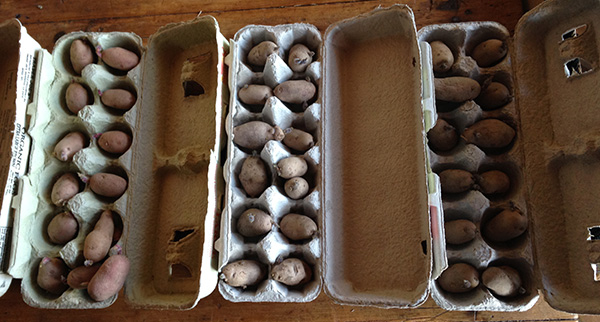
chitting potatoes

Chitting is letting your potatoes grow those little ‘eyes’ out. Put them in indirect sunlight. I use egg cartons to hold them so the eyes don’t break off. After they grow ‘eyes’, you should plant them this month-April. Chitting potatoes now will let you harvest them 2-3 week earlier when harvesting them later in the late summer.

This year, I’m growing them in ‘potato bags’ instead of a garden bed. My friend, Janet had fabulous luck with them last year-in fact she got more than I did in a raised bed so I’m trying her way this year besides it opens up another bed for me to grow other veggies in.

For more info on growing and chitting your potatoes, go to my original post ‘Growing and Chitting Potatoes’

2015 Santa Fe Seed Exchange

hg-seed-exchange

Santa Fe Seed Exchange-TODAY!
Tuesday, March 10, 2015

If you are looking for seeds and ideas for your vegetable garden, come to the Santa Fe Seed Exchange on Tuesday, March 10, 2015 from 4 pm-7 pm in Frenchy’s Barn on Agua Fria and Osage Ave. The City Parks Division and Home Grown New Mexico are hosting this event for all community gardens, school gardens and home gardeners. Agua Fria Nursery donated over $750 of seeds so there are plenty of seeds available. Come even if you do not have any to share. Bring flower, herb, vegetable and other seeds if you do.

The Santa Fe Master Gardeners will be at the event with an “Ask a Master Gardener” table for gardening questions and will have seed starting handouts to give away.

SB_BusinessCard_Back_photoThe SeedBroadcast organization will have their seedbroadcasting station to answer questions about saving seeds and seed story recording equipment.  Tell your story about the seed, where you got it, how you planted it and more.  See their website for stories across America.

Poki from Gaia Gardens and The Tomato Lady will be there with seeds also.

If you have questions, please contact: homegrownnewmexico1@gmail.com  or leave a message at 505-983-9706 and we will return your call.

Starting COLD HARDY VEGETABLES Super Early

lettuce_greenhouse germinating

So now that the Persephone period is almost over and the magic date of January 15th is upon us, what does that mean? It means our day lengths are getting longer and January 15th is when we start getting 10 hours of daylight that will continue to get longer every day. Have you noticed already it now gets dark around 5:30 instead of 5 pm? The darkest time of the year is over. What does that mean to gardeners? To learn how to start cold hardy vegetable seeds super early outside and how also how to start them inside read on.

STARTING COLD HARDY VEGETABLE SEEDS OUTSIDE: cold frme opened
If you want to try growing cold hardy vegetables outdoors at this time of year, you will need a cold frame, low tunnel or hoop house.

If you already planted cold hardy vegetables late last fall in a cold frame, low tunnel or hoop house, you may have noticed that the little seedlings haven’t been growing much at all as winter set in. Now with longer daylight hours, they will start to grow again and barring any devastating freezes, they will continue to grow and you can get cold hardy crops earlier this spring.

In late winter, before you have harvest your winter crops, decide what you want to plant in your bed once space opens up in your cold frame.  As the end of the Persephone period draws near (January 15) , you can re-seed the openings created from your harvesting or you could start planting seeds in your bed if you don’t have anything growing. My soil in my unheated greenhouse is at 40°F right now (as of January 12). Lots of cold hardy vegetables germinate in cold soil.  They will be slow to start at first but they will start as your soil warms up to 40°F and warmer. Now with the day light getting longer, you can think about starting early. The winter sowing you do will be ready for harvest by early spring, often long before the same crop when grown outside without protection. A bonus is many of the cold hardy winter crops don’t like our springs, bolting on the first few warm days so you’ll be able to harvest that spinach before it bolts!

Some cold-hardy plants planted inside a cold frame, low tunnel or hoop house can tolerate a hard freeze at night, provided they are allowed to thaw during the day. The plants must be completely thawed before you harvest them. In addition, put some winter row cover over seedlings at night to give them an additional 4-6°F protection even though they are already in a cold frame, etc. Remove the row cover on days when it is above freezing. Watering is necessary to get crops started, but they will generally need very little water during the winter season-early spring once established.

STARTING VEGETABLE SEEDS INSIDE:
I’ve already written about starting seeds inside on many earlier posts.
To learn all about starting seeds indoors to get a head start go here:
https://giantveggiegardener.com/2012/03/08/starting-seeds-inside/

WINTER HARDY VEGETABLES
The following list of winter vegetables to grow is from ‘The Winter Harvest Handbook’ by Elliot Coleman. These can be planted either as transplants (first started inside under lights) or outside as seeds in cold frames, low tunnels or hoop houses.

Asian greens-Tatsoi, Pak Choi (Mei Quing Choi), Mizuna, Tokyo Bekana,Komatsuna

arugula-Astro, Sylvetta

beets-Red Ace, Merlin, Touchstone Gold

beet leaves-Bull’s Blood, Red Ace

carrot-Napoli, Mokum, Nelson

chard-Fordhook Giant, Ruby Red, Argentata

claytonia

endive-Bianca Riccia

leek-Tadorna

lettuce-Red Saladbowl, Tango, Rex, Rouge d’hiver

 mache-Vit

minutina

mustard green-Toyoko Beau

radishes-Tinto, D’Avignon, Cherriette

scallion-White Spear

sorrel

spinach-Space

turnip-Hakurei

watercress

How to use my gardening website

apricot blossoms

Many people have contacted me about what’s going on in their vegetable and fruit gardens in the high desert of Santa Fe, New Mexico or in Zone 6a throughout the seasons and have particular questions. Feel free to write me but I want to go over how to use this website to your greatest advantage. Every few days I post something about what’s going on in the garden, or garden stuff I want to share. One way is to just go backwards (scroll down) and read them. But let’s say you have a question about growing tomatoes. You could go backwards which would take you forever as I have over 650 posts on various subjects (so far) but another faster way would be go over to the right hand column of this blog. From there:

Go down to ‘GARDEN TOPICS’ and scroll down to whatever interests you (in this case tomatoes) from starting tomatoes from seed, to garden hints, or all the way down to tomatoes in the vegetable section. That way you can cut out subjects that aren’t interesting for you. (What?)

Another thing I like in the right column is the ‘ARCHIVES’  section where you can read my posts for a particular month and even for a particular year. I use this a lot for myself as I look up when I planted something in previous years, or other info I want to review again for a particular month.

Another section is called, ‘PAGES’ which you can access from the right column or on the top menus on the blog. I think this is a great resource as you can look up the page for catalogs I like to get, my garden plans for each year, my seed lists of what I’m planting that year, classes I may offer,  films I’ve made from my Youtube channel-giantveggiegardener, Santa Fe Extension Master Gardener’s radio show, ‘The Garden Journal’ where I talk about what to do in the vegetable garden each month. and even the about me page with info about me and this website (if you care to know!)

So next time it’s snowing or cold and windy outside this winter, take some time to catch up on what’s going on. I know I do!

Final Clean Up in the Garden

Nick unloading manure

I’ve now cleaned out most of the beds except where the gourds are, the kale bed and the 2 perennials in the garden.

gourds in wheelbarrow

The gourds are drying nicely and I picked some of them this week. These are African Bushel Gourds.

rhubarb in dec

The 2 perennial plants in the garden have gone to sleep-the rhubarb and the strawberries. I will cover the rhubarb crowns shown above with straw (they look dead but they are not).

strawberrys in Dec

I will put row cover over these strawberry plants as I don’t like raking out straw from the strawberries in the spring-too much work. It is much easier to just uncover them. Look how the leaves turned red.

Since the kale is still alive, it is covered with row cover for now. I expect it to die too once we get really cold at night again.

nick closeup

My friend Nick and myself put 2 huge trailer loads of horse manure on all the beds after we cleaned them out of the dead plants  in November.

beds finished

Then we lightly turned the manure over in the soil to add more organic matter to the soil as shown above. This will break down over the winter and be ready to plant by spring. Yea! Because of him I actually got all the fall clean up done! Finally the garden can go to sleep and maybe me!

2 exciting classes this weekend!

I’m involved with teaching 2 classes this weekend that should be terrific! Read on!

If you’d like to come to either or both,  please RSVP  at 505-983-9706 so I know how many ingredients to buy for the Jam class and number of handouts to run out for both classes. We won’t be confirming your RSVP– just know you’re in! Come to one or both!

FIRST CLASS

rain-barrelSaturday, July 19
Creating a Rain Barrel and Learn About Rain Catchment
Learn how to make your own rain barrel and learn all about rain catchment
Time: 10 am-1 pm
Instructor: Amanda Bramble/Jannine Cabossel
Location: Milagro Community Garden (Rodeo Road and Legacy behind church)
Presented with Milagro Community Garden at milagrogarden@yahoo.com
RSVP to 505-983-9706 or email: homegrownnewmexico1@gmail.com

Learn how to make your own rain barrel with this hands-on workshop. Amanda will cover the basic elements of rain collection systems including sizing and sitting your tank as well as keeping the water clean. We will also discuss accessories like tank gauges, first flush systems, and filters for DIY systems. Jannine will demonstrate making a rain barrel out of a 55 gallon drum. Amanda Bramble is the director of Ampersand Sustainable Learning Center in Cerrillos, NM (www.ampersandproject.org).

Class is free but we have a suggested $10 donation or become a 2014 Member for $35 and the following free: classes, potlucks and one ticket to the big tour on July 27th.


THE SECOND CLASS

jam photoSunday, July 20
‘Jamming Jam Class’
Jam Making Class
Time: 10am-1pm
Instructors: Jannine Cabossel/Duskin Jasper
Location: Whole Food’s Community Room (St. Francis location)
RSVP to 505-983-9706 or email: homegrownnewmexico1@gmail.com
(You will not be contacted back, we just need to know how many are coming for printing handouts and how much ingredients/jars to bring.)

In this preservation class, you will learn how to make and process jams with available seasonal fruit. The twist on this jam session is our emphasis will be on adding unusual ingredients to make unique artisan jams. We will hand out recipes. We will also go over basic canning processes. You’ll get a jar of jam to take home! Come jam with us!

Class is free but we have a suggested $10 donation or become a 2014 Member for $35 and the following free: classes, potlucks and one ticket to the big tour on July 27th.

Use fencing wire for cages over vegetables

fence cage done

Fence cage covered with row cover for protecting vegetables. Shown with Tom-Tom the great packrat hunter!

The other day some of my followers on my blog asked what was under that row cover that was holding it up and I thought it was a great question. I’d like to say it was my idea but it wasn’t. A friend of mine, Tom (who helped me build the greenhouse) gave me those structures. It’s an ingenious idea.

fence cage ready

fence cage ready to go over vegetables

He took a 5′ tall roll of fencing wire (the holes were 2 inches by 4 inches but the hole size doesn’t really matter) and cut it into pieces that when bent in half would be about 15 inches high. You could make taller ones as well. I use to make hoops from 9 gauge wire but this is easier and supports the row cover better especially if it hails. I use them for low growing vegetables, vegetables that may need some shade, vegetables that I need to protect from insects and for transplants that need to acclimate to our harsh climate when I first put them out. The pokey ends get pushed into the ground. Then you put a piece of row cover over it big enough to cover both sides and the ends. The wind won’t pick up the row cover if you put rocks around the edges of the row cover. If you have longer rows, just over lap the cages to extend them.

closeup of fence cage

Closeup of fence cage covering kale and chard. Drip system in place.

I water with a drip system so I don’t have to get under them that much but they are easy enough to lift up on one side and tip back to get to the plants underneath to water. He originally bought the wire to make his tomato cages but found that you can’t get your hands through the holes to harvest and if you cut out some of the wire to make the holes bigger, the sharp edges shred your hands where you cut the wire so he used the wire this way. He had to move so he gave me the wire structures. What a great gift!

One last pumpkin goes in

giant pumpkins_050514

Barry Todd’s pumpkin, 556 Todd second from left. Photo taken May 6.

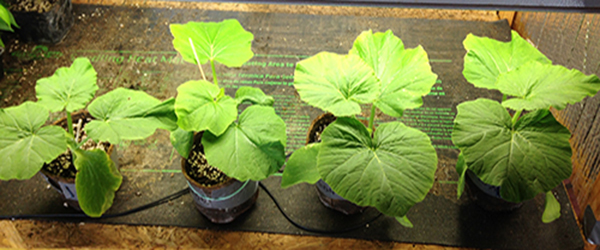
barrytoddToday I planted the 3rd and final giant pumpkin plant that has been growing steadily in the greenhouse. A pumpkin friend, Barry Todd, from Colorado gave me some pumpkin seeds a few years ago and I planted one of his last year and it was doing great when a rabbit or squirrel ate it down to the ground. So this year I wanted to plant another one of his seeds especially when I heard he was ill. He has been battling leukemia and is pretty sick but fighting on. This seed I planted is a cross between Cristy Harps’ 1725 giant pumpkin that broke the World Record in 2009 and another pumpkin Barry grew out a few years back that he is quite fond of-the Todd 50.  It is the 556 Todd. I was going to grow a giant bushel gourd where the pumpkin will go but I bumped the gourd to squeeze in Barry’s plant. I’m not sure if Barry is planting any pumpkins this year.

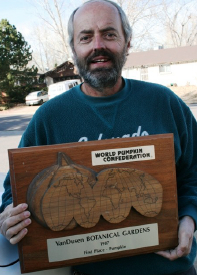
I met Barry a few years ago at the Old Colorado City Giant Pumpkin weigh-off and he was so nice to me and offered some pumpkin seeds for the following year. He was the Colorado State Champion for giant pumpkins with a 1308 lb pumpkin in 2010.We have been in touch since then regarding pumpkin growing and he has given me some great tips on how he grows em. I consider him one of my pumpkin mentors. I don’t know much about Barry except he is passionate about his pumpkin growing and his religion and I think it’s his faith that keeps him going. I wish you a full recovery Barry and hope this little plant breaks the NM state record. No matter what it does, I’m growing it in honor of you.

I still have one more plant in case one of the others get eaten or dies.

Giant Pumpkins are in!

pumpkin hotels

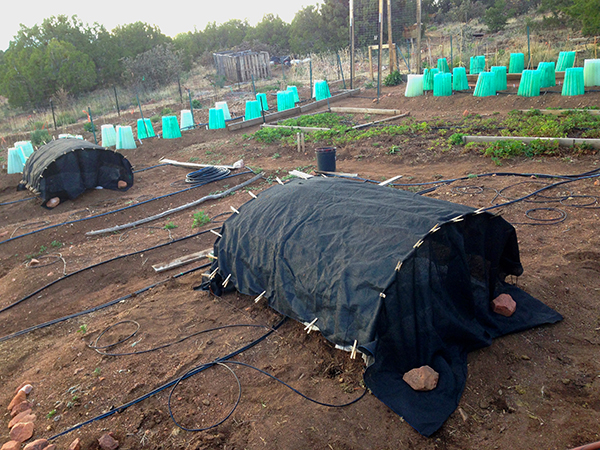
My giant pumpkins are in! Last week I managed to get them in the ground. They are being shaded from our intense heat and wind right now in these new low tunnels or ‘giant pumpkin hotels’ as I prefer to call them. This is the newest rendition of the low tunnels for them and I’ve had many designs. All I did is take one of my tomato cages which is made of concrete reinforcement wire and opened it up and put shade cloth over it (while they acclimate). I attached the shade cloth with clothes line pins and held the ends down with rocks. They are staked in the ground so the wind does not pull them up and inside each one is a pumpkin that is also covered with light weight row cover in case a squirrel comes in. As soon as they outgrow the ‘hotel’, I will take them off. They are about 5′ wide by 6′ long and if needed I can put row cover over the cage replacing the shade cloth for more light.

In the background is a strawberry patch I’m revamping but decided to wait before transplanting the ones growing out of their raised bed because they are June bearing strawberries so I want to harvest first. Then afterwards I will complete the move. Also shown are some of my tomatoes in their wall of waters. Some of them are now outgrowing the wall of waters so I am starting to take those off.

It is always amazing to me how desolate the garden looks when I first plant and how lush it will be later.  Nature’s miracle…oh ya and a LOT of HARD WORK!

Giant Pumpkins are UP!

giant pumpkins_050514Here is my final lineup for my giant pumpkins for 2014

HOW TO READ THE LINEUP BELOW:
The first number is how many lbs the pumpkin parent was, the next is the name of the grower, then the date it was grown, after that is it’s genealogy below it (it’s grandparents). It’s important to see who they were because they could have been bigger than the plant the seed came from. The genealogy can go back several generations further.

556 TODD 2011
-comes from: male: 1725 Harp 10/female: 50 Todd

856 Hoffman 2010
-comes from: male: 1544 Revier 09/ female: 1180 Pukos 09

1104 Wallace 2012
-comes from male: 1409.5 Miller/female: 1789 Wallace

1579 Wallace 2012
-comes from: male: 1381/female: 1789 Wallace

This slideshow requires JavaScript.

Here is the germination pics. They were planted on April 14th.

Here is my germination process: You need to start them inside the house where it is WARM. An unheated greenhouse or hoophouse will not work very well.

1. I first filed the edges lightly avoiding the tip until I see a little color change on the edge. Do not file too much.

2. I then soaked them for 12 hours in warm water with a few drops of seaweed emulsion.

3. I take a 4 or 5 inch peat pot and cut it in half on the sides only (not the bottom of it) and re-tape it so I can remove the plant more easily later if I need to plant up or if I can plant outside.

4. I planted them into 5 inch peat pots this year (I got the 5 inchers from Lowes here in town) with a good seed starting mix. (Some people put them on damp paper towels in plastic bags on heat mats until the root germinates but I prefer to direct seed them in the pots.

4. I then put them on a seed heating mat and cranked up the heat to 90-95°F. This is important as giant pumpkin seeds germinate faster when the heat is this high. So move other plants off this mat if they can’t handle the heat. If you don’t have a thermostat on your heating mat, you will need one to control the temperature.

5. Check them twice a day and keep moist until they germinate. Sometimes one of the first leaves that germinate (called cotyledon leaves) will push up with the seed shell still attached as in the picture above. I waited a day and gently pulled it off without damaging the leaf.

6. Once they germinate,  you can turn down the heat to about 80° F. They like heat-no they love heat.

7 . I water with a weak solution of seaweed, fish emulsion and microbe brew from Fox Farms (it has mycorrhizal in it to help produce more roots) every week in between their normal watering.

FOR MORE INFO ON HOW TO GROW GIANT PUMPKINS GO GROWING GIANT PUMPKINS


Green House Lettuce, Bok Choy & Chard on 3-31-14

GH lettuce 03-31-14

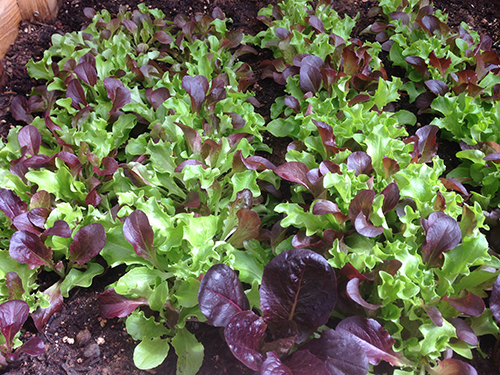
Holy Schmole! My lettuce, in the picture above was planted as transplants back on February 17th and look at it at the end of March. Fantastic! So excited to not have to buy lettuce and greens for a while. I’ve been experimenting in the greenhouse planting some seeds and some as transplants. I got these transplants as little tiny plants in pony packs from Agua Fria Nursery in town in February. On the left is Marshall Red Romaine. In the middle is ‘Winter Wunderland’ leaf lettuce and on the right is Bright Lights Chard.  They are growing in the middle raised bed where I had horse manure composting in January to try to add heat to the greenhouse but in mid February I took out as it cooled down and took all but the top 6 inches and added soil and compost and waa lah! You can see how big they got since March 21 here.

mesclun

Here is a pic of the lettuce I planted by seeds. It is a mesclun mix from Johnny’s called, 5-star lettuce mix. It’s not quite tall enough to ‘cut and come again’ but will be soon-probably in the next week.


dwarf bok choi

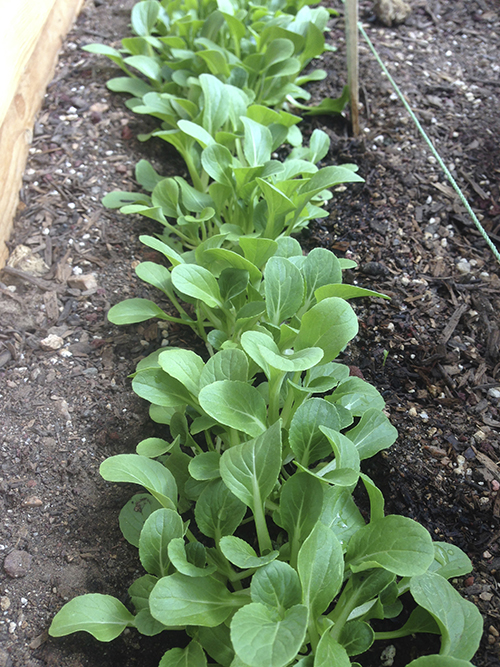
Here is a variety of dwarf bok choy (choi) I planted from seed. I will transplant some of these to sell a little later and the rest will have room to really get bigger. They are doing really well.

yellow green bok choi

I love the color of this yellow-green bok choi – chartreuse! Such a great contrast to the other ‘greens’.

tatsoi

Here is a variety called tatsoi-the hardiest of the bok choi family. It grows in little clusters.

I planted all of them on the edge of the raised bed as I’m going to put in some tomatoes soon  in the middle of the bed as another experiment to see how they do. My thinking is by the time the tomatoes need more room, the cold hardy greens will be done (eaten)  🙂

Cold Weather Protection for Vegetable Gardens Class-this Saturday

Here’s the flyer info for my class this Saturday April 5th-Hope many of you can come-it should be good!


WOW pic for blog


Saturday, April 5
Cold Weather Protection for Vegetable Gardens
Protecting your crops in spring
Time: 10 am-12 pm
Instructor: Jannine Cabossel
Location: Whole Food’s Community Room (St. Francis location)
Please RSVP to 505-983-9706 or email: homegrownnewmexico1@gmail.com

Jannine Cabossel, a Master Gardener and ‘The Tomato Lady’ at the Santa Fe Farmers Market will teach a class about how to use row cover, cloches, hoop houses, wall of waters, and other items to get your garden in earlier with protection.

Jannine has extensive experience in growing vegetables on her 3000 square foot garden using all organic methods. Follow her blog at giantveggiegardener.com. Suggested $10 donation. Become a 2014 Member for $35 with $250 value-includes all classes, potlucks and tour.

Spring has Sprung! Boing!

lettuce

Chard (left), WinterWunderland lettuce (center) and Mashal lRed Romaine (right) have doubled in size since planting in February in the greenhouse

Well, now that spring has sprung it’s time to get busy-really busy!  We vegetable gardeners will generally be headless from now on from pre-starting seeds to planting in the garden all those vegetables you’ve been dreaming of trying since January. And some of us are still cleaning up our gardens including me. Now is the time in our area, to continue seed planting or start seeds inside under lights or in a cold frame or a hoophouse. Just about any cold hardy veggies like Asian greens, lettuce, spinach, mesclun and many others can be started inside and some of those can also be started outside right now like arugula, bok choy, spinach and peas. Also if your space is warm enough, you can plant beets inside but DON’T plant beet and carrot seeds outside till April (right around the corner). The reason is the soil is still pretty cold outside in our gardens and they will just sit and sulk until the soil warms up. 😦