Winter Spinach!

Winter Spinach-Feb 1, 2011


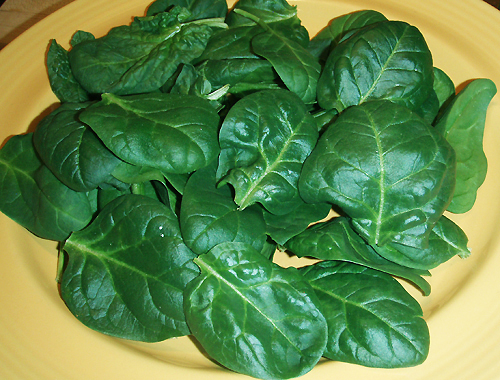
Just before we dipped down into -10 to -15°F for nightime lows during the first week of February here in Santa Fe, I picked all the spinach that had been growing up till then. I figured the winter garden greens growing in my coldframe (that is only protected by some bubble wrap on the lid-nothing protecting the 2 x 10 wood on the sides) would be toast but unbelieveably it survived! Not only survived but thrived! Now the chard is starting to really grow! I continue to be astonished by it all. I got 4 salads from the spinach and it was the best I ever had-I’m not just saying that either. I’ve never seen such deep green coloring for ANY spinach and it was so tender. Delicious! I only picked the bigger leaves so I’ll see if it regrows again. I’m starting to become a believer in this winter garden thing. Things grow a little slower in winter but hey, I’m a little slower in winter too.

OMG-what will it do in Spring?!

10 things to Do in February For the Garden

We may not be able to get out in our gardens right now but it is time to get busy with things to do to get ready for the garden. March will be seed starting time and there will be lots to do before for that. I will be elaborating on some of these items over the next few posts as I see there is moe info I can offer.

1. Go over your current seed supply. Organize it. Get rid of any seeds over 3 years old unless you froze them. Fresh seeds are essential for good germination. Older seeds have less success of germinating.

2. Decide which vegetables you want for this year and order any seeds you may need to get from seed catalogs.

3. Talk to your local nursery to see what they might be growing this year. I give a list to mine and they tell me what they are growing so I don’t duplicate. I prefer to let them do the growing, it’s just that I want to grow so many different varieties that they might not have so I have  to start some by seed.

4. Stock up on any fertilizers, amendments, compost, nutrients, mycorizzial, and biomicrobes you may need for veggies. i.e- tomatoes, giant pumpkins

5. Check your grow light boxes to make sure they work. Get new bulbs if necessary.

6. Check grow heating mats to make sure they work and get more if necessary. Last year I had one and ordered another as my seed growing expanded.

7. Purchase soil seed starting mix. I use Metro Mix 100 to start seeds. This stuff is great. The water doesn’t roll off the ‘dirt’ like many seed starting soils

8. Clean and sterilize any containers you plan to reuse for seed starting or transplanting seedlings. Use a 10% bleach to water ratio to rinse off the containers.

9. Buy any containers you may need for seed starting/transplanting. Most gardening stores sell up to 3″ in the peat pots. If you want a 4″ peat pot, go to Territorial Seeds. They are the only ones that have that size. I need them for my giant varieties cause they grow so fast. I also like the flats that have a raised lid. good for germination.

10. Read at least one good gardening book your interested in each month during the winter. I’m almost finished with ‘Four Season Gardening’ by Eric Coleman and just ordered ‘The Compost Tea Brewing Manual’ by Elaine R. Ingham.

More winter greens go in the cold frame

Well I got some more winter greens to plant from ‘The Veggie Man’ from the Santa Fe Farmers Market on Saturday. My good friend Lava, told me she saw him there selling veggie starts and found out where he has his greenhouse and we went over there and picked some up. I got Argula, Endive, Blue Kale, and Baby Bok Choy and Parsley. I will plant them on Wednesday in my Cold Frame (where I already have Swiss Chard, Oakleaf Lettuce and Spinach growing), weather permitting. We are suppose to get cold again on Wednesday so we will see if I or the plants can stand it.

More on winter gardening

Winter gardening is very different than summer gardener. It’s almost not gardening at all. In fact Eliot Coleman, author of Four-Season Harvest which I’m still reading says it’s not winter gardening but winter harvesting which puts it in a whole different light.  The only thing I need to do once in awhile is add water. There are no bugs or disease. I put my whole winter garden in with starts. Makes it really easy that way. He also talks abut eating vegetables when they are in their season so for winter gardening that could include spinach, tatsoi, bok choy, endive, arugula, corn salad, miners lettuce, radicchio, escarole, mesclun, sorrel, mustard, beets and carrots. I always thought that salads were a summer thing but that’s not true because salad crops grow best in the cool seasons and are sweetest then. That’s why we always have trouble with salad crops bolting. We plant them too late in Spring. I’m re-evaluating this whole winter gardening thing.

Winter Purslane (Miners Lettuce) and Mache (Corn Salad)

I was doing some research on Winter Purslane and Mache for including them in my cold frame for next fall/winter gardening and found a seed company in (of all places) New Mexico.  It is called www.gourmetseed.com and hails out of Tatum, NM and you can purchase these items and more from them.  Mache is pretty common but I haven’t heard about Purslane (except the wild kind that grows here). So let me talk a little about these two winter crops that have been grown in Europe for centuries.

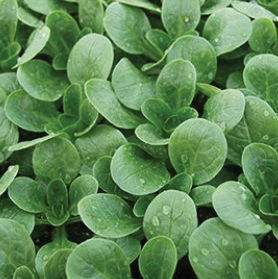
Mache (French Corn Salad)-picture from gourmetseed.com

Mache-(Valerianella locusta)

This gourmet green is also known as corn salad and lamb’s lettuce. It has been cultivated from France since the 17th century. Mache was named because it’s leaf resembles the shape and size of a lamb’s tongue!  It is one of the few greens that can handle our winters (like spinach). It grows in a rosette if you plant individually but most just broadcast the seeds (like you would for mesclun) in an area to make a carpet of leaves as they are very small. Growing low to the ground, it is harder to harvest but it has a nutty, sweet flavor worth the effort. To harvest it, just take a knife and cut it off below the leaf level being careful not to injure the delicate leaves and wash well. You can eat it alone or put it in with other salad greens but use a light vinaigrette or even lemon juice and a little oil-it is too delicate for heavy dressings. They say you can steam it like spinach but it is too small for me to do that. I grew this many years ago under row cover in raised boxes and it did well but grew very slow in our winter but when Spring came it was ready and I went out one day only to find the chickens had escaped and raided the garden and they ate all but a few leaves of my Mache! The few leaves left tasted wonderful so I hope they enjoyed it! It like colder weather so I may try again this early spring as it takes 6-12 weeks till harvest but much longer if it goes into winter. Mache doesn’t like to be warm. Maybe I’ll try it when I plant more spinach in early March and again next fall.

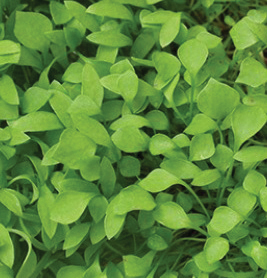
Winter Purslane (Miner's Lettuce)--picture from gourmetseed.com

Winter-Purslane-(Montia perfoliata)

This is not to be confused with the purslane weed that grows wild in New Mexico and throughout the U.S. I will write the next post on that one (Portulaca oleracea) because it is interesting too but for now I want to focus on this variety. This winter green is also known as Miner’s Lettuce or Indian Lettuce and is rich in Vitamin C. It was eaten by early miners to avoid Scurvy. This wonderful wild green is used in Germany and other European countries for it’s tender young leaves. It is used as an addition to mesclun and other salads or steamed like spinach. You pick the leaves when they are young and tender. Most people plant this in fall because it handles the winter so well. I think I will try this in my cold frame next fall. I haven’t done a cold frame in years until this year, but am enjoying seeing the spinach, oakleaf lettuce and chard in it. It’s nice seeing something green in the dead of winter and hopefully if they survive this winter, I will get an early crop of some wonderful greens and now that I’m excited again about fall/winter gardening, I will definitely plant some Mache and Purslane next year. You might consider it too.

Four Season Harvest

Four-season Harvest by Eliot Coleman

I am currently reading Four-Season Harvest by Eliot Coleman and am really enjoying it. It is about growing organically vegetables all year long. Great reading!  It has good information from season extensions to winter vegetable gardening and of course summer gardening. I highly recommend it. You can also go their site, fourseasonfarm for more information on all their gardening books and their farm.

Winter gardening

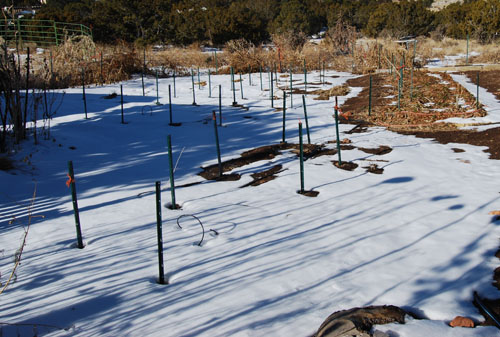
Main garden Jan. 8, 2011

Bri's Pumpkin Patch Jan. 8, 2011

It really looks like old man winter has arrived. Here are pictures of  the main garden and pumpkin patch down by the barn that I took this morning. We’ve had some precipitation (finally) on Dec 31-Jan.1 and some absolutely frigid temperatures last week which is why it is still on the ground.  Another Arctic blast is due here next week. Oh boy, can’t wait..

I went to get some carrots in my small patch protected only by 12 inches of straw up by the house for dinner last night and the carrots (yellow carrots) were looking good but the ground was frozen. All those nights in the single digits made the ground rock hard. Guess I’ll have to wait till spring when it thaws to harvest some.

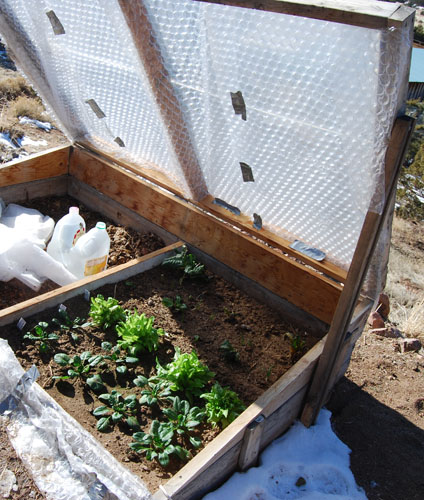
Cold Frame Jan 8, 2011

When I checked the cold frame, the soil is still soft and the plants are doing great!

Winter lettuce damage

A little damage on some of the lettuce leaves from the -4° we had one night but not bad considering I don’t pay any attention to it except for an occasional watering. In the picture notice I have large bubble wrap on my cover to add insulation and you can see the row cover to the left that I have to cover the crop with to also add protection. Guess this is working pretty well. The transplanted chard is holding it’s own and the spinach leaves ARE ACTUALLY GROWING-slowly but growing!  So I watered the cold frame winter veggies before the next big weather front.  I use gallon jugs to water-easier than the frozen hose…

Closeup of cold frame veggies