Transplanting winter lettuce and chard


chard crowded

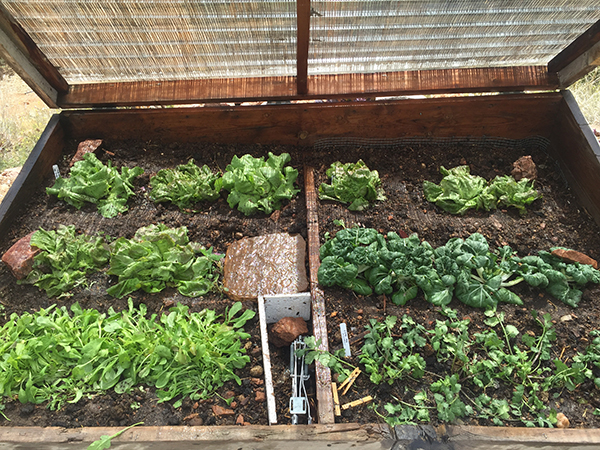
I went down to Agua Fria Nursery and got some lettuce and chard starts back in mid-November intending to plant them right away. I waited too long to transplant them and they got stunted and crowded in each cell as shown above.

chard just transplanted

Chard transplanted on Dec 1

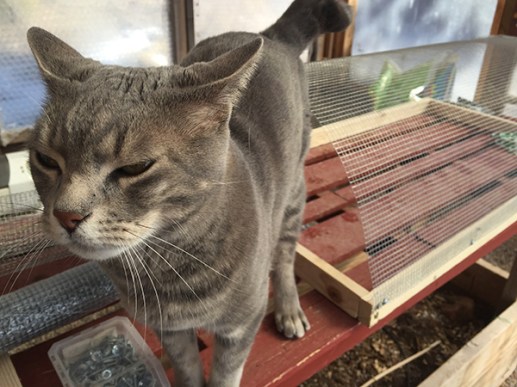
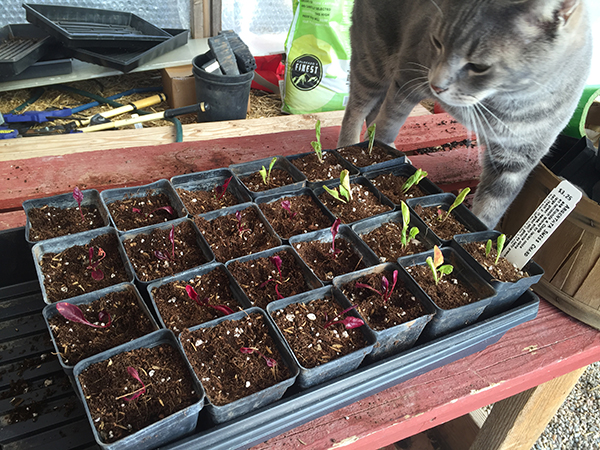
When I did transplant them I teased them apart and planted them in small pots. Here they are right after I transplanted them on December 1. ‘BT’, the man of the house, inspects them.

chard_2 weeks old

Chard transplants on Dec 14

Here are the Chard transplants on Dec 14-only 14 days later! Look at the difference between the two pictures. I’ve grown all the lettuce and chard transplants under my lights in the house as it is too frigid to put them in the greenhouse now. I figured I could wait till after the Persephone period was over and by then they would be just big enough to transplant in the GH. The Persephone period will be over on January 15th here in Santa Fe when the daylight hours get longer again. The plants will be ready to transplant way before that time period. The chards are coming along nicely. I’m growing ‘Argentata’ chard and ‘Ruby Red’ chard.

BATCH 64_MOONSHINE

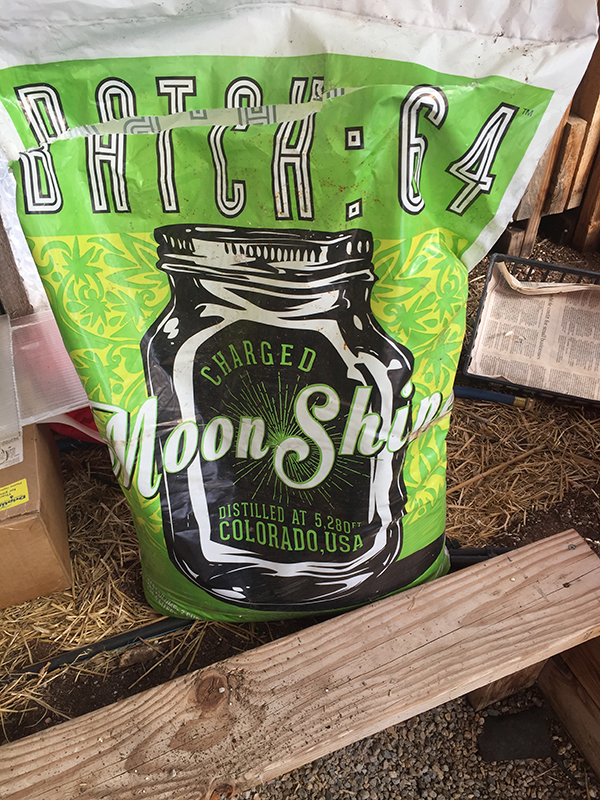
I planted them in a new potting soil called Batch 64-‘Moonshine’ which is available at Agua Fria Nursery in town. It’s fantastic with everything growing very fast. When I went back to Agua Fria Nursery and talked to Bob, he said he had the same experience last year, especially with the tomatoes.

Here are the ingredients in it: coconut coir, perlite, pumice, rice hulls, expanded shale, humus, worm castings, biochar, feather meal, fishbone meal, blood meal, alfalfa meal, oyster shell, metamorphosed evaporite, flaxseed meal, cotton seed meal, dried molasses, kelp meal, azomite, potassium sulfate, limestone, yucca extract, and mycorrhizae. Phew-quite a list!

The lettuces planted on Dec 1 are ready to transplant now! They have absolutely gone crazy growing super fast in this potting soil. The varieties I’m growing are North Pole, Winter Wunder and Marshall Red Romaine.

Veggie chips-yams, beets, carrots & red potatoes

veggie chips final

After making kale chips, I thought why not try making other veggie chips from some of my vegetables. After all, I’ve seen veggie chips in the stores and thought it would be fun to try make some. So far I’ve done yams, beets, carrots and red potatoes. Some of them I did in the dehydrator and some I did in the oven.

mandolinemandoline setting


For all of them I used a mandoline. Mandolines are used for slicing things very thin. The one I got was not very expensive but does the job well. It has 4 settings with #1 setting slicing the thinnest and #4 the thickest and all of the settings still slice thinner than you could do with a kitchen knife. Not having used one before, I started using #1 setting which slices super thin. I then tried #2 setting which I liked better for the dehydrator and then used the #3 setting which worked even better for both the oven and the dehydrator. It was all an experiment. Here is how I did them:

Yams
I started using the #1 setting of the mandoline to slice the yams which was too thin. Hard to believe it can slice veggies that thin. More like shavings. One big yam filled 10 trays!  I like the dehydrator for these as you don’t have to watch them so closely and they keep their gorgeous color. After they were done, they were paper thin. Subsequent batches I used the #2 and #3 setting which were more like a potato chip in thickness.

yam sliced

After cutting the slices of yams, I put lemon juice on them, about a tablespoon of olive oil and massaged them in till everything is coated.

yams on dryer

Then I put them out on the trays. You have to spread them out being careful to not overlap them so they can crisp up.I lightly put some crushed rosemary on some of them and just lightly salted all of them. The rest just had salt but no rosemary. Experiment. I set the dehydrator to 145-150°F for 2 hours and then turned it down to 135°F till the chips were crispy. Hard to say how long they take as it depends how thin you slice them and what temperature you use. It took 2 hours for super thin and maybe 4 hours for the #2 setting on the mandoline. They should be crunchy like potato chips.

beets sliced

Beets
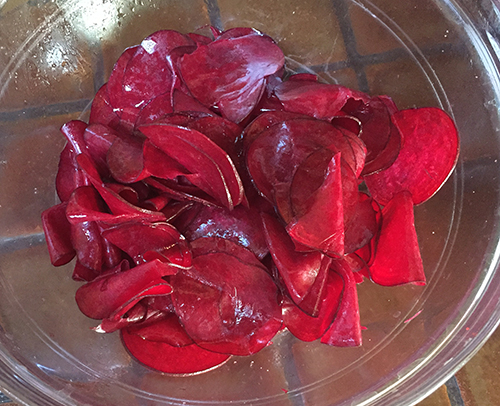
I used the#2 setting on the mandoline but think you can use the #3 setting as well for a more substantial bite. I put lemon juice and olive oil on some of them and on some of them I dipped in a cane sugar solution to make the beets sweeter-no lemon juice on those. I saw that as an ingredient in the store bought chips but afterwards felt it is not really necessary. Put on trays and lightly salt them.

carrots drying

Carrots
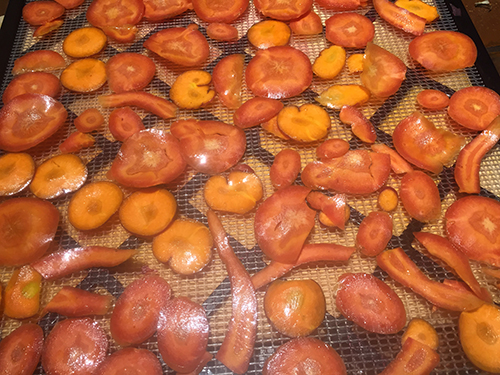
I used the #2-3 setting on the mandoline. Do the same as above with just olive oil and salt.


Red potatoes
For these I decided to try them in the oven as the thought of dehydrating raw potatoes didn’t really appeal to me. They were easy. I sliced them in my mandoline using the #3 setting which works well. I think they need to be a little thicker when using the oven as it gets done faster than using the dehydrator.

potatoes ready

When using the oven to dehydrate or baking the chips, you must really pay attention. If you do them in the oven, set your oven on 250°F (the lowest setting on many ovens). They cook pretty fast-about 45 minutes. You’ll have to watch them closely towards the end so not to burn them. Some recipes say set your oven at 300-400°F but when I did that they burned very quickly and were inedible.

For these I put about a tablespoon of apple cider vinegar and olive oil massaged in, then spread them out single layer on cookie sheet lined with parchment paper and then added salt on some, salt and pepper on others and salt and smoked paprika on still others. I tried onions but they turned out kinda funky.

potatoes_dried

Here are the finished potatoes.

Cherry tomato varieties review

cherry tomatoes group

There are many varieties of cherry tomatoes but this year I had 7 different varieties of small or cherry tomatoes. Six were heirloom or OP (open pollinated) varieties and one was a hybrid. Open pollinated varieties will be the next new heirlooms when they get to be 50+ years old. Six are shown above from left top row – Juane Flamme, Indigo Cherry Drop, Bottom row from left Artisan Blush Tiger, Artisan Purple Bumblebee, Artisan Pink Bumblebee and Sungold – not shown Black Cherry tomatoes (forgot to take picture!) I think it was way too many cherry tomatoes because of the time it took to harvest all of them every week (exhausting) but having said that, they were all very tasty. Three of the tomatoes pictured above were completely new to me. So let’s look at those above and review them.

tomato_juane flamme

Juane Flamme tomatoes

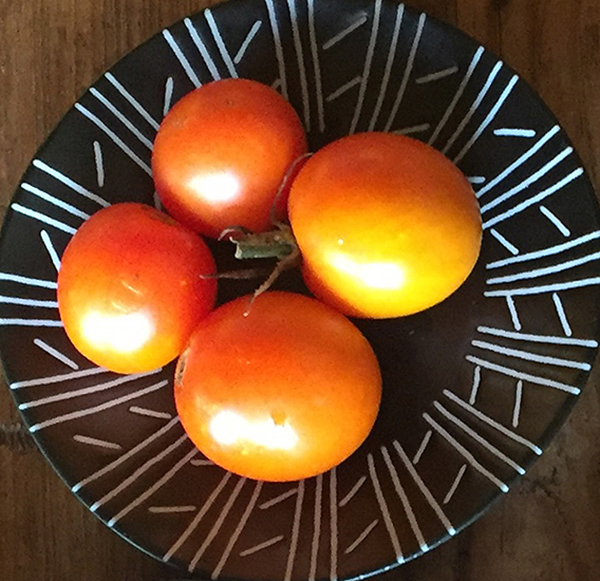
Juane Flamme – heirloom variety, mid-season tomato – originated by Norbert Perreira of Helliner, France. Extremely prolific. A favorite of my patrons at my Santa Fe Farmers market stand. Yellow turning tangerine color when ripe. Very sweet. Bigger than a cherry tomato but still small, about the size of a golf ball. The only problem I’ve had is in my garden, it was susceptible to Early Blight getting it 2 years in a row. Since I didn’t use any fungicides this year (but I did last year), I’m not sure that is fair although all my other tomatoes didn’t get Early Blight till the right at end of the season which I consider normal as they get more susceptible to diseases as they get old. Still if you like a very sweet tomato, you might try it and just be sure to use an organic fungicide early on to control it and you’ll be fine. You’ll need to get seeds unless we can talk the nurseries into growing them next year. Recommend it.

tomato_indigo cherry drops

Indigo Cherry Drops and Indigo Rose tomatoes mixed

Indigo Cherry Drop – OP (open pollinated) variety, early mid-season tomato-NEW to me this year. Excellent sweet flavor and incredibly large yields 1 inch cherry tomato. Part of the famous Indigo family where the shoulders are black and bottoms are red. Indigo Rose was the first tomato to come out and is a cross between a South American and Galapagos Island tomato. Any Indigo tomato-Indigo Rose (2-3 oz), Indigo Blue Beauty (4 oz) , Indigo Apple (4 oz), Indigo Blue Berries (too tiny to bother with) are the new darlings at the market and all the varieties have to do with the size of them as they all taste the same-excellent flavor hard to describe. Many of the Indigo varieties are available at the nurseries as starts in spring. Extremely prolific. I like them. Bigger Indigo varieties recommended but not the Cherry Drop-too small

tomato_artisan blush tiger

Artisan Blush Tiger tomatoes

Artisan Blush Tiger-OP (open pollinated) variety from Artisan Seeds, mid-season tomato. NEW to me this year. Unique julienne cherry tomato that is yellow with subtle pink stripes-very beautiful. Everyone loved this new variety. It has a fruity sweet, tropical flavor. Feathery foliage is different from regular or potato leaf types so don’t be alarmed – it’s normal. Did well and was disease resistant in my garden. You’ll need to get seeds unless we can talk the nurseries into growing them next year.  Recommend it.

tomato_artisan purple bumblebee

Artisan Purple Bumblebee tomatoes

Artisan Purple Bumblebee-OP (open pollinated) variety from Artisan Seeds, mid-season tomato. I actually grew these last year and liked them enough to grow again. They are dark purplish with green stripes. They have a superb sweet flavor. Very productive. You’ll need to get seeds unless we can talk the nurseries into growing them next year. Recommend it.

tomato_artisan pink bumblebee

Artisan Pink Bumblebee tomato

Artisan Pink Bumblebee-OP (open pollinated) variety from Artisan Seeds, mid-season tomato. NEW to me this year. I love this tomato as it has a very bright sweet flavor-a burst of flavor when you bite into it. Good disease resistance. You’ll need to get seeds unless we can talk the nurseries into growing them next year. Recommend it.

tomato_sungold

Sungold tomatoes

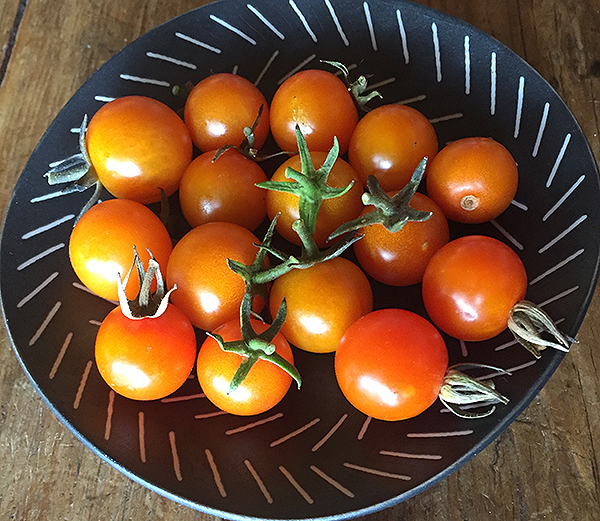
Sungold-hybrid variety. My only hybrid cherry tomato-early season. I’ve grown this for years as it is a supersweet tomato and when people ask for the sweetest tomato, I recommend this. Small yellow cherry tomato turns orange when ripe. Ripens early.  Extremely prolific. Available at the nurseries in spring. Recommend it.

Black Cherry tomato

Black Cherry tomatoes

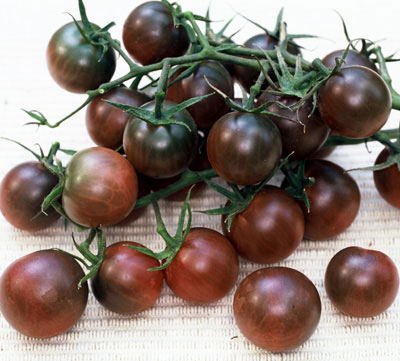
Black Cherry Tomato – Heirloom tomato originally from Russia, mid-season tomato. I have grown this for years as it is a favorite of mine and the patrons at the Farmers market. Sweet, earthy complex flavors so common with dark purple or black tomatoes. Good size cherry tomato that is a dusky purple. Available at the nurseries in spring. Recommend it.


Glass Gem corn experiment

Glass Gem corn 1

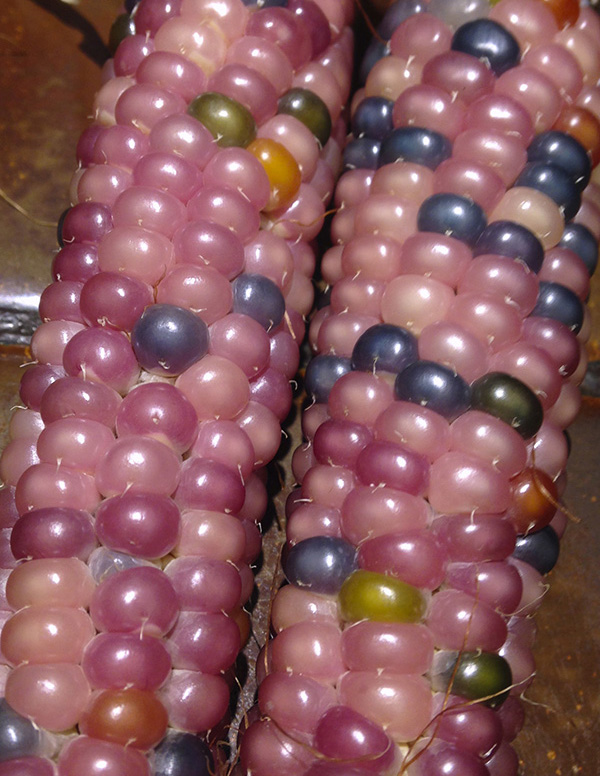
I like to do experiments in the garden and try different things. Last year I grew for the first time Glass Gem corn which you can read about in my post Glass Gem corn. When I harvested it at the end of the 2014 season, I got fantastic colors when I picked it. It truly is a special corn. But of all the many ears of corn with different colors, I got only little 2 ears of a gorgeous pink color which was like no other. I saved the pink kernels and cataloged all the colors i harvested which you can see in my post, Glass Gem corn colors. It was the only corn I grew and no neighbors grew corn so I feel reasonably certain that it is pure. This year in 2015, I decided to grow out those pink kernels and only them. I wanted to see if I would get more pink ones. Now since all the glass gem corn cross-pollinated with themselves, one would think I might get a great mix of colors this year again with such a big genetic pool, but not so.

glass gem corn ears pink

The majority of the corn was pink! Out of those 2 ears of pink corn (didn’t plant all the kernels), I got 27 ears of corn this year. I got 18 pink (3 not shown). That’s 66%. The pinks were in many different shades of pink as well.

glass gem corn ears mixed

I also got 6 mixed colors with very little pink if any and 3 more that were predominantly pink but had some purple in them too. If you include the other predominately pink ones as well, then that would be 77% of the corn I planted was in the pink family. That astonished me.

So what would happen if I planted the pink that I got this year for next year? Would I then gt 100% pink? Probably not. I think I would have to keep growing it out for about 5 years to keep eliminating any other color genes but it was a great experiment. Now there is something to be said about maintaining diversity. It tends to make stronger strains but I just might try it again next year in 2016 from this year’s corn and see what happens!

I’m finished with tomatoes for the year 2015!

JC at Farmer's MarketFinally this week there are no more tomatoes sitting around in the house! FINITO! NONE! DONE! Nice to see the kitchen table again! This week I made the last batch of tomato tapenade and the last batch of raw tomato sauce (24 frozen gallon bags of raw tomato sauce). Phew! As a friend Deborah says, ‘That’s the part no one tells you about’-preserving your produce. It goes on and on and on for months. Soon before Christmas, I will have to can some spaghetti sauce from some of the bags of frozen sauce. But not now-I’m gonna take a week off!

JC with fishIn fact right now I’m on a flyfishing trip on the San Juan River below Navajo Dam in our cozy SCAMP trailer. It’s cold outside tonight-going to get down to a lovely 20F° but the trailer is nice and warm inside (thanks Nevan for getting that great heater!) and do you believe it, we have internet access which is great as you want to be inside by dark because of the cold and going to bed at 6pm is a little early for me. Tomorrow we start fishing for some big ol’ trout HOGS. The fishing shops said today the dry fly fishing has been great. So I hope to catch some montrous fish and get some R&R while here for a few days. Better get some sleep (what me?!), although I don’t plant (freudian slip meant to say plan) to be out too early tomorrow…

Kale

winterbor_russian red kale

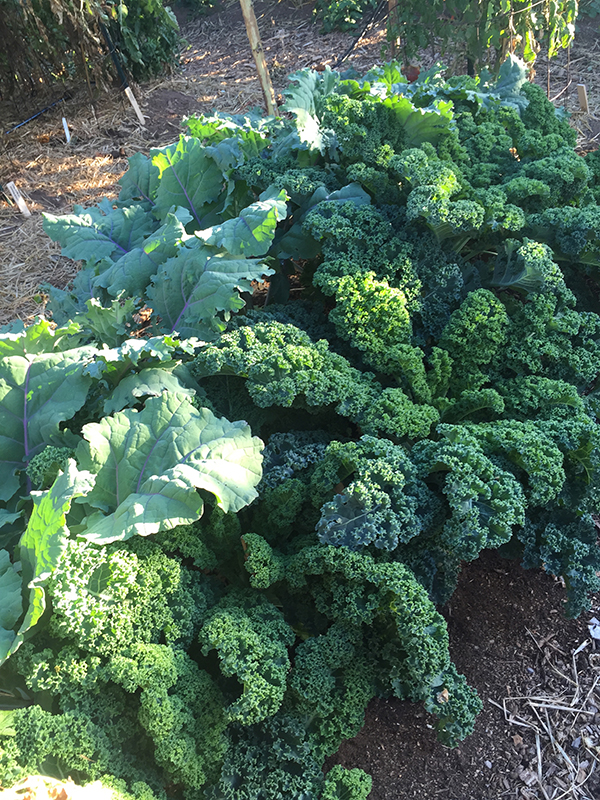
Russian Red Kale on left and Winterbor Curly Kale on right doing well with the cold nights

This year I grew 3 different varieties of kale-above is the Russian Red and Winterbor Curly kale growing together

lacinto kale

Lacinto kale (also known as Dino kale) It is the dark green in front of grape vine

Here is the Lacinto being shaded by the grape vine with carrots growing in front

Of the 3 varieties, Winterbor Curly Kale is my favorite and it is the most cold hardy. I started growing them the last week of July just before the Home Grown New Mexico Tour I was on. I had some holes in the garden so I ended putting some kale there. The Lacinto was partly shaded by a grape vine so it did not receive full sun. The Lacinto got heavily attacked by aphids. I sprayed all of them with water to help keep the aphid numbers down. But the Russian Red and Winterbor were planted elsewhere in the garden. I put them next to some tall tomato plants on one side and some tall sunflowers on the other side so they never got full sun either. They do well in our hot summers with some partial shade. They were not attacked by aphids. All three are still doing well. I’m not a great fan of kale so I’ve been looking for recipes that make me want to eat it. Here’s one wonderful way to eat it.

Kale Chips– you can use any variety of Kale to make this. This is now my favorite way to eat kale-dried! Kind of like potato chips but way more nutritional. Here’s a great simple recipe.

Kale Chips recipe courtesy of http://www.somastudio.net/2013/02/crispy-kale-chips/

Crispy Kale Chips
This kale chip recipe is easy to make and is so tasty you’ll want to make a double batch!

Ingredients:
2 big bunches of kale
1/2 cup raw tahini
1/4 cup olive oil
1/4 cup wheat free tamari
1/4 cup raw apple cider vinegar
1/4 cup nutritional yeast
2 cloves garlic
1 teaspoon onion powder
1 tpsp maple syrup
optional 1 tsp of chilli flakes

Instructions:
Rinse, de-rib, and rough tear the kale into a giant bowl.
Put all the other ingredients into a food processor or blender and mix until smooth or use a hand blender
Pour the mixture over the kale, and use your hands to toss it all together. Squish Squish! Get it good and covered.

Oven method:
Spread the kale out evenly on lined or oiled cookie sheets. You want them to be as ‘dehydrated’ as possible, instead of baked.  250º for 4 hours (ish). Every oven is different so you’ll need keep an eye on it and be your own judge. Just remember that too much heat will change the flavor.  Don’t overcook them!

Here is the recipe in PDF format for printing:
Kale Chips recipe

___________________________________________

MORE METHODS

Dehydrator method by http://www.giantveggiegardener.com :
Spread the kale out evenly on the dehydrator trays. Set temperature 115°F° or lower for about 4 hrs or more. Chips should be dry and crunchy when done. Every dehydrator is different so drying time may vary. This is still considered raw food done this way.

Raw food is food that is dehydrated at 115° F or lower to be the most nutritious and not lose vitamins. Above that and you start losing the nutritional value.

Here is some visuals of the process:

kale_squishing

Put cleaned, dry kale in bowl with the recipe ingredients below and squish with your hands so kale is well coated.

kale_putting on trays

Put on dehydrator trays

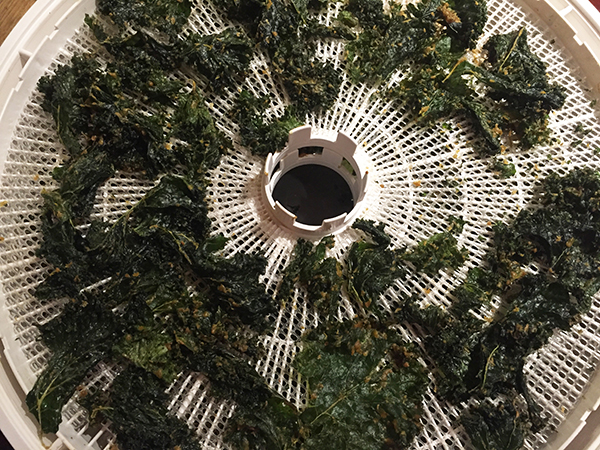
kale_drying

Dried Kale chips

kale_dried in jars

Store in jars or zip-loc baggies-I like storing in jars as the pieces don’t break up so much.


.


How to Save Tomato Seeds

Some of you may still have the last of your tomatoes inside your house ripening. If you would like to save the seeds or if you don’t have any seeds but would like to learn how to save them for next year then read on. It’s a simple procedure where we must remove the gel from around the seeds before drying them.

But before that, the first thing to consider is if the tomato is a hybrid or an open pollinated (OP) or an heirloom tomato. Don’t save hybrid tomato seeds as they won’t grow out true meaning they will not grow out to be the same tomato. They revert to one parent or the other and are unstable so you won’t know what you’ll get. If you have open pollinated (OP) or heirloom tomatoes you can save the seeds as both will grow out into the same tomato. An exception to this might be if you plant cherry tomatoes close to the tomatoes whose seed you want to save. Cherry tomatoes could cross-pollinate with other tomatoes but most heirloom tomatoes do not cross with each other. Just grow your cherry tomatoes away from  your other ones.

Put tomato seeds in a small jar of water (viewed from the top)

Put tomato seeds in a small jar of water (viewed from the top)

First you want to save a tomato that is really ripe and soft. To save the seeds from tomatoes we must remove the gel from around the seeds. Cut the tomatoes open and squeeze the tomato with the gel and seeds into a jar and add about 2-3 inches of water. Cover the jar.

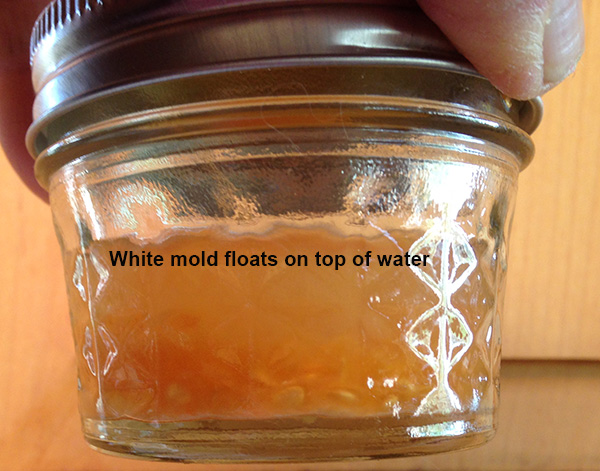
white mold grows on top of the water

white mold grows on top of the water

In a few days you will notice that there is a white mold growing on top of the water and most of the seeds will have sunk to the bottom of the jar. Don’t freak out, this white stuff is fermentation working on your seeds.

drain the tomatoes and stuff off

drain the tomatoes

After about 4 days, strain the tomato seeds in a fine sieve or strainer and wash the yuck and tomato stuff off of the seeds. If you wait too long the seeds will start to germinate which will ruin them.

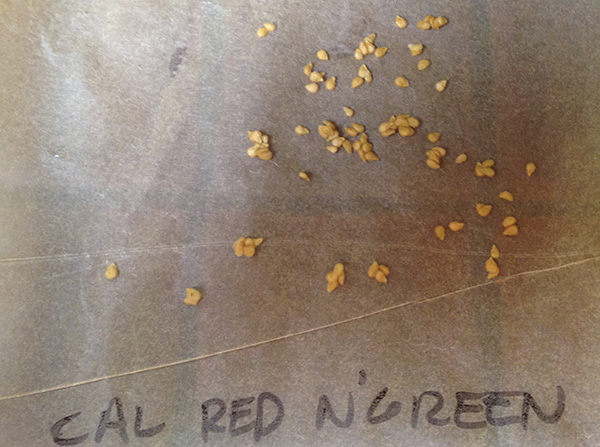
Put your seeds on wax or parchment paper. Write down the variety.

Put your seeds on wax or parchment paper. Write down the variety.

The seeds can now be put on wax paper to dry. If you use paper towels, the seeds may stick to the paper causing trouble removing them. Be sure to label them so you remember which variety they are. After they are thoroughly dry, store them in a plastic bag or jar for next year. It’s fun to save seeds and see what happens next year.

Drying tomatoes

IMG_7961

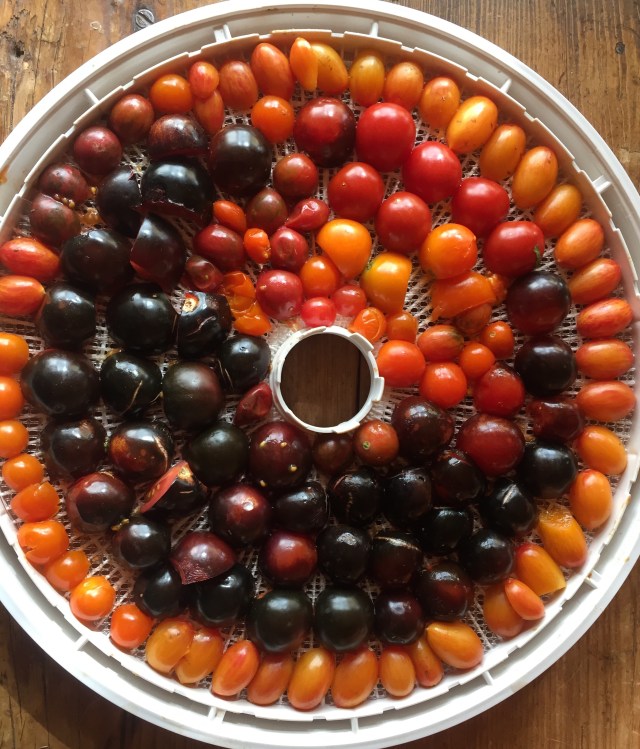
So someone gave me a jar of dehydrated tomatoes in olive oil and I thought they looked very beautiful and I know when you put them in pasta dishes, it’s bursts of intense tomato flavor. A great addition in the kitchen. So I thought, that’s what I can do with all those little cherry tomatoes! Look how beautiful they look when first put on the trays. I’ve dehydrated some during the last 2 weeks. I put all kinds together and not just cherry tomatoes.

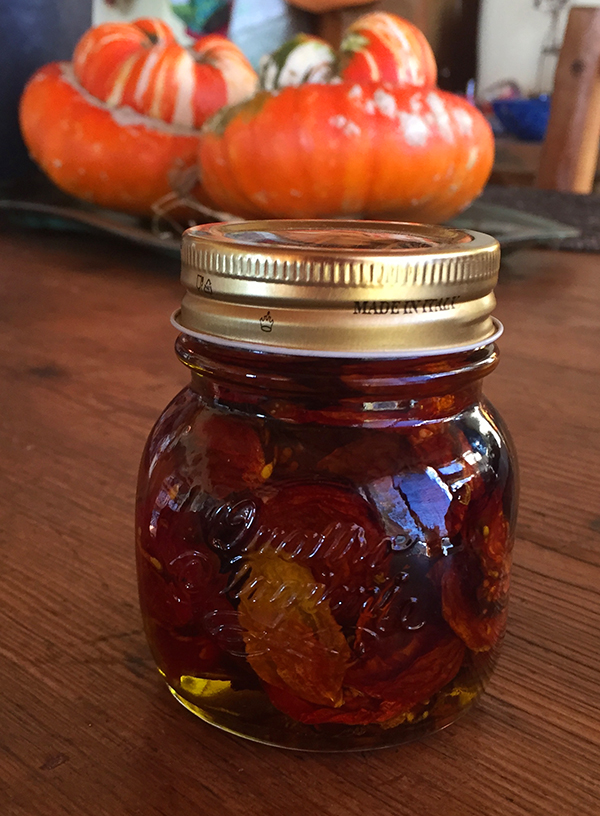
tomatoes in oil

Here they are in the olive oil in a jar. I love these jars from Italy-Quattro Stagioni.
You can get them at Amazon. These are the 5 oz size.

I want to still eat some fresh while they last but there is definitely more than I or a small army can eat before they go bad. Today I also made 4 more pans of tomato tapenade. Pantry is getting full quick!

Turk’s Turban Squash

turk's turban squash

This year, one of the squash I grew is called Turk’s Turban (Curcubita Maxima). I picked all of them last week right after the first frost which killed the vines. Winter squash gets sweeter if you leave it outside for one frost. It’s a beautiful heirloom winter squash with a cap like a turban hence the name and is orange, green and white with some warts. It is also known as French Turban and Turk’s Cap and is an old variety from France (predates the 1820’s). They can get up to 12″ in diameter but my biggest was about 9 inches. It was easy to grow and didn’t get squash bugs which was great. Many people use them as a gourd because of their beauty but I’m going to eat it to see how it compares to other winter squashes. They say it is sweet, rich and nutty—I’ll let you know!

Mexican Sour Gherkins

MEX SOUR GHERKIN PLANT

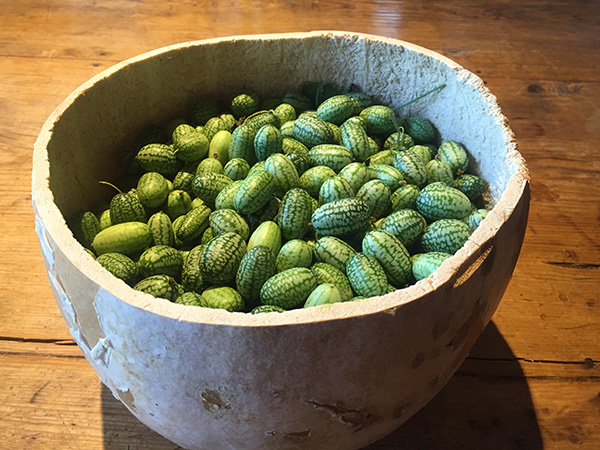
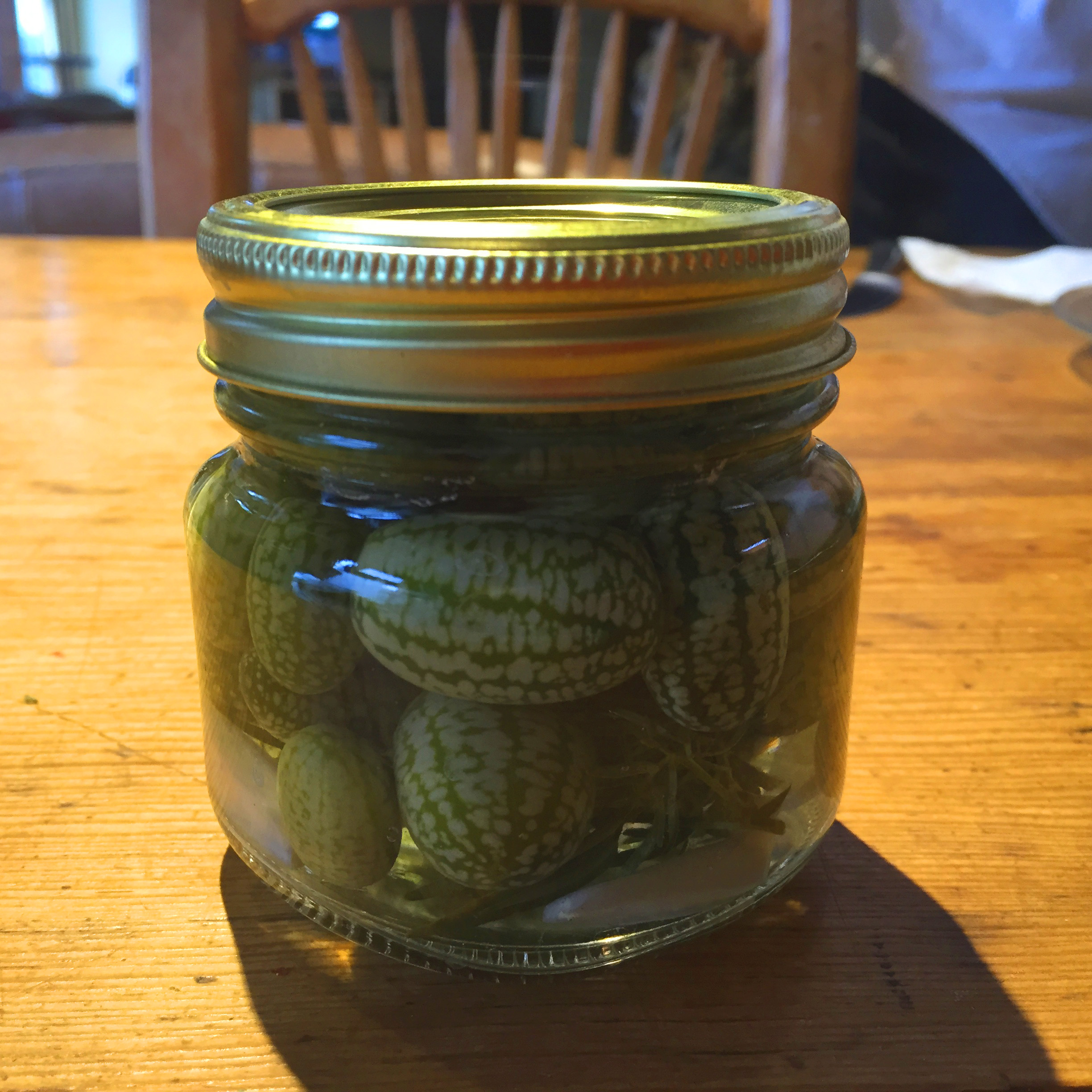
This year I tried growing a few new things in the garden. One of them was Mexican Sour Gherkins. What is so cute about them is they look like miniature watermelons. They are about the size of a large olive and taste like a tart cucumber. They are native to Central and South America and are in the Curcubit family like a cucumber but are not cucumbers but are a cousin being in a different genus-Melothria scabra. They call them Sandita (little watermelon) in Spanish. They are also known as Mouse Melons and other names. They’ve been domesticated for eons. They were very hardy being drought tolerant and both disease and pest resistant.

MEX SOUR GHERKINS_BOWL

I grew them as novelty items to try out in martinis in place of olives. They are a vining plant and took forever to grow but once they took off, they were very prolific as pictured above.  I harvested them about a month ago and a friend, Mernie, came over and we pickled them using two different recipes. One as a simple salt/vinegar brine with some garlic and red pepper and the other way had all kinds of other ingredients for the martinis.

MEX SOUR GHERKINS_CANNED

Well yesterday we opened up one of each jar after letting them soak up all the ingredients for a month. I liked the simple brined ones the best and imagined them in martinis (we just ate them, no martinis yet) or served with a cheese plate. I thought they were both a bit too crunchy so I am taking some of my jars and use the water bath method to hopefully soften them up a bit (we used the refrigerator method on all of them) and see how that is. I do think they will be quite the conversation piece when we serve them with martinis (are you listening Jerry and Laura?)! The rest of you can eat them with cheese!

Curing Potatoes

potatoes just dug up

Dig up potatoes when the soil is drier so not much dirt sticks to them.

A friend of mine asked me why a few of her potatoes that she just harvested are soft. I honestly don’t know except that I know we need to ‘cure’ potatoes for about a week before we store them to heal any abrasions, minor cuts and thicken the skins a bit. So here’s how to cure potatoes.

Dig up potatoes in the fall, when the plants are dying, then the tubers will be as big as they will get. When you first dig up your potatoes, don’t wash them right away. Dig up potatoes when the soil is a little drier so not much dirt sticks to them. Discard any bruised, green ones or soft ones. Use up any damaged ones right away. Put them somewhere where it is a little cooler and they get good air circulation out of direct sunlight. I put mine in a basket lined with newspaper (so the dirt doesn’t get everywhere) with the dirt still on them inside my pantry as it is darker in there. If I had a garage, I’d put them in there but I don’t. They just need to be out of direct sunlight. Then after about a week, I take them out and brush off the dirt well with my hand but I still don’t wash them. I wash them as I use them. You want the skins to be dry. I also again look for any soft ones and discard them as they can ruin the rest and I put them back where the sun don’t shine as I don’t want them to turn green. Don’t eat any green ones as the skin has some photo toxins in them from being exposed to too much sunlight. I’ve never gotten sick from eating one as it is mildly toxic but why eat anything that is toxic. That’s the point of organic gardening right? I use to think store bought potatoes tasted the same as home grown potatoes but not so. Nothing better then fresh potatoes. They’re fantastic and not so starchy tasting.

Tomato tapenade


tomato tapenade all tomatoes

Being the Tomato Lady I have lots of tomatoes. One of the things I’ve done with my tomatoes, especially my older ones is making tomato tapenade. It’s easy to do and is so yummy you’ll want to make more with any tomatoes you can get your hands on at this time of year. The picture above I have mixed up all kinds of tomatoes.

1. Preheat the oven to 300°F

tapenade beginning

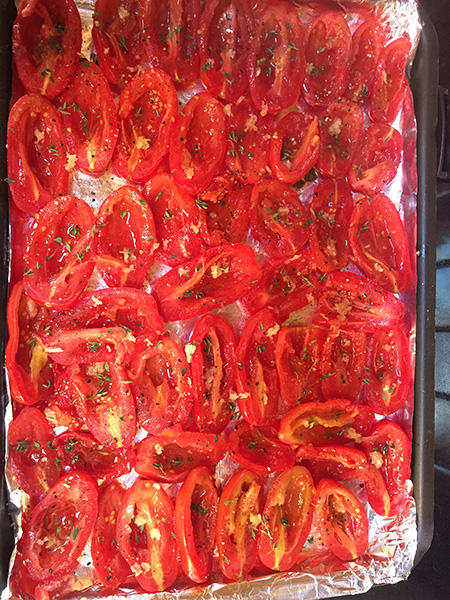
2. Take a cookie sheet and cover it with a big sheet of foil to protect your cookie sheet. Don’t try to piece two pieces together, it won’t work. The tomato juices will leak between the two pieces and what a mess it makes. I first tried it with parchment paper underneath and it was worse so don’t try that either. I learned the hard way and ruined a cookie sheet. Then I spread some olive oil on the sheet so the tomatoes don’t stick and cut my tomatoes in half and put them on the cookie sheet.

3. Put salt and pepper on the tomatoes and crush up some garlic (lots) and put that on top of the tomatoes.

red tomato tapenade

4. Put fresh thyme on top of the tomatoes.

sauteed onions

5. Then (this is optional but so good) Slice an onion or two and saute it in olive oil until soft and carmelized as above. Then spread the onions on top of all of it. Now I have made this both with and without the onions and it is definitely better with the onions but is really good without it too if you want to save more time.

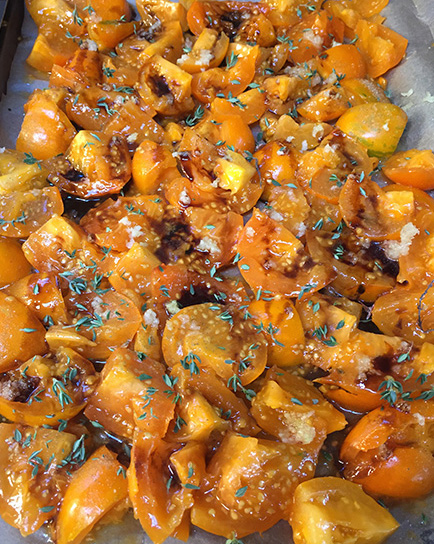
yellow tapenade with garlic and thyme

6. Drizzle some good quality balsamic vinegar and then a little olive oil over it as well.

7. Cook and check often till soft and slightly caramelized. I start with half an hour and then keep checking every 15 minutes till done. Should take between 1-2 hrs if your tomatoes are bigger or juicy. There will be some black on the edges and that’s OK but watch closely as it gets closer to done as it can overcook quickly and the whole thing could burn black. A little black good, a lot of black bad. I scrap off the tomatoes (skin and all) off the foil and viola its done! I don’t puree it as I like it chunky and the skins are soft enough that you don’t even notice them.

8. I make some crostini out of some french bread toasting the slices till slightly crisp on the outside.

9. Then I spread some chevre goat cheese on the crostini and put a spoonful of the tomato tapenade on top. Sometimes I put a Kalamata olive on top, sometimes not. Divine!

Two cookie sheets makes about 2 cups of the tapenade. Refrigerate for immediate use or freeze or preserve it using a canning method for longer storage.


Garden Harvest Early October

oct 8 harvest

I love this time of year. It’s like the garden’s gone wild, everything ready for harvest all at once and a sense of urgency is felt by me and the vegetables to get it done. Get it picked, get it harvested and get it preserved. It is a crazy intense time as fall is here for real and soon we will have the first 32°F night (historically the middle of October). Right now nights are in the mid 40’s but that will change soon. The mornings require a sweatshirt in the garden now.

The sunflowers have come and gone, my cucumbers are done. I spent hours picking and pickling them as I love pickles. The zucchini are gone too. The green and purple beans are mostly finished. The shishitos and poblano peppers and eggplants are done as of this week. The 25 lbs of pears and 30 lbs of apples Michelle gave me are already dried into chips. The corn tassels are drying and soon I will see if my experiment of planting all pink kernels of Glass Gem corn will turn out pink ears or still be multi-colored. Either way is fine. The tomatoes are definitely fading, preferring much warmer nights and their size and harvest is getting smaller. I’m making tomato soup, tomato tapenade and tomato sauce like crazy-so far 18 gallon freezer bags of raw sauce in each that I will later make pasta sauces with (once the garden is done). Today was my last day at the Farmer’s Market as the Tomato Lady for this year as I will not get enough tomatoes again.

But the potatoes still need digging, the herbs need trimming and drying, Jimmy Nardello peppers are still kicking and need picking, the beets and carrots I planted in early spring are ready for harvest and the chard and different kales I planted in late July are loving the cooler weather now and will endure until we have really cold weather. Crazy busy around here.

My favorite sauce tomato

Goldman's American Italian

Here is my favorite sauce tomato!

First I want to share a fantastic tomato I grow every year and never sell it at the Farmer’s Market. Why? Because I think it is THE BEST sauce tomato I’ve every grown and I’ve grown many varieties.

GIA_SAN MARZANO

The San Marzano tomato top while my favorite sauce tomato is on the bottom

San Marzanos use to be my favorite sauce tomato but now they are numero 2. I’m selfish and save it for me to make tomato sauce out of. In fact I make a lot of tomato sauce as you can imagine and tend to mix up many varieties which tastes good. But when I get a bunch of these tomatoes, I only make sauce from them and don’t dilute them with any other tomatoes. The sauce is sweet, flavorful, rich and thick. A great base for any tomato sauce recipe.

GIA TOMATOES IN PROCESSOR

So what variety is this tomato? It’s called Goldman’s Italian American or as I label it on my freezer bags, GIA– so I know it’s different from my other raw tomato sauce. It comes from Amy Goldman who wrote a book on tomatoes. The only hitch on this tomato is it takes all summer and fall to ripen. It takes 90 days to ripen so some years I’m picking them when they are still green before a freeze and finishing ripening them inside but not this year. This year they are huge from all the rain and ripening nicely on the vine and I have a lot of these behemoths and lots of sauce.


I’m Baaack-Tomato Lady returned to Farmer’s Market last Saturday

tomato lady2

So last Saturday I returned to the Farmer’s Market here in Santa Fe and plan to be there on Saturdays until the end of the season when it freezes. I saw many friends and old faces there-people who have been waiting for my return and it was good to see them come back. Thank you!

It’s such a short market for an heirloom tomato grower. Our end of season is always dependent on when the first freeze happens. Sometime it happens in late October, once it happened in September (God forbid), and only once in November! Pray for a nice long fall or as we say around here, an Indian summer, so I can get all those wonderful tomatoes that are just coming in on my mini farm to the market.

I have 31 varieties this year and 125 plants. Someone asked me if they are all there at the market at the same time and alas the answer is no as I have early varieties, mid-varieties and late season varieties growing in the garden. What I can tell you is that I grow many unusual varieties of heirloom and open pollinated tomatoes whose seeds come from all over the world. Many of them you will not find here at our market or even be able to get the plants in the garden nurseries. I start them in April inside the house and transfer them to the garden after the last freeze in spring and this year, our last snow was May 16. So as you can see, it takes a long time to get these babies to the market. And after spending so much time with them I do indeed call them my ‘babies’.

Every year I have some new varieties I try. This year some of them are Black and Brown Boar, Cascade Lava, Artisan Blush Tiger and Purple Bumblebees. I also have my favorites that I grow every year for the market like Costuluto Genevese, Pantano Romanesco, Marmande Garnier Rouge, Juane Flamme, Paul Robeson, Indigo Rose and Pink Berkeley Tie Dye plus many more varieties. Then at the end of the season I evaluate them based on your taste buds and input and some of the new ones make it on my ‘all star’ list and some don’t. So come down to the market and check out what other tomatoes I have going on. I also sell other heirloom veggies like Fairytale eggplant, Shishito peppers, many varieties of beans and other veggies but as you all know tomatoes are my speciality!