Potato update!

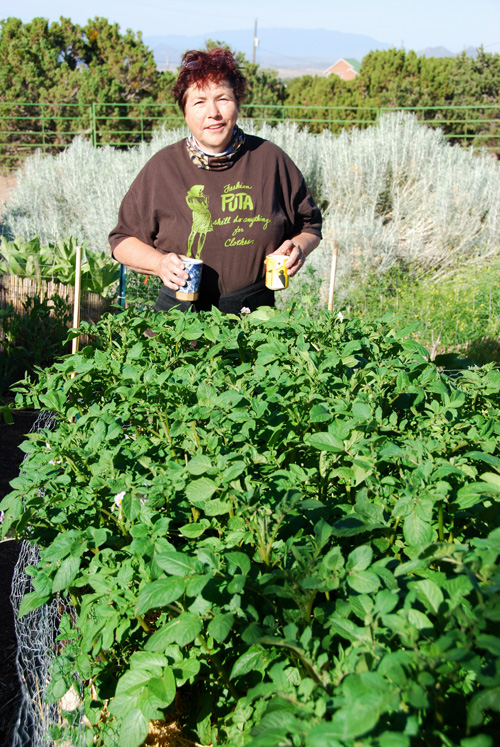
First thing in the morning with a cup of coffee looking over the potatoes-time to WAKE UP!

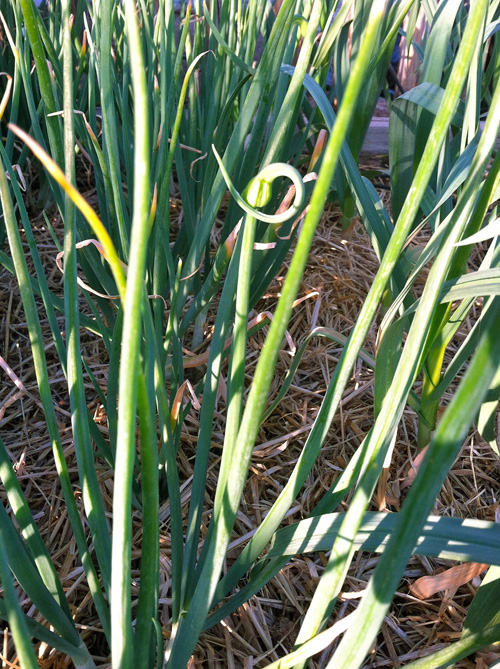
My potatoes are growing so fast that I can’t keep up on burying them. Besides that, I don’t have enough dirt to bury them either as some of them are already 4 feet tall. I wonder how farmer’s grow potatoes in fields? I mean who has soil three feet deep to bury them?

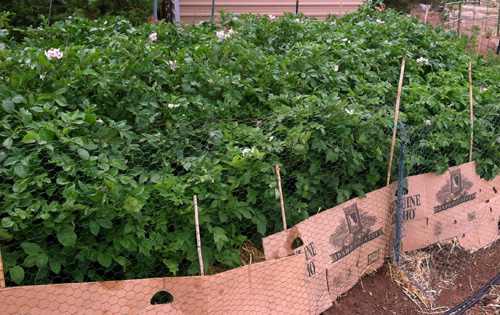
Potatoes are corralled, straw put around potatoes and cardboard put on inside edges to keep light out

I built a temporary corral around the potato patch with small green t-posts and some chicken wire I had laying around.  I then cut some cardboard boxes open and lined the corral with them. Afterwards I got some straw to put inside the corral to cover the potato plants. I put the straw top of the soil which is already 18 inches deep. The corral keeps the straw from blowing away and the potatoes will (hopefully) grow inside the straw where it is dark.

Here are what potato flowers look like. After flowering the plant starts producing potatoes. I can’t wait! My friend Mernie thinks I might get around 150 lbs of potatoes! I might have to go to the Farmer’s Market as the POTATO LADY!

What have I been doing?

I’ve been busy in the garden! It is ALMOST  finished. I have 8 more tomatoes to plant tomorrow that I forgot to get that are some of my standards at the SF Farmer’s Market. OPPS! But they will be ready in time.

Two weekends ago I had 7 friends/family help with planting the majority of the tomatoes. A great big THANK YOU to all that helped-Elodie, Flynn, Ronnie, Lava, Tom, Sharon and myself! I couldn’t have done it without you! I also have a few more flower seeds to plant by the entry. Otherwise it’s done-FINITO! Yea right-there is always something to do in the garden! Here are some of the things happening in the garden:

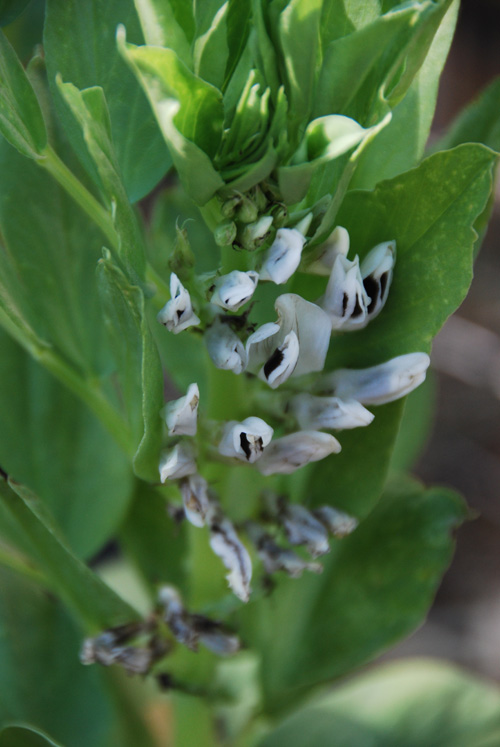
The fava beans are looking good. Here they are flowering. I like the black and white flowers. I don’t think I’ve ever seen black and white flowers on a plant before. They had some aphids so I sprayed them with insecticidal soap and they are looking better. They have baby fava beans on them now.

The beets and carrots are coming along quite nicely. They are outside the pole bean tent area and will fill in nicely

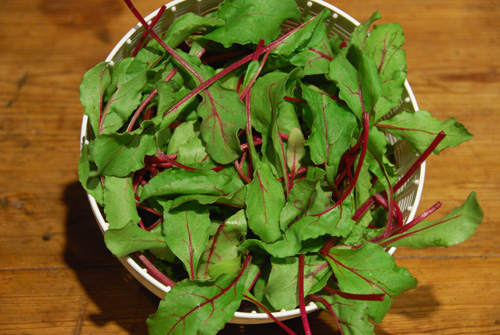
Here are some beet greens I harvested while thinning out the beets to give them room to grow. They are yummy in a salad and are so beautiful.

In the shadiest part of the garden I planted some bok choi and lettuce and have had it covered with row cover since planting to help keep them from the heat and bugs. They both are looking great. I’ve never grown bok choi before so I’ll have to research when to harvest as they are getting to be pretty big and won’t like the heat for too long.

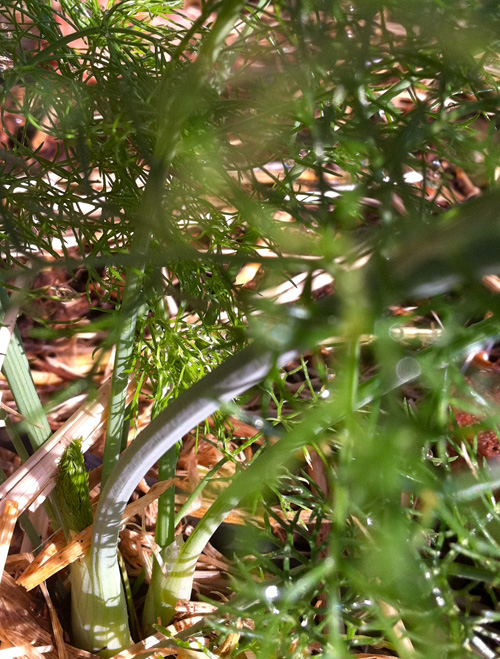
The fennel bulbs are getting bigger and are almost ready to harvest. Maybe another 2 weeks. They also won’t do well in the heat. I wonder if they will get as big as the ones in the grocery store..

About half of the tomatoes I previously planted are growing out of the top of the wall of waters and I need to take them off before it gets too difficult.

It’s been fun growing some early stuff. The bok choi, fava beans, fennel and lettuce are more cool season crops and will have to be harvested soon because of the heat. Probably all of them will be harvested BEFORE July.

I also have potatoes that are growing through the roof, strawberries that are being harvested and rhubarb that is ready to pick but will save that for other posts.

Shallot Scapes!

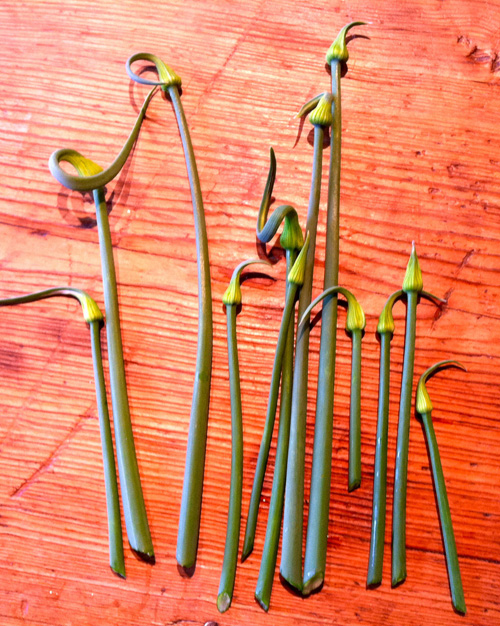
The last few days I’ve harvested shallot scapes. They are just like garlic scapes in that they are the flower bulb. I pick it before it opens so all its energy will go into making the bulbs below the ground larger.

They are really delicious sautéed. We already made an omelet with cheese, spinach and scapes and also in some fried rice. If you see them on your shallots or garlic, cut them off  but don’t throw them away!

Americorp students help plant tomatoes

Today I had some AmeriCorps students help plant some of my tomatoes. I think we planted about 25 of them. What a great bunch of young adults giving service. In case you didn’t know AmeriCorps is like the Peace Corps  (only here in America) where people join and give their time and energy for one year to help communities and farms and learn many skills on their journeys. I explained how I plant tomatoes and  gave them some handouts to take home explaining the process. I hope they take back this information to their communities and share their new tomato growing skills! My only regret is I didn’t get a picture of them before they left! A big thanks to all of you who helped today!

More tasty tomatoes and peppers with Epsom Salts

Get more tomatoes with Epsom Salts

Epsom Salts May help increase blossoms in tomatoes and pepper plants. Increase in blossoms means more tomatoes and peppers!

Epsom salts contain magnesium sulfate, two important elements for plant growth.

Magnesium– can become depleted in soil usually later in the season. Magnesium helps strengthen plant cell walls, helping the plant to absorb nutrients. It also helps to increase blossoms.

Sulfur– improves the growth and overall health of plants, it may also help our high alkaline soil here in the southwest.

There are two ways to use Epsom salts for tomatoes.

1. Mix 1 tbsp of Epsom salts into the soil at the bottom of the planting hole when transplanting tomatoes or peppers or mix 1 tbsp in a gallon of water and water the transplant. It may help plants absorb Calcium and other nutrients from the soil.

2. Use as a foliar spray of 1 tbsp per gallon of water when the plants flower. Epsom salt helps set more blossoms.

I’ve used Epsom Salts on my tomatoes, peppers and even roses for years. It will help roses produce more flowers. Scratch in 1/2 cup of  Epsom salts in soil around rose bush and water in.

Started planting tomatoes May 11

15 TOMATOES PLANTED

I started transplanting tomatoes into the new garden section. My friend Tom, and I got 15 of them in the soil-all ready to go. We added to each hole: more compost, yum-yum mix, mycorrhizal fungi (for root growth), worm castings, epsom salts (for many blossoms), and dry milk (adds calcium to avoid blossom rend rot later). And this year to (hopefully) conserve on water usage, I’m trying silicon gel granules and some volcanic ash, both of which will keep water longer around the plant root zone.  All this stuff is mixed up with some of the existing soil in the hole.  Then we put the tomato plants in (and if they are rootbound, open the roots up a little), made a well around each one and water each hole several times to get the soil wet. Then I go back a third time and water in some Superthrive and seaweed fertilizer (helps with plant transplant shock). Afterwards I put a drip line around each plant and then put a wall-of-water around each of them to keep them warm at night because just when we think we are out of the woods weatherwise, it gets cold again.

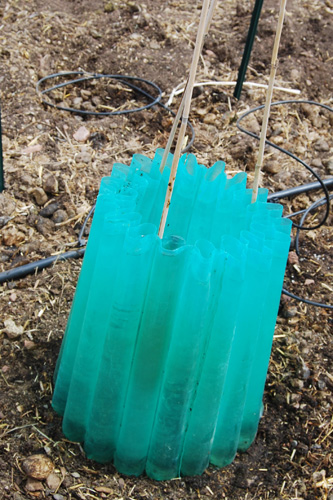
To keep the wall-of-waters from collapsing when the wind gets blowing hard, I put some bamboo stakes inside the walls as shown in the second picture. Overkill? Maybe. But I will get some fantastic tomatoes during the season. I still need to put the main drip hose (1/2 inch size) around the perimeter of the patch and connect each individual drip line to it but I can hand water every other day for now till I get to it. Planting is the hands on intensive part-later it will be a breeze watching them grow..

Tomorrow-May 16, Amy Hetager, from Home Grown New Mexico, is coming with her students from Americorp to plant some more tomatoes. No shortage here-still got 55+ tomatoes to put in the ground!

Growing Bulb Fennel (Finocchio)

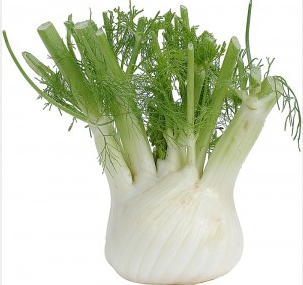
Finocchio fennel. Photo courtesy of growingherbsforbeginners.com

More on another new vegetable I’m trying this year-Finocchio Fennel.

There are several types of fennel, the bulb type (which is Italian called Finocchio or Florence), sweet fennel (fern like) and bronze fennel (fern like). All can be used as an herb but sweet and bronze are used for their foliage in cooking and Finocchio or Florence is used for the bulb in cooking. Sweet or bronze fennel will not bulb up. I used Finocchio in a Cioppino (seafood stew) at New Year’s and it was so wonderful that I decided to grow some. This post is about Finocchio Fennel.

I tried to grow some inside from seed- it didn’t do very well only getting a few to germinate so I ended up I buying a little pack at Agua Fria nursery here in Santa Fe.

Fennel growing well-May 7

Now from from what I’ve read they are not suppose to transplant well in the soil but I had so many of them in each little cell (and they were very young) that I teased the roots apart (carefully) and transplanted them directly into the soil.  I then put a drip on each one, made a little well that I put straw in so the water would not evaporate and then I put a cage I made out of wire material and covered it with some row cover. I was afraid the row cover might be too heavy directly on the baby fennels at first as they were very delicate-hence the cage. I thought the row cover would add more protection from the wind. Fennel can handle the cold (in fact it likes it) but the wind was what I was worried about.

closeup of developing bulbs

Here is a picture of the one of them developing bulbs. All 17 of them are doing really well.

Fingerling Potatoes-May 7

The potatoes I planted Mar. 30 are doing great. Most of them came up with a few exceptions. Not bad for my first try. Of course the proof will be if I get some nice potatoes. Right now they are about 8 inches tall and when they hit 10 inches I will start the hilling process. Basically every ten inches or so I will add soil slowly filling the trench and burying the base of the potato plant I started with. I thought I would use straw for the hilling process but decided to stick with dirt because it is so dry here and I thought the straw would probably blow away anyways. Besides when I dig them out it will be like an Easter egg hunt! Since this is my first year at trying to grow potatoes, I am excited about what might happen.

Create a teepee of pole beans for the summer

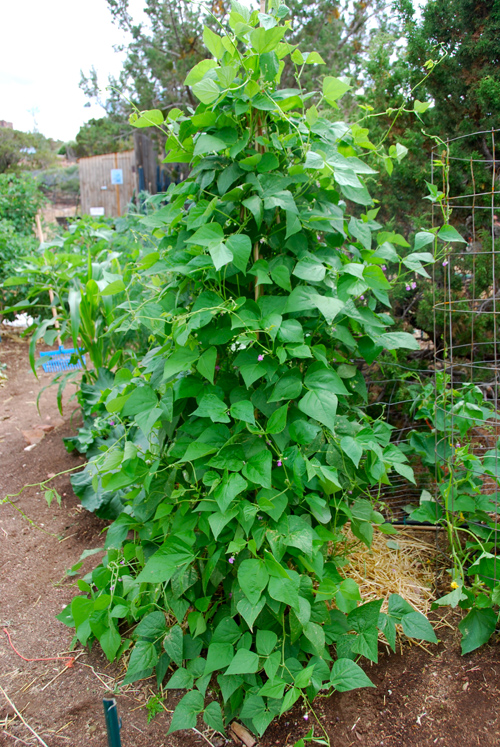
On Sunday, Caleb and Elodie and I created a bean teepee in one the beds where pole beans will grow. I wanted to make it large enough that a person (even an adult) could sit inside it this summer when it is covered with bean plants.  I can’t wait to experience what it will be like.

Here is the pole bean teepee I had last year but it was completely closed so this year we left an opening in the tee-pee to get in and out.

I had some really tall poles so we could get the height and width needed to make it large enough. I got the poles from my friend, Tuko, who had them on an arbor at her house and was taking it down. That was many years ago and I’ve saved them all this time for something special and I think I found that special project. I’m hoping that my neighbor’s grandson, Aiden will go in it later this summer.

So today in the wind, I went out and planted some seeds before this supposed rain comes. I planted beets and carrots on both sides and then I covered them with row cover (for now) so the seeds wouldn’t blow away and stay wet longer when I water them. The row cover helps the seeds stay in place! Later after the plants come up I will take off the sheets!

When Will I Plant Tomatoes?

I think I’m going to start planting tomatoes by the weekend.  I won’t get all of them in but this will be the EARLIEST I have ever planted here in Santa Fe. I checked the weather for the next 10 days and no freezing weather is projected. Of course it’s always a crap shoot here in NM but I think the odds might be in our favor this year. I will still put them in wall of waters (WOWs) because they grow so much faster in them than without them and if we get a freeze, they offer lots of protection.  But I will hold off on the eggplants and peppers for a little while longer cause they want HEAT. I checked the weather for the next 10 days and no freezing weather is projected. I’m not recommending anyone plant before our last freeze date of May 15th, just letting you know what I’m thinking. Unbelievably beautiful weather-so different then last year’s-no wind, no freezing weather-just fabulous! Time to spend lots of time in the vegetable garden!

Rhubarb and Asparagus starting to come up!

Asparagus coming up!

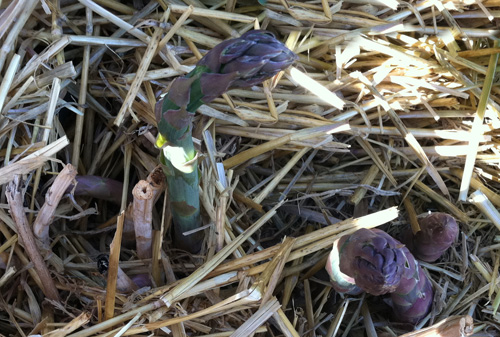
I can’t wait! It’s been 4 years since I planted the asparagus and I hope I get enough to harvest this year. About 5 spears are already poking through the straw they hide under and that is just one of 4 plants.

Rhubarb coming up too!

Last year I read rhubarb is a good companion plant for asparagus so I got 2 that were already in gallon pots and transplanted them. I got lots of rhubarb last year because they were already 2 years old. They are now coming up like gangbusters. I have them covered with row cover on freezing nights but they seem fine with cold nights. Spring is here!

Potatoes Were Planted on March 30th

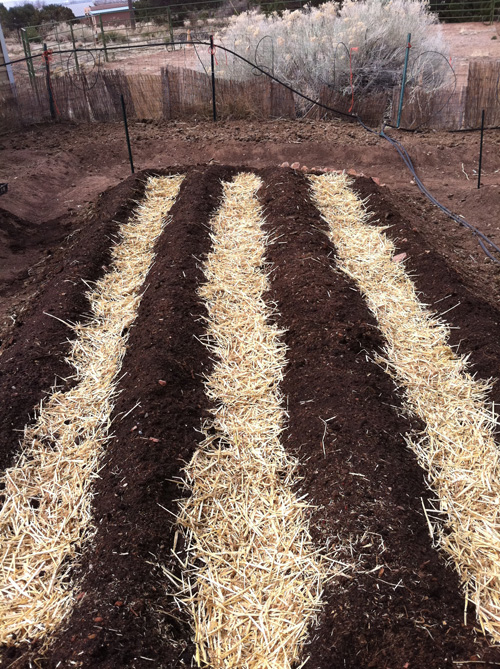
Potatoes planted in deep rows-covered in straw

I’m trying a lot of new varieties of vegetables this year besides the varieties I always plant. I’ve never planted potatoes before but thought I’d give them a try this year. I actually planted the potatoes on March 30 and am just now getting around writing about them. I just couldn’t wait any longer. I put them in my best bed that is 12 inches deep with very rich fluffy soil. I figure even if it snowed (which of course it did), the ground wouldn’t freeze up 3-4 inches below the soil where the potatoes are. Plus I got the drip in place (even though it isn’t turned on yet) on the potatoes and covered them with straw to protect them from the snow. I planted all fingerlings-French, Russian Banana and a purple variety. They are not up yet but can’t wait till they are. A brand new crop for me.

Seed Germination Trouble-seed heating mat too hot!

Some new tomato seedlings coming up among the others

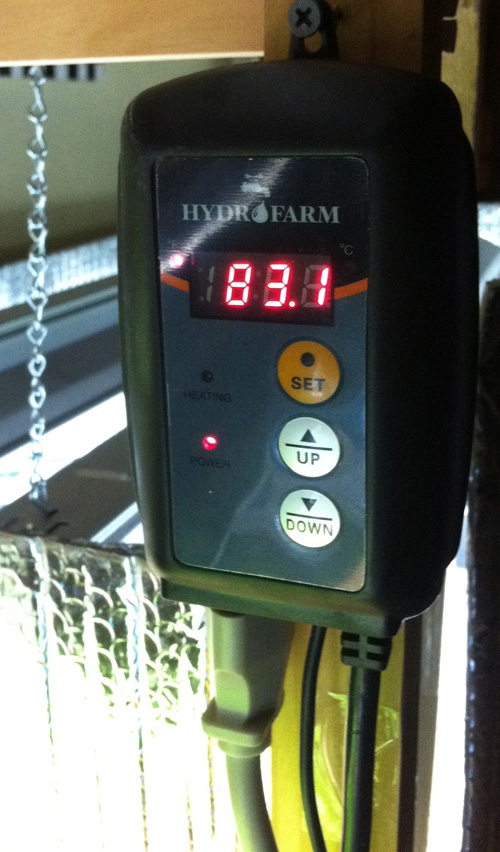
This year I have been struggling with my seed starting this year. Many seeds have not germinated. The seed germination mats seemed way too hot. I’ve never had this problem before (usually it is too cold) but when I did some research, I found out the mats are suppose to be 20 °F over the ambient temperature. This spring so far has been very warm (especially inside the house even without the heat on) and when I took the temperature of the soil in the little pots it was between 95 and 1oo°F! Way too hot for germination. No wonder very little was coming up—I’ve been frying the seeds!

So I got a soil germination thermostat that will control the temperature which I keep at 80°F and within 3 days I had 11 tomatoes come up. Wow what a difference. I will have to replant some tomatoes seeds but hopefully I will be fine. Guess I won’t have to worry about the plants growing too big this year before I transplant them in the garden.

Chitting and Growing Potatoes

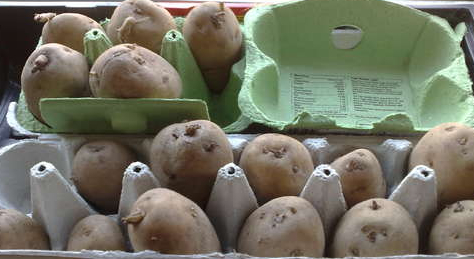
A gardening friend of mine, Gene asked me to explain ‘Chitting Potatoes’. Why do we want to chit potatoes? It will knock off a couple of weeks to harvest time so you’ll get them sooner. Now I am new to this myself being a first year potato grower but basically it is ‘prespouting’ the potatoes to force healthy new sprouts before you plant the potato ‘seeds’. Potato seeds are not seeds at all but the actual potatoes.  We keep potatoes we want to eat in the dark so they won’t turn green and quite often they start to develop smaller flimsy white sprouts while in the dark but what you want is thicker healthier sprouts that are either green or purple. If you missed the opportunity to chit the potatoes, it’s ok to just plant them when the time is right. I’m going to try growing fingerlings-Russian Banana, Purple Peruvian and French fingerlings.

Here’s how to ‘chit ‘ them (sounds southern doesn’t it?!)

1. Get a couple of egg cartons so you can stand the potatoes with the pointed side down. The blunt side generally produces more sprouts so keep that side up. The egg cartons make it easy to support them this way. Sometimes there is no pointy side which you should then just look at your potato and put the side with the most ‘eyes’ or sprouts up.

2. Put them in a cool space that gets good light in your house and they will develop thick sprouts  in 2-4 weeks instead of those flimsy one that grow in the dark.

3. Plant them outdoors when the soil is 50°F or warmer. There are many ways to plant potatoes which you can research on the net but I’m going to dig a deep trench about 10 inches deep in heavily amended fluffy soil.

4. Place the presprouted (or chitted) potatoes with the sprouts up (the sprouts become the leaves) and bury them 4-6 inches deep depending on the size of the potato. BE CAREFUL NOT TO BREAK OFF THE SPROUTS. Spacing them 12 inches apart and rows 12-24 inches apart.

5. After the sprouts come up and they get leaves, I’m going to start filling straw around the plants instead of dirt to make access to the potatoes easier come harvest time. I hope they stay cool enough with the straw.

6. I should see the sprouts come up through the dirt in a couple of weeks. If it is still freezing at night, I will cover the plants with row cover.

7. Potatoes will start producing tubers when they flower.

8. Fingerling potatoes should be ready to harvest when the plants die back in about 90 days. Leave in the ground 2 weeks to harden off before harvesting.

For more information on growing and buying good potato seed go to: http://www.irisheyesgardenseeds.com/growers10.php

Thinning and preparing mesclun/greens-keeping your homegrown greens fresh!

Here are my steps to thinning and preparing mesclun so it doesn’t WILT in your refrigerator. In fact you can use this method after you clean any greens in ANY STAGE from microgreens to full grown lettuce and greens from the garden or store bought.

The MOST IMPORTANT THING if you are growing any greens is to PICK THEM FIRST THING IN THE MORNING when they are fresh-not the heat of the day, OTHERWISE THEY WILL BE WILTED NO MATTER WHAT YOU DO (are you listening Lava?). During this first stage of mesclun, it is a little more labor intensive. (After the leaves grow more, you will just cut off the tops above the crowns so they can grow back and there will not be much dirt since you are not pulling these out by the roots.)

Here is the mesclun in my salad bowl I made. Notice they are very cramped with not much dirt showing. I need to thin these out so the leaves can get bigger without overcrowding.
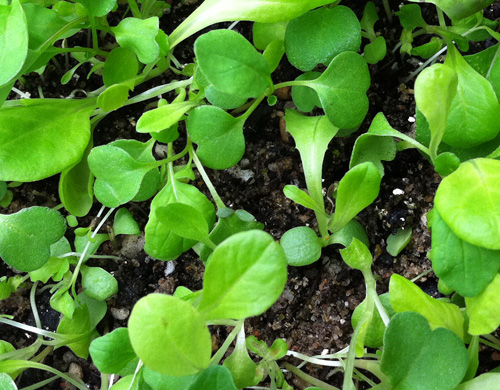
Thin out the mesclun. The goal here is to have some dirt showing to give the remaining leaves some room to grow.
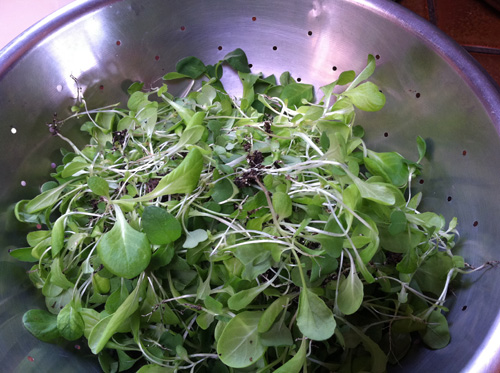
Now the mesclun (first thinnings) are like microgreens and are ready to clean. Notice the roots are still on them. You can cut them off or eat them if you rinse well. Here I’m leaving them on. Of course you could just feed them to the chickens or throw them out but I don’t like to waste them plus they are yummy! You would pay big bucks for just a tiny bit of microgreens in the stores.

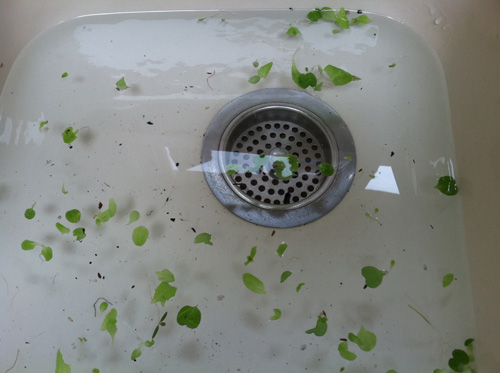
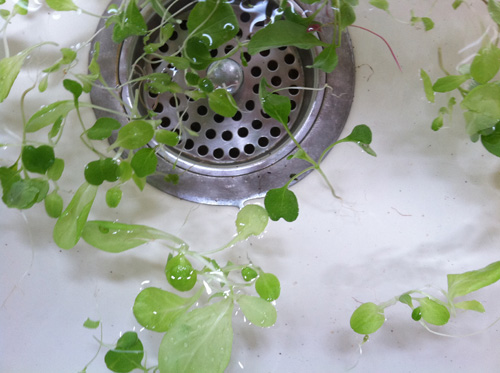
Here is the mesclun at the first rinse. I first clean my sinks out with bleach so I know they are clean. I suppose you could use big bowls to rinse instead. I filled my sink with COLD WATER from the faucet. Notice the leaves float on top while the dirt mostly sinks to the bottom. From here I gently scoop out the leaves trying to leave the dirt on the bottom of the sink or bowl and transfer them to the other side of the sink full of water for the second rinsing. By the way, rinsing this way is way easier than using a colander.  It works really well for spinach too. This way removes the dirt that can stay in a colander.

Second rinse-Notice most of the dirt is gone at the bottom of the sink after I  have removed the leaves.

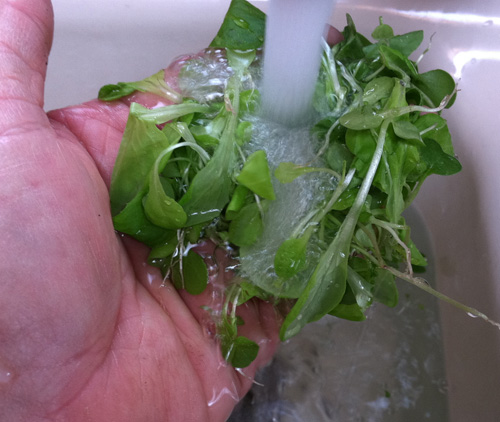
At this stage I do one hand rinse in case their is more dirt trapped on the roots. Then I put them into…

The last rinse- notice the dirt is gone. Rinse more if you still have dirt.
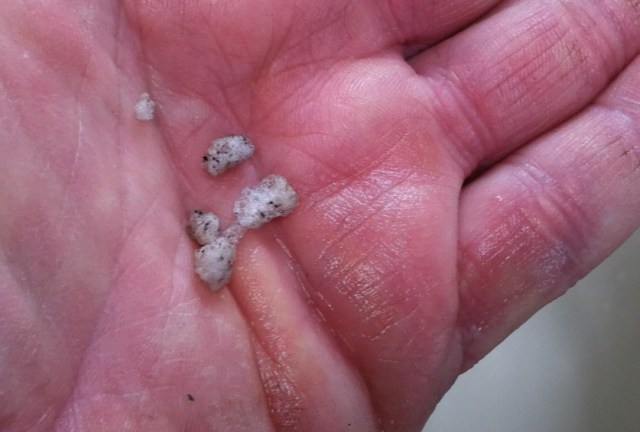
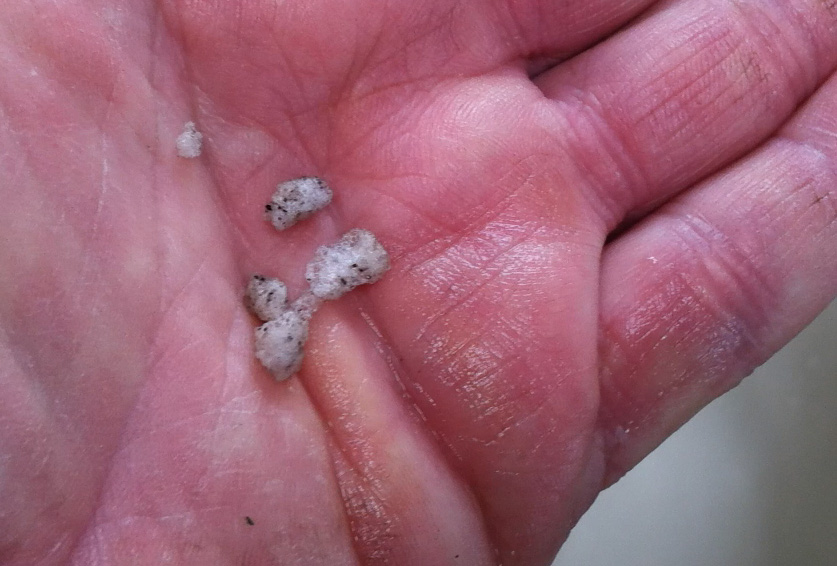
Since I grow the lettuce bowl inside, I use seed starting mix and you need to look out for the perlite that is in it as it can float in the water instead of sinking like the dirt-so be on the lookout for it. Just scoop them off the surface of the water before you do each rinse. It would be a little too crunchy in my salad!

Now the leaves are ready for the spinner. Just don’t pack it too full as the leaves are very delicate. Spin it in small batches and..
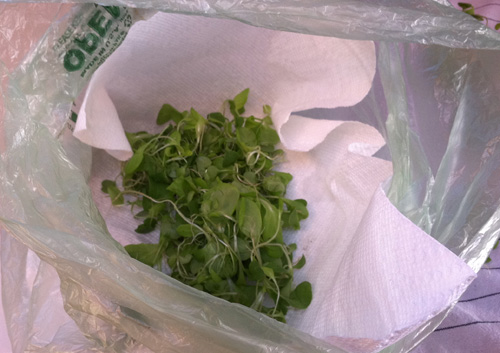
gently place it in a loose plastic bag (not ziploc) lined with a dry paper towel. Then this next trick is very important. I learned it from reading Dorie Greenspan’s book,  Around My French Table where you…

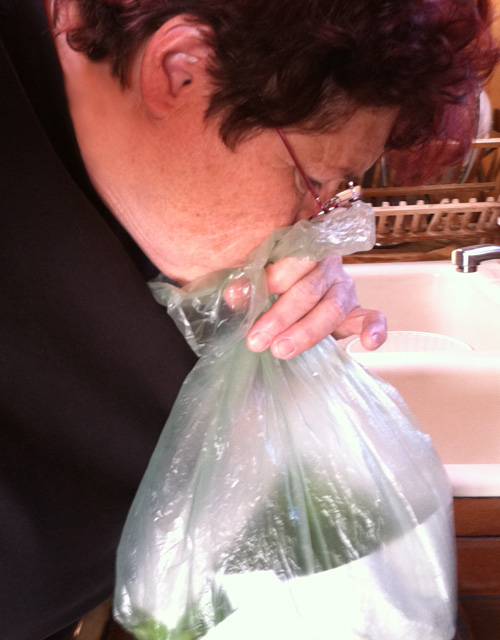
squeeze the bag so there is only a small opening and blow into the bag with your breath. This will fill the bag with carbon dioxide (which we expel) and then blow it up till it is full and..

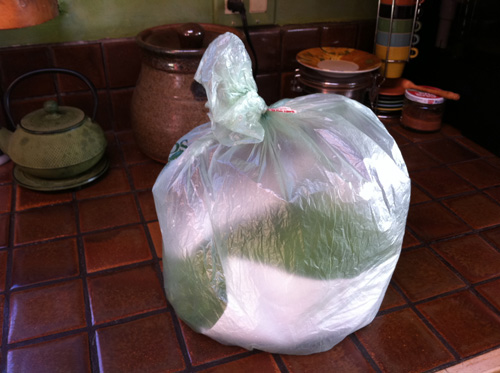
tie off with a twistie tie so the air doesn’t escape and put into your refrigerator. YOUR GREENS WILL STAY FRESH FOR ABOUT A WEEK. Be sure you blow into it each time you get some greens out before putting it back into the refrigerator again. This takes up a little more room in your refrigerator but is worth it. No more homegrown wilted greens! Pretty cool trick, huh?!