Monday finished picking all the tomatoes and then the garden froze that night. Now I have a houseful of green and ripening tomatoes everywhere! Tomorrow I go to our Farmer’s Market and sell them. In fact I have 9 boxes which ain’t bad for end of October. Usually I sell out and there are hardly any tomato people there now. I’ll wait and see how the rest of the tomatoes develop-just take it week to week as to whether I go back or are finished. Meanwhile the garden is a mess since it froze. I started to clean it up but the plants are too heavy still with water so I’ll wait till they are lighter. I think I’ll hire some help with it.
Category Archives: GIANT TOMATOES
Tips on How to Ripen Tomatoes Inside

How to ripen green tomatoes
So now that you’ve been waiting all season for your tomatoes to ripen, what do you do when you know that a hard frost is going to hit and you still have lots on the vine? Here are some tips on ripening tomatoes inside.
• Watch the news to see when we will get a potential freeze forecast. I have been caught running out at night picking as many as I could because I didn’t watch the weather forecast. I try to look a few days ahead now so I’m not out in the garden at night with my flashlight!
• If we are going to get a freeze, run out before it freezes and pick all the decent size ones off. I don’t bother with the small ones, they are probably not mature enough to ripen properly anyways.
• Sort the tomatoes from rock hard green to almost ripe and put them in heavy grocery paper bags and fold over the top. That way you don’t have to go through each bag every day and pull out the ones that are ripening sooner.
• When they start to change color, I pull them out and put them in bags where they are all similar in the ripening stage.
• In the bags with the green ones, I will put an apple in the bag to help ripen them if I am in a hurry. An apple releases ethylene gas (the tomatoes produce this as well) which helps the ripening process. That is why you fold over the bag to help trap the gas that both the tomatoes and apple are releasing. Don’t forget to check your bags every few days.
• Some people say to pull the whole plant and hang it upside down and watch the tomatoes as they ripen. Keep the plant out of direct sunlight. This can be done if you have a few plants but if you have a lot of plants, you may not have the room inside (visions of a tomato jungle inside my small house) and this is why I bag mine. I can keep them in another room out of the way.
• You can also choose to wrap green tomatoes individually in newspaper and lay them in shallow cardboard box in a single level. Store out of direct sunlight. Check them regularly. I don’t use this as I would have to unwrap all of them to see where they are at but this would work if you don’t have a lot of tomatoes.
• Leave them stem side up-they won’t rot as quickly.
• When your tomatoes are almost ripe, to increase flavor, set them in front of a warm window a couple of days before you want to use them.
• Also to increase flavor, be sure to store them in a room that is at least 55 degrees. Last year I didn’t and they didn’t have much flavor. If they won’t ripen or aren’t flavorful they are probably stored in too cool of a place or perhaps they were too small to begin with.
• Lastly you can always pickle green tomatoes or cook with them!
Another Big Tomato-Striped German

Closeup of Striped German Tomato inside-my all time favorite

2.14 lb Striped German
My other big tomato is a Striped German, a beautiful bi-color tomato. I’ve been waiting for these to ripen all season. I grow them for eating. They can grow very big as they are a beefstake and are a super sweet tomato with just the right amount of acid to balance it. They get lots of cracks because they are thin skinned, very typical of an heirloom tomato but nobody cares because of that incredible flavor. Very luscious and juicy. The flavor is unbelievable. If you ever get a chance to try one, jump on it. It is the first one I always sell out of at the Farmers Market.
It is one of those tomatoes that runs down your chin when you eat it in a BLT. I think out of all the tomatoes I have grown over the seasons, it is my all time favorite.
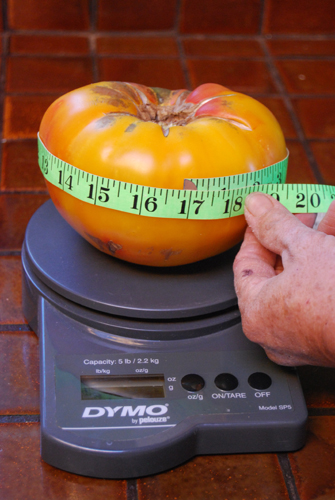
16.5 inch Striped German
Soon our tomato season will be gone as the nights get colder. We must watch the weather now for that first freeze. I still have many on the vine and will most of the bigger ones off when I hear we will be getting a freeze on the news. Then I will bring them inside to ripen. I usually have tomatoes to eat well into November. Maybe we have another week-if we are lucky..
2 lbs 11.4 oz Giant tomato-My NEW personal best

2 lbs. 11.4 oz
GIANT TOMATOES I have several tomatoes that ended up pretty good size. One type I grew for giant competition and the other for good eating. This post will be about the competition giant tomato.
My biggest competition tomato comes from the 7.18 N.Harp plant and is 20.5 inches in circumference. It weighs 2 lbs-11.4 oz.
This is now my personal best!
I was going to take it to the weigh-off in Colorado Springs but since it was still green and I wanted the seeds from it, I kept it home so it could get fully mature and red and let the seeds develop. I believe this tomato (grown by Nick Harp) originally came from a Big Zac variety several generations back. I also have a 17 incher that weighs 2 lbs 6 oz.

20.5 inches in circumference
I grow the Big Zac variety for competition but do sell them as well at our Farmers Market. They taste wonderful and have a good old fashion tomato flavor unlike some super sized competition tomatoes. Not bad-supersized and tasty!
Virginia Sweet Tomato

Virginia Sweet Tomato
Check out this tomato! Yesterday, my friend Janet Hiron, a fellow S.F. Master Gardener, gave me an huge tomato that she grew called ‘Virginia Sweet’. She only has maybe 8 of them on her plant (so I got 1/8th of her harvest-bless her). What a beauty and I can’t wait to eat it! It is a bicolor and should be marbled with red orange and yellow streaks inside. She said the flavor is unbelievable. This one is over 2 lbs. Thanks Janet!
Master Gardeners tour-Giant Vegetable Garden
I’ve been getting ready for my first Giant Veggie Garden Tour for the Santa Fe Master Gardeners group next Sunday from 9am-12 noon. I have 3 giant marrows, one being around 30+ lbs, 2 giant pumpkins, many giant sunflowers, and a couple of giant tomatoes (still green). I’m cleaning up, trimming and generally sprucing up the garden. By the time they come next Sunday I should be ready. Seems like there is always something to do in a garden no matter the size. Fall is definitely in the air with the nights cooling off into the high 40-50s. Daytime temperatures are in the 80s. Perfect weather to be in the garden…
tomato hornworm attack!
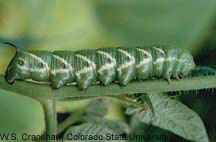
tomato hornworm courtesey of W.S. Crenshaw/Colorado State University
I’ve found some tomato hornworms in the garden this morning. I picked them off and gave them to the chickens. Here is some information about them. This pale green caterpillar has white and black markings, is 3 1/2 to 4 inch long and is the larval stage of the Sphinx moth.

sphinx moth courtesey of W.S. Crenshaw/Colorado State University
It is also called the hawk moth or hummingbird moth. It is called the hummingbird moth because of it’s long “beak” which is not really a beak at all, but a slender, tubular feeding and sucking organ. It is not a hummingbird but an insect. It is a grayish-colored moth with a wing spread of 4 to 5 inches. I see it visiting my flowers at dusk and at night. It is attracted particularly to purple flowering plants. The moth is not harmful to your plants only as the larva caterpillar-the tomato hornworm. A friend of mine called me to say her plants were being visited by the Monarch Butterfly and wanted to know if they would hurt her tomatoes. The answer is no, the Monarch Butterfly lays it eggs on milkweed and when it is a caterpillar feeds on milkweed and feeds on nectar from other plants when it is an adult.
I noticed a couple of things about the hornworm today. First I got out early and caught it sleeping. At least I think it was sleeping as it didn’t move for a long time and it was still really chilly outside (I thought maybe it needed warmth to get up and going or perhaps it had a hangover from eating so many tomato leaves!). The first thing I do after looking to see if the plants look good (as in no disease showing up) is to see if any of the leaves are eaten. The hornworm usually start feeding from the highest part of the plant first. If I see that, then I also look for their poop (called frass) which are quite large pellets about 1/8 inch in size. You can see it sometimes on the branch or on the ground. The hornworms are hard to see as they blend in so well with the foliage but keep looking around the damaged areas and you will find them. Anyways the 3 times I’ve seen them so far this year, they all hang upside down on the tomato branch-so look for them that way. I don’t like to handle them with my bare hands. I usually have gardening gloves on so I’m not so squeamish about picking them off. They are so large they give me the creeps but they are quite beautiful. I will have to do more inspections to catch them.
I luckily haven’t had huge amounts of them so I prefer handpicking them but if I found I had tons of them, I would spray with Bt for caterpillars. Bt is short for Bacillus thuringiensis. It is a live bacteria that kills caterpillars only. It doesn’t harm bees, or birds or humans-only caterpillars. It is perfectly safe for organic growers. When the caterpillar takes a bite of your leaf, it dies. It interferes with their digestive system. You can buy it at a nursery. Usually the big box stores don’t carry it. The only bad thing about Bt, is that is washes off with the rain and must be reapplied.
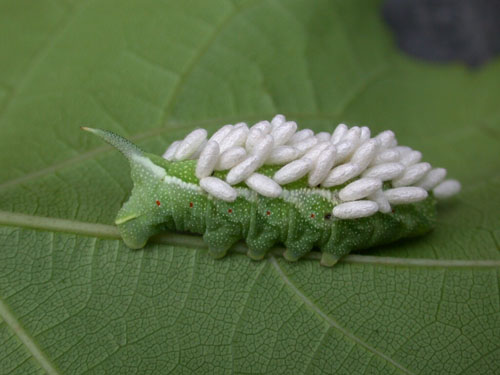
hornworm with wasp cocoons
The other thing that is helpful comes from nature itself. If you see little white cocoon things on the hornworm, leave them alone as a helpful parasitic wasp has layed their eggs on them and the caterpillar will soon die. An added bonus is all the little wasps will attack other hornworm caterpillars. The wasp is not like the wasp we think of that stings us. It is a little thing, almost fly like, doesn’t sting us and is one of those beneficial bugs you would like to have in your garden.
Giant tomato
Here is a picture of one of my giant tomatoes on it’s way to stardom. (I hope!)

baby giant tomato
Notice this tomato looks deformed and gnarly. It has 4 little tomatoes that have fused together-kinda like Siamese twins only this one is quadruplets! Most giant tomatoes are a result of a megablossom where 2 or more blossoms fuse together. Many megablossoms do not pollinate fully and so they have a higher self abort rate. So far this one is doing well. I have a few other megablossoms right now but not many. Some varieties produce more megablossoms and hence more giant tomatoes. Two varieties that have the potential of producing giant tomatoes are Delicious and Big Zac. There are other varieties that can produce giant tomatoes too. This one in the picture comes from a Nick Harp tomato seed. His plant grew a 7 lb+ tomato last year and he gave me a few seeds. I call his plants the ‘Harpies”! I have 5 growing right now. Hope this one becomes a monster! Since I’m an organic grower I’ve been feeding it fish and seaweed fertilizer from the Neptune brand.
tomato suckers

tomato sucker
Don’t forget to pinch out the suckers on your tomatoes. Some people say pinch them and some say not to. I am in the camp of pinch them. I might try to leave one with suckers on to see how they differ throughout the season next year but they are all pinched or will be pinched soon this year! Where a branch comes off the main vine and in the crotch or ‘v’ where the two branches meet is a little branch that starts-this is a sucker and if left to grow will help contribute to unruly growth. The sucker in the picture is starting to get big and needs to be pinched out. You’ve probably had some tomatoes that were out of control growth wise. If you don’t pinch it out, your plant can become monstrous. I need to take them off weekly. Notice I said need..I’m having my friend, Lava, come over next week who loves to pinch off the suckers-that should be a big help! Pinching is not a one time job but if you start early you can keep up on it. Keep looking at the new growth so you can pinch them when they are small. Otherwise take some scissors to cut them out if they get too big on you. Just remember to disinfect your scissors or hands with a little alcohol in between plants so as not to pass any diseases from one to another.
tomatoes ready to come out of wall of waters
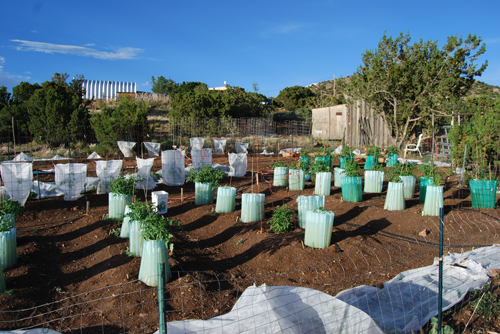
tomatoes in wall of waters and row cover
Here are the tomatoes in wall of waters and some under row cover. I am ready to take the wall of waters off as many of them have grown out of the wall of waters. 61 tomatoes total. Most of the ones that I planted in early May are doing great considering they had to weather freezing temps at nights and incredible winds. Now it is blistering hot but they love the heat!
The last of the tomatoes are finally in. Phew..
Yesterday I planted 10 more tomatoes to make a grand total of 61 tomatoes! That’s it-I’m done planting tomatoes-no mas! I still have to put in the corn, winter squash, and giant pumpkins which should be done by the end of the weekend. The end of the big push is in site!
giant tomatoes in garden
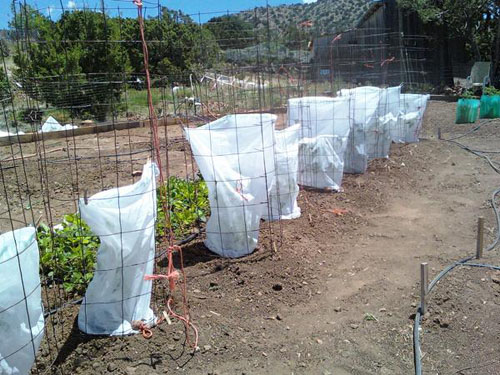
giant tomatoes in tomato sacks
I finally planted my giant tomatoes that I’ve been growing in the house since March. Looking good-all are over 2 foot tall. I have five ‘Big Zacs’ and 6 ‘Nick Harps’. I put on some row cover tomato sacks (like potato sacks) that I sewed up last year to protect them from the leafhopper early in the season. The leafhopper carries bacterial wilt disease but if you protect your tomatoes when they are young, they can quite often resist the disease. The young tomato plants succumb easily to bacterial wilt. The sacks also help them from getting sunburned when you first put them out.
eggplants and peppers in
I planted the shishito and padron peppers and the fairy eggplants. I still have to plant the Thai yellow egg eggplants that are just begging to go into the ground. They have been inside under lights since March-April and I have been trying to wait patiently till the nights warm up but I’m afraid I’m not very good at waiting. I guess I got spoiled last year with such a mild Spring. Everything was planted and up by now. Not this year! Today was the right time.
When planting the shishito peppers one of mine already has small peppers and it is still May! It is one of the ones I started in March. Peppers love heat. Today is going to be 81 degrees so they should love that!
All Star giant tomato lineup ready to plant!
Well here are my all star giant tomatoes that are going out as soon as I harden them off in the next few days now that the nights are finally in the high 40’s. They were out for about 45 minutes today in the sun and breeze today and that was enough for them. I brought them in and watered them with some organic seaweed and superthrive while they are going through the transition to help reduce stress. Maybe I should drink the stuff to reduce my stress (just joking)!

giant tomatoe plants ready to plant!
I have in my lineup for giant tomatoes (6) Big Zacs (seeds from Totally Tomatoes), (1) N. Harp (that came from a 4lb+ tomato), (2) N. Harps (that came from a 5lb+ tomato), and (3) N. Harps (that came from 7lb+ tomato)! Nick Harp is a phenomenal giant tomato and giant pumpkin grower in the midwest that was kind enough to supply me a few of his seeds. Thanks Nick! I can’t wait to see what these will do this year!
warm season veggies-here we come!
May 15th is fast approaching and is the average last frost date for Santa Fe and the time for putting your warm season vegetables in the ground. I sneaked some of mine in earlier but that is still a gamble in case we get one of those late frosts (we did) that plus the spring winds have been horrible this year. Never the less, I do grow some late season tomatoes that take 80-90 days to get fruit so I take the gamble on them and stick those transplants in early with the help of wall of waters and row cover. And of course my giant pumpkins take 5-6 months to grow so they need all the time they can get in the ground before that first fall frost hits even though I start them inside! So that takes care of the ones I sneak in early but what about the main vegetables crops?
For all summer squash, winter squash, cucumbers, beans, corn, I plant seeds directly in the ground (following directions on the package) as they will germinate quickly in the warm soil and will grow very quickly barring the birds from eating the seedlings. To prevent that, I put some LIGHTWEIGHT row cover (you can get it at the nurseries) over them until they are over the seedling stage and the birds aren’t interested anymore. It comes in big sheets but you can cut it up for smaller areas or it can cover the whole raised bed. Tack it down with some rocks so the wind doesn’t carry it away! Lightweight row cover is from -.01 to .03 in thickness. The handy thing is you can water right through it and it keeps bugs out.
For the majority of my tomatoes and all peppers and eggplants, I will transplant my plants that I started earlier inside or buy plants from the nurseries. When I plant them put them in a hole where I add some compost and maybe Yum-yum mix to get them going and create a well around them so the water is collected instead of running off.
So let’s talk tomatoes for a minute. Why? Well what is a vegetable garden without those homegrown, sweet tomatoes? Let’s face it, it is the main reason most of us have a vegetable garden. You want to put in tomatoes that are decent size plants. The reason being that they take a long time to grow to produce fruit and our season here is Santa Fe is so short that we need all the help we can get. Plus they take a long time to get them to a decent size which is very important to get that head start. So I started some in March and I also buy some. So as a rule of thumb, if I’m growing say an Oregon Spring tomato that takes 65 days to produce fruit, I might buy them in 4 inch pots but if I’m growing a Brandywine tomato that takes 80 days I will definitely spend the money and buy the gallon size. When deciding which tomatoes you want to grow, look at the amount of days it will take to get some fruit. When the tag or description says 80 days, that means it will take 80 days to become a mature plant that produces blossoms, and then it takes another 70 -80 days to produce mature fruit depending on pollination date. So let’s say a Brandywine plant is planted on May 15th outside, blossoms sometime in June-July, you should get some tomatoes 70-80 days later which puts us sometime in September! Why try to grow a tomato that takes that long? Flavor. The longer it takes, the better the flavor! They have more time to develop those sugars needed for great flavor. If I had a normal size garden (which I don’t but most of you do), I might try one or two of those longer varieties and I would try a few 65 day varieties and would have the bulk of my tomato varieties in the 70-80 day range. That way I hopefully will get some tomatoes early, mid and late season. That’s the thinking anyways!
So now you have everything up and growing what else can you do to help yourself get the best veggies? For one, I became a believer of drip systems a few years back after being a hand waterer for years. I put a simple drip system in and saw my yield at least double and it saves on water because it puts the water in the root zone. Another good reason for doing drip is that if you water from overhead, you could be encouraging some diseases from splashing the soil on them (there are soil borne diseases) or powdery mildew later in the season.
Next I would put a couple of inches thick of mulch in my wells (not in May when the soil is colder and your plants are trying to get warm) but by late June when it really heats up around here. Just put it over your drip system. This will help keep your water from evaporating. I like straw (not hay-it produces too many seeds) as it is lightweight and if you turn your soil over in the fall after harvest, it will break down for the next season. When you first put straw down, I do water it from the top so it won’t blow away and then let the drip work underneath it (so make sure it works before you cover it with straw).
So let’s talk fertilizer. I stay away from chemical fertilizers as they can hurt or kill your beneficial microbes that keep your soil healthy and help your plants grow and stay healthy. So stay away from Miracle Gro and the likes of that. I use more natural fertilizers-both organic fish emulsion and organic seaweed fertilizer together. The reason I use both is the fish emulsion is a general all purpose fertilizer but the seaweed has very little fertilizer but trace elements our veggies need to grow big and healthy. I put them together in a 5 gallon container and use it as a drench in my wells around the plants. Sometimes I also just spray the seaweed on the leaves for a foliar feeding. I fertilize once or twice a season except for giant pumpkins which get fed once a week. Believe it or not, as a giant pumpkin grower, they are the only fertilizers I use.
So what are you waiting for? Get busy and happy gardening!
 giantveggiegardener