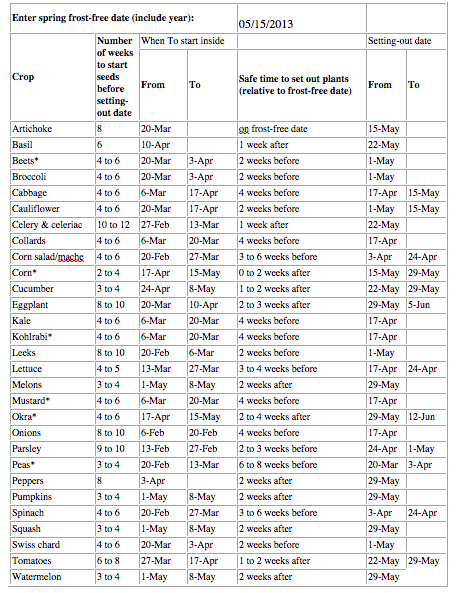
Below is a seed starting date calculator from Johnny’s Seeds. I downloaded it from the interactive tools section on their home page. I put the date of our spring frost-free date (May 15 in the Santa Fe area) and it automatically put in all the dates from when to start seeds inside to when we can safely put the plants out in our gardens. I just copied the vegetable section here for you to see but it also has many flower planting dates as well-it was just too big to capture it all. If you live in another area or want to capture the flower information as well, then be sure to go to the interactive tool section at Johnny’s to get your own. But here it is for those of you who live in Santa Fe, NM for all the vegetables they list. If you click on the image it will show up clearer and you can print it.
Category Archives: starting seeds tips
USDA Plant Hardiness Zones and ‘average first frost free dates’ explained
So what are USDA Plant Hardiness Zones? And what is this ‘first frost free date’ we hear about as gardeners so often?
The Plant Hardiness Zone is a standard set by the USDA (United States Department of Agriculture) and is calculated by accumulating many years of data. Zones are used by gardeners to help determine which plants will most likely thrive in their area. “The maps are based on the average annual minimum winter temperature, divided into 10 degree-F Zones”. There are 13 Zones, the coldest being Zone 1 and the warmest is Zone 13.
In Santa Fe, we used to be in USDA Plant Hardiness Zone 5 but now Santa Fe is in Zone 6b (-5 to 0°F). The reason our Zone has been changed according to the USDA is because it has better models to follow with more information gathered throughout the years- not necessarily because it’s getting warmer (although I do believe that too). Some areas in our county could be Zone 6a (-10 to -5°F) if they are closer to the mountainous areas. If you are not sure what zone you live in (where ever you live) go to the USDA plant hardiness site and type in your zip code and it will tell you what zone you are in-it’s as simple as that. So when you go to a nursery and the plant tag says zone 7-forget about it—it won’t survive our winters but any tag with Zone 6 or lower number should survive.
The average first frost free date is the date that we can safely put plants outside in our gardens. Notice I said average because some years we are colder and some years warmer. You’ll just have to watch the weather closely in spring for deciding if you want to try to sneak them out earlier in your area if spring appears to be a warm one. In Santa Fe our first average frost free date is May 15. So plant away outside after May 15, unless you hear we are getting a hard freeze! Of course if you are starting them in a hoophouse or greenhouse, you can start seedlings much earlier.
Now, once you know your planting zone and first frost free date, you can use the many tools available on the web for calculating all kinds of things from seed starting to succession planting to harvest times. Many seed companies have web tools to help you calculate the dates. In my next post I will show one such tool I use.
Seed Germination Trouble-seed heating mat too hot!
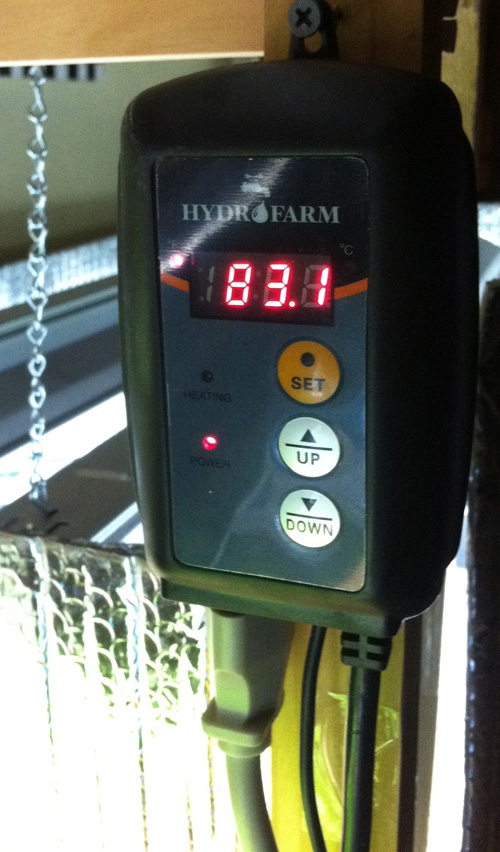
This year I have been struggling with my seed starting this year. Many seeds have not germinated. The seed germination mats seemed way too hot. I’ve never had this problem before (usually it is too cold) but when I did some research, I found out the mats are suppose to be 20 °F over the ambient temperature. This spring so far has been very warm (especially inside the house even without the heat on) and when I took the temperature of the soil in the little pots it was between 95 and 1oo°F! Way too hot for germination. No wonder very little was coming up—I’ve been frying the seeds!
So I got a soil germination thermostat that will control the temperature which I keep at 80°F and within 3 days I had 11 tomatoes come up. Wow what a difference. I will have to replant some tomatoes seeds but hopefully I will be fine. Guess I won’t have to worry about the plants growing too big this year before I transplant them in the garden.
Seed starting INSIDE
I’ve been planting seeds INSIDE for a couple of weeks now. Here is my update on my seed starting endeavors this spring so far.
PEAS-Not everything is successful-My pea seeds I planted inside have NOT done well as I had hoped. They are barely coming up now inside so I planted more outside and if these make it, I will add to the other seeds that I planted outside on Saturday. I think the heating mat was too hot for them so I put them on a table under the lights but with no heat. We will see..
FAVA BEANS-I’m so excited-I’ve never grown fava beans before but are trying them this year. I sprouted fava beans that I got from that Homegrown seed swap and bought some more that I got from Spanish Table Market here in Santa Fe. The companies would like to say that the ones they sell you to eat are different then the ones they sell you to grow. If they are treated then that would be true but so far I have not found that to be the case. They are both sprouting just fine. Today I saw three of them breaking ground in their little pots on the heat mat under the lights. Once up I will transplant them outside as they like the cold. I’ll talk about them later.
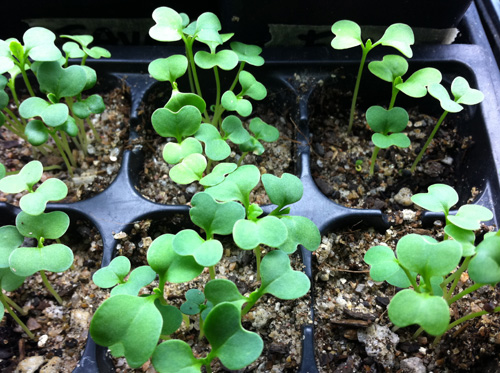
CHARD, BOK CHOY seeds planted-MAR 13-The chard and bok choy germinated in 2 days!
BORAGE seeds planted-MAR 13-Germinated in 3 days!
MORE LETTUCE-seeds planted-MAR 13-just starting to come up
SPINACH seeds planted inside as well as outside -MAR 13-Not up yet
TOMATOES-seeds planted today-Sunday, MAR 18-planted 27 different varieties! Hope to put them out 8 weeks from now-mid May or sooner. Last year I planted tomato seeds inside on Mar 21.
POTATOES-I’ve been chitting them for a week now. Chitting is getting the potato eyes to sprout.
The next major inside seed starting will be in 2 weeks-Basil, oregano, marjoram, zinnias and probably a lot more.
Master Gardener Intern Class-Vegetables
I’ve been totally busy teaching classes lately and the last class I taught was the Santa Fe Master Gardener Intern Class on Vegetables. All I can say to the interns is hang in there. Yes there are some difficult classes to get through but there are some great instructional classes as well that are like a breath of fresh air. It wasn’t till I became a Master Gardener that I really blossomed as a gardener. And now I am a rabid gardener! The knowledge you will continue to gain afterwards, the contacts, camaraderie and friendships you will develop will help you grow as well as the plants you will be growing! Hopefully you enjoyed and learned a lot from the Vegetable class. (Yes it was my favorite class when I was an intern!) So for those of you who couldn’t come to class or aren’t in the program but are interested, here are the information sheets. I want to make them available to all.
VEGETABLE GARDENING IN SANTA FE gives an overview of vegetable gardening in Santa Fe.
INFORMATION SHEET covers what the differences are between an Heirloom, Hybrid and GMO plant and explains what mycorrhizae fungi is and how it helps plants grow.
HERBS is a list of perennial and annual herbs we can grow here in Santa Fe.
PLANTING TOMATOES and PLANTING SQUASH both address how to transplant them into the garden and some of the things I add to help grow these beautiful vegetables and also how to help thwart the dreaded squash vine borer and squash bugs.
SEED STARTING DATE CALCULATOR from Johnny’s Seeds is the same one from the previous post but if you didn’t read it, then here it is. A great tool for when to start seeds or transplant them into the garden.
And now if you will excuse me, I will continue starting my seeds inside! Perfect day-cold, windy and snowy!
Starting Seeds Inside
Last Saturday I taught a seed starting class at the Railyard classroom. I want to share the information sheets I provided in class with anyone who might be interested.
STARTING SEEDS INSIDE will help anyone who wants to get a head start on how to start seeds inside.
One of the tricks with peas (especially if they are older) is to soak them in a water/ascorbic acid mix. To read how, go to PRESPOUTING SEEDS. I soaked them for 2 days and then put them in damp paper towels and in a plastic baggie. The little seed germinates the root right away. Then plant each pea root down in a little pot being careful not to break the root and wait for them to come up. My goal is to plant the pea PLANTS by March 17th (St. Patrick’s Day) instead of planting the SEEDS that day.
DIRECT SEEDING: TRANSPLANTING covers planting seeds for warm season crops directly in the soil AFTER the danger of frost has passed.
COOL-WARM SEASON CROPS is a list of plants you can grow by season. We are right now in the beginning of our growing seasons which is COLD SPRING/FALL meaning we can plant those plants in early spring and again in fall. The next group we can plant on the list (generally in April) is called COOL WEATHER crops and then of course we go into the WARM SEASON crops which is after the last frost freeze date (our area May 15th) and for those cold hardy people there is a list of WINTER crops.
I suggest you read Eliot Coleman’s Four-Season Harvest book which is a great resource for all seasons.
SEED STARTING DATE CALCULATOR from Johnny’s Seeds does all the work for us as to when to start seeds inside and when to plant them in the ground (that also means when to put in transplants if you choose to buy them instead). I just plugged in the last frost free date and it does the rest. Now all we have to do is get a calendar out and write down when we should start the seeds for the plants we want to grow this year. A terrific resource. Johnny’s has some other great tools on their main page in the left hand column under GROWING GUIDES called Interactive Tools. Be sure to check them out.
NEXT: MASTER GARDENER INTERN VEGETABLE CLASS
Seed Heating Mats for Starting Seeds Indoors
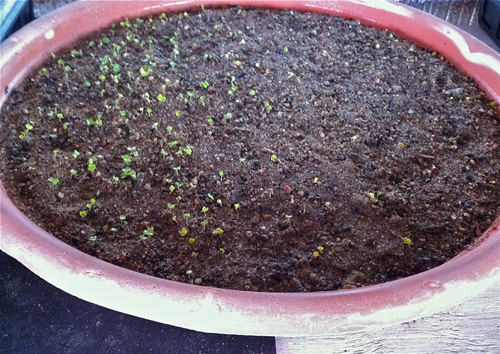
I did a little experiment. I started my lettuce bowl, putting seeds on the ‘bowl’ and lightly covering with sand. I didn’t have enough room to put the whole bowl on my seed heating mat (I’ve ordered another one) so I put half ON my mat and half OFF the mat as in the picture. The heat comes from the bottom. The temperature of half ON the heat mat was 77°F and the half OFF the mat was much cooler at 70°F. The half on the mat germinated in 3 days while the half off the mat had only a few seeds germinate. Amazing how the temperature affects the germination rate. Lesson here? If you plan to start seeds indoors, get a seed heating mat. Next: Review of my Seed Starting Class last Saturday.
Good day to plant seeds inside-Cold!
Good day to be inside today. Caleb, my apprentice, came out and we planted many things inside as the wind was blowing outside and it snowed until midday. Very cold! So he planted his tomatoes up to the next size pots, and we planted seeds of 13 collards and 14 dino kale. Then we planted 27 flowers in 2 inch pots and 2 mystery gourds as we don’t know what type it is. I’ve never planted flower seeds INSIDE before. I usually plant them directly in the ground OUTSIDE, so this is new for me. Now I need another big plant heat mat for them. For now they are on the floor by a south facing window. I may see if they germinate there as I don’t know how warm they need to be-not like tomato plants that want it warm…
Transplanted Tomatoes Again to Bigger Pots
Ok, yesterday I made another mess in the kitchen. I transplanted more tomatoes up to bigger pots from 2 inch pots to 4 inch pots. I washed the empty pots in bleach water and after planting them, I fertilized them with a weak solution of fish emulsion and Thrive. I knew I needed to transplant them as their roots were growing out of the bottom and they were starting to look stressed. Stressed? How can they be stresssed when they are in a nice warm cozy house under gro lights in a controlled environment-just wait till they get out in the ground, then they’ll be stressed! I tell them they got it cushy now. I think they know their going out early!
I’m chomping to get the tomatoes out. Patience, I tell myself. I looked up when I planted the tomatoes last year and the year before. Last year I planted tomatoes on May 4th and the year before I planted on April 29th when we had a warmer spring. So I guess I’ll wait till around the first of May. It’s always a guessing game when to plant if you want to plant earlier than the first frost free date which is May 15th here in Santa Fe. I like to try to sneak in the tomatoes early because I grow so many mid-late varieties which can take all the way up to 100 days+ to harvest. We have such a short growing season here in Santa Fe that I use all kinds of season extenders to get them in early so they have more time to ripen before that first frost next fall. OMG! I can’t be talking already about fall, we just got into spring and the plants aren’t even in the ground!
Giant Pumpkins and Greenie are up!
The giant pumpkins and greenie squash germinated and are looking GOOOD! I planted the seeds on April 7. The first one up was the greenie on April 12, then the pumpkins followed by April 14. The cotyledon leaves (very first leaves to appear or baby leaves) are huge. My all star lineup so far is:
Giant Pumpkins: 1046 Grande 10, and another 895 Grande 08 (which became my New Mexico State Record for giant pumpkin last year)
Giant greenie squash: 903 Noel 07
They are in 4 inch peat pots on a plant heating mat in a light box and I just see the beginning of the first true leaf on the pumpkins and greenie. Looking good so far! Grow naguas, grow!
Starting Giant Pumpkins, ‘Giant Greenie’ and Giant Marrow
I planted all the seeds for my ‘All Star Lineup’ of giant pumpkins, giant marrows and also new this year is a giant ‘greenie’ squash (think green pumpkin) and 2 long gourd on last Thursday, April 7.
-For the pumpkin and greenie (giant green squash) seeds I filed the edges just a little so the seed can absorb water more readily to help it germinate. Then I planted them in a 4 inch peat pot about 2 inches deep pointed side down. For the Giant Marrow I just planted the seed point side down.
-I put all of them on the plant heating map to keep the soil warm for germination. They are in the light box and get watered every day. Hopefully they will all germinate.
Shhh! Don’t Tell Anyone..
As a gardener, I try to do some things when I’m alone. Not that I don’t like company but planting seeds and transplanting seedlings up in new containers in the kitchen is dirty business. I mean literally.
Yesterday was one of those days. The kitchen counters got potting soil all over them, dirt got tracked on the floor, there was a bucket of dirt in the house (for my soil sample test!), the kitchen table was full of pots and seeds and the kitchen sink had dirt in it (which I carefully scoop out so it didn’t go down the drain). I would of just died if the doorbell rang and some friend ‘popped’ in to visit and saw what a disaster I was in the middle of! But I always clean it up (with bleach!) before anyone comes and sees what a mess I made all day in the kitchen!
By the time evening rolls around, it is spotless and nobody know any better! Shhh! Don’t tell anyone!
Tips for Growing Tomato Seeds
Lately I’ve been getting some questions about tomato seeds not germinating from more than one grower and thought I should address some of the problems and offer some helpful tips. If you haven’t started your tomato seedlings yet, you should start now. You have 6 weeks until May 15th which is the last average freeze date here in Santa Fe. You can still get a good head start if you plant soon.
1. Tomatoes do not like cool soil. Soil temperature in the 60’s is too cold for tomatoes. Tomatoes, peppers, eggplants like it very warm to germinate (in the 70-80°F). Some people put them on top of a refrigerator where it is warmer. Even if your days get warm where ever you live, if your nights still get chilly (i.e. in the 60’s), they shouldn’t be outside. Period.
2. Get a plant germination heating mat. The best thing you can do if you plan to germinate some of your own seeds is get an electric plant germination heating mat. Amazon has a lot different sizes on the internet here. You may be able to find them at one of your local nurseries (but not at a big box store). It will keep the soil evenly warm-in the 70-80’s°F range. My tomato seeds germinated in less than a week with them sitting on it inside the house.
3. Plant tomato seeds 1/4 inch deep and put sand on top of them instead of the ‘soil’ (like play sand from Home depot or Lowes). This makes it easier for the seed to push through to the top.
4. Make a solution of Chamomile tea to ward off dampening disease. Dampening disease is a soil borne disease that sometimes attack seedlings right after they come up. You’ll know if if you get it because the new seedling wilts and dies. This usually happens when the first 2 leaves (called cotyledon leaves) pop up.
I put one tea bag in a cup of hot water (like you would drink) and then when it is cool, transfer it to a little sprayer (like what you might use for your hair) and spray those new leaves. There are some properties in Chamomile tea that thwart off this disease-try it-it really works. After 4 of the true leaves, (they are the next leaves that come up that look like tomato leaves) I stop using the Chamomile tea.
5. Water from the bottom. This helps avoid getting ‘dampening off’ disease and also keeps the little seed from washing away when you water from the top. Put them in a sink or tray with some water and when the soil absorbs the water, it will look damp in top.
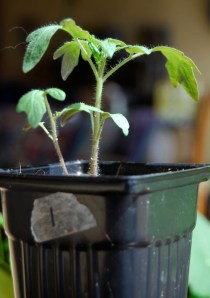
6. Transplant after you get 4 true leaves to the next bigger container. I’m assuming you start with small containers. Plant them deep-up to their first true leaves. They will root along the stem and become stronger. Every time you transplant up, bury your stems deeper. Always use disinfected pots-use 10% bleach solution to water to rinse your pots in.
7. Give them light. They need light and lots of it. If you don’t have a light box then put them in a south facing window and rotate them daily as they will lean toward the light. Be careful you don’t fry them with too much heat from a hot window. For those of you that have them under lights keep the lights about 2 inches above the seedlings and raise the lights as the plants grow. This will help keep them from getting ‘leggy’.
8. Give them dark. Yes that’s right. Plants need a period of darkness for photosynthesis to take place. I give mine 8 hours of darkness at night. Photosynthesis is the process where the plant takes the energy it gets from light in daytime and converts it into sugars as plant food. I have my lights plugged into a strip plug and the strip plug into a timer so I don’t have to think about it.
9. Use rock phosphate if your tomato leaves turn purple. Purple leaves means your plant is too cold. If your little tomato leaves start to turn purple (just look at the underneath side of a leaf), then they are cold and your soil is cold. They can’t access the phosphorus in the soil when the soil is cold. Get them to a warmer place and get some rock phosphate (which is a powder) and sprinkle some on top of the soil and water in. They will green up again within a couple of days.
10. Fertilize lightly. I only use thrive and diluted seaweed when I first transplant up and then only after the plant is doing well will I fertilize lightly with diluted fish emulsion. Don’t overdo it.
11. Grow thicker stems by brushing the plants. Make your tomato plants strong not leggy. You can make your plant produce stronger thicker stems by either brushing your plants with your hand when you walk by once or twice a day or put a fan on them (low speed). This mimics being outside where a breeze gives the plant a ‘work out’.
12. Keep planting up. Don’t let them stay in the same pot where they can get leggy. Once they outgrow their pot, plant up to the next size. I start with a little 6 pack and then plant up to a 2 inch pot then to a 3-4 inch pot and then to a gallon size pot if needed. I don’t use Mycorrhizal until I do the final transplanting into the ground.
I will give more tips when we are ready to transplant outside.
Tomato seeds planted inside-March 21
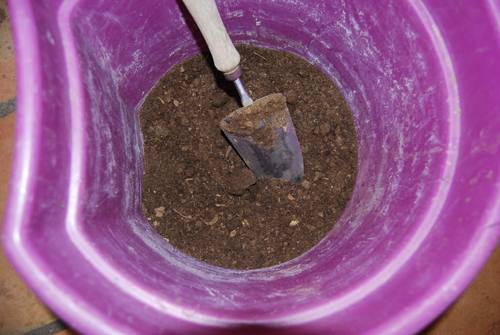
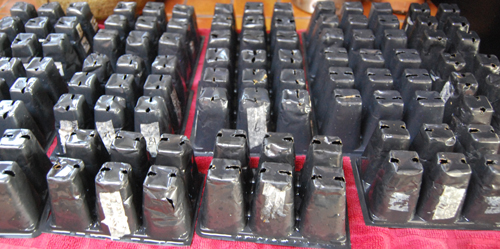
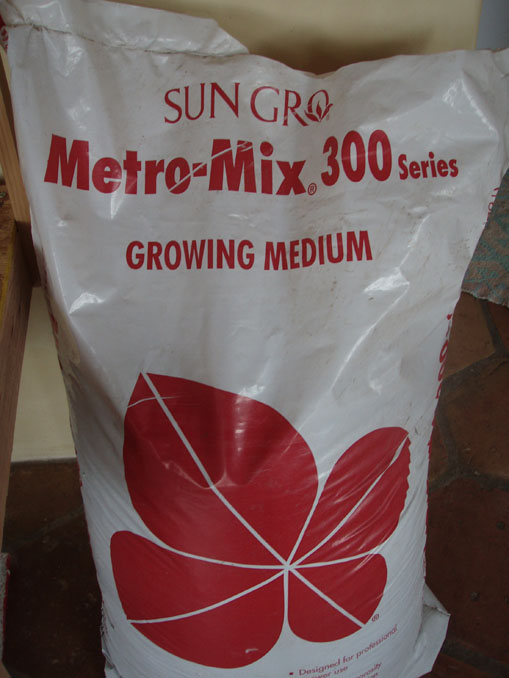
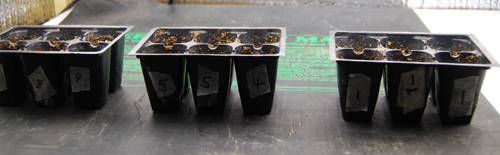
Last evening I planted my tomato seeds-both heirloom and hybrid seeds. I brought out and set up the light boxes and heating mats last week. Before planting my seeds, I always clean the little pots with some bleach water that I use for starting tomato seedlings. It’s important to disinfect the pots because you don’t want your plants to pick up any soil borne diseases. I use about a 10% bleach to water ratio. I use the kitchen sink and try to not get dirt everywhere from the used pots. The trick is to convince your partner that it is ok! Just tell them you are disinfecting the sinks out (which is true)! I picked up the seed starting soil-Metro mix 300 from Agua Fria Nursery last week. It comes in a big bag but you will be planting up into larger containers in a few days after the second set of true leaves appear and besides if you have any left over, you can use it for next year. I’ve bought many seed starting soil mixes (usually at the big box stores) and hate the way the water rolls off of the soil when you first go to use it. With this soil mix (Metro Mix 300) I just plant the tomato seeds about 1/4 inch deep and water it all at once. It saves time and anything that saves time I like!
After I water the seeds, I put them under my lights and on top of a heating mat which is great for warming the soil for the seeds to germinate. I’m starting the tomatoes later this year because last year I started the first week of March and they got too big-about 3-4 feet tall because I couldn’t put them out with the cold spring we had. This year I’m hoping to get them transplanted into the garden around mid April (with protection) weather permitting. Why do I think I might be able to get them in early this year? We are in a La Nina which generally means warmer weather in spring but less rain. By planting them later if I have to, they shouldn’t be as big as last year.
How to build a light box to start your vegetable seedlings inside
You can buy light boxes to start your seedlings in or you can make it. This is nothing fancy but works like a charm. Here is my simple light box I built myself with some scrap lumber I had around the house. It will fit between 2-4 big trays under the lights. See pictures for details of construction. I had already built them (I have two) or I would have done a step by step but I think you’ll be able to follow.
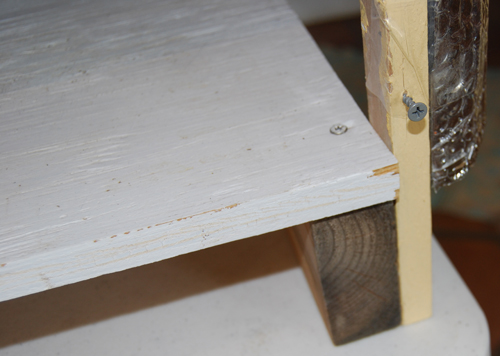
1. BASE: I use plywood – 2′ x4′ by 1/2 inch thick piece for the base of the box that I attach with screws to 2″ x 4″x 2′ on the short sides (depth). The base is now done.
2. TALL VERTICAL SIDES: I attached 1″ x 2″ x 45″ pieces to each corner with screws. I connect with screws on the short sides (depth) another piece of 1″ x 2″ x 2′ to hold them together.
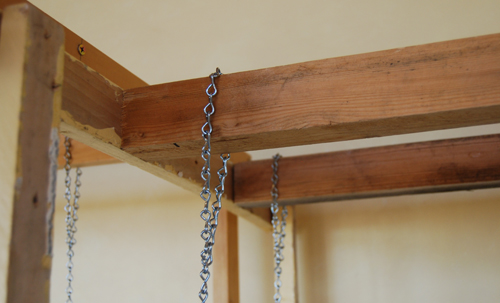
3. CROSSPIECES LENGTHWISE: To connect the top pieces for stability and to also hang the lights, I attach (2) 2″ x 2″ x 4′ across the width.
I screwed them in from the outside. They are set 6″ in from the front and back so the lights can hang and not touch each other.
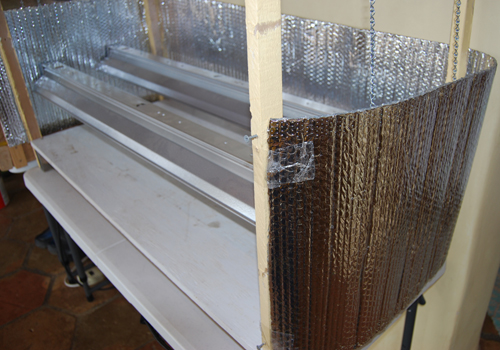
4. CHAIN TO HANG SHOP LIGHTS: I buy around 40″ on light chain and get some hooks to go into the light slots to hang the lights. Each light will have 2 chains. The chains can be raised as the plants get taller.
4. FOIL INSULATION: I buy a roll of foil insulation (looks like foil bubble wrap) from Home Depot or Lowes to wrap the outside of the light box on three sides. I attach it with wrapping tape to the corners. I left the front piece separate so I can take it on and off. Notice the screws in the front of the wood so I can hang the front piece of insulation off them. I made some holes in the foil (I reinforced the area where the holes will be with more packing tape so the holes won’t stretch too much).
Here it is with the front piece on. I leave this on all the time as it makes it warmer except if I need to get to the plants for watering. I also like the reflection of light from the insulation when the lights are on providing more light to the plants.

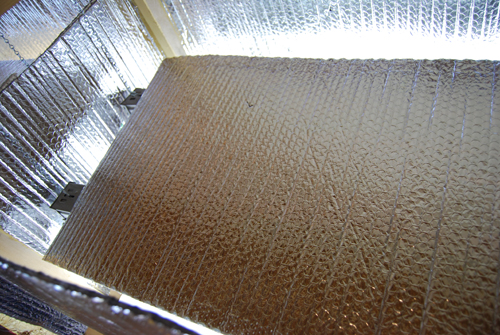
Here the lid is resting on top of the lights at night (the lights should be OFF not on like in this picture)
I also have an extra piece to put on top of the lights at night. I keep my house pretty cool at night (64°F) and find having a top keeps some of the heat in. I don’t put the top piece of insulation on top of the lights until I turn off the lights at night and I take it off in the morning when the lights go back on.
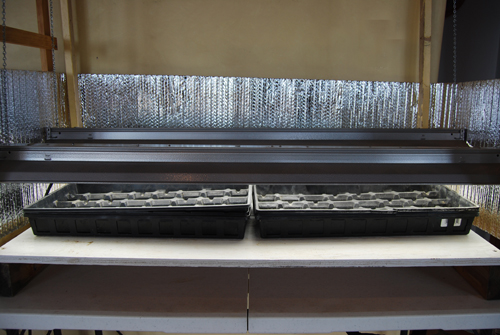
Here it is ready to start seeds inside.
Next: What kind of inside lights to use for starting seedlings