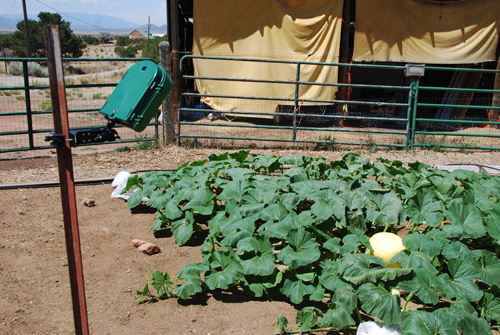
UPDATE-The other giant vegetables in the garden.

Here’s the update on the other GIANT VEGETABLES I’M GROWING THIS YEAR.

1048 pumpkins on Aug.16, 2011

I also have several little pumpkins (biggest 16 lbs.) on another pumpkin plant, the 1048 Grande, that are in great position on the main vine. They were pollinated later and so they are smaller right now but have the potential to get bigger than ‘MAX’. They are growing slowly right now gaining about 5 lbs a day. Hope they take off as well.

This is one plant! HUGE! Biggest I've ever grown. Notice the greenie squash on the right side.

The ‘Greenie squash plant has really blossomed (no pun intended) putting out 5 little green pumpkin type squashes. They are so beautiful, just like a pumpkin only a beautiful green and the plant is huge. Lots of leaves to feed all of them!

Giant Marrow (zucchini)

Meanwhile this giant zuck is doing great measuring 30 inches in length and 12 inches across right now and growing steady. I also have 2 others that are a little smaller than this one on this plant. One of them will go to the NM State Fair but the biggest I will save for the Giant Pumpkin Commonwealth Contest in Colorado Springs in early Oct.

And the giant long gourd has many gourds but one gourd growing about 6-8 inches a day in length but it is not on the top of the trellis. I hope I get one pollinated way up on top so it has 10 feet to grow down! This is the one I showed you only 7 days ago when it was 4 inches long!
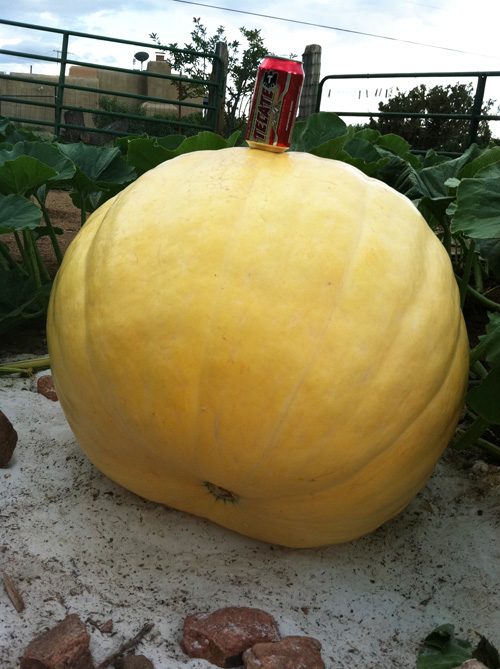
Giant Pumpkin named ‘MAX’

MAX at 216 lbs on August 16, 2011

Well I culled the last little pumpkin on the 895 Grande pumpkin plant, leaving one giant pumpkin who I’ve named ‘MAX’ to suck up all the juice.

Last culled little pumpkin off the 895 Grande 😦

This last little one wasn’t growing for 4 days so I culled it. I only hope nothing happens to MAX that will ruin  my season. It hit 216 lb benchmark today. Hope the rest of August and all of September are WARM which will help put on the LBS! It has been putting on 13 lbs A DAY for a week now which isn’t a lot in the giant pumpkin world, but I’ll take it here at 7000 ft elevation. It is on the main vine but only 8 feet out. Giant pumpkin growers like to wait till the blossoms are 10 feet+ out from the main vine to pollinate.  I thought it would be the one I would have to cull later. But noooooo, MAX decided it wants the vine all to itself robbing all the other little pumpkins of nutrients (juice) and the plant is not putting out anymore female flowers either which is good-all the energy is going to MAX now as it wants!

Just to put this in perspective on this date, August 16 of last year, KING KONG, who became the NM State Record, was 32 lbs! It got pollinated on July 29, and MAX got pollinated on July 10. I figure it has an additional 2-3 weeks to grow bigger than Kong  IF the weather stays warm at night. Wish for a Indian Summer for me… GROW NAGUAS, GROW! (Chinese for grow pumpkins, grow!)

One small step for bees..One giant step for beekind!

Caleb came over and we went through the rest of the hive that we couldn’t get to the first time.  The outfits we wear remind me of the astronaut clothing for the lunar landing, hence the title. Lucky for us, the first 7 bars that hold the babies were in pretty good shape. Those bars had the brood and a little honey. I saw the queen! She was busy scurring around with her court and laying eggs. There was a good amount of brood and some pollen and honey. Caleb thought they looked better than he expected with conditions and lack of flowers this year. We will not be getting any honey because they will need all they make and we will have to feed them this winter to help get them through it. Here are some photos.

This slideshow requires JavaScript.

Tomato hornworms are here!

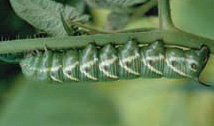
Sphinx larva-tomato hornworm

Well I knew it would be too good to be true! The tomato hornworms are here-late but here. Picked off about 15 today that were found on the tomato plants. Boy are they hard to see. Great camouflage artists. I haven’t been in the garden much this past week due to a lot of art events around the SOFA show that just ended here in Santa Fe. As a result, three of us-Caleb, Elodie and myself found about 15 hornworms on the tomato plants. The hornworm is the larva of the Sphinx moth (also called the hummingbird moth but not related to hummingbirds). I was hoping that maybe they wouldn’t show up but they’re here! They can be seen in the top of the plants, not deep in the interior, thank god, where I wouldn’t be able to find them and they are almost inevitably always found hanging upside down on the branch they are munching on. When I find them, I pick them off  (wearing gloves) and under my shoe they go! I think their instant death is better then giving them to the chickens who would peck them to a tortuous death. I do try to be humane in their demise! They aren’t hard to control by handpicking, it just takes a little time. Glad one never finds more than one or two in each plant. So tomorrow and everyday this week I will go hornworm hunting until I can’t find anymore..

Growing gourds- Giant Long gourd plants growing wild

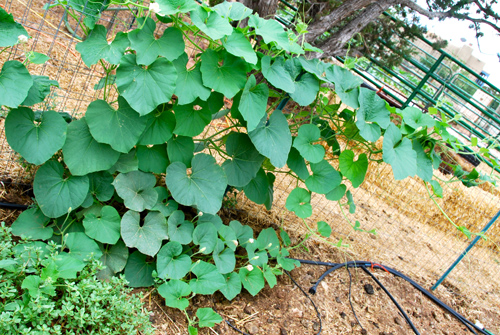
Long gourds grow over the top

Fuzzy little long gourd baby-4 inches long

The long gourd plants are really taking off. They are now over the top of the gourd trellis or tower as I like to call it and filling in. They seem to like the heat, humidity and extra moisture we’ve been getting lately-in fact all the gourds have gone bonkers.  Caleb is coming over today and after we check the bees, we are going to reinforce the top of the tower they are growing on as I hear they get extremely heavy as they get longer. They already have some babies growing but not on top where I want them. If they get big enough this month I will put those smaller ones in the State Fair at the end of the month.

I read and heard from a fellow gardener at the SF Farmers Market that gourds are pollinated by night pollinators like night moths. I’ve never seen a honeybee interested in them. We must have some night pollinators here as I have some baby fruit growing on them.

Mystery gourd (I don't know what type it is)

This little pear gourd came from an 89 lb giant pear gourd

I’m growing three types of gourds this year-giant long gourd, giant pear gourd and a mystery gourd (not sure what type it is but looks like a small pear). All the gourd seeds were extremely hard (at least for me) to germinate-they took forever to come up and some I had to plant twice, but once they came up and I put them in the garden, they have been easy keepers and give a certain lushness to the garden without lots of water. They are part of the Curcubita genus which includes, pumpkins, squash and cucumbers. I bet you didn’t know pumpkins and squash are part of the gourd family did you?

So far none of the gourds seem to attract bugs-like the squash bug, perhaps because of their scent when you handle the leaves. They are kinda stinky but not too bad. But like I said, they are beautiful to look at and the leaves and small furry fruits are fantastic. Both are really soft to the touch, like suede, unlike pumpkins or squash whose leaves are rough. They also have beautiful delicate flowers. I’m really enjoying them so far.

Mystery gourd flowers

My Garden Kicks Ass!

I think this is my best garden ever even though I don’t have a lot of produce yet-but it’s all coming! It’s gotten so lush with just a couple of days of rain. I don’t mean to brag but I must-it’s really hard to grow a garden like this in the high desert. I fight the pests and have problems too just like you but diligence and hard work has really help. Hope you enjoy these photos.
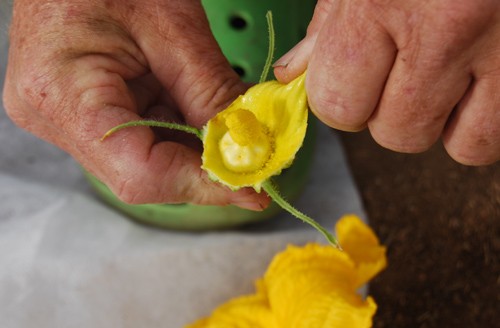
This is the same angle from the corner of the garden I’ve photographed  since the beginning of this year.  Wow what a difference 2.5 months makes.

55 tomatoes planted May 15th!
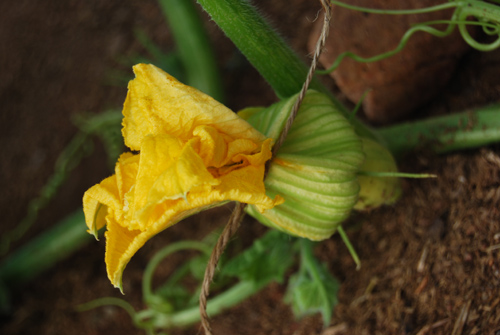
Here is the same corner in  the beginning of the season back on May 15, 2011

Here the view is looking towards the entry from inside. Zucchini, flowers, scarlet runner beans, rattlesnake beans tomatoes, corn, asparagus, sunflowers, rhubarb all stuffed in the entry!

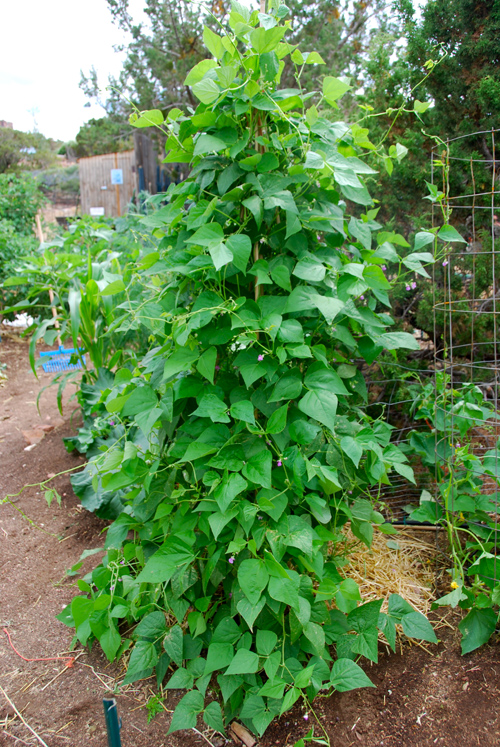
These Emerite pole beans are hiding the teepee now.

Corn, asparagus, flowers, rhubarb and sunflower coming along.

Baby cucumbers- these are Boothsby Blonde variety. They will make great bread and butter pickles.

Caleb, my apprentice, gave me a gourd seed that someone had given him but he didn’t know what type it was, so I call it-Caleb’s mystery gourd. Notice the purslane in the left corner. I’m going to try some this year so I left it in..

Flower bed to the right of the entry-zinnias, cosmos nasturtiums, pole beans and sunflowers. I can only imagine this when they all bloom.

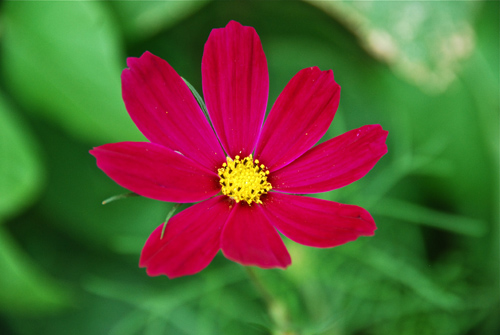
My one lone cosmos flower yet but what a beauty-Magenta cosmos flower

Here is Caleb’s baby mystery gourd-wonder what kind it’ll be. Kind of looks like a pear right now.

The tomatoes have really shot up-about 5 feet tall now. Now the Long Gourd tower in the background doesn’t look as tall.

Best tasting zucchini ever-Costata Romanesco

Pepperoncinis’ with eggplants behind them

The Long Gourd is stretching towards the top of that 10′ trellis tower I built! Never thought I’d see that!

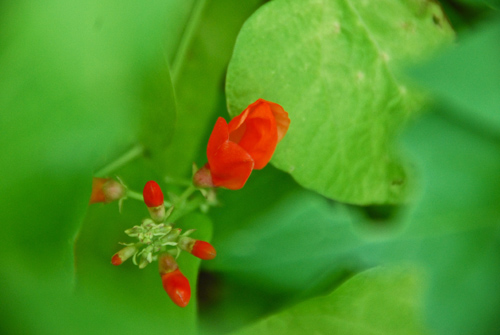
Scarlet Runner bean flower-beautiful!

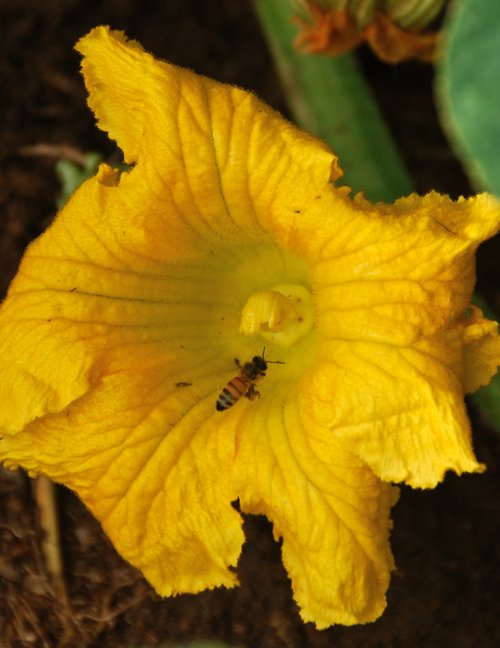
Here’s  one of Caleb’s bees doing it’s thing with the pumpkin flower.

Finally the Shishito peppers are kicking in.

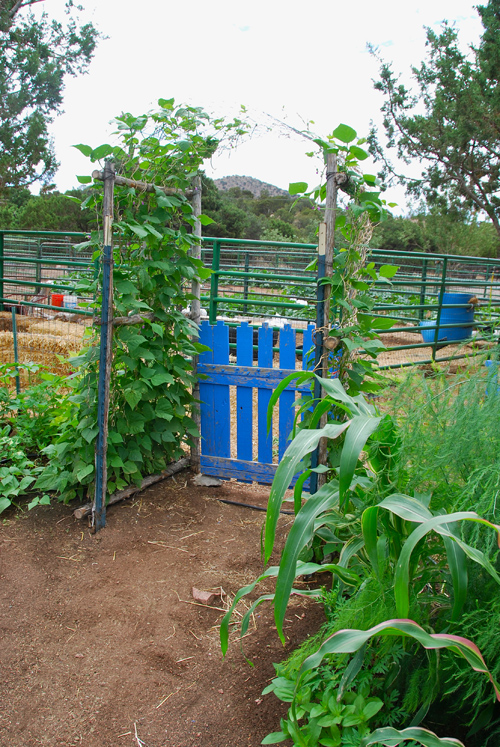
View from the inside looking out towards the gate. The Rattlesnake pole beans are producing and growing over the arbor now. Way in the background inside the corral is the pumpkin patch.

Finally a baby ‘Greenie’ pumpkin-about 5 inches in circumference right now-small but I’ll take it!

Put my cell phone on top of the giant pumpkin today to give it some perspective. It put on 11.5 lbs yesterday— went from 56.5 lbs to 70 lbs.  Hope the squirrel doesn’t get it. Been hiding all the pumpkins under row cover and burlap to discourage the squirrel.

Today’s small harvest-slow but steady!

Finally RAIN!!

This slideshow requires JavaScript.

Finally been getting rain in Santa Fe. Here are some photos of the storms from the house. All photos by Elodie Holmes.

How to tell when to pollinate a female giant pumpkin blossom

Another gardener friend, Mac asked me a great question about the female flower and the timing of the pollination so I thought I’d give you all some more info.

When you spot a female pumpkin blossom that you want to hand pollinate later, you need to watch it daily as it grows.  The optimal position of a female flower will be on the main vine and at least 10 feet out or longer although I did pollinate one this year at 8 feet out for insurance in case no others ‘took’. I will also pollinate every female flower on the secondary vines that grow out from the main vine on the sides. This is all for insurance in case something happens to the best one. Later, after I feel confident which one of these pumpkins is growing the fastest, I will cull all but the first and second fastest growers. So each plant I care about, will have 2 giant pumpkins growing on them. The first and a backup.

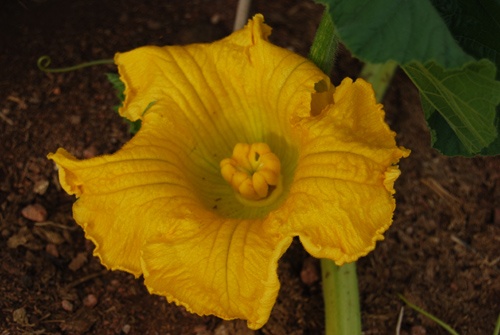
Here is a female blossom NOT READY. The blossom is still very green although getting larger.

Here is a female blossom that will be ready to open the next morning. So how do I know when the female blossom will open? I watch the female blossoms closely (they are the ones with the baby pumpkin attached to the base of the flower. I always look for the blossom to get big (still closed) and then the day before, the blossom will get the slightest hint of yellow green on the tip. That’s when I know it will open the next morning. Works everytime. I cover the female flower the night before after the color change and get out in the patch early the next morning.

We have 4 hours from the time the blossom opens which is always first thing in the morning. This is usually between 6am -10am. So I cover the female flower the night before with a piece of row cover and get out in the patch early before the beez take all the pollen from the male flowers. Many times I cover three male flowers that will be ready the next day as well  (they haven’t opened up but look like they will the next day) so I have lots of pollen on them. The beez get out early too and will take it all of their pollen if not covered.  The pollen is food for the bees. It is protein for them. Beez will go after the nectar and the pollen on these plants. I’m sure the beez are attracted to the big blossoms and wonderfully sweet smell the blossoms emit. Someone should make a perfume out of this smell-it is wonderful. What would that be? Parfum de fleurs de citrouille (scent of pumpkin flowers)!! If I know I’m pollinating, I will get up early. Generally between 6-8 am is when I pollinate them but I have forgotten sometimes and ran out at 10 am to pollinate.

Then after pollination be sure to close up the female with a twistie tie or piece of string for 24 hours as shown here. After 24 hours, you can let the flower open up cause it will either be successful or not and you won’t know till after at least day 10 (that is the benchmark) if it was successful. The female flower shrivels up and drops off (like an umbilical cord) and the baby pumpkin will get larger and larger. If the pollination didn’t take it could be because of several reasons. One reason is because it was too hot the day of pollination (over 90°F). This might cause some pumpkins to abort later. The second reason is because we didn’t get enough pollen on the stigma part of the female blossom. Either way, you’ll see the pumpkin start to grow and then suddenly stop. It looses it shininess, getting duller and softer and usually spots show up as it decays which is a self abortion.  If this happens, cut it off. That is why we pollinate more than we need because sometimes the plant self aborts its babies if something is wrong-kind of like a miscarriage for us.

How to pollinate a giant pumpkin

Here are pictures on how I hand pollinate a giant pumpkin…

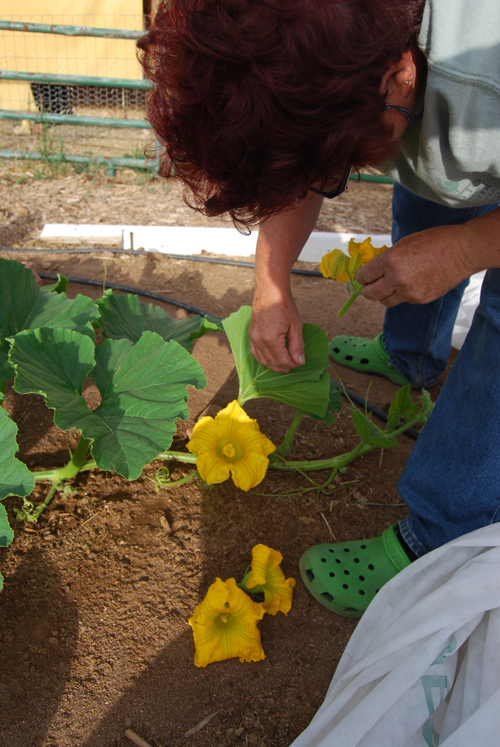
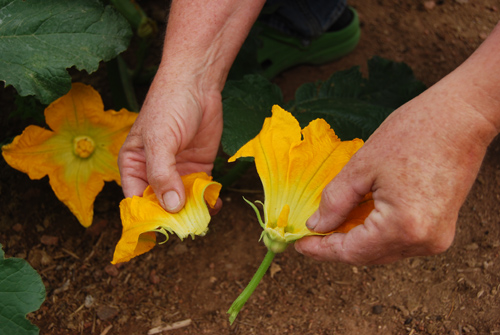
Here I’m getting ready to pollinate a giant pumpkin. I’ve gathered several male flowers that are  by my shoe. I have one in my hand ready. I try to use several male flowers to make sure I get enough pollen on the female flower. Notice the female flower just below my hand that is open and ready to be pollinated.

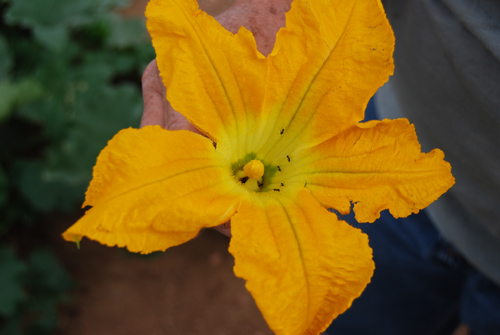
Here is a closeup of the male flower. The ants can be accidental pollinators too.

Here is a closeup of the female flower. When she opens up first thing in the morning, she is ready to receive pollen.

Here I’m peeling off the flower petals from one of the male flowers. I peel off the petals so only the stamen is left. That way it can get to the female stigma.

Here is the male flower with all the petals off.  Notice the pollen on the stamen and around the base.

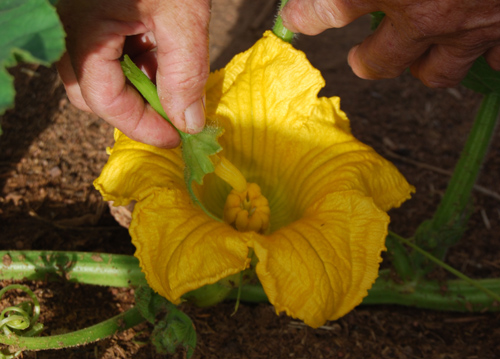
Now I take the male stamen that is loaded with pollen and use it like a paintbrush to paint the pollen all over the female stigma. then I repeat with the extra male flowers.

Then I tie and close up the female flower so it can’t accidentally get pollinated by the beez. It will stay closed up for one day and then I will untie it as the female blossom will only acept the male pollen for about a 4 hour period. If you want to know who are the parent pumpkins, this is the way to control the assurance of the genetics. We try to get bigger and better pumpkins each year which is why we hand pollinate.

Tomatoes Starting to Ripen

My tomato plants are looking good and are loaded with tomatoes although mostly green. I was starting to get one ripe tomato here and there a couple of weeks ago and now I get several a day-not enough to go to the SF Farmers Market yet but certainly enough to have every night now with dinner. AHHHH! I wait for this time in the garden! I have yellow, orange, black, green and of course red starting to ripen.

To beat the birds from pecking holes (I don’t always win) I am picking the tomatoes a little early when they first start to get a little color and let them finish ripening inside.

I love to slice them and put over a bed of lettuce and drizzle a little balsamic vinaigrette over them. I’m also thinking I need to make some grilled cheese sandwiches with sliced tomatoes inside. YUM!

First Giant Pumpkin

The first giant pumpkin is still growing nicely. Hopefully it won’t abort. We are at day 16 of its life. It is now bigger that a basketball. If it does abort, it will be soon. Hope not. It is bright, shiny and it’s skin is soft. The yellow color is standard with all giant pumpkins. It will turn more orange or salmon color later.  It is currently at 38″ in circumference putting on about 2″ a day.  We measure around the fattest part of the pumpkin for the circumference measurement. I am not using the OTT method until I know it doesn’t abort. The OTT method will include not only the circumference but the length and width too.

I better get some sand underneath it soon while I still can pick it up. I put fine sand underneath it so a small rock won’t pierce it and water can drain around it so it’s not sitting in mud. Ha! No mud around these parts!

Giant Pumpkins on July 26, 2011

The pumpkin patch is filling in  quite nicely but not quite full yet. Look at those big gorgeous leaves-more leaves, more food for the pumpkins! Notice the row cover on the ground in the background. I’m trying to keep the pumpkins uncovered more since it has cooled down and starting the monsoon season.  I don’t want to promote fungal diseases by keeping them damp and covered. The plants need to dry out between showers. I keep the actual small giant pumpkin fruit covered in heavy row cover and burlap to shade them out of the sun and keep the squirrel off them. I want their skin soft while they are young. Too much sun hardens them up and slows growth.

So far I have 3 little GIANT PUMPKINS (one is growing quite fast) on the 895 Grande plant, none on the 1048 Grande plant (I accidently broke two female flowers off the main vine and a squirrel ate the only pollinated one) on that plant.

I have 2 pollinated ‘GREENIE’ female blossoms (we’ll have to wait to see if the pollination ‘took’ on them but they had the biggest stigmas on both female flowers I’ve ever seen in my giant pumpkin career-4 years. lol. I hope they took as I’ve never grown GREEN PUMPKIN LIKE SQUASH before.

I also have quite a few GIANT MARROWS going (thank god as the squirrel ate one of those too) on the 78 giant marrow plant. The other giant marrow is now just starting to produce more female flowers-the boyz and the beesz are just waiting for them to be ready! I don’t hand pollinate the giant marrows-I let the beez do it. I don’t worry about the marrows cross pollinating with the pumpkins because the pumpkins are in the Curcubita Maxima family and the giant marrows are in the Curcubita Pepo family so they can’t accidentally cross.

I have one more plant in the pumpkin patch and that is a GIANT PEAR GOURD. I haven’t talked much about it yet as it isn’t very big compared to the other gorillas in the patch but it is flowering and I hope the bees pollinated it. It has beautiful soft fuzzy leaves and tendrils and likes the heat.

As for that squirrel, I’m trying fox urine granules that I bought at Agua Fria Nursery. I sprinkle it every 3 feet all around the perimeter of the garden (like marking my territory and also around each plant). OMG that is stinky stuff. I sure hope it works because tonight I will leave everything uncovered in the pumpkin patch. Wish me luck the stuff works and the squirrel doesn’t have a feast..

Plant Cam on Pumpkins

Plant Cam pointed at pumpkins

closeup of plant cam

PLANT CAM

Yesterday I set up a ‘Plant Cam’, which is an outdoor waterproof digitized camera. I set it to take one picture everyday at 9am of my 3 giant pumpkins on the 895 Grande plant as they grow. That way I will be able to make a video of the growth of the pumpkin in a video after the season. Once I choose one to keep, I will cull the other two and zero the camera in on the one remaining.

Growing Borage

I wanted to try Borage and couldn’t find it in starters in the nurseries around town. Perhaps one of you did? So I grew it from seed this year and read that it is a good companion plant Strawberries do better with borage growing in with it. I have three plants and put them in the strawberry patch and both the strawberries and borage are doing great. They are a bee attractor which is a bonus.  It has gray-green fuzzy leaves with beautiful blue flowers that many people use in salads to make more beautiful. They have a slight cucumber taste. Can’t wait to put it in a salad. You must take off the sepals behind the flower and only use the flower itself.

NOTE: Pregnant women or nursing moms should not eat borage as it may increase lactation.

Homegrown New Mexico-Vegetable Gardens, Potagers and Coop Tour

Today I volunteered at the first Homegrown New Mexico tour of 6 homes featuring vegetable gardens, potagers and chicken coops. I can’t say how impressed I am with this organization. First, they picked some fantastic examples in our city. The tour was incredibly organized AND they are only 5 months old. Phew! A big chunk to bite off and they did it extraordinarily well. At every site I got several ideas that I will want to incorporate into my own gardens. Here are some of the things I particularly enjoyed. Great job to all!

This slideshow requires JavaScript.