Identifying Tomato Curly Top Virus (CTV)-more info

Photo credits: curly top disease - photo courtesy of http://ucanr.org/blogs/blogcore/postdetail.cfm?postnum=3352

Curly Top Virus (CTV) on tomatoes
Last year, the Beet Leafhopper which transmits ‘Curly Top Tomato Virus’ was rampant in our gardens and devastated many of our tomato plants. I lost only 4 plants out of 74 to it but only because I take extraordinary measures to protect them. Here is some information on the beet leafhopper., how to identify it, symptoms and how to protect your plants.

The Beet Leafhopper flies in on the winds in early June through July, jump on the tomato plants and taste them. It is a big problem in the Southwest and inland in California where it is hot. They don’t even like to eat tomato plants but sample them, transmitting the disease in the process, then fly off to visit other plants.

Identifying Beet Leafhoppers
The beet leafhopper is very small-about 1/8 inch long, pale green to light brownish green and has wings that look like a tent when folded up vs spread out like a moth. See photo on left. They come when conditions are dry, hot and windy. Sound familiar? This is typical June weather here in the greater Santa Fe area.

I notice they leave after the monsoons come in July when it is cooler and wetter. You will know if they are in your garden as they come in and when you walk around your garden, you’ll see jumping little green bugs that fly off when you walk by. Then they leave—flying to the next garden. Because of this, you can’t really spray anything to get them because they hop so fast and only stay in the garden a short time—here today, gone tomorrow. By the time you notice something is wrong with your tomato plant, they are long gone. It takes about 2 weeks for symptoms to show up.

Symptoms
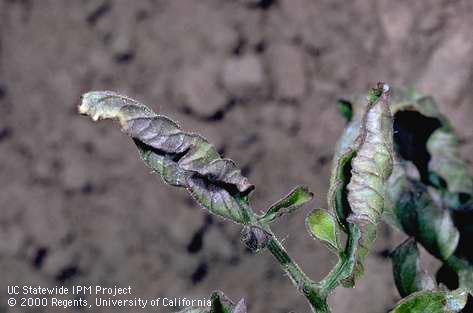
closup of leaves of curly top virus

Your tomato plant leaves will start to curl and the underside of the leaves and veins will turn a purplish color as pictured above.


curly top virus_helthy plant

Tomato Curly Top Virus-beginning stages and advanced stages


The leaves then start to wilt and the plant will look stunted. You might think it needs water but it doesn’t, it is sick and won’t recover. ‘Curly-Top Virus’ is only transmitted from bug to plant and is NOT transmitted from plant to plant hence you will see a healthy plant next to a sick plant. The pictures above show 2 plants with curly top. The first one is beginning to be sick with curly leaves and the veins will turn purple.  The second plant in the picture is advanced.

Now there are three cases where you may think you have curly top virus but may or may not have it.

Denver Downs Farm, Anderson, SC;  High temperature on black plastic; lower leaves only.

Physiological Leaf Roll-Photo courtesy Clemson University

The first condition that may not be Tomato Curly top Virus is Physiological Leaf Roll that can happen on some tomatoes and could be caused by various factors including stress and that is not necessarily curly top-if you plant has rolled leaves but no purple veins as shown above, it possibly has physiological leaf roll and look for why it may be stressed. It is getting enough water, too much water, too much nitrogen? Also drought, pruning, root damage and transplant shock can all be reasons for leaf roll. For more info on this condition go here.

purple tomato_purlple leaves

Phosphorus deficiency in tomatoes happen when the weather is still cold-not in June.

The second condition is early in the season, sometimes the leaves turn purple when it is still cold outside. This is a phosphorus deficiency. This never happens in June or later when it is warm but more in May if you plant early and it is still cold outside.

The third condition (no pic) is if you are growing a purple or black variety of tomato your plant may have purple veins so don’t pull it unless it start to looks sick with the curly leaves and looks like it needs water.

Remedies
There is NO CURE for this virus and if your tomato (or pepper for that matter) shows signs of the disease, you should pull the plant. You could leave the plant in BUT if another wave of leafhoppers come by and a healthy leafhopper bites your sick plant, it only takes 10 minutes in 90°F weather for it to be able to transmit the disease to one of your healthy plants. The best thing to do is pull any sick plant and dispose of it. I don’t compost ANY tomato plant that shows disease.

Here are some remedies:
• Leafhoppers do not like shade and if your plants are partly shaded, that may help keep them off but since most of us grow tomatoes in full sun that might be difficult.

Create a physical barrier with row cover

Put row cover over tomato plants

• The main thing I do is create a physical barrier between the bugs and the plants.  I now cover all tomato plants with row cover until the bugs pass. Wrap the row cover around your tomato cage and put a piece on top of the cage BEFORE they come.

• Lastly you could put out some tomatoes later in the season after the bugs leave but you’ll have to put in early season varieties so you can still harvest before the season ends. I buy gallon size at that point so as not to be too far behind. A couple of years ago when I was out at the Santa Fe Community Garden, I noticed many rows of sick tomato plants but one row of perfectly healthy plants and when I asked about them, it turned out they were put out about a month later than the rest of them and by then the leafhoppers were gone.

Dry, sunny, windy weather are perfect conditions for the leafhoppers so look out this summer-conditions are ripe again!

I remove the row covers after the monsoon season comes. They usually leave or are suppressed by then. Monsoon season historically comes in early-mid July.

Santoro lettuce-a great butterhead variety

IMG_5764

This year, one of the lettuces I grew is called Santoro, a type of butterhead lettuce that is heat-resistant, cold resistant, has a wonderful taste and grows really big if given the chance. I got the seeds from Cooks Garden seed catalog. I started them inside the house on Jan 29, transplanted them into 2″ pots on Feb 14 and transplanted them again into the greenhouse in mid April.  I read somewhere Santoro lettuce can produce 12″ heads if you give them the room. So I spaced them really far apart to see if they could get that big. They say if you crowd big varieties they will never reach their maximum size. In the picture above I’ve picked the outer leaves to eat and wanted to see if they would grow back. The heads on the right haven’t been touched yet. As you can see I picked pretty hard. They grew back almost to the same size as the ones that weren’t picked.

IMG_5763

A couple of weeks later-Check out the size of these heads-a full 12 inches across. They are still growing in the greenhouse but now I’m picking the whole head  (instead of just the outer leaves) as I had to make way for the tomatoes that will grow in there. In fact I already have all 18 tomato plants (in wall of waters) inside the greenhouse as of May 13. I know it will get too hot for lettuces inside the greenhouse this summer so I’m starting to pull them to eat.

santoro lettuce_17 inches

May 31-I just picked this last head of Santoro lettuce yesterday (shown above between the tomatoes in the wall of waters) and it hadn’t bolted yet even though the temperatures in the greenhouse have gotten over 80 degrees. It’s handled 19 degrees to over 80 degrees! It reached 17 inches across! Hasn’t gotten bitter and is still soft and wonderful to eat. I’ve never had such great lettuce as this year, not only with this lettuce but with all of them in the greenhouse. Seems I’ve figured out how to be successful with them. I’ve done a lot of research on them from Nov-Dec to find some great varieties that were cold tolerant and now I’ve researched out what varieties of lettuce are heat tolerant, hoping to grow them in the shade this summer here in Santa Fe without bolting. Most of us don’t even try to grow lettuce in the summer as it is pretty warm here. I will list the heat tolerant varieties of lettuce in the next post and do an experiment with some of them outside in the garden.

May 21-ALL TOMATO PLANTS IN

growfood,not lawns

It’s time to get growing!

Now is the time to seriously get into your garden. This is the busiest time of the gardening season with everybody wanting to get everything in their gardens. The day temperatures are now in the mid-high 70’s and the evenings are in the mid-high 40’s. PERFECT PLANTING WEATHER! Here is what’s been going on at my place. I feel I’m ahead so I actually have time to post something.

May 21-I waited to plant till after that last snow right after the May 15 date. All 120 tomato plants were in the gardens by May 21 with the help of Elodie Holmes, Lava Ewersmeyer, Mernie Ellessner and Janet Hirons and of course me! Many thanks to all my friends for their help! Boy, was I tired by the end of last week. This is the most tomato plants I’ve ever planted-hopefully it will be a great year and I will have many tomatoes to sell at the Farmer’s Market later this summer! I have 31 varieties this year. My favorites plus many new varieties. They are all in Wall of Waters (WOW) and I wouldn’t attempt to plant them at this date at our 7000 ft high altitude without them. Later the WOWs will be removed once the tomato plants reach the tops of them which will be sometime in June.

May 24-Meanwhile I’ve already put SEEDS in for Atomic Red carrots, Cosmic Purple carrots, Cylindra beets and Craupadine beets, transplanted broccoli-raab, Lacinto kale, Ruby chard, Argentata chard, Burgundy Amaranth and Zino fennel bulbs as of this week. All got row cover over them to give the transplants time to adjust in their new environment.

May 25-The peppers and eggplants are still inside, the little finicky darlings, basking in the windows as the nights are still too cold to plant them yet. If it stays warm I will put them in by the end of the first week of June.

May 26-I will NOW plant bean, corn, cucumber seeds, many flower seeds AND my giant pumpkins. I will also put row cover over them till they come up about 4 inches to keep the birds from eating them.

HAPPY GARDENING!!

250,000 visits

milestoneToday is a milestone.  250,000 people have visited my site!

That’s 1/4 of a million people-WOW that’s a lot!

I guess there is truth to the saying, “If you build it, they will come”

Thanks for visiting! If you keep coming, I’ll keep writing.

SNOW-May 16th?!! Yes

Well I hope the wall of waters will keep my newly planted tomato plants warm enough with the snow we had today. Not much snow but then tomatoes don’t like snow at all! And I hope it’s not too cold tonight. They do like this rain though…

Tent Worms

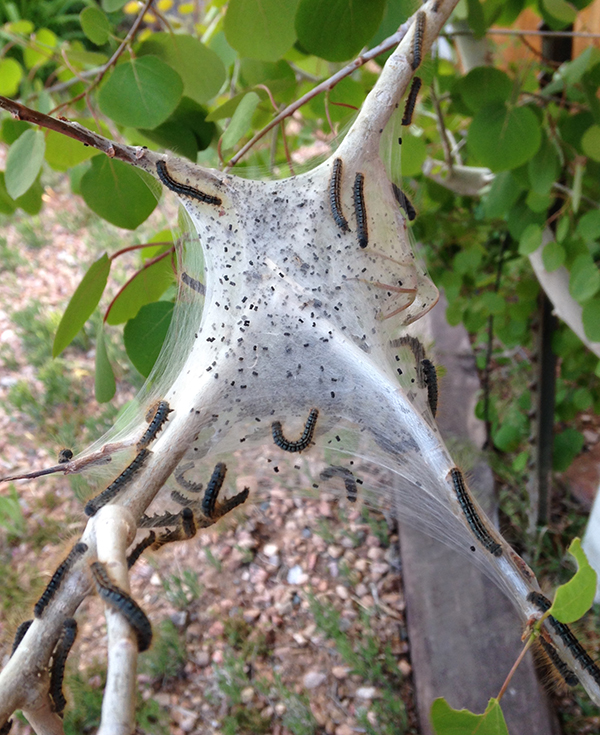
tent worms nest with small black eggs and tent worms on a Aspen tree

Tent worms nest with small black eggs and tent worms on an Aspen tree

So about this time of year tent worms appear in my apple trees, apricot trees and aspen trees. They are also known as web worms because of the web they live in. But unlike fall web worms which appear in the fall, tent worms appear in the spring. If left to their own devices, they will eat many leaves off your trees. I even saw them in my Currant plant. They leave the web in the day eating the leaves and go back to the web at night. They look like long skinny caterpillars.

I asked a landscaper friend of mine what’s the best way to get rid of them and they said to just cut off the branch they are on and put them in a plastic bag and dispose of them.  This year I’m on top of the problem so they can’t keep multiplying and it seems to be working. Keep an eye out for them. They can be anywhere on the tree branches-down low or up high.

Great Weather! Time to Plant?

RAIN5

Wow! Great weather this weekend with no wind, warm temperatures and wonderful rain today. I hear tomorrow brings more rain. Today we had some great rain and boy is it welcomed. The native plants and trees and all of our plants are sucking it up. I can’t remember getting this much rain at this time of year in May. A great big plus is the night temperatures are starting to warm up too with the next 10 nights suppose to be from 35°F- mid 40’s. Pretty cold but above freezing.

So can we plant tomatoes? Is it time? Well that depends on whether the nighttime temperatures remain above freezing. Of course the first frost-free date is officially May 15th historically speaking, but back in 2011, we had a very warm May and many of us planted early as it never got below freezing that May. Is this one of those Mays? Who knows, unless you have a magic ball. By the way, I waited to plant my giant pumpkins till later in 2011 (as they are so frost tender) and my 2010 State Record got broken that year by someone who went for it early. I guess I should have put them in but I just didn’t want to chance it. You have to be a bit of a gambler to put your plants in now.

tomatoes in wall of waters 1

But if you are a gambler and want to plant your tomatoes early, be sure you plant using wall of waters (WOW) as shown above.  If you use them, and the temperatures dip below freezing, they will protect your new tender plants. I always use them even when the nighttime temps are in the 40’s as I feel they provide more heat at night and keep them from setbacks. The cells of water warm up all day and give back the warmth at night to the plants like little greenhouses or cloches. Once they outgrow the WOW’s  (like in the photo above), take them off  the tomatoes, which will probably be late May. Do not leave them on all summer.

Master Gardener Spring Garden Fair

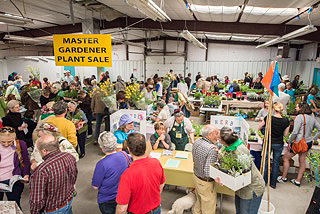
Garden Fair 2014-1401

Today is the annual Santa Fe Master Gardener Spring Garden Fair from 9 am – 3 pm at the Rodeo Grounds off of Rodeo Road. I think it is the best gardening fair in Santa Fe. There are demos, exhibitors, vendors, a giant plant sale, guest garden speakers and much more. The first time I went, I was blown away how fantastic it is and how inspiring it is for gardeners and that was before I became a Master Gardener. Now that I am a Master Gardener, I’m always involved one way or another. This year I will be working at the plant sale. So come on by and say ‘hi’ and get some great plants, gardening stuff and learn how to do something new in the garden. If you want to get motivated to get gardening, come to this event!

Wait! Not quite yet-Patience!

snow2_april 26

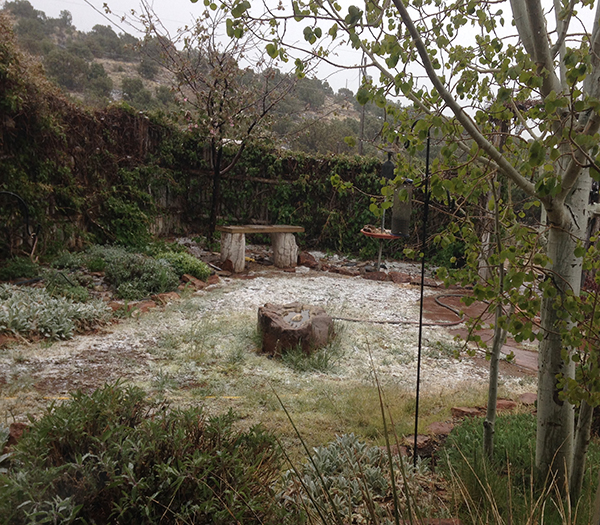
Snow-April 26, 2015!

Just when we are all chomping to get growing, here comes another snow.  Big wet snowflakes. Not surprising as we are still in April, (although late April). Yesterday I went to the Farmer’s Market to sell greens and tomato plants and I told everyone-don’t plant them yet, put them in a warm window sill, we still could have cold weather coming and here it is. Of course most of us know that the first frost-free day is around May 15th  to start planting but still I always fantasize getting everything in early and usually must wait. Wait. Wait. Wait.

Patience! It seems gardening is a lesson in patience and patience is one of  life’s lessons. We must be patient for the winter weather to end so we can put our plants in the garden. Patient for the seeds to germinate. Patient when they don’t and must reseed. Patient for the soil to warm up so the plants will grow in earnest. Patient that the crops will grow and prosper. Patient for the all elusive harvest. So keep the faith, be patient, we will be able to plant soon, not just yet.

Apple blossoms update

bee on apple blossom3_blog

After last week’s super cold spring weather of 20°F at night and then the snow (hey it least it was warmer) I’m happy to say that not all the apple blossoms died. This morning I noticed a lot more blossoms have opened and the bees are all over them which means I might get a reduced crop but won’t be wiped out completely unless we get another bitter cold night. Looks like we are back to warm days again as well. Yea!

BRRR!!! FREEZING NIGHTS TONIGHT thru THIS SUNDAY!!

220px-Old_man_winter.svg copyJust when I think that it is warming up nicely, the weather turns. Don’t be caught off guard if you’ve already planted, even cool season crops are in danger with the cold nights coming. To protect your plants, put row cover over them at night. It will add between 4-6°F protection and may help them endure the cold. You can get some at Agua Fria, Plants of the Southwest and Paynes Nurseries.


Here is the temperature (lows) forecast for the next 5 nights:

Tonight-Wednesday  29°F

Tomorrow night-Thursday 26°F

Friday night-29°F

Saturday night-28°F

Sunday night-31°F


Apple blossoms and bees

Yesterday Elodie took some fantastic pictures of both honeybees and native bees visiting the apple trees blossoms. The blossoms are in full bloom now which are gorgeous and smell heavenly but tomorrow night  (Wednesday) and Thursday night is supposed to get in the high 20’s at night which is a real bummer because the cold will probably knock off the blossoms and that will be the end of our apple season again… Meanwhile let’s enjoy these great pictures while we have them.

I call this the drunken bee-drunk on nectar!

I call this the drunken bee-drunk on nectar!


bee getting pollen on apple blossom_blog

Here’s a closeup of a bee


bee on apple blossom_blog

This honey bee has some pollen on her legs


Native bees visit the blossoms too!

Native bees look very different from honey bees

bee on apple blossom5_blog

Honey bee visits an apple blossom


Dorothy is ok!

DOROTHY closeup APRIL 2015

Here is Dorothy in the middle of a comb being attended to by the other bees.

When we had the micro burst of wind happen last week, we found our queen bee, (promptly named Dorothy because her house was turned upside down), outside the hive. I quickly picked her up on a bar that was tossed to the ground and she seemed ok. Queen bees are very delicate and can get easily injured so we worried that she might not be able to lay eggs even though she appeared fine. Yesterday, Elodie and I inspected the hive and she is truly fine.

DOROTHY_ eggs_closeup

Look! We found eggs which means she is not damaged and the other bees will be capping them soon. They are in the comb-notice they look like tiny grains of rice. We are so relieved because a hive without a working queen is a doomed hive and the hive could not survive as the queen keeps the continuum going with the hive. Since the worker bees only live about 6 weeks, it is the queens only job-laying eggs, making brood so more bees can be born to keep the hive going!

Are you chitting those potatoes?

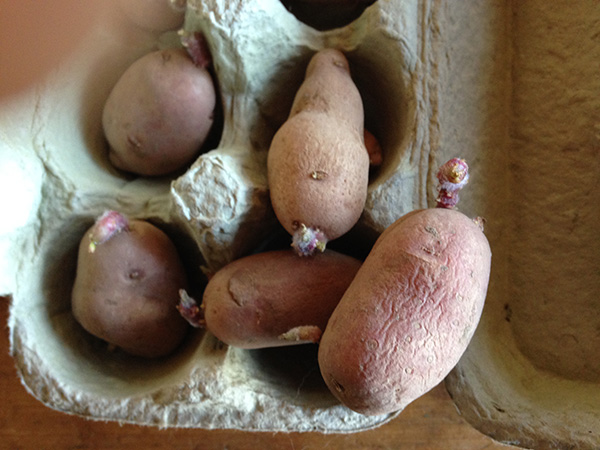
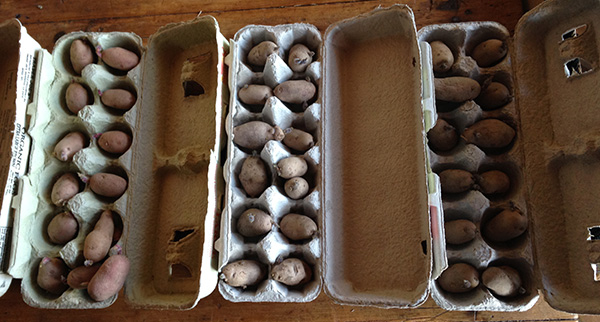
chitting potatoes_closeup

Are you chitting your potato seeds yet? Careful how you say that! You can get potato seeds at the local nurseries now if you plan to grow them this year. Potato seeds are actually smaller potatoes that you plant. Don’t use grocery store potatoes as most of them have a sprout inhibitor on them to reduce sprouting which is what we want.

chitting potatoes

Chitting is letting your potatoes grow those little ‘eyes’ out. Put them in indirect sunlight. I use egg cartons to hold them so the eyes don’t break off. After they grow ‘eyes’, you should plant them this month-April. Chitting potatoes now will let you harvest them 2-3 week earlier when harvesting them later in the late summer.

This year, I’m growing them in ‘potato bags’ instead of a garden bed. My friend, Janet had fabulous luck with them last year-in fact she got more than I did in a raised bed so I’m trying her way this year besides it opens up another bed for me to grow other veggies in.

For more info on growing and chitting your potatoes, go to my original post ‘Growing and Chitting Potatoes’

Micro-burst wind throws new bees around

new bee

Yesterday I was planting vegetables in the greenhouse, when this huge micro burst of wind came and almost tore the window shutters off of the greenhouse. Afterwards, I inspected the shutters that were slapping so violently to see if the hinges were damaged. Luckily they were ok. Then I decided to check on the new bees we had just put into a hive on Sunday. The hive got turned almost upside down with all the topbars, bees, honey and sugar-water thrown on the ground behind it. I called Elodie and she came and together we put them back in. I tried to quickly put all of them back in because the queen was already out of her cage and I needed to find out if she was dead or alive. The queen was in that pile on the ground and luckily she was surrounded by thousands of other bees and I found her running around on one of the combs we had supplied. How lucky is that?! She looks fine and I hope she is not damaged or she will not lay any eggs. I’ve named her Dorothy after the Wizard of Oz when she and her house got thrown around in a tornado. I will check in a few days to see that she has started laying eggs, otherwise we will have to get another queen. Keep your fingers crossed that Dorothy is ok…