Tips on How to Ripen Tomatoes Inside


How to ripen green tomatoes


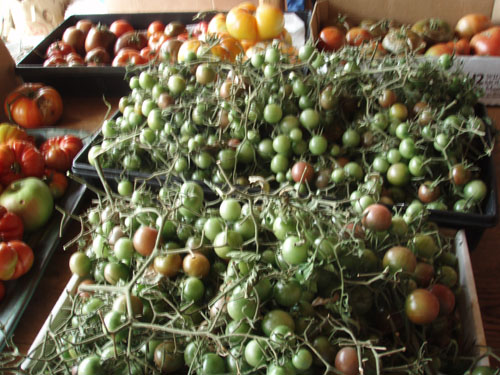
So now that you’ve been waiting all season for your tomatoes to ripen, what do you do when you know that a hard frost is going to hit and you still have lots on the vine? Here are some tips on ripening tomatoes inside.

• Watch the news to see when we will get a potential freeze forecast. I have been caught running out at night picking as many as I could because I didn’t watch the weather forecast. I try to look a few days ahead now so I’m not out in the garden at night with my flashlight!
•  If we are going to get a freeze, run out before it freezes and pick all the decent size ones off. I don’t bother with the small ones, they are probably not mature enough to ripen properly anyways.
•  Sort the tomatoes from rock hard green to almost ripe and put them in heavy grocery paper bags and fold over the top. That way you don’t have to go through each bag every day and pull out the ones that are ripening sooner.
• When they start to change color, I pull them out and put them in bags where they are all similar in the ripening stage.
• In the bags with the green ones, I will put an apple in the bag to help ripen them if I am in a hurry. An apple releases ethylene gas (the tomatoes produce this as well) which helps the ripening process. That is why you fold over the bag to help trap the gas that both the tomatoes and apple are releasing. Don’t forget to check your bags every few days.
• Some people say to pull the whole plant and hang it upside down and watch the tomatoes as they ripen. Keep the plant out of direct sunlight. This can be done if you have a few plants but if you have a lot of plants, you may not have the room inside (visions of a tomato jungle inside my small house) and this is why I bag mine. I can keep them in another room out of the way.
• You can also choose to wrap green tomatoes individually in newspaper and lay them in shallow cardboard box in a single level. Store out of direct sunlight. Check them regularly. I don’t use this as I would have to unwrap all of them to see where they are at but this would work if you don’t have a lot of tomatoes.
• Leave them stem side up-they won’t rot as quickly.
• When your tomatoes are almost ripe, to increase flavor, set them in front of a warm window a couple of days before you want to use them.
• Also to increase flavor, be sure to store them in a room that is at least 55 degrees. Last year I didn’t and they didn’t have much flavor. If they won’t ripen or aren’t flavorful they are probably stored in too cool of a place or perhaps they were too small to begin with.
• Lastly you can always pickle green tomatoes or cook with them!

Another Big Tomato-Striped German


Closeup of Striped German Tomato inside-my all time favorite


2.14 lb Striped German


My other big tomato is a Striped German, a beautiful bi-color tomato. I’ve been waiting for these to ripen all season. I grow them for eating. They can grow very big as they are a beefstake and are a super sweet tomato with just the right amount of acid to balance it. They get lots of cracks because they are thin skinned, very typical of an heirloom  tomato but nobody cares because of that incredible flavor. Very luscious and juicy. The flavor is unbelievable. If you ever get a chance to try one, jump on it. It is the first one I always sell out of at the Farmers Market.

It is one of those tomatoes that runs down your chin when you eat it in a BLT. I think out of all the tomatoes I have grown over the seasons, it is my all time favorite.


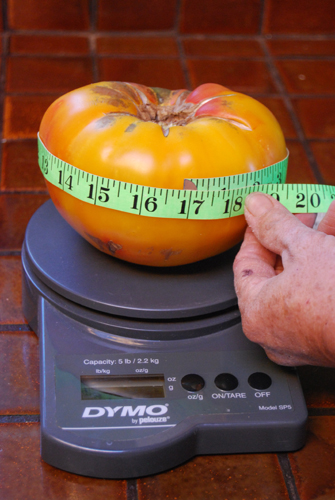
16.5 inch Striped German


Soon our tomato season will be gone as the nights get colder. We must watch the weather now for that first freeze. I still have many on the vine and will  most of the bigger ones off when I hear we will be getting a freeze on the news. Then I will bring them inside to ripen. I usually have tomatoes to eat well into November. Maybe we have another week-if we are lucky..

2 lbs 11.4 oz Giant tomato-My NEW personal best

2 lbs. 11.4 oz

GIANT TOMATOES I have several tomatoes that ended up pretty good size. One type I grew for giant competition and the other for good eating. This post will be about the competition giant tomato.

My biggest competition tomato comes from the 7.18 N.Harp plant and is 20.5 inches in circumference. It weighs 2 lbs-11.4 oz. 

This is now my personal best!

I was going to take it to the weigh-off in Colorado Springs but since it was still green and I wanted the seeds from it, I kept it home so it could get fully mature and red and let the seeds develop. I believe this tomato (grown by Nick Harp) originally came from a Big Zac variety several generations back. I also have a 17 incher that weighs 2 lbs 6 oz.

20.5 inches in circumference

I grow the Big Zac variety for competition but do sell them as well at our Farmers Market. They taste wonderful and have a good old fashion tomato flavor unlike some super sized competition tomatoes. Not bad-supersized and tasty!

2010 Tomatoes winners from my garden

This year I planted 20 varieties of tomatoes and want to give you my favorites. Here are the winners!

HEIRLOOMS

costuluto genevese tomato

Costuloto Genevese-This Italian heirloom is the prettiest tomato I’ve ever seen. It has highly fluted or scalloped edges that are beautiful when sliced horizontally. It ripens to a beautiful deep red and and has that old fashioned tomato flavor. Very prolific. One of my favorites for Caprese salad.

Black Cherry-I grew them last year. Wonderfully complex, earthy sweet flavor so typical for black tomatoes.

Paul Robeson-I grew them last year and I like them even better this year. This one is a favorite of many at our Farmers Market. Complex flavors of sweet and just the right amount of acid.

Green Grape-This is my new favorite cherry tomato. Unbelievably complex sweet flavor. I like to mix them in with my other cherry tomatoes for a medley of color and flavors

black pear tomato

Black Pear-New for me this year, they have a wonderful sweet black tomato flavor. Very abundant.

Striped German-Giant Bi-Color beefstake that is a supersweet. Beautiful yellow and red marbling inside. Takes all summer to ripen but it’s worth the wait!

pantano romanesco tomato

Pantano Romanesco-Another Italian heirloom hailing from Rome. This one is very prolific and nice sized.  Beautiful fluted tomato with that old fashioned tomato flavor

Giant Marrows gone to State Fair

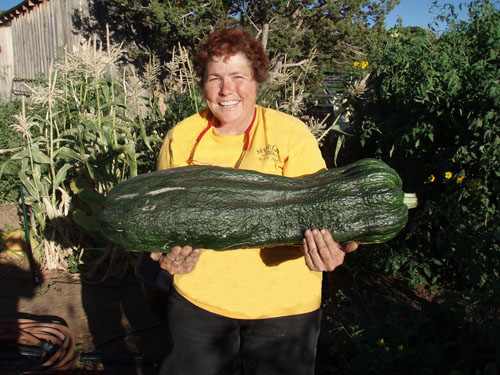
I had my friend Lava, enter 3 zucchinis in the New Mexico State Fair in Albuquerque last Tuesday for me while I’ve been gone in NYC. One (the smallest) was a traditional zucchini, and 2 were giant varieties called marrows. A marrow is in the zucchini family-Curcurbita Pepo. It is grown more in Europe than in the states. It is eaten when small but the giant varieties have the capacity to get big-really big-much bigger than our ordinary variety of zucchini! I weighed my two smaller marrows that I entered into the fair on my bathroom scale and one was about 25 lbs and the other was around 35 lbs. I wonder if anyone in NM is growing a giant variety of marrow. I didn’t even weigh my traditional zucchini because it was so small compared to the giant varieties. I am going down to the fair today to see if I got any ribbons..

Getting ready to measure the biggest marrow

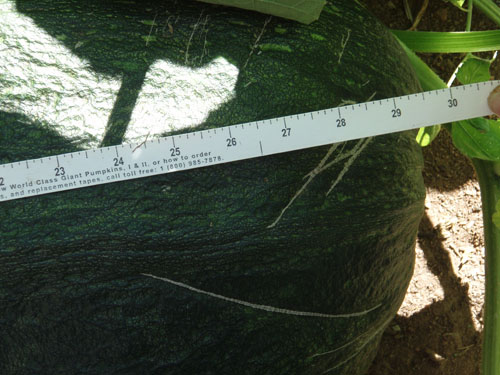
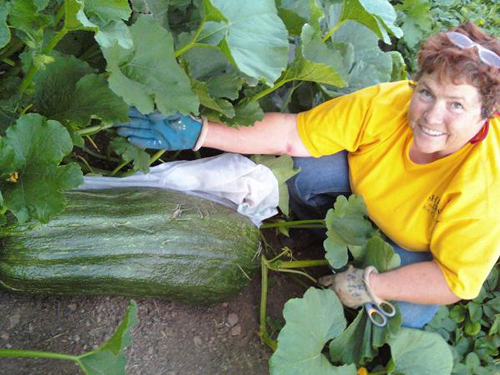
I still left the biggest marrow in the patch to see how big it will grow before the Colorado weigh-offs. It measured almost 30″ long and 14″ wide about a week ago. I think it weighs about 45 lbs right now. Here is a pic of me getting ready to weigh it.

measuring length-almost 30" (see I wasn't lying!)

I love the marrows-one of the most exciting plants I grew this year. I’ll have to harvest some seeds, although they were probably cross-pollinated by the bees with my winter squash. I’m still going to keep some seeds..

I also entered in ‘Harpie’, one of my two giant pumpkins. Lava said it officially weighed 99 lbs at the fair. I don’t think it will place but I’m gonna try!

biggest marrow that went to the fair-35 lbs!

See the difference between a marrow and a regular zucchini?!

measuring width-almost 14"

Virginia Sweet Tomato

Virginia Sweet Tomato

Check out this tomato! Yesterday, my friend Janet Hiron, a fellow S.F. Master Gardener, gave me an huge tomato that she grew called ‘Virginia  Sweet’. She only has maybe 8 of them on her plant  (so I got 1/8th of her harvest-bless her). What a beauty and I can’t wait to eat it! It is a bicolor and should be marbled with red orange and yellow streaks inside. She said the flavor is unbelievable. This one is over 2 lbs. Thanks Janet!

Master Gardeners tour-Giant Vegetable Garden

I’ve been getting ready for my first Giant Veggie Garden Tour for the Santa Fe Master Gardeners group next Sunday from 9am-12 noon. I have 3 giant marrows, one being around 30+ lbs, 2 giant pumpkins, many giant sunflowers, and a couple of giant tomatoes (still green). I’m cleaning up, trimming and generally sprucing up the garden. By the time they come next Sunday I should be ready. Seems like there is always something to do in a garden no matter the size. Fall is definitely in the air with the nights cooling off into the high 40-50s. Daytime temperatures are in the 80s. Perfect weather to be in the garden…

Check out my giant marrow!

giant marrow on 08-25-10

Ooo wee! Check out this giant marrow (which is actually a giant zucchini)! I don’t know how one measures for weight but I have several really big ones. One will go to the State Fair and the other up to the Rocky Mountain Giant Vegetable Growers weigh off in Colorado if I can get it to last that long. It has been really fun growing it this year and watching the marrows grow. The Plant does fine in the heat and ultraviolet rays (we are 7000 ft high here in Santa Fe). No wilting at all. Grows like crazy. The only thing I will change next year is that it will go in the giant pumpkin patch where it will have more room to grow. It can duke it our with the giant pumpkins! Right now it is growing over everything and I already hacked it back twice!  This one came from a seed from Brad Wuersten in the Netherlands who has the European World Record for it over there and was kind enough to give me a seed from one of his giant marrows.

‘The Tomato Lady’ returns to Santa Fe Farmers Market

‘The tomato Lady’-first day sold out of Tomatoes

Yesterday I returned to our Farmers Market here in Santa Fe, NM as the ‘Tomato Lady’ and sold out of my tomatoes by 10 am.

It’s been a long wait all summer for my tomatoes to ripen and they have started but are not full blown yet. So I had some tomatoes but not a ton. In another couple of weeks, I should be overwhelmed with tomatoes. I also had Costata Romanesco  and Lungo Bianco zucchini, Bennings Green Tint and Yellow Custard scallop summer squash,  Fairytale eggplants, Shishito peppers, Padron peppers, Parade, Armenian cucumbers and Rattlesnake pole beans. For tomatoes I had Early Wonder, Pantano Romanesco, Goliath, Sun Sugar and Black Cherry and a few Costuluto Genovese. Hope I have lots more next week!

How to make pickles

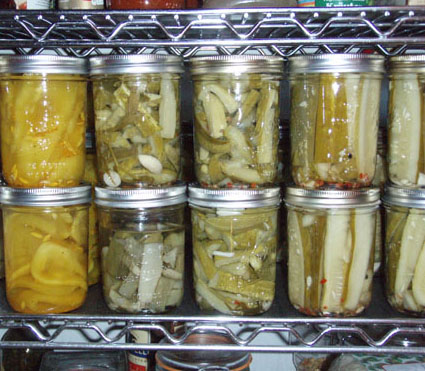
From left- bread and butter, cornichons, and dill pickles

Following are the recipes I use for each of them:

BREAD AND BUTTER PICKLES II (I modified this from Allrecipes.com)
Makes 8 one quart jars or 16 pints-you can make smaller amounts if you want

25 cucumbers, scrubbed, cleaned, and sliced, blossom end cut off (the pickles will get discolored if left on)
6 onions, thinly sliced
3 cloves garlic. sliced
1/2 cup salt

3 cups white vinegar
5 cups white sugar
2 tablespoons mustard seeds
1 1/2 tablespoons celery seed
1/2 teaspoon whole cloves
1 tablespoon tumeric

DIRECTIONS:
1. In a large bowl, mix together cucumbers, onions, garlic and salt. Allow to sit 3 hours.
2. In a large saucepan mix together the vinegar, sugar, mustard seed, celery seed, whole cloves, and turmeric. Bring to a boil.
3. Drain liquid from cucumber mixture. Rinse and drain cucumbers. Stir the cucumbers mixture into the boiling vinegar mixture. Remove from heat just before it returns to a boil.
4. Transfer to sterile containers. Seal and chill in the refrigerator for one month before eating or process in water bath for 10 minutes or 15 minutes for our high altitude. (Add an additional 15 minutes for our 7000′ high altitude) I put some in the refrigerator and process the others. For water bath process, store in a cool dry place and wait one month before eating. Refrigerate after opening.

Be sure to wait one month before eating, whether making refrigerator style or water bath process-the flavors permeate the cucumbers better. Once I couldn’t wait and opened a jar after 2 weeks but it was not as flavorful. It’s worth the wait.

REALLY QUICK DILL PICKLES (from ‘The Joy of Pickling’)
Makes 3 one quart jars or 6 pints-this is a no brine method

-For firmer pickles, add 2-3 grape leaves or 6-8 sour cherry leaves of each qt of pickles but it is not necessary.

You can double or triple this recipe to fit your harvest.

ONE QUART METHOD
DIRECTIONS:
To make a single qt of pickles, you’ll need 1 cup water, 7/8 cup vinegar=3/4 cup + 2 tablespoons vinegar, 8 peppercorns, 2 garlic cloves, pinch of dried pepper flakes, 1 dill head. Pour boiling liquid mixture over packed cleaned cucumbers in jars. Leave 1/2 inch headroom in jar. Seal and process. See below.

3 QUART OR 6 PINTS METHOD
DIRECTIONS:
4 lbs of cucumbers, scrubbed and cleaned, blossom end cut off (the pickles will get discolored if left on)
24 peppercorns
1 garlic head, peeled and sliced
dried pepper flakes to taste
fresh dill heads (or dill seeds if fresh dill not available)
2 3/4 cup white vinegar
3 cups water
1/4 cup pickling salt (or non iodized salt)

1. Half or quarter cucumbers lengthwise. Divide the peppercorns,garlic, and hot peppers (if you are using them) among 6 pint or 3 quart mason jars. Pack the cucumbers in tightly into the jars.

2. In a saucepan, bring the vinegar, water, and salt to a boil, stirring to dissolve the salt. Pour the hot liquid over the cucumbers, leaving 1/2 inch headspace. Close the jars with the 2 piece caps. In a boiling water bath, process the jars for 10 minutes, quart jars 15 minutes (Add an additional 15 minutes more for our 7000 ft high altitude).

3. Store in a cool dry place and wait one month before eating. Refrigerate after opening.

FRESH PACKED REFRIGERATOR DILL PICKLESLEMON DILLS (from ‘The Big Book of Preserving The Harvest’)
Makes 1 quart or 2 pints

10-14 pickling cucumbers, scrubbed and cleaned, blossom end cut off (the pickles will get discolored if left on)
3 sprigs dill
2 cloves
1/2 cup fresh lemon juice
cold water

DIRECTIONS:
1. Pack sterilized jars with cucumbers, dill, and garlic leaving 1/2 inch headspace
2. pour the lemon juice over the cucumbers
3. Seal and refrigerate. These will keep 6 weeks or more in refrigerator. Wait one -2 weeks for flavors to blend.

SHORT BRINED DILL PICKLES (from ‘The Joy of Pickling’)
Makes about 8 quarts

-This recipe is very flexible as long as you keep the proportions of vinegar, water salt and sugar. You can vary the seasonings as you like.
-For firmer pickles, add 2-3 grape leaves or 6-8 sour cherry leaves of each qt of pickles but it is not necessary.

ONE QUART METHOD
DIRECTIONS:
You may prefer to make your pickles by the quart. For this, drop into each jar 2 sliced garlic cloves, 4 peppercorns, and pinch of hot pepper flakes. Pack the cucumbers into the jars with 2-3 heads of dill and pour over the cucumbers a hot solution of 1 cup each vinegar and water with 1 1/2 teaspoons sugar and 2 teaspoons salt. Leave 1/2 inch headroom at top of jar. In a boiling water bath, process the jars for 10 minutes, quart jars 15 minutes (Add an additional 15 minutes more for our 7000 ft high altitude) Store in a cool dry place and wait one month before eating. Refrigerate after opening.

8 QUART METHOD
12 lbs 3-5 inch cucumbers, scrubbed and cleaned, blossom end removed
1 1/2 cups pickling salt
2 gallons plus 2 quarts water
7 1/3 cups white vinegar
1/4 cup sugar
16 cloves garlic, sliced
32 peppercorns
16-24 heads of dill
dried hot pepper flakes (if desired)

DIRECTIONS:
1. Half or quarter cucumbers lengthwise or leave whole. In a very large bowl or soup pot or crock, dissolve 3/4 cup pickling salt in 2 gallons of water. Add the cucumbers and weight them with a heavy plate that just fit the container. Let stand in the brine at room temperature for 8-12 hours.
2. Drain the cucumbers. If you like less salty pickles, rinse well and drain them again.
3. In a non reactive pot, bring to a boil the remaining 3/4 cup pickling salt, the remaining 2 quarts water, the vinegar, and the sugar. While the mixture heats, divide the garlic and peppercorns amount the 8 quarts or 16 pint mason jars. Pack the cucumbers, dill, hot pepper (and grape or sour cherry leaves if you are using them).
4. Pour the hot liquid over the cucumbers, leaving 1/2 headspace. Close and in a boiling process pint jars for 10 minutes, quart jars for 15 minutes (Add an additional 15 minutes for out altitude at 7000 ft high) Store in a cool dry place and wait one month before eating. Refrigerate after opening.

CORNICHONS (from ‘The Foodlovers Guide to Paris’) tiny tart pickles
Makes 2 quarts or 4 pints- you can make smaller portion by cutting the recipe in half.

60  two inch small pickling cucumbers
1/4 cup kosher or pickling salt
1 quart water plus
3 cups white vinegar
1 tablespoon sugar
12 small white pickling onions
4 large sprigs fresh tarragon
6 cloves garlic sliced
dried hot peppercorns
2 bay leaves

DIRECTIONS:
1. Trim off stem ends of cucumbers, rinse and drain.
2. In a large bowl combine the salt with one quart water. Stir until the salt is dissolved, add the cucumbers and let stand for 6 hours.
3. Drain the cucumbers, discarding the salted water. I like to rinse them.
4. In a medium saucepan over medium heat combine the vinegar, 1 1/2 cups water and the sugar and bring to a boil. Layer the jars with the drained cucumbers, onions, herbs and spices. Pour the boiling vinegar mixture into the jars leaving 1/2 headspace. In a boiling water bath, process the jars for 10 minutes, quart jars 15 minutes (Add an additional 15 minutes more for our 7000 ft high altitude) Store in a cool dry place and wait one month before eating. Refrigerate after opening. You can also just refrigerate them but still wait one month before eating.

Different cucumbers for different pickles

Sunday afternoon, my good friend John came over and we made pickles. All different kinds. Last year I researched what kind of cucumber was good for different types of pickles.

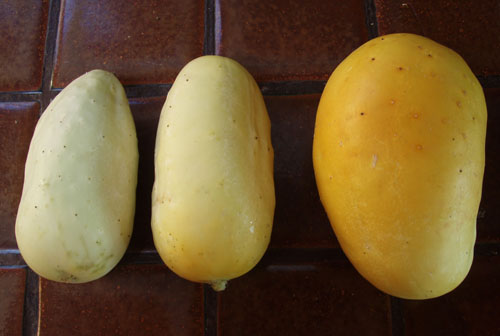
'Boothsby Blonde' cucumbers- good for bread and butter pickles

We made bread and butter pickles with my Boothsby Blonde cucumber, a creamy white  flavorful cuke that turns bright yellow.  All stages are edible with no bitterness.  After making my own bread and butter pickles last year, I will never buy store bought again. The flavor is incredible and is at least 100x better than the store bought and I’m not kidding.

'Parade' cucumber makes a good dill pickle

Then we made some dill pickles from my Parade cucumber which is a great cuke for dill as they are also excellent flavor, firm and evenly sized which is great for cutting them into dill spears. We used some fresh dill I grew from my garden.

Lastly we made my favorite- cornichons. I first fell in love with them in a little french cafe in San Diego where the french owners served them with sandwiches. We made the cornichons (which means tiny tart pickle) with Parsian cucumbers.

'Parsian' cucumbers-use for Cornichon pickles

In the picture I show one that grew too large and the rest are good size. I cut the ones that are 4 inches in half and leave the 2 inch cukes whole. I even cut the big one down into smaller spears about 4 inches in length. The Parsian cucumber has small seeds and is never bitter. We try to pick them very early when they are 2-3 inches long as they are meant to be a small pickle but sometimes you’ll find a large one hiding under the leaves. If it is much larger than the one shown, then I compost it or feed it to the chickens. Your main herb for flavor is tarragon instead of dill with cornichons.

zinnas and japonica corn

Here is a picture of some beautiful zinnias right next to Japonica corn. The corn comes from Japan, is organic and I bought it purely for its beautiful leaves. I got it from Seed Saver’s Exchange and here is the description from them-“Extremely beautiful ornamental corn from Japan, listed in the 1890s as Striped-Leafed Japanese Maize. Variegated leaves striped with green, white, yellow and pink. Tassels are dark purple, kernels are burgundy. Beautiful used as a border.”

How to control squash bugs

Squash bug adult-photo courtesy University of Minnesota

Well it’s that time of year-Squash bugs Ughh! You can control squash bugs in your organic garden. Here are some ORGANIC things you can do to deter squash bugs:

-Plant a crop late in the season if possible. Many areas of the country only have one generation of squash bugs and if you plant later you may miss them. If you live in the south where they have 2 generations, read on..

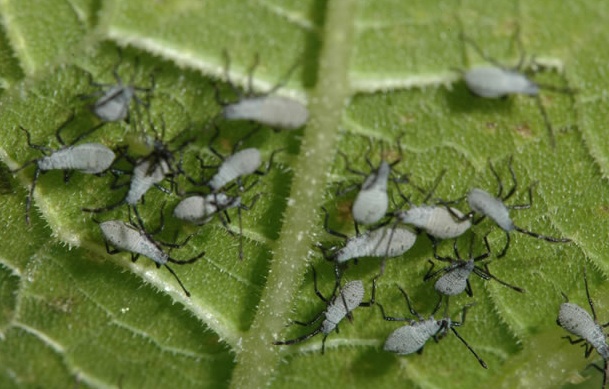
squash bug nymphs-photo courtesy University of Minnesota

Cover your plants with row cover to keep them off. This works beautifully but you may have to piece some row covers together to cover some of the larger plants. I use clothes pins to clip them together.

-Use Neem. It is an organic pesticide (and an added benefit is a fungicide). It must be sprayed very early before the bees come out or at dusk when they aren’t around as it won’t hurt them if it is not a direct hit as they only visit the flowers and it is a contact spray. I think it mostly helps deter the squash bug.

squash bug eggs

-Inspection, hand picking and kill the little buggars. (now you know how strongly I feel about them) By far the most labor intensive but very effective. I hate to handle squash bugs (or any bug-I’m squeamish) so I use gloves, a bucket of soapy water (it drowns them) and inspect each leaf underneath to look for nymphs, eggs, or adults. The adults I throw in the soapy water and if a leaf is really loaded with nymphs, I cut it off and throw it in the soapy water otherwise I just squish them. For the eggs  (they are a cluster of rust colored eggs attached to the underneath side of the leaves) I usually just tear off  or cut out that portion of the leaf (it won’t hurt it) and throw them into the soapy water. The key to keeping it under control, is to catch them before they multiply too much. I looked up the life cycle online of the squash but and it goes from egg to nymph in 7-10 days so if you get out there every 7 days you will catch them before they get out of control and multiply. Most people wait too late. Get out there and look at your plants!

-Companion planting. I think it was in ‘Organic Gardening Magazine that I read under ‘letter to the editors’, that a lady wrote in to say that you could deter squash bugs on pumpkins, winter squash, summer squash and marrows with diluted/strained onion juice. Evidently just grind one or two up, put it in gallon of water and strain the onions out so your sprayer doesn’t clog. Well she went on to write that doing that was too much work and she plants onions bulbs with her squash every year and hasn’t seen a squash bug since. Well I did the same for my summer squashes, but not for my winter squashes. There have been no squash bugs on the summer squash but I found one on the marrow which means there will be more. I told one of friends that owns a garden nursery about the onions and he said it was too late to plant onions but he was going to throw some chopped onions out in his patch. I’m doing the same today for the marrow and winter squash and will let you know what happens! It can’t hurt and maybe it’ll work!

Cucumbers,Tomatoes and squash oh my!

looking from inside the garden out

Lava suggested I take some shots of the garden as it is right now-a jungle-not just closeups! I need to get in and trim and prune everything but it is fun to look at especially here in Santa Fe where everything tends to be dry. Lava also suggested I get on the roof of the barn to get a bird’s view and I just might do it! Meanwhile here are the jungle garden pics!

corn and winter squash

summer squash

entry into the tomato jungle

between rows of tomatoes

cucumbers

Garden Arbor Entrance update August 4

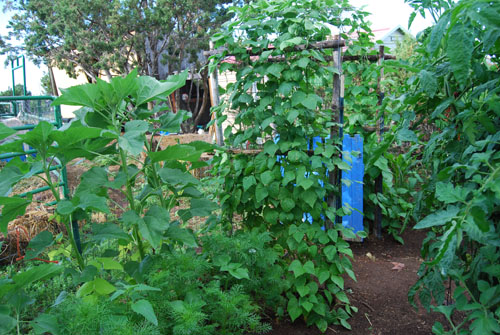
garden arbor entrance

Here is a picture of the garden arbor in my entrance to the veggie garden. The ‘Rattlesnake’ beans, a pole variety that can grow 13 feet a season, are doing really well covering the arbor-just like I envisioned when I built it at the beginning of the season. An added bonus is they taste great. You only have to pick the beans before they get too big and tough. I ate some raw right out of the garden and they have a nutty sweet flavor that I like better than the ‘Contender’ bush beans that are just finishing up. Rattlesnake beans are a winner!

entrance right side

Also pictured to the right of the arbor are chartreuse colored ‘Golden Sunshine’ Scarlet Runner beans  I got from Cook’s Garden growing on the fence. They come from England. I love their bright yellow green leaves against the other greens. I grow them just because they are so beautiful and I love that purple varigated color of the seeds when they are dried. They haven’t flowered yet as they are just climbing the fence but when they do, the bright red blossoms will look great against that yellow-green.

Behind the Scarlet runner beans, still on the right side of the entrance are my giant ‘Titan’ sunflowers that will be fantastic a little later when they get their huge flowers. They will grow up to 10 feet tall and have heads that can get up to 24 inches wide! I call all sunflowers the guardian angels of the garden. Did you know sunflower flower heads follow the sun all day long? Sun worshipers! Hence their name. They are so majestic! Behind them are various flowers that will be blooming soon to add color and attract beneficial insects.

entrance inside left

entrance inside left

On the left side just inside the entrance, are asparagus fronds, calendula, ”Bright Lights’ chard, ‘Chianti’ sunflowers, multicolor ‘Japonica’ corn from Seedsavers Exchange and other flowers coming along. I got a late start in this section of the garden but it should look great later this month and I will take more pictures then.