Giant Pumpkin patch growing

Here are some pictures of the giant pumpkin patch taken on July 4th. There are also 1 greenie squash and 2 giant marrows in the patch so I think it’s gonna get crowded in there. I hope I have a sea of green by August!
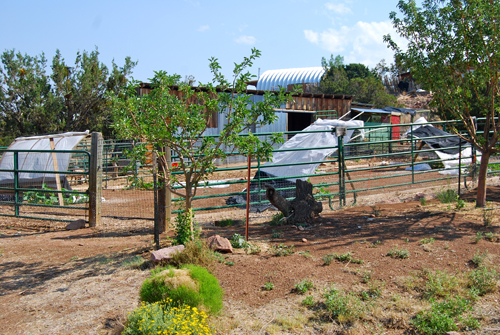
Here is the overall view of the pumpkin patch from the road.

I have the low tunnels propped up so I can work on the giant squashes. Kind of like opening a car hood! I took off the row covers for pictures.

The giant pumpkin plants are doing well-they are just coming out of their low tunnels. Here is the 895 Grande plant with the low tunnel off.

Some of those big leaves are 18″ across. I just love this pumpkin plant. It’s sister seed took the NM State record last year. The leaves are much bigger than the 1048 Grande.

Here is the 1048 Grande. It’s leaves are smaller but they say leaf size has nothing to do with pumpkin size. Is that like the shoe size argument?!
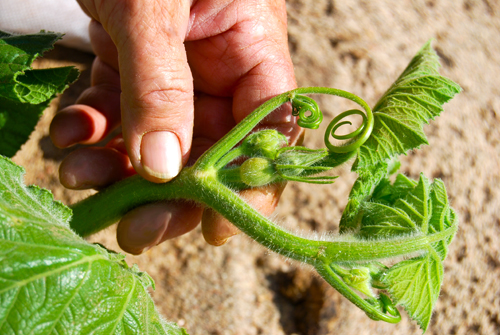
I saw my first female flowers on the 895 Grande pumpkin plant on the end of the main vine. Isn’t it beautiful! The only issue is it is only 7 feet out from the stump. I should wait to pollinate until it reaches at least 10 feet out but may not. We do that to allow the plant to develop more leaves behind the future pumpkin-more leaves-more food. Lot’s of times we pollinate many pumpkins and then cull the smaller ones so I think I will do that.  Notice the oval shape of the possible baby pumpkin.

The only problem is the male flowers that are there are also very small and they usually bloom before the girls even show up. The boys are always the first to arrive at the pumpkin blossom party and usually the girls show up later. It’s ok because my first pollinated pumpkin flower last year was July 27 so perhaps I will be ahead of that date which is important because it will give me more days to put on more pumpkin weight.

Here is the greenie-The greenie looks just like any giant pumpkin plant but the fruit will be green. It is doing well. I saw a really small female flower with the potential baby green fruit. The seed came from 2007 so I was surprised it even germinated The plant looks fantastic. Just goes to show that you can’t always listen to the folks that say get rid of your seeds after 2 years old.
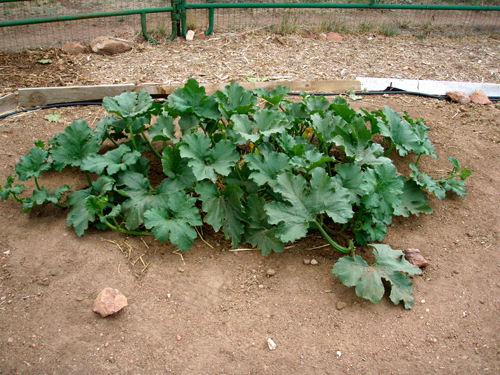
Here is the 78 marrow-kinda bushy. Very different than the other marrow in the patch.

This is the other giant marrow that came from my last year’s plant. I’m very suspicious of this one as it doesn’t look quite like the other marrow above which I know is pure in strain. Mine was pollinated by the bees and so it could of crossed with one of the winter squashes last year. It will be interesting to see what the fruits look like on this one later on!

I also saw one squash bug (which ended up under my shoe) and some eggs on the underside of 3 leaves. I just took off all those leaves that had the eggs on them and put it in a bucket of soapy water-goodbye eggs. I will plant some onion sets in their wells to help deter them and I will probably have to keep the pumpkin plants covered with row cover. I will be on the lookout from here on out.
Rabbits in the Giant Pumpkin Patch

Once again I found a rabbit in the giant pumpkin patch running through the 2″ x 4″ field fencing around the patch. Then I left the 1048 Grande pumpkin uncovered and the next morning there were some leaves eaten. Maybe it will be good luck because the same thing happened last year in the same spot that the NM state record pumpkin came from. Luckily the leaves eaten were by the base of the plant and not the growing end of the vine. So I’ve been covering everything in the giant pumpkin patch until I can put some small 1″ chicken wire all around the fence. I got the fencing, just need the time to do it, so for now they will stay covered at night.

Giant pumpkin care today

chop sticks help push the giant pumpkin vine down

If you were crazy enough try to grow giant pumpkins this year, here is some advice from this obsessive giant pumpkin grower!

To grow a giant pumpkin, you must BABY them. They need a lot of CARE. It’s like RAISING A VERY LARGE CHILD or more like JABBA THE HUT. You don’t go out and just throw some seeds in the ground and expect to grow a record pumpkin. You wouldn’t be able to go out and become a world boxing champ without training, lots of proper food and working up for it and so it is with giant pumpkins. A person asked me last year at the GPC (Great Pumpkin Commonwealth) weigh-off in Colorado Springs, Co how do I grow them? I asked him if he planted some and he said, “Yes, but they didn’t do anything”. So I asked him if he amended the soil, had them on a fertilizer program, used organic fungicides for diseases, did any preventative insect control or hand pollinated them just for starters. He said, “No, I didn’t do any of that. I just put the seeds in the ground”. I told him that’s probably why he wasn’t successful. Then he asked me, “What do you feed these big pumpkins?” For which I responded looking at his kid, “Small children”! Then he grabbed his child and ran off! The point being you must be some kind of nut to want to grow these behemoths!

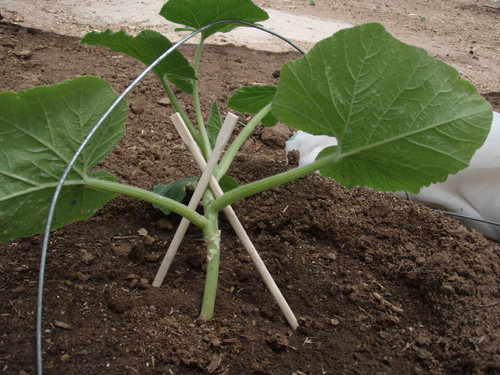
Today I fertilized the pumpkin plants, greenie and marrows with Seaweed and Fish emulsion and added Super Thrive since I took off the shade cloth and they have to adjust again.  Mind you they still have a low tunnel over them and another layer of row cover directly on them but I am now weaning them off so much protection since they have gone through their first adjustment well and I see new growth. I also started them on ‘Companion’, an organic fungicide, which helps ward off  fungal diseases. All these things go in a bucket of water so it’s easy to apply. They are still taking 1/2 gallon of water a day. I also put chop sticks over the stem (see photo), making an ‘x’ with them, gently pushing the vine down towards the ground. Push the sticks with the plant  a little farther towards the ground every few days until the plant is lying on the ground. If you let them stay tall, they could snap off in the wind so I must train them to lay low! This pumpkin plant in the picture comes from the same one that last year grew the 2010 NM State Record. I also have it’s cousin plant (who comes from a bigger pumpkin), but this plant is already much bigger than it’s cousin. I love this seed!

Planting Giant Pumpkins-In ground- June 1!

Giant pumpkin inside low tunnel

On Wednesday  I transplanted the giant pumpkins in Bri’s Pumpkin Patch here at the property.

Bri, my horsey, is no longer with me. Last year I used her 2000 sq foot corral as the giant pumpkin patch and I got a New Mexico State Record-421 lbs for Giant Pumpkin last year. I think she is watching over them! I miss her terribly.

Here’s how I plant the pumpkin transplants that I started in the house.

1. First I dig out an area about 4 feet around and 1-2 feet deep where their root system will grow. This year I added generous amounts of compost, 1/2 cup of mycorrhizal, 1 cup humate, and 1 cup of worm castings and mixed it into the area. (I did not add any fertilizers as my soil test I had done in Spring said I was high in nitrogen, potassium, and potash, which is your basic fertilizer ingredients. (This is weird because the pumpkins usually use up all available nutrients by the end of the season. The only thing I did last fall was put some chicken manure on top of the ‘holes’. I didn’t even dig it in but I think the nutrients leached into the soil from the winter snows and increased the levels.)

2. Then I dig a small hole where I place the pumpkins and I add another handful of worm castings and 1/2 cup more of mycorrhizal (it’s dry granule stuff) and mix them together. This way the castings and mycorrhizal will be right in the immediate root zone in the beginning and the bigger amended area will be accessible as the root system grows.

3. I carefully peeled off the peat pot including the bottom so not to disturb the roots but if the pumpkin is root bound, I must carefully squeeze the roots to loosen them up so they can grow outwards. This year I didn’t have to do that. I placed the pumpkins in the bottom of the hole opposite the first true leaf so it grows in the direction I want and put the amended soil back around the root ball. I make a well around the plant so I can add water right to the root zone.

4. In a 5 gallon bucket, I added 1 tsp/1 gallon of water of liquid seaweed and about 3 drops of Super Thrive/1 gallon of water which helps immensely with transplant shock. Super Thrive is super expensive and super good. It has lots of the B vitamin complex in it which helps with stress-just like for us! I first watered the well 2x to make sure all the soil was soaked around the plant, then I added the liquid seaweed/thrive in water to the well.

5. I put the Seaweed and Thrive with the water in each day for about 5 days, then afterwards I normally give them water with fish emulsion once a week but for now since my nitrogen is high I will wait awhile. I do water every day with about a 1/2 gal of water right now.

6. I don’t put fertilizers in the water every time I water, normally just once a week. I will also add other things to the water once a week but will discuss that as I go along in the season. I still have to do a drip system for the pumpkins and will hand water them until I get it up and running.

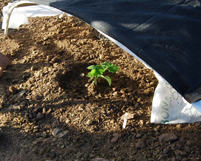
7. I cover the transplant with a small piece of row cover to help it in it’s transition with the intense sun and wind and keep rabbits away. I tack it down with rocks.

8. On Thursday I put the low tunnels I previously made over the already covered pumpkins to protect them from the heat and wind even more.  Low tunnels are like high tunnels but only go over the plants. You can’t walk inside them-they are low!  They will stay on till the plants grow out of them at the end.  So far they are looking good. The soil is nice and warm at 70°F.

9. Saturday (today) I put the shade covering over the low tunnels as the sun is sooo intense right now. I can take it off once they adjust to the outside elements.

Can any pumpkin become a Giant Pumpkin?

Christy Harp with her 2009 World Record Giant Pumpkin-1725 lbs!

Can ANY pumpkin grow super big if you feed it a lot? The answer is no. Just as there are varieties of tiny pumpkins (like Tom Thumb-2 lbs), there are varieties that grow medium size (field pumpkins-15-25 lbs), big size varieties (Big Max-100 lbs) and then there is ONE variety that grows RECORDS-STATE AND WORLD RECORDS! The current Atlantic Giant Pumpkin World Record is 1810 lbs, grown by Chris Stevens of Wisconsin. The picture above is of Christy Harp of Ohio who held the record in 2009. This picture just shows you how big they are! They say someone will hit the 2000 lb mark within a couple of years but it won’t be me. I don’t live in an area that would be conducive to that-too short of growing season here in Santa Fe. It was hard enough growing a giant pumpkin 421 lbs last year here. Of course I’m trying to break my own record again this year!

Now that we are (finally) getting into giant pumpkin season, I will share my techniques for growing them throughout the season. Stayed tuned…

Planting, planting, planting…

Well, if you are wondering why I haven’t been posting, it is because I’ve been out PLANTING, trying to get the last of the garden in. So far, I have 70 tomato plants, ‘Rattlesnake’ pole beans around my trellis, 4 ‘Pepperocini’ pepper plants, 16 eggplants, 2 rhubarbs and put additional wall of waters around all of the tomatoes and created some new drip sections for all these.

Tomorrow (Sunday) goes in 12 shishito pepper plants, bush bean seeds, pole bean seeds, 4 different types of cucumbers seeds, ornamental japonica corn, flowers and a new drip system manifold (I take a deep breath now) I hope to get this done (early-way early!) before the BIG WINDS come in AGAIN and make life MISERABLE….

Monday goes in 2 giant pumpkins, 1 giant greenie squash, 2 giant marrows and a giant pear gourd go in. The long gourds will have to wait till I make them a trellis later this week or next.

Phew! It is always such a big push in spring to get things in the garden and fall come harvest time. The rest of the time I feel like I’m just cruising in the garden! All this on 4000 sq feet of garden which is only 1/10 of an acre…

Giant Vegetables Coming SOON!

Me with a giant marrow growing in 2010

So someone asked me, ‘Hey Jannine, how come we haven’t heard about your giant vegetables yet?” Well, I’ve sort of been preoccupied with getting the tomatoes in the ground lately but all the giant vegetables are still in the house all cozy under my gro lights just waiting to go out. We still have some cold nights ahead in the next few nights so I want to wait a little more. Also all my peppers and eggplants are still inside as well as they HATE being cold more than tomatoes do. One cold night can stunt a pepper plant all season so I suggest you protect them with something the next few nights if yours are already out.

But back to the giants-I have 2 giant pumpkins, one giant ‘greenie’ squash, 2 giant marrows (think supersized zucchini), 1 giant pear gourd, 2 long gourds and 6 giant tomatoes. I’m shooting for next week to get them out. Don’t worry, I’ll be talking alot about giant vegetable how-to’s once they get going. Here is what I still have to do for the GIANTS:

I still have to do a final mixing of my soil and add some amendments in the giant vegetable patch I have.

I still have to get out my low tunnels for the giant pumpkins and greenie to go under to protect them from our intense sun and cold nights.

I still have to build a super tall arbor for the long gourds which can get as tall as 109+ inches. But I can still get them in the ground and build the arbor around them. If you build it, they will come!

I still have to create the drip system for a new giant tomato bed.

I still have to do a drip system for the GIANT VEGETABLE PATCH

I don’t know where the giant pear gourd is going yet! I think Bri’s GIANT VEGETABLE PATCH (named after my beautiful horse Bri who is no longer with us) is going to be really full this season!

Don’t Plant Tomatoes Outside Yet-Cold Weather Forecasted AGAIN

Weather forecast April 27-May 1

Here we go-Cold weather AT NIGHT again. Today the weather is cold high 56°F and low 25°F, already snowing a little bit. It’s ok , we desperately need the moisture. Unfortunately we are also going to get high winds-up to 70 mph! Above is the forecast for the next 5 days.

All 60 tomatoes and giant pumpkins, giant squash and marrows are inside and waiting to go out but I’m hanging tight and will wait till the nights are a little warmer and above freezing. I will still plant them in wall of waters for extra protection when they go out but why throw them out when I know what’s coming…I try to sneak them out early every year but I just have to wait and see. Our first frost freeze date is May 15th and it looks like we might go to then..

GIANT PUMPKIN/WINTER SQUASH-How to Tell Which Direction a Vining Squash Will Grow

Have you ever planted winter squash and it grew in a direction you didn’t want? Here is a good tip for how to tell which direction a vining winter squash (versus a bush variety) will grow. I will use my giant pumpkin as an example but any winter squash that is a vining squash will act the same.

Let’s say you plant some vining winter squash next to a wall or on the edge of a garden bed and you need it grow away from the wall not into it or into your squash bed not out of it (good luck on that one!) When the plant puts out the first two leaves as I have described in previous posts, these are called the cotyledon leaves (baby leaves) and don’t look like any of the other leaves it will grow afterward. All leaves after the cotyledon leaves are called true leaves.

put mark on side of pot opposite of first true leaf

Sooo pay attention to that FIRST TRUE LEAF.  The plant will GROW IN THE OPPOSITE DIRECTION FROM THE FIRST TRUE LEAF. If I’m growing them inside for a head start, it is easy to mark the container as you will not remember which one was the first leaf (trust me!) when the second one appears. I just take a marker and mark the opposite side of the pot so I know when I transplant it into the ground which direction I orientate it. If I grow directly into the soil, after the first true leaf appears, I gently dig up a big amount around it and gently lift it and the dirt so as not to disturb the new roots and rotate it in the direction I want it to grow. For those who are growing their winter or summer squash seed in the ground, it is too early. Wait till May 15th (our first frost free date) to plant directly into the ground when the soil and weather are hopefully warmer.

Giant Pumpkin Cotyledon Leaves Compared to Tomato Cotyldon Leaves

Here’s a comparison of the giant pumpkin cotyledon leaves (the first 2 leaves to pop out) along with it’s first true leaf compared to a tomato cotyledon leaves along with it’s first true leaf. Notice the size difference! Giant pumpkin cotyledon leaves are the biggest baby leaves I’ve ever seen.

cotyledon leaves on giant pumpkin and tomato

Giant Pumpkins and Greenie are up!

Giant pumpkins and greenie are up! The giant marrow is the small one popping up

The giant pumpkins and greenie squash germinated and are looking GOOOD! I planted the seeds on April 7. The first one up was the greenie on April 12, then the pumpkins followed by April 14. The cotyledon leaves (very first leaves to appear or baby leaves) are huge. My all star lineup so far is:

Giant Pumpkins: 1046 Grande 10, and another  895 Grande 08  (which became my New Mexico State Record for giant pumpkin last year)

Giant greenie squash: 903 Noel 07

They are in 4 inch peat pots on a plant heating mat in a light box and I just see the beginning of the first true leaf on the pumpkins and greenie. Looking good so far! Grow naguas, grow!

Mycorrhizal products here in Santa Fe

Someone just wrote me if I knew a source for Mycorrhizal (also called Mycorrhizae) products here in Santa Fe. So I thought I’d respond in a post in more detail as well as reply to him in the comment sections.

Mycorrhizal is a fungi that help protects plants from many diseases and drought like conditions. It forms a symbiotic relationship with the roots, making water and soil mineral nutrients more available to the roots of a plant while the plant feeds the mycorrhizae sugars it produces. It is found in nature in most UNDISTURBED soils. Gardens do not have undisturbed soil- we work the soil to various degrees adding amendments and tilling soil.

There are two main types of Mycorrhizal.

ECTOMycorrhizal works on more woody crops like trees. I don’t use it myself on my trees.

ENDOmycorrhizal works for most (90%) but not all vegetable crops (some crops do not respond to any Mycorrhizal like Brassica crops, spinach and beet crops). I used myco products for both my giant pumpkins and tomatoes in previous years but will also try it on all my curcubit crops this year as well as they seem to get the most diseases and the prices seem to be coming down on mycorrhizal products as it starts to become mainstream.

I just saw that Santa Fe Greenhouse has some Mycorizzial products. I bought ‘BUSHDOCTOR MICROBE BREW’ (by Foxfarm products) from SFGH and will try it this year. It is a liquid. It says on the directions to use 2 tsp/gal of water every 2 weeks as a drench. I think a bottle would last the whole gardening season for most people. I can’t remember what it cost (I bought it a month ago), but didn’t seem like it was exorbitant. I use to have to order myco on the internet so I’m anxious to see how it works. The Microbe Brew also has a bunch of soil bacteria and microbes in it besides the Mycorrhizal that will be good for the soil and plants as well. All these things help the plants either protect or fight off diseases-all organically.

Growing Giant Pumpkins From Seed (Or What Did I Get Myself Into)

Article first published by me as Growing Giant Pumpkins From Seed (Or What Did I Get Myself Into) on Blogcritics.

growing giant pumpkins

Giant Pumpkin growing season is once again upon us. Why grow giant pumpkins? Why not? Hey if every veggie gardener grew a giant pumpkin, the world would not be hungry! World famine banished!

For all those nuts who grow giant pumpkins, now is the time to start your engines (I mean seedlings) indoors, that is unless you live in Hawaii in which case you probably already have a new one started several months ago!

To start seedlings you must first get your hands on some giant pumpkin seeds- the usual variety being Atlantic Giant Pumpkin. You can buy some from Amazon or you might get some from someone who grows these monsters. Many of us are willing to give away our seeds. Did I say us? Yes it’s true I am one of these nuts. When I first saw the film, “Lord of the Gourds”, there were giant pumpkin growers in the film who babied their giant pumpkins by playing them music, naming them, feeding them high octane food, hugging them, and even putting blankets on them when the weather turned cold. I saw this and I said, “What a bunch of nuts” and the next year I became one of them. Well almost. I don’t play them music.

So after you score some seeds, you need to dedicate the next 6 months to growing these monsters. They become your mistress. So if you have a family, better put them in therapy now for their abandonment issues they will develop and resentment issues over vacations they won’t be able to go on. Who wants to go on vacation anyways? Gas is too high this year. Still interested? Ok, then the next step is to plant them inside your house, pointy side down in seed starting soil in a four-inch peat pot. Then place them on a plant-heating mat (the one you need to buy) under that grow light box you just built and wait for them to germinate. What grow light box you say? The one you’re going to build for these monsters. Are you with me so far? Good. Welcome to giant pumpkin mania…

Starting Giant Pumpkins, ‘Giant Greenie’ and Giant Marrow

I planted all the seeds for my ‘All Star Lineup’ of giant pumpkins, giant marrows and also new this year is a giant ‘greenie’ squash (think green pumpkin) and 2 long gourd on last Thursday, April 7.

Here is a picture of a Giant Green Squash-'Greenie'-not mine!

-For the pumpkin and greenie (giant green squash) seeds I filed the edges just a little so the seed can absorb water more readily to help it germinate. Then I planted them in a 4 inch peat pot about 2 inches deep pointed side down. For the Giant Marrow I just planted the seed point side down.

-I put all of them on the plant heating map to keep the soil warm for germination. They are in the light box and get watered every day. Hopefully they will all germinate.

Apprenticing

The other day when Caleb, the beekeeper, brought his bees over, I mentioned that when I applied to the Santa Fe Farmers Market, it asked on the application if I want an apprentice and I checked off yes. So Caleb asked if he could be an apprentice and I said yes. We will have flex hours as we work for ourselves. Today he came over from 8:30-12:30. I really enjoyed working with Caleb.

First we took some soil samples from the giant pumpkin patch that I’m sending off to a lab in California to see what the soil might need. I’ll have to fill out the paperwork tomorrow and send it off. It looks pretty good but I’m anxious to see what the test says. Then I can figure out what amendments it will need.

Then we planted the giant pumpkin seeds, giant marrow seeds, some tomato seeds, transplanted some new tomato seedlings, soaked the long gourd seeds and made some tomato cages! Got a lot done in 4 hours.