Cosmic Atomic Carrot Soup

Check out the color in this carrot soup!

Check out the color in this carrot soup!

If you haven’t had carrot soup before, this is really good. I’m not a huge carrot eater but went back for seconds with this soup! It is made with Cosmic Purple carrots and Atomic Red carrots (hence the name) but can be made with any other variety of carrot as well.

Cosmic Atomic Carrot Soup

1 large onion

½ lb. Russet potatoes

½ stick butter

1½-2 lbs fresh carrots, cleaned and sliced

6-8 cups veggie or chicken broth

1 cup cream (or half and half)

salt/pepper to taste

honey (to taste) – tablespoon+

Saute onions in butter on medium heat in a SOUP POT till tender. That way you can just add the other ingredients without using more pots. Add carrots, potatoes and broth and cook till they are fork tender. Pour into a blender and blend till smooth. You will have to do it in batches. You could use a ‘wand’ but I find the blender purees it better and it should be silky smooth. Pour it back into the soup pot. Add honey to taste to just bring out the sweetness of the carrots and stir in well. Taste. Add more honey if needed.  Stir in cream. Reheat till warm but do not boil. Delicious!

Reflections on a Carrot

I like to take time at the end of the season and reflect on some of the new veggies I grow. It may help you decide if you want to grow something but it definitely helps me decide for the next year especially when my thoughts are fresh about them.  Mind you I’m no expert so this is strictly my opinion. This year I planted 3 varieties of carrots: Paris, Cosmic Purple and Atomic Red.

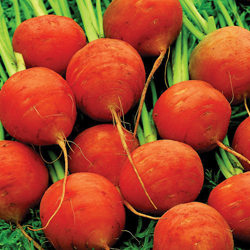
Paris carrot-photo courtesy of Huffington Post.com

Paris carrot-photo courtesy of Huffington Post.com

Let me start with Paris carrots. They are considered a gourmet variety from France. They look like large radishes only orange and are suppose to have superior flavor. They would be great in very hard soil where a long root would have a hard time penetrating. However, I was disappointed in the taste-rather bland and not all that flavorful so I wouldn’t be growing them again. Perhaps the New Mexico soil isn’t right for them.

cosmic carrot_kitazawaseed com

Cosmic Purple carrot-photo courtesy of Kitazawaseed.com

Next carrot that I grew was a Cosmic Purple carrot. The color is a very dark purple on the outside and bright orange on the inside-very pretty and they are about 6-8 inches long. The taste is excellent with an almost spicy carrot flavor-hard to describe but very good. I have grown these in the past and will grow these again.

AtomicRedCarrot_artefactual org

Atomic Red carrot-photo courtesy of artefactual.org

The last carrot I grew was an Atomic Red carrot-I love everything about this carrot. Although it isn’t a supersweet carrot, it still has excellent carrot flavor. It is also about 6 inches long. But the best thing about this carrot is it has the most fantastic red color.  When added to a carrot soup with other carrots, it gives the soup a deep rich reddish-orange color that is almost neon. It is also wonderful in salads. I will definitely grow these next year.

‘Rouge Crapaudine’ Beets-say what?!!

Rouge Crapaudine beet. Photo courtesy of www.frenchgardening.com

Rouge Crapaudine beet. Photo courtesy of http://www.frenchgardening.com

I tried a new variety of beet this year-a heirloom beet named ‘Rouge Crapaudine’. Do I dare try to pronounce it?! Ha! This beet hails from France and is one of the oldest varieties of beet in history possibly dating back 1000 years and still around! Craupadine means female toad in french! It’s not pretty-it’s shaped like a very rough fat carrot  (definitely toadlike) and it’s skin looks like tree bark (toadlike again) hence the name. In fact it’s downright ugly BUT the dense purple flesh is divinely sweet and sought out by chefs. In France they sell them at farmers markets both raw and roasted. I was curious so I looked up how they cook it over there.

craupadine beet cooked

Cooked Crapaudine beet. Now it needs to be skinned.

First wash the beets (you don’t have to oil  or skin them) and place them in several layers of foil (beets on shiny side) and close it up tight on the top and both ends. Then put it directly on hot coals in your fireplace (yes that’s right) but not on a direct flame. A fun thing to do in the winter after having a nice warm fire.

It will cook inside the foil on the coals. How long to cook it depends on how hot your coals are. Mine took about 45-50 minutes total turning halfway through. You’ll have to take it off the coals and check it for tenderness with a fork from time to time as there is no exact science as this is an art!

Wear gloves if you don't like your hands red after skinning beets

Wear gloves if you don’t like your hands red after skinning beets

The skin will come off easy after they are cooked once they cool down.  But be aware your hands will turn a lovely shade of magenta! For more details you can go here  at the website frenchgardening.com where I learned about this beet and French cooking method.
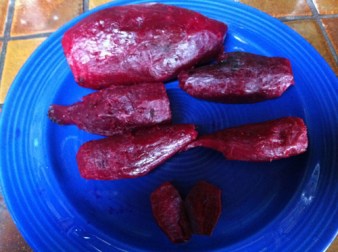
Crapaudine bet skinned and ready to eat!

Crapaudine bet skinned and ready to eat!

Crapaudine beets get a sweet smoky flavor cooking it this way. You can also cook them in a more traditional way in an oven for about 45-60 minutes at 350°F. They’ll still be good but without the smokiness. Do try it in the fireplace for a treat.

After cooking them in the fireplace, I made a salad with the beets sliced and placed on a bed of greens with some crumbled goat cheese, pinon nuts sprinkled on them and topped with a balsamic dressing-absolutely fantastic. I didn’t even like beets-until now.

Crapaudine beet seeds are hard to find but I found them at Baker Creek Heirloom Seeds. Sow them next spring and just be sure you sow more seeds than you think necessary as they are tough to germinate and some won’t come up. Plant them in spring as they will take at least 3 months to be ready to harvest. Then harvest in late summer and store in a refrigerator all winter if you like and save for a wonderful fall-winter treat. Crapaudine beets can also be used in any beet recipe.

Potatoes harvested! Garden asleep!

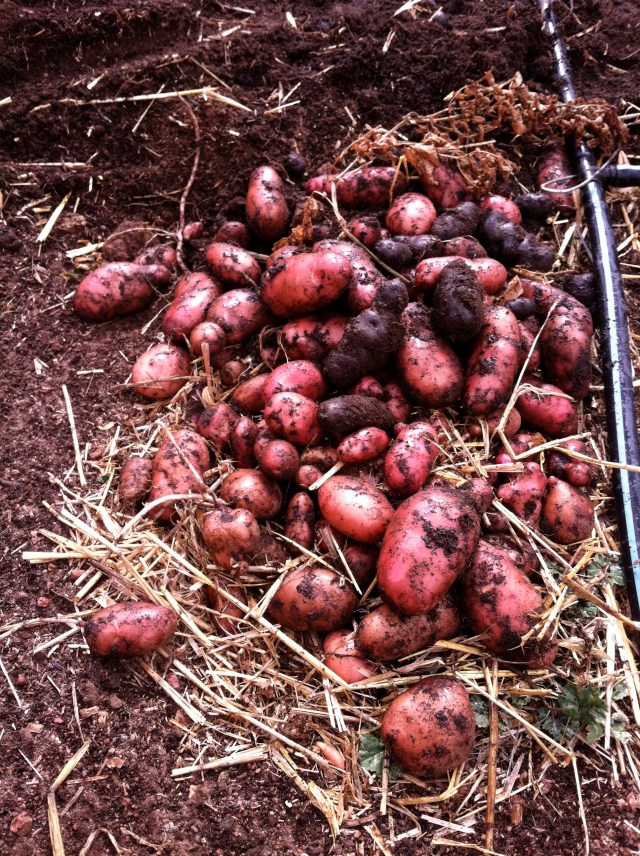
Potatoes dug out just in the nick of time!

Potatoes dug out just in the nick of time!

Well all my potatoes were harvested before the first snow fall last week. Lava, Adam, Janet, Bob and Mernie all helped dig them out (and of course they all got some too). Thanks to all! I have about a half a bushel left of potatoes after we dug them out. I’m going to try a buttermilk potato leek soup with some of them and will share the recipe later.

From left-Peruvian Purple, French Fingerling and Russian Banana

From left-Peruvian Purple, French Fingerling and Russian Banana

I only grew gourmet fingerlings for my first try at growing potatoes this year. Here are the three kinds of fingerlings I grew-Peruvian Purples, French Fingerlings and Russian Bananas (I think). I loved the Peruvian purples but they  were small and I didn’t get many of them. I also loved the French Fingerling which are the red ones and the whitish ones are Russian Banana fingerlings. Both the Peruvian purples and the French Fingerlings have a wonderful flavor-kind of  a sweet, nutty potato flavor and are creamy in texture. I will definitely grow them again. The Russian Bananas were watery, not sweet, and when never got completely soft when cooked-they stayed crunchy. I won’t be growing these again. Plus I think I will try to grow a little bigger purple potato as the Peruvians were very small. You can check out hundreds of varieties at Irish Eyes Garden Seeds where I got mine online. They have a great choice of potatoes. I will definitely grow potatoes again.

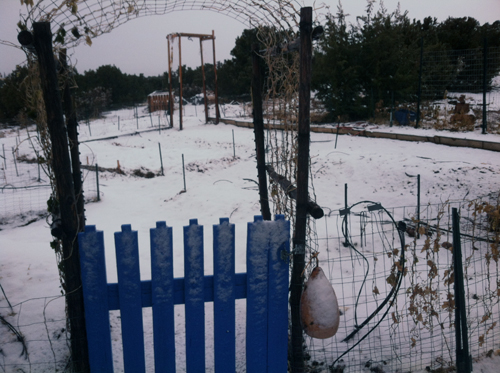
Garden finally asleep!

Garden finally asleep!

Lava helped me unload 2000 lbs of manure in the garden and Beto and Beto Jr. came by and dug in the manure in each bed and finished cleaning up the main garden and pumpkin patch.  Nice to get it all done before winter really hit. So now the veggie gardens are sleeping!

So much to catch up on!

Fall Garden cleaned up

Fall Garden cleaned up

I haven’t been posting much lately because I’ve been busy tearing out the garden before it snowed, preparing for winter inside, working (i.e. making a living) and am studying Permaculture design with an online study group. BUT I have LOTS to share with you and will in the coming posts. Some of it will be on the fall harvest, preparing the harvest to eat, review of last season’s vegetables and about the coming season (OMG! NOT YET-yes it’s true-the seed catalogs are coming in!)  I find winter is a great time to catch up on lots of things we were unable to do in the summer/fall because of the intense gardening and to catch up on the three R’s (rest, reading, and reflection). So stay tuned!

Catch Up in the Veggie Garden

I can’t believe I haven’t posted in almost a month! Not like me! But I have an excuse-I’ve been headless with the final harvesting of giant pumpkins, tomatoes, harvesting the rest of the veggie garden, being ‘The Tomato Lady’ selling tomatoes at the Santa Fe Farmers Market AND planting the fall garden. What’s that you say? Planting a fall garden? Am I not burned out yet of the season? Well almost, but I know I will crave something green in Dec-Jan so I sucked it up and planted some greens in my cold frame. They are already looking so pretty and green. So now that it has gotten cold at night and the garden has been put to sleep (I disconnected the drip systems), I will catch you up on what’s been happening in the garden in the next few posts and what to do with all that produce!

Truck Farm Movie! Monday July 23 at CCA at 6:30 pm

Monday night the movie, ‘Truck Farm’ presented by Whole Foods is about people in New York who wanted a garden in New York City and didn’t have a place to put one  so they planted it in the back of a truck! Afterwards Homegrown New Mexico will have a panel discussion on community gardening. Come see our own ‘truck farm’ which will be on display at the movie.

Curly Top Virus -tomato problem right now

I’ve noticed a few of my tomato plants have got curled leaves, lost their bright green color and their veins turn purple and I’ve got several friends with the same problem who have contacted me about what this might be. I’m pretty sure its Curly Top Virus transmitted from the beet leafhopper which has been really prevalent this season. This is not to be confused with leaf roll where the tomato leaves roll. I think the combo of leaf roll and purple veins is the key. Read on.

Here is some info on Recognizing Tomato Problems from Colorado State University website. http://www.ext.colostate.edu/pubs/garden/02949.html

‘Curly top virus is transmitted by the beet leafhopper. This problem is common in western Colorado but seldom found in eastern Colorado. Infected plants turn yellow and stop growing. Upper leaflets roll and develop a purplish color, especially along the veins. Leaves and stems become stiff; fruit ripens prematurely. It is difficult to control because leafhoppers migrate from southern areas. Hot, dry springs with predominantly southwest winds usually indicate increased problems with this disease. No chemical controls are effective. Use row covers to protect tomato plants from the leafhopper.’ Of course this is for Colorado but applies here as well.

Unfortunately after tomatoes get the virus, you should pull the plants. I’m concerned that a leafhopper might bite an infected plant and then bite a healthy plant and infecting it.  So far 4-5 of my plants have this. I’m pulling them tomorrow..

Giant bean teepee

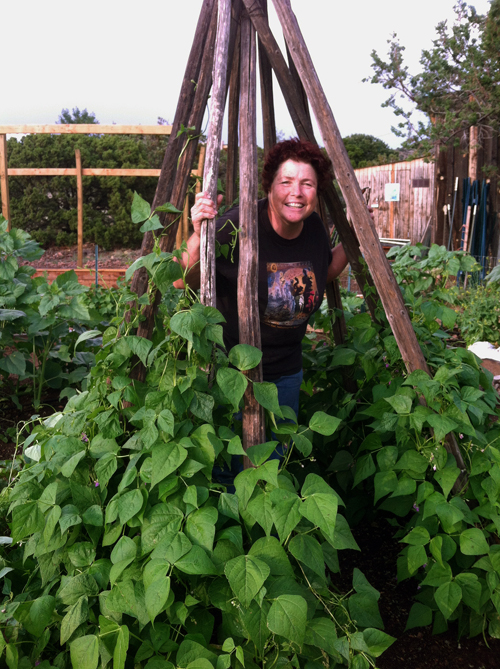
This year I made a giant bean teepee, one I could stand or sit in. The beans are really taking off. I chose Emerite green beans (pole beans from Scheepers Kitchen Garden Seeds) partly because they grow fast and tall and partly because they are so delicious. At first I had to tie up the vines to train them to grow up the poles but now the beans are growing up it nicely on their own. I can’t wait till the whole teepee is covered (except for the opening!). What a beautiful centerpiece for the garden!

Today’s Harvest-July 16!

Today’s harvest!

Today the ‘Emerite’ beans, some beets and 3 little tomatoes were ready for harvest!  The beans are french vericots and should be picked very thin when they are tender. If you wait till they are bigger they will be tough. The beets were from thinning them out some more so the rest of them can get bigger. The garlic in the picture was harvested a couple of weeks go and is dry and ready to clean up.

Harvesting Bok Choi

Bok Choi. Photo courtesy of http://www.diynetwork.com

I’m growing new exciting vegetables for me this year and one of my favorite that I’m going to replant for a fall crop was Bok Choi (also spelled Bok Choy). I thought they were baby Bok Choi when I planted them but they ended up full size. No difference-they are delicious! I love chopping them up and putting them in rice dishes and stir-frys.

I also like to cut them in half and then saute them in a little olive oil. Once they are brown on the cut side, I turn them over and cook some more till slightly brown. Then I put a little water (like 2 tablespoons) in the pan and a lid on to finish cooking them. The steam from the water makes them tender. Then just before taking it out of the pan, I splash a little tamari on them in the pan and then serve them. Another wonderful vegetable!

Time to start your fall vegetable garden?! But wait it’s still summer!

Photo courtesy of aggie-horticulture.tamu.edu

OMG! I’ve received newsletters already talking about starting our fall vegetable gardens! What?! Already?! I’ve barely harvested my spring garden and haven’t harvested the summer garden yet!! No! No! No!

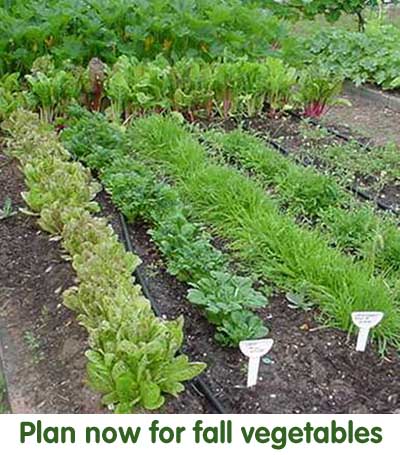
Yes folks, it is time for us to consider planting our fall vegetable gardens mid-month. The fall garden is very similar to the spring gardens in the varieties of veggies we can grow. If you want lettuce, chard, kale, spinach and many of the cool season crops later in the fall, you should consider putting them in this month. I would either plant seeds inside under lights to transplant later or buy seedlings at the nursery (that way you can plant a little later). Just make sure you buy heat-resistant varieties of lettuce and spinach and give them some shade for now. If you plant by seed, most lettuces take around 60 days till fully mature which would put us in September-October. Hard to believe isn’t it?

To figure out when to plant each variety, just look on your packet of seeds and count backwards from the time of the FIRST AVERAGE HARD FROST (Oct.3 in Santa Fe ) and add 14 days for shorter daylight hours (I add 15 days to make the math easier for my memory). So if I have some lettuce that will take 60 days till harvest and I add the extra 15 days, that would bring me 75 days (2 1/2 months) ahead to plant before a hard frost. So if I plant on July 15th, I would harvest right around Oct. 1. Unbelievable! Now with spinach and kale you can wait a little longer as they can handle some frost. And if you want some in Sept. you better plant now-like this weekend! Just when you thought you could cruise till summer harvest!

PS: More on the dreaded squash vine borer

I just posted about the squash vine borer and a gardening friend, Gene, mentioned that his squash is smaller than in the video in a comment in the earlier post on squash vine borers. I forgot to mention that while the squash is small before they blossom, I keep them covered with row cover which keeps both the SVB and the squash bugs out but once the plants are bigger and blossoms, we have to take the row cover off for the bees to be able to pollinate them-that’s when we should use the foil.

Did I die and wake up in hell?

IT’S HOTTER THAN HELL RIGHT NOW. Did I die and wake up in hell? What’s happening here? This could be a new reality show, ‘Hell’s Garden’ instead of ‘Hell’s Kitchen’ where gardeners see how long they can work until they drop like flies. I left Phoenix to get away from the heat (now they get killer heat there) but I swear it’s looking more and more like a desert here in Santa Fe-cause that’s how it feels right now with the unbelievably hot temperatures we’re getting. Today I had to quit the gardening early (on my day off to work in the garden)! Water, Gatorade, lemonade, ice tea-no matter, nothing worked today to help with the heat outside. I crawled back to the house. I was like a limp noodle. Needless to say it wasn’t a very productive day in the garden today. Wah! Tomorrow I’m getting up at 6 AM before the heat comes on…

Photo courtesy of: thekruser.com

Protecting Your Squash Plants from Squash Vine Borers

We have 2 nemesis for our summer squash, winter squash and all pumpkins-squash vine borers and squash bugs and they will be here soon if not already here. This post addresses the squash vine borer.

The squash vine borer as seen above has a BLACK AND ORANGE BODY with CLEAR WINGS. If you see a waspy looking bug that is BLACK with ORANGE WINGS, this is NOT the squash vine borer but a tarantula wasp – don’t mess with it as it has a painful bite but usually won’t sting us unless we agitate it and it is harmless to our plants. Take a good look at the picture above so you can identify the squash vine borer.

This video and article, Protecting Your Squash Plants – Vegetable Gardener is from the Vegetable Gardener site (great site) and shows how to protect our squash vines from the squash vine borer.

In addition to using foil and panty hose as shown in the video, I also bury all my stems as they lay down on the soil-main stem and secondaries so the SVB can’t find the stems. Mostly the SVB attacks the BASE of main vine so be sure to protect that part of the squash vine. This use to be an east coast problem but the SVB has finally crossed west of the Rockies. So be on the lookout.

If your plant suddenly wilts even though it has enough water, or if you do see SVB’s around, look for frasse (poop) that looks like sawdust around the base of the stem and that is where the larvae will be-inside the stem eating your plant. You can try to cut vertically (not across) the stem and dig out the larva with a knife, then bury the stem with dirt. Depending on the damage, your plant may or may not survive. Take precautions now to thwart this pest.