Why we don’t have ripe tomatoes right now

So if you still have tomato plants after the curly top virus hit many of our plants, congratulations! I had 84 tomato plants and am down to 48. Thankfully I planted more this year or I wouldn’t be at the Farmer’s Market. I’ve gotten many questions on why we don’t have many ripe tomatoes now. Lots of green ones, but few ripe ones and normally we would have LOTS of ripe tomatoes now. The reason is we had an unusually hot July with day temperatures over 90°F almost every day and the blossoms dropped back then, failing to set fruit.  The number one reason for blossom drop is high temperatures over 90°F  during the time blossoms would normally set in July (the number two reason is cold temperatures under 55°F). Once the temperatures dropped below 90°F in August they resumed setting tomatoes again hence the green tomatoes we are seeing now. So basically we are a month behind but should start seeing most of the tomatoes ripening.  Ahh, the challenges of growing vegetables in the high deserts!

First Caprese salad!!

Here is the first caprese salad of 2012! Fantastic! Yellow, orange and black tomatoes with mozzarella, basil and olives drizzled with an 18 yr old balsamic vinaigrette! Been waiting for this since last November! Need I say more?

Curly Top Virus -tomato problem right now

I’ve noticed a few of my tomato plants have got curled leaves, lost their bright green color and their veins turn purple and I’ve got several friends with the same problem who have contacted me about what this might be. I’m pretty sure its Curly Top Virus transmitted from the beet leafhopper which has been really prevalent this season. This is not to be confused with leaf roll where the tomato leaves roll. I think the combo of leaf roll and purple veins is the key. Read on.

Here is some info on Recognizing Tomato Problems from Colorado State University website. http://www.ext.colostate.edu/pubs/garden/02949.html

‘Curly top virus is transmitted by the beet leafhopper. This problem is common in western Colorado but seldom found in eastern Colorado. Infected plants turn yellow and stop growing. Upper leaflets roll and develop a purplish color, especially along the veins. Leaves and stems become stiff; fruit ripens prematurely. It is difficult to control because leafhoppers migrate from southern areas. Hot, dry springs with predominantly southwest winds usually indicate increased problems with this disease. No chemical controls are effective. Use row covers to protect tomato plants from the leafhopper.’ Of course this is for Colorado but applies here as well.

Unfortunately after tomatoes get the virus, you should pull the plants. I’m concerned that a leafhopper might bite an infected plant and then bite a healthy plant and infecting it.  So far 4-5 of my plants have this. I’m pulling them tomorrow..

Video: Early Pruning of Tomato Plants

Last Saturday I taught a vegetable class on Organic Pest and Disease Control for Home Grown New Mexico. It was held at Milagro Community Garden. Part of the class was how to trim your tomato plants to help thwart soil-born fungal diseases like Early Blight. Most people don’t trim their tomato plants enough in the beginning. Here is a video I found from Vegetable Gardener site that shows exactly how to do it. Don’t be wimpy about it-trim them all the way up to the first blossoms.  As a preventative, I will spray Serenade organic fungicide on all the leaves both on top and underneath  about every 10 days. Doing all this should get your tomatoes off to a healthy start. Here’s a link to the video.

Video: Early Pruning of Tomato Plants – Vegetable Gardener.

Make a great tomato cage

Tomato in cage, drip underneath, trimmed up off the ground, straw mulch in well and staked to t-post

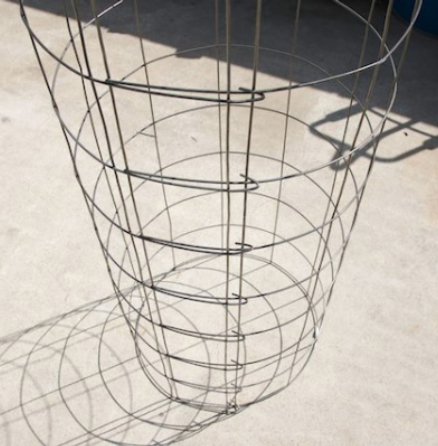
You need to ‘cage’ your tomatoes before they get unruly. I hate those tomato cages they sell in the store. They are too little and flimsy and the tomato plant will quickly outgrow them. I found a great way to make cages in ‘The New Victory Garden‘ by Bob Thompson.

First use concrete reinforcement wire to make your cages. It is heavy-duty wire that has 6 inch openings so you can get your hand through the openings with a fat tomato. Think optimistically – you’re gonna get a 2 lb giant juicy tomato on you plant and need to get out of the cage! You can buy it by the sheet, which is 4 ft high, or by the roll which is 5 ft high. One sheet will make one cage. The only trouble with the 4 ft height is it is too short for many heirloom tomatoes but some people stack two of them together to make an 8 ft high cage!

I buy the roll, which isn’t cheap, but is a one-time cost and the cages you will make can also be used for beans and cucumbers, in fact almost anything you want to grow vertically and will last a lifetime. A roll is 120 ft in length and will make about 18 cages so if that is too many than I suggest you go in with another gardener friend (or 2) and share the cost. Cut the wire with bolt cutters or an angle grinder not hand wire cutters-your hand will be wrecked-I speak from experience. Here’s how I do it:

1. If using a roll unwind it and hold it down with some BIG rocks or bricks so it doesn’t wind back up. Count 13 squares and cut off one side of the wire leaving it long.
2.  Then bend the long wire into a ‘u’ and hook it back on itself as shown in this photo.

The cage will be approximately 24 inches in diameter when finished. Then I cut off the bottom leaving all the ends pokey (not shown) so I can push the ends into the ground so it won’t blow over.

3. If using a sheet, I wouldn’t cut the bottom edge as I do with the roll to keep as much height as possible.

4. Stake either cage with a 3 ft high green t-post pounded next to the cage and tie the cage to the green post to keep the cage from falling down from wind as shown in the top photo.  This is important when the plant gets top heavy. If you are next to a fence, you could tie it to that. The point being that you don’t want your tomato plant to fall over. Some people growing in pots just put the cage over the whole pot and the pot keeps the cage from falling over as the plant gets bigger.


Americorp students help plant tomatoes

Today I had some AmeriCorps students help plant some of my tomatoes. I think we planted about 25 of them. What a great bunch of young adults giving service. In case you didn’t know AmeriCorps is like the Peace Corps  (only here in America) where people join and give their time and energy for one year to help communities and farms and learn many skills on their journeys. I explained how I plant tomatoes and  gave them some handouts to take home explaining the process. I hope they take back this information to their communities and share their new tomato growing skills! My only regret is I didn’t get a picture of them before they left! A big thanks to all of you who helped today!

More tasty tomatoes and peppers with Epsom Salts

Get more tomatoes with Epsom Salts

Epsom Salts May help increase blossoms in tomatoes and pepper plants. Increase in blossoms means more tomatoes and peppers!

Epsom salts contain magnesium sulfate, two important elements for plant growth.

Magnesium– can become depleted in soil usually later in the season. Magnesium helps strengthen plant cell walls, helping the plant to absorb nutrients. It also helps to increase blossoms.

Sulfur– improves the growth and overall health of plants, it may also help our high alkaline soil here in the southwest.

There are two ways to use Epsom salts for tomatoes.

1. Mix 1 tbsp of Epsom salts into the soil at the bottom of the planting hole when transplanting tomatoes or peppers or mix 1 tbsp in a gallon of water and water the transplant. It may help plants absorb Calcium and other nutrients from the soil.

2. Use as a foliar spray of 1 tbsp per gallon of water when the plants flower. Epsom salt helps set more blossoms.

I’ve used Epsom Salts on my tomatoes, peppers and even roses for years. It will help roses produce more flowers. Scratch in 1/2 cup of  Epsom salts in soil around rose bush and water in.

Started planting tomatoes May 11

15 TOMATOES PLANTED

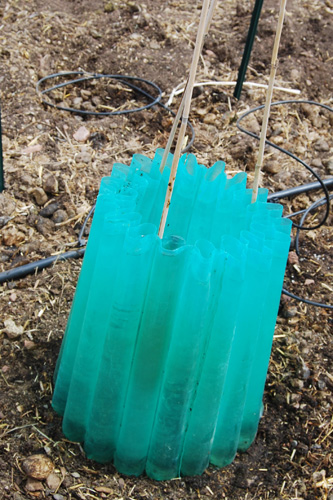
I started transplanting tomatoes into the new garden section. My friend Tom, and I got 15 of them in the soil-all ready to go. We added to each hole: more compost, yum-yum mix, mycorrhizal fungi (for root growth), worm castings, epsom salts (for many blossoms), and dry milk (adds calcium to avoid blossom rend rot later). And this year to (hopefully) conserve on water usage, I’m trying silicon gel granules and some volcanic ash, both of which will keep water longer around the plant root zone.  All this stuff is mixed up with some of the existing soil in the hole.  Then we put the tomato plants in (and if they are rootbound, open the roots up a little), made a well around each one and water each hole several times to get the soil wet. Then I go back a third time and water in some Superthrive and seaweed fertilizer (helps with plant transplant shock). Afterwards I put a drip line around each plant and then put a wall-of-water around each of them to keep them warm at night because just when we think we are out of the woods weatherwise, it gets cold again.

To keep the wall-of-waters from collapsing when the wind gets blowing hard, I put some bamboo stakes inside the walls as shown in the second picture. Overkill? Maybe. But I will get some fantastic tomatoes during the season. I still need to put the main drip hose (1/2 inch size) around the perimeter of the patch and connect each individual drip line to it but I can hand water every other day for now till I get to it. Planting is the hands on intensive part-later it will be a breeze watching them grow..

Tomorrow-May 16, Amy Hetager, from Home Grown New Mexico, is coming with her students from Americorp to plant some more tomatoes. No shortage here-still got 55+ tomatoes to put in the ground!

When Will I Plant Tomatoes?

I think I’m going to start planting tomatoes by the weekend.  I won’t get all of them in but this will be the EARLIEST I have ever planted here in Santa Fe. I checked the weather for the next 10 days and no freezing weather is projected. Of course it’s always a crap shoot here in NM but I think the odds might be in our favor this year. I will still put them in wall of waters (WOWs) because they grow so much faster in them than without them and if we get a freeze, they offer lots of protection.  But I will hold off on the eggplants and peppers for a little while longer cause they want HEAT. I checked the weather for the next 10 days and no freezing weather is projected. I’m not recommending anyone plant before our last freeze date of May 15th, just letting you know what I’m thinking. Unbelievably beautiful weather-so different then last year’s-no wind, no freezing weather-just fabulous! Time to spend lots of time in the vegetable garden!

500 lbs of tomatoes..

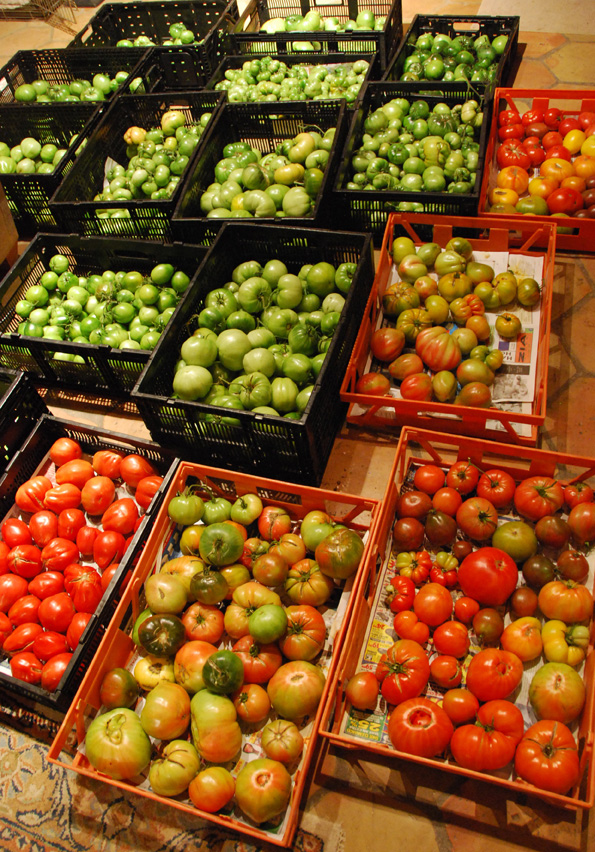
There must be 500 lbs of tomatoes all over the house in different states of ripeness now. Little paths throughout the house to walk around! With all the freeze scares each day for the nights, I went out and picked almost all the tomatoes that can finish ripening. I started picking hard on Wednesday and then my good friend Mernie came over and helped picked the rest on Thursday and Friday. On Saturday I had one of my best days ever at the Farmers Market as “The Tomato Lady’. It has been cold and had rained in Santa Fe and snowing on our mountain and I think everyone started thinking OMG- the tomato season is almost over! It was like a shark frenzy. My patrons didn’t want anything else-only tomatoes. I completely sold out. Now I just have to manage the remaining tomatoes in the house to make sure they ripen nicely. While I’m gone on Saturday at the giant pumpkin weigh-off, Caleb will be ‘The Tomato Lady’ again and then I will be back the following Saturday!

Santa Fe Farmers Market/The Tomato Lady

This slideshow requires JavaScript.

Saturday went well for my first time at the Santa Fe Farmers Market for this year. It is actually my third year returning as The Tomato Lady. I had many varieties of tomatoes, much more than I anticipated and sold most of them. I had a few left over which I made into tomato sauce and tomato tapenade today.

‘The Tomato Lady’ returns to Santa Fe Farmers Market this Saturday, Aug 20

Here are some of the tomatoes I’ll be bringing to the Santa Fe Farmers Market

FINALLY, I will arrive at the Farmers market this Saturday, Aug 20 in the SAME LOCATION INSIDE THE BUILDING not outside. (COME INSIDE the BUILDING BY THE 2ND ENTRY WHEN YOU WALK DOWN MAIN OUTSIDE AISLE). I won’t have as many tomatoes YET as I would like so if you want some incredible, organically grown, heirloom tomatoes, you better come EARLY as I anticipate SELLOUT by 9:30am even though the market stays open till 12:30. Of course not all of them ripen at the same time so you will have a variety of tomatoes to pick from each week. Over 25 heirloom tomato varieties on 70 plants this year! This is the beginning-it will only get better as each week more and more tomatoes will ripen. I will also have other heirloom veggies there – Shishito peppers, a few Pepperoncini peppers, incredibly sweet, never bitter Fairy eggplants, fantastic nutty flavored Rattlesnake beans, wonderful thin French filet beans, Emerite, but mostly tomatoes, tomatoes, tomatoes! Hope to see your happy faces soon!

Tomato hornworms are here!

Sphinx larva-tomato hornworm

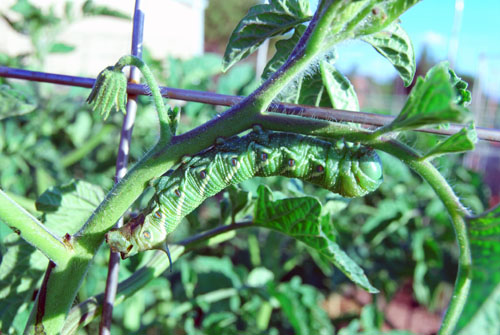
Well I knew it would be too good to be true! The tomato hornworms are here-late but here. Picked off about 15 today that were found on the tomato plants. Boy are they hard to see. Great camouflage artists. I haven’t been in the garden much this past week due to a lot of art events around the SOFA show that just ended here in Santa Fe. As a result, three of us-Caleb, Elodie and myself found about 15 hornworms on the tomato plants. The hornworm is the larva of the Sphinx moth (also called the hummingbird moth but not related to hummingbirds). I was hoping that maybe they wouldn’t show up but they’re here! They can be seen in the top of the plants, not deep in the interior, thank god, where I wouldn’t be able to find them and they are almost inevitably always found hanging upside down on the branch they are munching on. When I find them, I pick them off  (wearing gloves) and under my shoe they go! I think their instant death is better then giving them to the chickens who would peck them to a tortuous death. I do try to be humane in their demise! They aren’t hard to control by handpicking, it just takes a little time. Glad one never finds more than one or two in each plant. So tomorrow and everyday this week I will go hornworm hunting until I can’t find anymore..

Tomatoes Starting to Ripen

My tomato plants are looking good and are loaded with tomatoes although mostly green. I was starting to get one ripe tomato here and there a couple of weeks ago and now I get several a day-not enough to go to the SF Farmers Market yet but certainly enough to have every night now with dinner. AHHHH! I wait for this time in the garden! I have yellow, orange, black, green and of course red starting to ripen.

To beat the birds from pecking holes (I don’t always win) I am picking the tomatoes a little early when they first start to get a little color and let them finish ripening inside.

I love to slice them and put over a bed of lettuce and drizzle a little balsamic vinaigrette over them. I’m also thinking I need to make some grilled cheese sandwiches with sliced tomatoes inside. YUM!

Where are the tomato hormworms?

tomato hornworm revealed

I haven’t seen any tomato hornworms yet which I think is unusual for this time of year. I looked up in my blog posts from last year to see when the tomato hormworm showed up- they appeared on July 8th. And come to think of it, I haven’t seen any Hummingbird moths or Sphnix moths either yet. Maybe the -20°F weather we had last winter killed the larvae! We’ll see.