Artisan Farm Tour-2014

It’s been a very busy summer for me. I’ve been preparing for my tour here on the property since spring. Nothing like having people over to get things done. I’ve had a punch list that I’ve chipped away at and finally got almost all of them done before last weekend when I had an educational tour for the Santa Fe Master Gardeners of my little Artisan Farm here in Santa Fe. Between the Home Grown Kitchen Garden & Coop Tour (different tour the week before) and my tour last weekend, I’ve pretty much been headless all summer. Now it’s all over and I can get back to a more normal pace. But wait, I’m getting ready to go to the SF Farmer’s Market! Always something. I guess I can rest in the winter! Here are some pictures of my Artisan Farm tour last weekend. The garden looks the best ever…

Home Grown New Mexico’s ‘Kitchen Garden & Coop Tour’!

I’m on the Board of Directors of Home Grown New Mexico organization and we are putting on our main fundraiser this Sunday, July 27 from 9 am – 2 pm. Please come out and support us, you won’t be disappointed! I just went by all 5 houses this week and they are totally inspiring! Here is the post from our website.

FINALWEB 2014 HGNM KItchen Garden Tour

IT’S HERE! The print version of the 2014 Kitchen Garden Tour addresses and map

Just print it out and come out for the tour. Read on for more info on how to purchase tickets and the homes on the tour!

Our 4th Annual Kitchen Garden and Coop Tour is on Sunday, July 27  from 9 am – 2 pm.  Come get inspired for your own gardens! See five of Santa Fe’s most inspirational gardens.  Pick up ideas that you can use at your place or just enjoy these beautiful edible and functional landscapes.

‘The 5 properties on the tour this year will feature many gardening ideas—beautiful vegetable gardens, backyard chicken coops, beehives, composting, greywater systems, hoophouses, a neighborhood community farm, permaculture sites, edible landscapes and rainwater harvesting systems.’
Excerpts from: Edible Magazine, our premiere sponsor

 Tickets are $25 this year and children under 12 are free.

*Tickets can be purchased 2 ways:
1-Pre-purchase tickets online here.
2-Purchase on day of tour at homes. Cash or checks accepted at each house and credit cards accepted at house #1 only.

HERE ARE THE ADDRESSES FOR THE 5 SPECIAL PROPERTIES ON THE TOUR:

1. Linda and Jim Archibald- 1105 Caminito Alegre
This Casa Solana home features chicken coops, fruit trees, large raised vegetable gardens, perennial and annual flowerbeds.

2. Jesus and Charlotte Rivera – 405 Salazar Place
Tune-Up Café’s owners, Jesus and Charlotte Rivera’s home features raised vegetable gardens, fruit trees, herbs and greywater systems. Charlotte’s goal is to use greywater only for watering all her gardens.

3. Reese Baker – 2053 Camino Lado
The RainCatcher’s owner, Reese Baker’s home incorporates many Permaculture designs. His mature gardens will amaze and inspire all. His edible landscaping includes fruit trees, berries, edible bushes and vegetables. He has chickens, a fishpond and passive water harvesting systems including Zuni bowls, rainwater catchment and greywater systems that channel water to the fruit trees and pond. This site is a great example of what can be done on a small city lot!

4. Poki Pottin/Gaia Gardens – 2255 Paseo de los Chamisos
Poki who started Gaia gardens is known from the Santa Fe Farmer’s Market where he sells his vegetables. This is a phenomenal property that is a neighborhood community farm based on biodynamic principles. The farm features many vegetable gardens, chickens, composting systems, hoophouses and even has ducks! Poki will have lots of  plant starts for sale if you still need some.

5. Jeremiah Kidd – 29 Hidden Valley Road
San Isidro Permaculture’s owner, property in the foothills of the Sangre De Cristos showcases permaculture designs in keeping with our arid high desert. His property features edible landscaping, erosion control installations, grey and blackwater systems, rainwater catchment and a hoophouse. His edible landscaping includes berries, grapes, fruit and nut trees and many other exotic edible plants.

Master Gardeners and the homeowners will be present to answer questions at each site. Don’t miss this exciting Kitchen Garden & Coop tour in Santa Fe this year!

Other contributing sponsors for the tour are: Joes’ Diner, Osuna Nursery and Whole Foods

2 exciting classes this weekend!

I’m involved with teaching 2 classes this weekend that should be terrific! Read on!

If you’d like to come to either or both,  please RSVP  at 505-983-9706 so I know how many ingredients to buy for the Jam class and number of handouts to run out for both classes. We won’t be confirming your RSVP– just know you’re in! Come to one or both!

FIRST CLASS

rain-barrelSaturday, July 19
Creating a Rain Barrel and Learn About Rain Catchment
Learn how to make your own rain barrel and learn all about rain catchment
Time: 10 am-1 pm
Instructor: Amanda Bramble/Jannine Cabossel
Location: Milagro Community Garden (Rodeo Road and Legacy behind church)
Presented with Milagro Community Garden at milagrogarden@yahoo.com
RSVP to 505-983-9706 or email: homegrownnewmexico1@gmail.com

Learn how to make your own rain barrel with this hands-on workshop. Amanda will cover the basic elements of rain collection systems including sizing and sitting your tank as well as keeping the water clean. We will also discuss accessories like tank gauges, first flush systems, and filters for DIY systems. Jannine will demonstrate making a rain barrel out of a 55 gallon drum. Amanda Bramble is the director of Ampersand Sustainable Learning Center in Cerrillos, NM (www.ampersandproject.org).

Class is free but we have a suggested $10 donation or become a 2014 Member for $35 and the following free: classes, potlucks and one ticket to the big tour on July 27th.


THE SECOND CLASS

jam photoSunday, July 20
‘Jamming Jam Class’
Jam Making Class
Time: 10am-1pm
Instructors: Jannine Cabossel/Duskin Jasper
Location: Whole Food’s Community Room (St. Francis location)
RSVP to 505-983-9706 or email: homegrownnewmexico1@gmail.com
(You will not be contacted back, we just need to know how many are coming for printing handouts and how much ingredients/jars to bring.)

In this preservation class, you will learn how to make and process jams with available seasonal fruit. The twist on this jam session is our emphasis will be on adding unusual ingredients to make unique artisan jams. We will hand out recipes. We will also go over basic canning processes. You’ll get a jar of jam to take home! Come jam with us!

Class is free but we have a suggested $10 donation or become a 2014 Member for $35 and the following free: classes, potlucks and one ticket to the big tour on July 27th.

Tomato Snob!

tomato snob

This says it perfectly! Some of my tomato seeds came from Secret Seed Cartel this year. Can’t wait to try them out!

Here they come-FIRST TOMATOES!


FIRST TOMATOES 2014

Ok, I have something to confess – I’M TOMATO ADDICT!! I need my fix! Here are the first organic tomatoes of  2014 season. I got 5 Sungold and Black Cherry tomatoes during the last week of June. That is the earliest I have ever gotten tomatoes ready to eat. Sungolds are one of the few hybrid tomatoes I grow because they are soo sweet and Black Cherry tomatoes are an heirloom tomato that is fantastic as well with it’s sweet earthy flavor. I have gotten more little tomatoes since then that are eagerly eaten-sometimes right off the vine – if I can’t wait. I HAVEN’T HAD A TOMATO SINCE LAST OCTOBER! I never eat the ones in the restaurants or buy any from a grocery store-I just patiently wait until my tomatoes get ripe during the tomato season. It’s been about 9 months since I ate a real tomato!

FIRST CAPRESE 2014

Here is a mini Caprese without the basil. Of course I had to go get some fresh mozzarella to go with those first tomatoes! I don’t have any big Italian basil yet to add to my Caprese but gobbled them up with the mozarella and 18 yr old balsamic vinegar and olive oil over them.  The sweetness was divine!

jc baby pic2_FB


And to think I HATED tomatoes as a kid – couldn’t stand those slimy seeds! My how things change through the years! Of course all I ever got were those store-bought tasteless tomatoes. It wasn’t until I had a REAL tomato ripened on the vine that I became a tomato addict!

Why else have a vegetable garden in the summer if not for the tomatoes!

Use fencing wire for cages over vegetables

fence cage done

Fence cage covered with row cover for protecting vegetables. Shown with Tom-Tom the great packrat hunter!

The other day some of my followers on my blog asked what was under that row cover that was holding it up and I thought it was a great question. I’d like to say it was my idea but it wasn’t. A friend of mine, Tom (who helped me build the greenhouse) gave me those structures. It’s an ingenious idea.

fence cage ready

fence cage ready to go over vegetables

He took a 5′ tall roll of fencing wire (the holes were 2 inches by 4 inches but the hole size doesn’t really matter) and cut it into pieces that when bent in half would be about 15 inches high. You could make taller ones as well. I use to make hoops from 9 gauge wire but this is easier and supports the row cover better especially if it hails. I use them for low growing vegetables, vegetables that may need some shade, vegetables that I need to protect from insects and for transplants that need to acclimate to our harsh climate when I first put them out. The pokey ends get pushed into the ground. Then you put a piece of row cover over it big enough to cover both sides and the ends. The wind won’t pick up the row cover if you put rocks around the edges of the row cover. If you have longer rows, just over lap the cages to extend them.

closeup of fence cage

Closeup of fence cage covering kale and chard. Drip system in place.

I water with a drip system so I don’t have to get under them that much but they are easy enough to lift up on one side and tip back to get to the plants underneath to water. He originally bought the wire to make his tomato cages but found that you can’t get your hands through the holes to harvest and if you cut out some of the wire to make the holes bigger, the sharp edges shred your hands where you cut the wire so he used the wire this way. He had to move so he gave me the wire structures. What a great gift!

New arbor for veggie garden

new garden arbor

I’m pooped. Yesterday some major changes took place in the vegetable garden. Nick came over to help me renovate the old strawberry patch into something new and hopefully beautiful later this season and for many seasons to come.

We tore out a little over a third of my large strawberry patch and built a new arbor in it that will show off some vines and flowers. The patch was getting old and I needed to thin it out and it was laid out crooked in the garden when I first built it. This always bugged me so since we would be thinning it out anyways, I straightened the bed out. Plus it had spread out beyond it borders and some borage plants were taking over parts of the strawberry bed  and path around it where I had introduced them several years ago. Now borage is a great plant and attracts bees but what I didn’t know is it easily re-seeds itself taking over everything in its path becoming unmanageable. So I plan on planting more borage in areas where I don’t care if it re-seeds.  We made 2 strawberry beds book ending the arbor in the middle and re-did the drip system in each of the beds as well. I plan to plant hyacinth beans and scarlet runner beans up the sides and plant sunflowers and zinnias around each side as well. Hyacinth beans are really beautiful but poisonous to eat but this garden feature wasn’t built to eat but to beautify the garden and add interest. I can see it in my mind’s eye and will show you pictures as the vines grow up it!

Row cover everywhere!

row cover in early summer

My main vegetable garden is basically divided into three sections-Section 1, Section 2 and Section 3-each section being around a 1000 square feet. So as I look at what I call ‘Section 3’, all I see is row cover everywhere! Looks like I laid out my laundry all over the ground but this is temporary. Row cover is used for extending the seasons and for protecting crops.

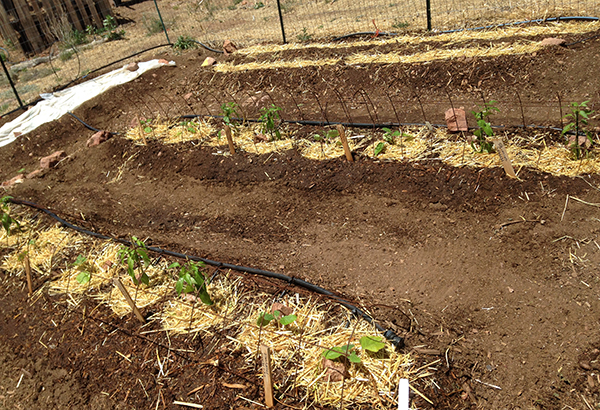
When I plant new transplants such as eggplants and peppers, I find our winds horrible on them, whipping them around and drying them out-totally stressing the poor little things so I put these mini hoops over them and put row cover on that protecting them from the ferocious winds we’ve had. When I plant seeds, I also cover them with row cover to protect them from the birds and other animals eating the seedlings as the germinate. Birds love bean sprouts, corn sprouts and cucumber sprouts but when I cover them, the birds don’t know what’s going on underneath when they germinate. So the garden looks like hell for a couple of weeks but will save me time and frustration of replanting more seeds later. This year after I planted the corn, bean and cucumber seeds, I put straw around them to help keep the soil moist and since I waited to plant later, an added bonus is the soil is pre-warmed  and the straw will help hold in the moisture when I water.

One last pumpkin goes in

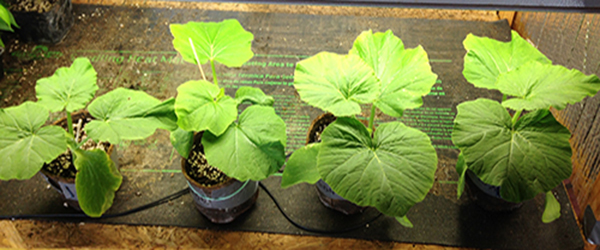
giant pumpkins_050514

Barry Todd’s pumpkin, 556 Todd second from left. Photo taken May 6.

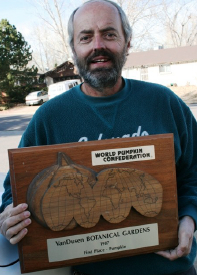
barrytoddToday I planted the 3rd and final giant pumpkin plant that has been growing steadily in the greenhouse. A pumpkin friend, Barry Todd, from Colorado gave me some pumpkin seeds a few years ago and I planted one of his last year and it was doing great when a rabbit or squirrel ate it down to the ground. So this year I wanted to plant another one of his seeds especially when I heard he was ill. He has been battling leukemia and is pretty sick but fighting on. This seed I planted is a cross between Cristy Harps’ 1725 giant pumpkin that broke the World Record in 2009 and another pumpkin Barry grew out a few years back that he is quite fond of-the Todd 50.  It is the 556 Todd. I was going to grow a giant bushel gourd where the pumpkin will go but I bumped the gourd to squeeze in Barry’s plant. I’m not sure if Barry is planting any pumpkins this year.

I met Barry a few years ago at the Old Colorado City Giant Pumpkin weigh-off and he was so nice to me and offered some pumpkin seeds for the following year. He was the Colorado State Champion for giant pumpkins with a 1308 lb pumpkin in 2010.We have been in touch since then regarding pumpkin growing and he has given me some great tips on how he grows em. I consider him one of my pumpkin mentors. I don’t know much about Barry except he is passionate about his pumpkin growing and his religion and I think it’s his faith that keeps him going. I wish you a full recovery Barry and hope this little plant breaks the NM state record. No matter what it does, I’m growing it in honor of you.

I still have one more plant in case one of the others get eaten or dies.

Rhubarb-Raspberry French Galette

I made a French galette the other day. Thinned out the rhubarb in the garden and got some raspberries from the market although it is great with strawberries too. A galette is like a pie only you don’t have to be so careful about putting the dough in a pie tin and you can put almost any fruit for them. Here’s how I did it.

galette

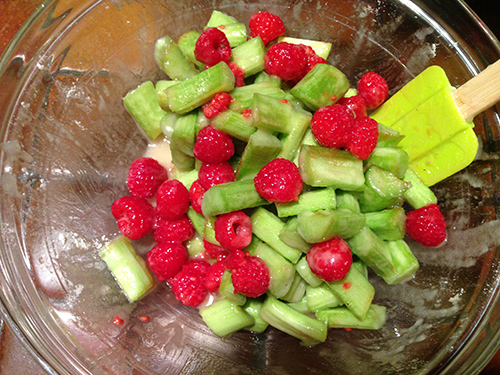
First I cut about 2 cups rhubarb from the garden (cut leaves off-use only stalks) into 1-2 inch pieces and added 1 tablespoon lemon juice and lots of sugar because rhubarb is so sour (about 1 cup). The variety of rhubarb in my garden is called Victoria, a green variety although there are many other varieties. Then I added 2 tablespoons flour and stirred it up in a bowl. Lastly I added 1 cup of raspberries and gently folded them in to keep them intact.

galette_dough ready to roll out

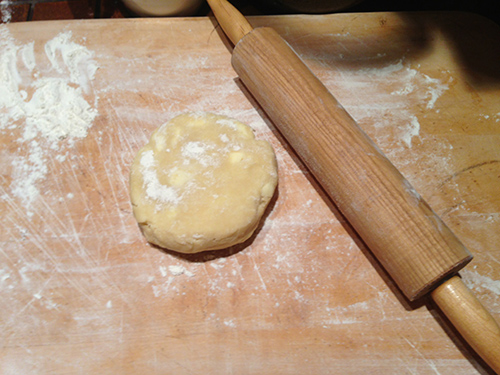
Make the dough. I use Debra Madison’s recipe from ‘Seasonal Fruit Desserts’. The recipe makes the lightest flakiest crust I’ve ever made.

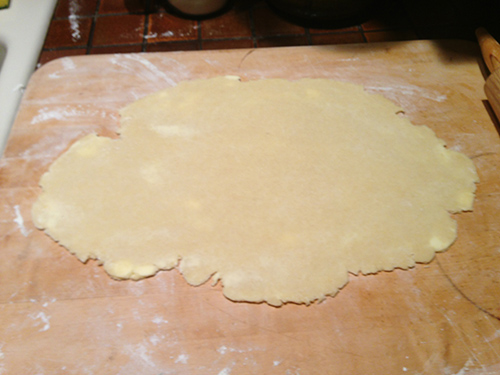
galette_roll dough on cutting board

After refrigerating it for about 30 minutes, I roll it out thin approximately round or oval. This is what I love about galettes – you don’t have to be perfect in its shape. Kinda like a farmhouse pie.

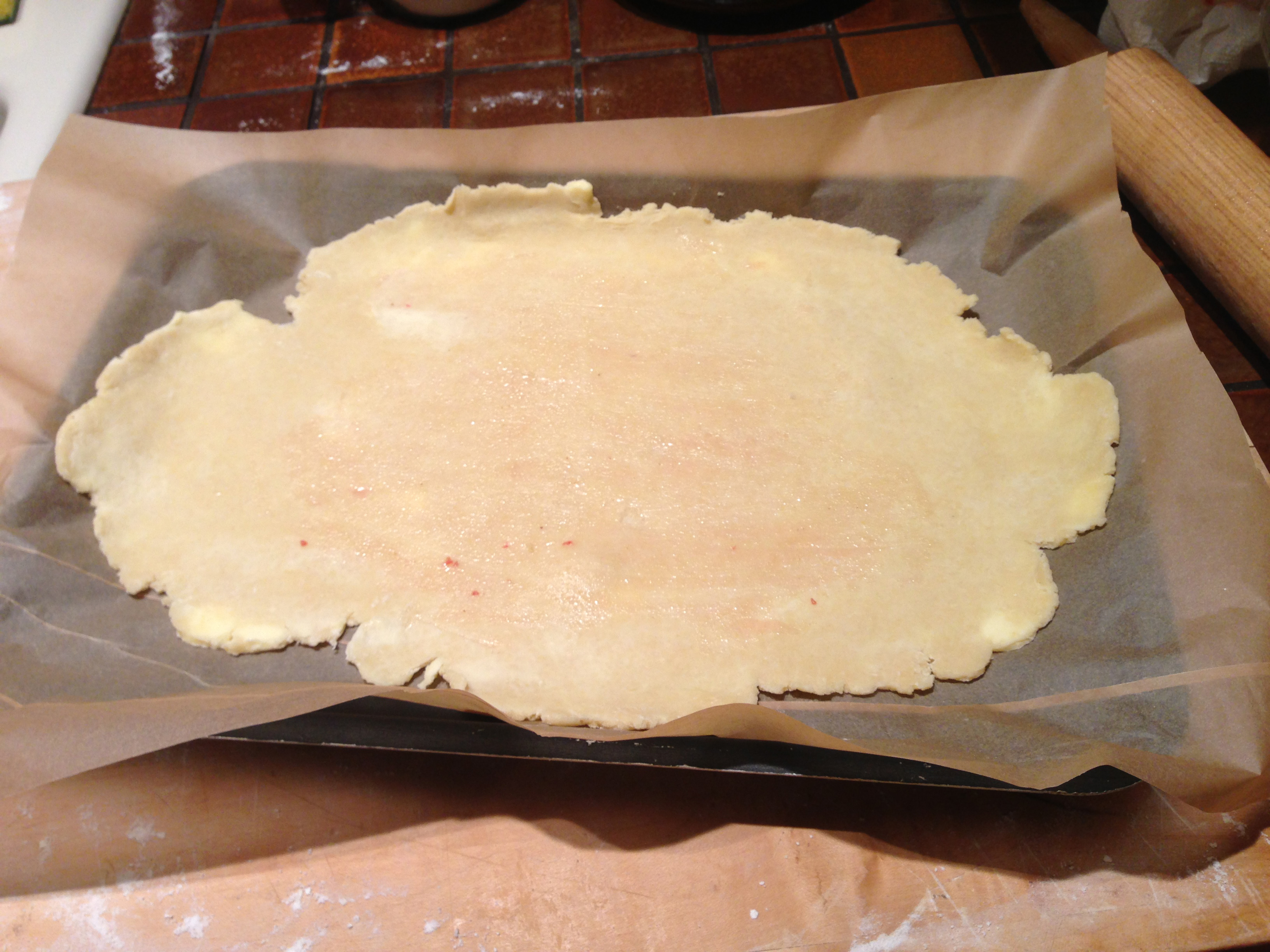
galette_picking it up

Now transfer the dough to a cookie sheet that has parchment paper on it (to keep from sticking)

galette_rolled out

Here it is ready for the filling.

galette_ready to cook

Put the rhubarb-raspberry mixture in the middle and fold up the sides. Sprinkle crust with a little sugar. Bake for about 50-55 minutes at 375°F. Check it often. If you see it starting to burn, cover it loosely with foil to keep crust from burning.

galette_final

I couldn’t even get a picture before it was half eaten!

Peredovik Black Oil Sunflower Seed – food for the birds!

peredovik-sunflower heads

Close up of Peredovik sunflower heads-after the flower petals fall exposing the seeds

peredovik-sunflower

Peredovik Black Oil Sunflower in bloom

Today I planted my Peredovik Black Oil Sunflower Seed from Russia. They are the black oil sunflower seeds that the birds love to eat and this is the variety that is in your bird seed mix that you buy in the store. They are particularly good because they are high in natural fat giving the birds energy. This makes them the best choice of sunflower for feeding birds although the birds love all varieties of sunflower seeds.

I got mine for 2016 from Southern Seed Exchange and can’t wait for them to come up. Just plant like any other sunflower seed mixed in your garden with other flowers. They have multiple heads on each stalk. They won’t be as tall as some of the giant sunflowers usually reaching 4-5 feet tall but it’s nice to know I’m helping the birds. After they flower, I leave the heads on and it’s fun to watch the birds eat them right off the plant in the fall. I leave them well into winter where the wild birds will continue to get the seeds out of the heads.

Cucumbers, corn and potatoes are in!

peppers and eggplants in

Why do I feel so far behind?!

Yesterday I finished putting in my seeds for cucumbers, potatoes (really late there)  and a new corn called ‘glass gem’ yesterday. Then I remind myself it just hailed last week and snowed the week before so perhaps I’m more on schedule than I think this year. All the crops will get row cover over them to protect them from birds eating the seedlings. Out of sight, out of mind.

Today I put in 8 pepper and 8 eggplant transplants and have 8 more of each to plant tomorrow plus squash seeds and Tarabais bean seeds to plant by the weekend.

Sounds easy but after I lightly turn the soil in the bed, add amendments in each hole, put the plant in, make a well around each plant to hold the water around the plant, connect a drip line and wrap it around each plant, put straw around each well and make cages to protect them and lastly put row cover over the cages which I secured using rocks so they won’t blow off. Phew—it all takes time. I get tired just thinking about it!

I am still germinating the gourds under the lights in the house which as soon as they come up and grow their first true leaves I will put out. Oh yea and the beets and carrots have to still go in. Sigh—so much to do! And did I mention I put in my one purple tomatillo plant? Blah. Blah. Blah.

Giant Pumpkins are in!

pumpkin hotels

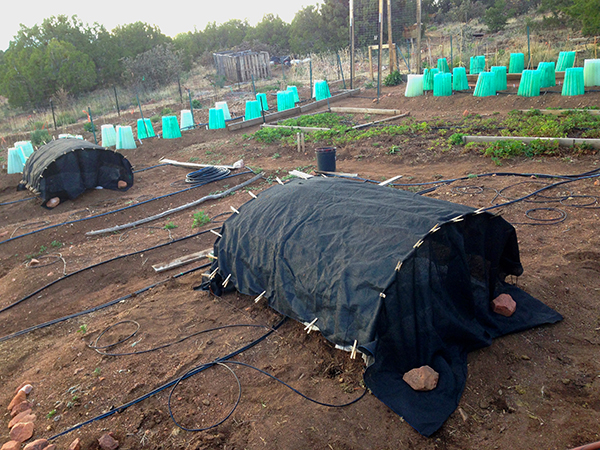
My giant pumpkins are in! Last week I managed to get them in the ground. They are being shaded from our intense heat and wind right now in these new low tunnels or ‘giant pumpkin hotels’ as I prefer to call them. This is the newest rendition of the low tunnels for them and I’ve had many designs. All I did is take one of my tomato cages which is made of concrete reinforcement wire and opened it up and put shade cloth over it (while they acclimate). I attached the shade cloth with clothes line pins and held the ends down with rocks. They are staked in the ground so the wind does not pull them up and inside each one is a pumpkin that is also covered with light weight row cover in case a squirrel comes in. As soon as they outgrow the ‘hotel’, I will take them off. They are about 5′ wide by 6′ long and if needed I can put row cover over the cage replacing the shade cloth for more light.

In the background is a strawberry patch I’m revamping but decided to wait before transplanting the ones growing out of their raised bed because they are June bearing strawberries so I want to harvest first. Then afterwards I will complete the move. Also shown are some of my tomatoes in their wall of waters. Some of them are now outgrowing the wall of waters so I am starting to take those off.

It is always amazing to me how desolate the garden looks when I first plant and how lush it will be later.  Nature’s miracle…oh ya and a LOT of HARD WORK!

Grasshoppers are here!

grasshopper:photo credit: ncsu.edu

Grasshopper: Photo credit: ncsu.edu

Whoa! The grasshoppers are here in the Santa Fe area now.  I read last month an article in the Albuquerque Journal (after Poki from Gaia Gardens warned me about them) about the ‘moving sidewalk’ of grasshoppers in west side Albuquerque. Sounds like they are there in Biblical proportions this year.

Looks like it’s going to be a bad year for us too. I’ve noticed more of them now – not so much in the garden but in the outer regions outside the garden (and on the pavement-go figure that one out). So yesterday I put out some ‘NOLO’ bait after noticing a few more of them around than usual (but not the ‘8 grasshoppers per square yard’ that were in the directions for use). It probably blew away with all this awful HOT wind that came in last night but I can always put out more. I checked this morning and the piles are still there on the outside of the garden.

5lb_NoLoBait_thNOLO bait are bran flakes that have been laced with nosema locustae, a  protozoan bacteria that kills the baby grasshoppers when they eat it. Then the adult grasshoppers eat the dead babies (horrible) and they get sick and die too. That’s what they get for being cannibalistic!  Bastards! Now the one downside of all of this is it takes some time for it to start working-about three weeks so get some soon and get started in controlling this out of control pest that can devour your garden. It must be noted this does NOT provide immediate elimination of  grasshoppers and is most effective when put out when the grasshoppers are little-about 3/4 of an inch long. This is a more long-term solution to them. It is organic and does not hurt the bees, birds, animals or us-only grasshoppers.

In the meantime I’m going to put row cover over everything until I see less of them.  You should call and see if the local nurseries still have some. You may have to go on the web to get some NOLO bait as I think they are almost sold out around here. Ah, the joys of gardening!

69 tomato plants in the ground! 5 more to go

IMG_3912

The tomatoes in their Wall of Waters to stay warm at night. Doesn’t look like much now but come July the tomatoes should look like a jungle.

What a whirlwind week. Elodie Holmes and Mernie Elsesser helped me plant 35 tomato plants on Monday and on Friday Janet Hiron helped me plant 24 more tomato plants for a total of 59 in the main garden. Great to have such good friends help with what would be an overwhelming task for one person! Thanks to all!

Sunday I planted 10 more in the greenhouse and still want to plant 5 more in the raised beds by the house but the bulk of the work is done with the tomatoes. There will be a total of 74 tomato plants this year for the Tomato Lady. We put wall of waters around each plant. Even though we are past freezes at night here in Santa Fe, tomatoes (and peppers) do not like the cold nights and 45°F is cold to them right now. They don’t like any temperature from 55°F and lower and it will be a while before we get above 55°F at night. The wall of waters act like little greenhouses keeping your tomatoes and peppers warm at night after absorbing all that sun in the daytime. By the time the tomatoes outgrow the wall of waters, the night temperatures will be warmer and we can take them off.

This week: Planting giant pumpkins and the start of the rest of the veggie garden