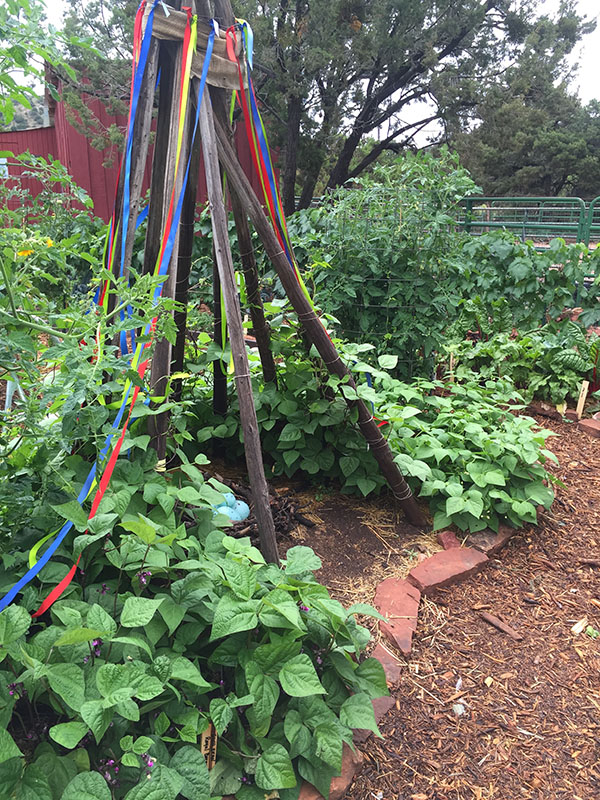
Why are my tomato plants dropping their blossoms?

When the temperature outside is 92°F or hotter, the tomatoes will drop their flowers (blossoms) and will not set any fruit. This is called Tomato Blossom Drop and is normal for a tomato to do. Basically they self-abort their blossoms. Why? Because they want to survive. They will continue to produce new blossoms and once the temperatures is BELOW 92°F, they will start to set fruit from the blossoms.

What can we do to prevent blossom drop? Nothing. We really are at the hands of mother nature. The funny thing is once they do pollinate (tomatoes are self-pollinating and wind-pollinated and don’t need pollinators) and they produce baby fruit, they do fine when it’s hot-it’s just while they are trying to set fruit that the temperature is critical. There is also a low temperature where they will drop the blossoms, but we don’t have to worry about that here.

Last year we had 3 months of intense heat with everyday being 92°F or warmer and the blossom just couldn’t set fruit. Finally when the monsoons came mid-August (which is one month later than normal), and it cooled down, they were able to set their fruit. Luckily for us we had a long fall and were able to harvest before we got a freeze. So don’t despair, they will set fruit from their blossoms when the time is right. Hopefully the monsoons will come in July. So for now, just surrender and chill out (if you can).

Row cover protects tomato plants and more

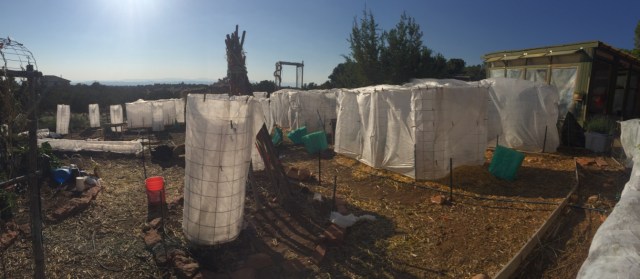
Here is what my garden looks like right now. Just about everything is covered with a material called row cover (also called Remay). My tomato cages are covered from top to bottom with it. This acts as a physical barrier to keep a bug called the beet leafhopper from biting them and transferring a disease called Curly Top Virus (CTV). I’ll take it off my tomatoes when the monsoons arrive.  The bug leaves when the monsoons come.

I also put row cover over my other veggie transplants while they adjust to the heat and wind when I transplant them into the garden. And I put it over other veggies that I plant by seeds like beans, cucumber and corn. I just plant the seeds in the ground and put a sheet of row cover over them tacking it down with rocks so the wind doesn’t blow it away-but don’t make it too tight.  Give the plants some room to grow under it. When the seeds germinate, row cover keeps the birds from eating the sprouts and I don’t have to replant seeds as often. Plus you can water right through it. Row cover comes in 3 weights. A heavy weight (1.0) for fall-winter, a mid-weight for summer (.5) and a light weight (.3) which does not work well here because of the winds-it rips easily. I use a mid-weight in the summer in my garden.

So basically I use row cover in the beginning of the growing season on almost everything. You can get it at most nurseries.  And you won’t have to keep it on all summer. Once your corn and beans grow up about 4 inches, and your transplants adjust to outdoor growing and the bugs leave, you can take it off and enjoy watching your garden grow. Another plus is it gives some protection against hail. Great stuff. I highly recommend it to be a more successful gardener.

Planting, planting planting!!

last year’s garden-2016. Looking forward to another great garden year in 2017.

I haven’t written in a while as the planting season has been upon us. Now that the danger of a freeze is basically over (never say never tho) I’ve been busy first weeding the vegetable garden and now planting the veggie garden. Most everything will be in by end of this week.
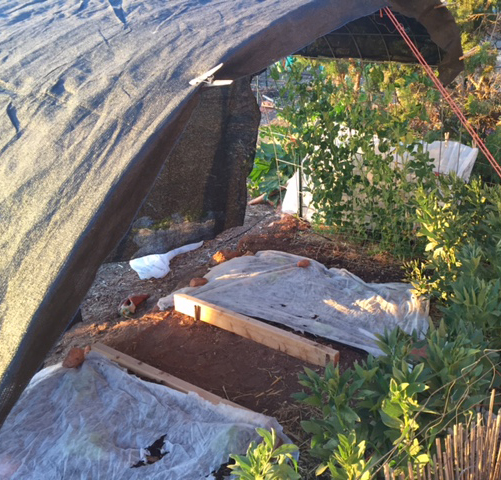
New shade garden-an arbor covered with shade cloth and new lettuce covered with row cover. Also peas in background and Fava beans on right in front

In addition to part of my garden being an Italian garden, I just finished up a new shade garden. I have a semi-shady area where a shed and juniper shade early in the day but I needed shade from the intense sun in the afternoons. I put shade cloth from Home Depot, over the top of an arbor to shade some late season cool crops still in the ground like peas and Fava beans. Also planted some heat tolerant lettuces under row cover yesterday.

TOMATOES: 54 were transplanted in on June 5th in wall of waters (WOWs). Many of them are now peeking out of the WOWs and they need to be taken off.  I put row cover around the cages and over the top (acts as a physical barrier) to keep the dreaded beet leafhopper from the plants.

LETTUCE: Last night I planted some heat tolerant lettuce and Violetta pak choi in the new shade garden.

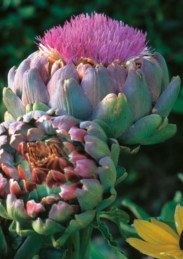
ARTICHOKE: More of an ornamental here but so beautiful.  Transplanted yesterday.

BEANS-Borlotti-Lamon: An Italian variety of a dry bean. Pre-started the seeds inside. Coming up now and will be ready to transplant this week. Pole variety.

BEANS: Emerite-pole variety of a French haricot bean. Pick when pencil thin.

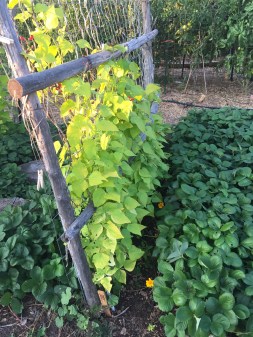
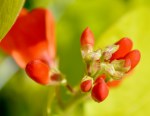
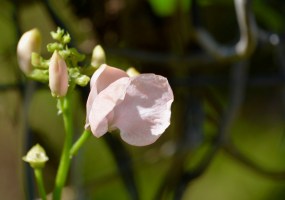
RUNNER BEANS-pole beans-Painted Lady and a Chartreuse leaf variety of Scarlet Runner. Beautiful flowers and you can eat the beans when young or save for dry bean recipes like soups.

PEPPERS: I wait to plant peppers till June 1 till it really warms up and we are now in the 50’s at nite so all peppers will go in this week under row cover. Varieties include: Shishito, Jimmy Nardello, Caribbean Seasoning, Poblano (for chile relleno), Pasilla (for mole sauce), Aji Amarillo Grande, and Baby Aji Amarilla both from Peru.

EGGPLANTS: ‘Fairy Tale’ variety. Will go in with peppers this week under row cover.

CHARD/KALE: Lacinato, Vates Curly varieties of kale and Argentata chard. I have baby plants to put in this week. Coulda, shoulda already be in the ground but not enough time.

FLOWERS: Many flowers by seed-Cosmos, Zinnias, Nasturtiums, Asylum, morning glories, different sunflowers. Calendula and Marigolds are transplants.

SUMMER SQUASH: Costata Romanesco zucchini, Bennings Green Tint patty pan. Seeds went in the ground last week. A few popping up under the row cover.

WINTER SQUASH: Butternut Rogosa Violina “Gioia”. Seeds in the ground today.

GIANT PUMPKIN: This time I put seeds in the ground instead of pre-growing them. Not up yet.

CORN: Glass Gem INDIAN CORN. Not in yet. Hopefully this week.

ONIONS/LEEKS-transplants going in this week. Very late going in-will see how they do.

BEETS-Chiogga variety. Seeds went in this week. Will get fall harvest from them.

CARROTS: Atomic Red and Cosmic Purple went in this week for fall harvest.

CUCUMBERS: Seeds going in this week around teepees to grow up. Varieties include: EATING:Poona Kheera. PICKLING: Parisian (cornichon), Boothsby Blonde (Bread n butters), and Russian Pickling (dill).

STILL TO COME THIS WEEK: I’m going to try a short season variety of Sweet potatoes called Beauregard (90 days t0 harvest). Getting slips of it in mail.


Tomatoes started!

Tomato seeds planted March 24. Germinated 4 days later. Picture taken April 2 at 9 days old.

It has begun!

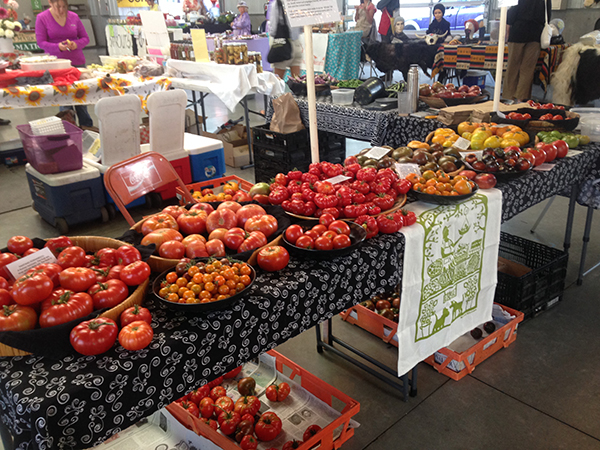
I’m going back to the Santa Fe Farmers Market this summer with my tomatoes! I have a lot of new unusual tomatoes started as well as my stable of wonderful favorites for the public.

Pictured above, the baby tomato seeds are inside the house under lights and keep warm on a germination heat mat set at 85°F. They will be transplanted this week into 2 inch pots and later this month they will be transplanted again into 4 inch pots and then finally transplanted outside in the garden in May. Plus I will take some of the plants to the Farmers Market at end of April/May to sell.

Italian Vegetable Garden

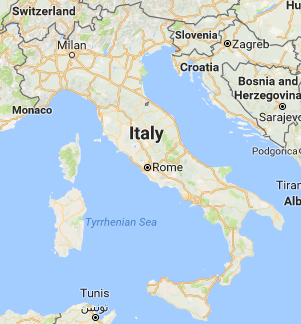
Always looking for something interesting to grow in my garden, I’ve decided to put in an Italian vegetable garden section inside my main vegetable garden. When I started looking at vegetables to grow, I noticed I already had a fair amount of vegetable seeds from Italy that I always grow but they were always interspersed with other veggies. Now they (and more Italian vegetables) will be grouped together to form this new section. It isn’t a permanent section, just something I’m putting together this year and it is just part of a larger array of vegetables I grow. It was fun selecting vegetables from Italy that I like and could group together. By doing this, it has opened me up to all kinds of new varieties to possibly grow. Here is my list:

2017 ITALIAN GARDEN

Cool Season Vegetables
Fava bean-Precoce Violetto
Onion-Red of Florence
Fennel-Mantovano
Rapini-Cima di rapa Quarantina Riccia di Sarno
Kale-Nero di Toscana
Radicchio-Rosa treviso sel Svelta
Beet-Chiogga
Chard-Argentata

Warm Season Vegetables
Bean-Borlotti Lamon
Butternut squash-Rogosa Violina “Gioia”
Zucchini-Costata Romanesco
Zucchini-Zuchetta Rugosa Friulana
Tomato-Costoluto Fiorentino
Tomato-Costoluto Romanesco
Tomato-Pantano Romanesco
Eggplant-Prosperosa
Sweet pepper-Jimmy Nardello

Vegetables for the Table-Tomato Lady 2017 favorites

Here are my favorite vegetables going into the 2017 growing season. I may not have room for all these in the gardening but these are my favorites as of right now

VEGETABLES FOR THE TABLE-TOMATO LADY’S FAVORITES

HEIRLOOM TOMATOES

SAUCE TOMATOES
Goldman’s Italian American-85D
San Marzano

DRYING TOMATOES
Principe Borghese
Any cherry tomato

CHERRY TOMATOES
Sungold*
Green Grape
Black Cherry
Pink Bumblebee
Purple Bumblebee
Artisan Blush Tiger

EARLY TOMATOES-52-65 days
Matina
Stupice
Sungold (cherry)*
Glacier
Siberian
Fireworks

MID-SEASON-65-78 days
Bella Rosa*-very firm even when ripe
Marmande
Pink Berkeley Tie Dye
Black and Brown Boar
Paul Robeson
Costoluto Genevese
Juane Flamme

LATE-SEASON-80 days +
Porkchop
Big Zac*
Pantano Romanesco
Purple Cherokee-purple tomato
Paul Robeson-dark tomato
Indigo Apple or Indigo Rose
Lucky Cross

*denotes hybrid tomato

BEANS
Rattlesnake-pole
Emerite-french filet-pole
Romano-Italian pole or bush
Tarbais-dry pole bean for French cassoulet

BEETS
Cylindra
Touchstone Gold
Detroit Red
Chiogga-beautiful red with white stripes inside

CARROTS
Cosmic Purple
Atomic Red
Scarlet Nantes-orange sweet
Chantenay Red-orange very sweet

CHARD
Ruby Red-gorgeous red/good flavor
Argentata-white stem-favorite in Italy-very cold hardy

CUCUMBERS
EATING
Poona Kheera-best tasting ever
Lemon cucumber-never bitter

PICKLING
Boothsby Blonde-Bread and Butter pickles
Parisian-Cornichon pickles
Russian Pickling-Dill pickles
Mini Whites-sweet pickles

EGGPLANT
Rosa Bianca-big eggplant for Eggplant Parmesan
Fairytale-small, sauté or BBQ

PEPPER
Jimmy Nardello-red thin skin pepper for sautéing-SWEET
Shishito-Japanese small green pepper-saute-serve for tapas-NOT HOT
Poblano-use for chile relleno/MILDLY HOT

SQUASH
Winter Squash
Sweet Meat
Butternut-will not attract squash bugs
Galeux D’ Eyesines

Summer Squash
Costata Romanesco-zucchini-Favorite of Deborah Madison also
Bennings Green Tint-patty pan


TOMATO GROWING 101 CLASS

Ok folks, the Tomato Lady (that’s me) has decided to teach a comprehensive course for all the tomato lovers who want to be successful at growing their own tomatoes here in the greater Santa Fe area. Interested? Read on.

TOMATO GROWING 101-Season Long Course

Do you want to learn how to grow great heirloom tomatoes organically from start to finish? Think of the money you can save by learning to grow your own heirloom tomatoes from seed. Plus you can try new varieties that are not sold in the nurseries.

These hands-on classes will emphasis learning how to grow tomatoes successfully throughout the whole season. Participants will learn how to grow tomatoes from their seeds, what starting mix to use, what soil to transplant in, how to handle the delicate seedlings when transplanting up, how to produce sturdy plants. Lighting systems will be discussed and your seedlings will stay under lights at my farm under my care until time to plant outside when you will take your plants home to plant outside in your garden.

All planting materials, seeds, soil, amendments and pots supplied while growing them at the farm. Class participants will get a workbook with printed material added at each class to help them be successful throughout the growing season. Students will get experience with actual planting to gain confidence and will come back to learn how to prune them, how to identify diseases and pests and how to control them.

Participants must sign up for all classes at once. Course payable at signup for a total of $150. Class size is limited-10 students max. This takes a commitment. No partial classes.

____________________________________________

To register for the class is an easy two-step process:

1. Fill out the CONTACT FORM below and hit the submit button. Then to pay:

2. TO PAY: click the PAY PAL button (below the contact form). You don’t need to have a paypal account.  They will process credit cards too.

Step 1: Fill out this CONTACT FORM:

Go back

Your message has been sent

Warning
Warning
Warning

Warning.

Step 2: TO PAY: Purchase all 7 classes for $150 here

Buy Now Button
____________________________________________

HERE IS A PDF OF THE SCHEDULE BELOW. PUT THIS SCHEDULE IN YOUR CALENDAR AND PRINT IT SO YOUR DON’T FORGET!

tomato-growing-101-class-schedule

____________________________________________

REVIEW CLASS SCHEDULE

Section 1
HANDS-ON LEARNING OF HOW TO START TOMATO SEEDS/CARING OF THE YOUNG SEEDLINGS AND TRANSPLANTING UP/PREPARING SOIL IN GARDEN

Class 1    
Wednesday, March 22nd—10am to 12 noon

Learn how and why to plant tomato seeds/how to pick your varieties, what soil medium to use, learn about germination troubles and how to avoid them/plant your seeds

Class 2
Wednesday, April 5th—10 am to 12 noon

Transplanting up to 2” pots/changing the type of soil, adding amendments for great growth and how to deal with transplant shock and learning how to maintain your plants.

Class 3
Wednesday, April 19th—10 am to 12 noon

Learn about transplanting up to the next stage of growth-up to 4” pots, how to transplant to get the best sturdiest stems, additional amendments you can use and how to maintain your plants.

Section 2
LEARN HOW TO TRANSPLANT THE TOMATO PLANTS OUTSIDE IN THE GARDEN /LEARNING ABOUT SOIL AMENDMENTS/TAKING YOUR PLANTS HOME

Class 4
Wednesday, May 10th—10 am to 12 noon

Participants will learn how to transplant their tomato plants out in the garden, how to prepare planting hole and what amendments to add when planting for better growth of tomatoes. Discussion and demo of how to use wall-of-waters and how to set them up properly. After learning how to do all this, students will take home their plants to be planted in their own gardens.

Section 3
THEY’RE IN THE GROUND, NOW WHAT?
THE NEXT STEPS FOR TOMATO GROWING SUCCESS

Class 5    
Wednesday, June 7th—10 am to 12 noon 

Participants will learn how and when to remove wall of waters, how to control leafhoppers, learn about tomato cages-what works and doesn’t work, saving water by mulching, using organic fertilizers, using row cover as protection.

Class 6    
Wednesday, July 12— 10 am to 12 noon

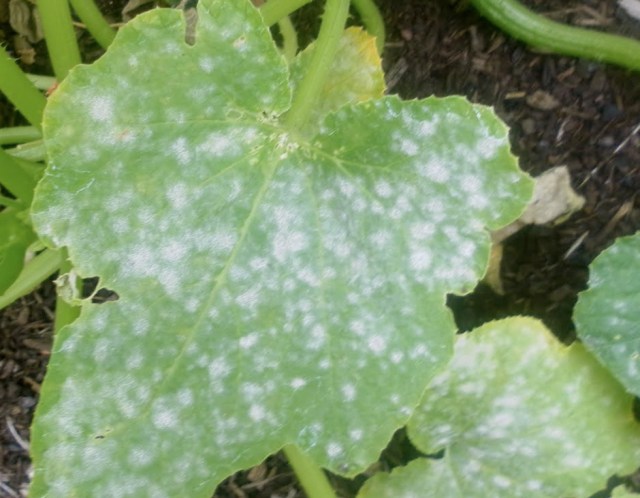
Trimming and pruning your tomato plants, the pros and cons of sucker control and how to remove them. Learn to make compost tea. Identifying beginning problems, which organic fungicides and insecticides to use as the season goes on if needed.

Section 4
MAINTAINING YOUR PLANTS-PRUNING TECHNIQUES, IDENTIFYING AND CONTROLLING DISEASES AND PESTS AND HARVESTING

Class 7
Wednesday, August 9th—10 am to 12 noon

Participants will learn how to maintain their plants, pruning techniques,      harvest techniques, identify tomato diseases and pests and how to control them organically.

Cool season crops have begun

transplants-2-weeks-old

When I was looking through what I plant each year, I realized I actually grow many varieties of cools season crops (like greens/lettuce). I started some seeds of cool season crops inside under lights but no heat on Jan 17!  I never put the heat mats on for cool season crop seeds, only for warm season crops and it is way too early for them just yet.

I started:
Asian greens: bok choy, pak choy, Wasabi arugula

Lettuces: 4 Season Lettuce butterhead, Yugoslavian Red butterhead, and Santoro butterhead lettuce. Can you tell I like butterheads?!

Leeks: Solaise, King Richard and American Flag

Onions: Candy (it is an intermediate or neutral variety) which is they type of onion we have to grow here.

Spinach: Carmel-Just planted the seeds today. Still have some spinach plants that have overwinter nicely outside in a raised bed with only winter weight row cover on it. By planting a crop of spinach last fall, I’m hoping I get a bumper crop of spinach in March! The variety of spinach I like the most is called Carmel which overwinter last year and looks to do the same this year. You can get seeds from Johnny’s or plants from Agua Fria Nursery.

4-season-lettuce

four season lettuce is looking good

Today I transplanted up lettuces and Asian greens to pony pots from seed trays. The plants are looking good but need to grow more before I put them out in my green house or cold frame. You can plant outside in sunny raised beds in March but all-greenhouse, cold frames or just plain old beds will need winter weight row cover on the little starts to protect them from our cold nights.  I’m hoping to put them out by beginning of March. The varieties I grow at this time of year are very cold hardy. I’m trying to get a head start as our cool season crop season is pretty short here before it gets too hot and everything bolts. And there is nothing better than spring spinach or lettuce!

More daylight hours/plants start to grow again

Growing Spinach and Lettuce in a Cold Frame

The Persephone period is over. Elliot Coleman in his Winter Harvest Handbook, coined this name. When daylight hours are less than 10 hours per day, the plants that are in the ground slow down or stop growing altogether during this time. This means that the spinach or mache you planted last fall had slowed down and by Thanksgiving stopped growing. The Persephone period can be longer or shorter depending on what latitude you live in. For us in Santa Fe, it is from Thanksgiving to Jan 14th.  In states that are further north, they are still in the Persephone period. As the daylight hours continue to get longer and longer, you should notice the plants starting to grow again. I grew ‘Carmel’ spinach last fall in one of my beds up by my house and it is still alive, covered with winter weight row cover. I did this the year before and it survived and gave me beautiful spinach by March that I was able to harvest 4 times before it became too warm. If you didn’t grow anything to overwinter, you can now start spinach, Asian greens like ‘Tatsoi‘ and ‘Baby Bok Choy’, mache and some very cold hardy lettuces like ‘Winter Wunder’ and ‘Marshall Red Romaine’ once the soil warms to 40•F+. If you keep them covered with winter weight row cover to protect them from our cold nights, you will be able harvest them in early spring barring any devastating deep freezes. If you can’t wait and want to speed up the process, start the seeds under lights inside now and transplant them next month in February. To find other extra cold hardy crops to grow, go here.

NEW! ‘Veggie Gardening 101’ radio show starts Jan 14

I’ll be on the Santa Fe Master Gardener’s Gardening Journal radio show with host Christine Salem twice a month now. My original show gives tips and advice about what to do in a vegetable garden each month as the gardening season progresses. This assumes you have an existing vegetable garden.

We are adding a Vegetable Gardening 101 show. It seems we have many people here in Santa Fe that either have never started a garden or haven’t had success here in our challenging garden area. Many want to be successful organically growing their own food and need help on where to start. So I will take us from the beginning through planning and building a garden, creating good soil, raised beds vs in-ground beds, starting seeds, transplanting plants, varieties that grow well for beginners and even harvesting tips. This will be more basic info but even advanced gardeners might benefit from some of the tips I’ll be giving.

Go here to listen to past radio show podcasts and pick up awesome information -https://giantveggiegardener.com/radio-show/

Here’s the rundown:

SHOW #1—my regular radio show-‘Monthly Veggie Garden Tips’

Where:  airs on KSFR 101.1 on the Garden Journal

When: on the last Saturday of each month

Time: from 10:00-10:30am

Topics: What to do in our gardens for each month, problems that arise and solutions

SHOW #2—my NEW radio show-‘Veggie Gardening 101′

Where: airs on KSFR 101.1 on the Garden Journal

When: on the 2nd Saturday of each month

Time: from 10:00-10:30am

Topics: Beginning vegetable gardening from start to finish and everywhere in between.

Garden Journal

journalIt might be good at the end of the year to review what happened in your garden and/or hopefully you took some notes last season. You can refer back to it instead of relying on your memory on what worked and didn’t work for future years. If you don’t like writing it down than use your computer. I still keep a notebook on when I start seeds, put them in ground, etc but I’m using the computer and my phone more and more these days for my garden notes. I like to go around throughout the season and especially at the end of the season before everything is torn out and make notes on my phone while things are still fresh, then I go back and enter them in on my computer where the pieces of the puzzle fall in place and are sometimes are very revealing as to what happened that year.

So this coming season if you haven’t been keeping a journal, write down important things like did you amend your soil, when you first planted seeds, when the first frost-free day actually occurred and did a late freeze sneak in, when you transplanted seedlings outside, did you protect them,  how hot was the weather and for how long, how cold were the nights, how much rain did we get and did it do any damage (hail), which pests and disease were particularly bad, which plants did well, were they prolific, how long you could harvest certain crops, how long was the season and when the first frost got us.

Sounds like a lot of work? Not really. It’s just recording your OBSERVATIONS through the season and by doing it, you will become a better gardener. It helped me realize a few years back that one variety of tomato got Early Blight for 3 years in a row while the other tomato plants did not (it seemed susceptible to EB- I don’t grow that variety anymore) and that this past season, I could have started my seeds indoors much earlier than I did.

Make a seed box

seed-box2

I have my saved seeds everywhere. I had them in cardboard boxes which have seen better days. Some got wet, some got chewed by mice where I keep them in a shed. I needed to get better organized and wanted better protection from the elements and mice so I found some boxes with lids with clasps.

seed-box1

After that, I got some cardboard dividers for the different varieties of vegetable seeds. I had to trim them down to fit in the box and I had to fold over some of the seed packages so they would fit inside. I also made some labels for each box like Cold Season varieties, Warm Season varieties and many other categories. So far I have 6 boxes done. Nice project for winter.

2016 Garden Review

bean-pole-and-beets

2016 GARDEN REVIEW

Here is what happened in my garden in 2016. Wow-what a weird but interesting year mother nature threw at us.  It looks like over and over again I could have planted earlier in hind site.

PLANTING SEEDS INSIDE INFO-for those of you who want to plant your own seeds

BATCH 64_MOONSHINEI use a seed starting soil called Metro mix 300 from Agua Fria Nursery. I plant seeds in very small seed flats (see here). I transplanted up 2 times using a soil mix called Moonshine, also available at  Agua Fria Nursery. Growth was unbelievable with this stuff. I grew my best tomato transplants ever this past year. All warm crop seeds were planted and brought inside and placed on heat mats and under lights as it is too cold to keep them in an unheated greenhouse. All cool season crops were brought inside and under lights but no heat mat, they germinate at a lower temperature.

APRIL
Normal spring weather pattern. Cold one day and warm the next. Windy.

Tomato seeds were planted on April 15 which is late BUT it worked because I used the soil mix Moonshine when transplanting up to a 4 pak from the seed flats (see post above). Moonshine makes everything grow faster.  I think I should have planted the seeds on March 25.

Eggplant and pepper seeds were planted on April 15th with the rest of the tomato seeds and they should have been planted 10 weeks before putting them outside in the ground.  So that means I should have planted them on March 15 to plant them outside by June 1. I’ll remember that this year!

Basil, kale and chard seeds were planted in early April. Did well but I should have started the seeds in March. Transplanted 2x before being planted outside in early May.

MAY
May was warmer than usual. No late frosts. Windy as usual.

-Potatoes were planted May 3. Could have planted them sooner.

Tomatoes were transplanted to 2″ pots on May 6.

Tomato plants were transplanted outside in wall of waters by May 24. This was late but they caught up as the soil was warmer.

– The soil was too cold for any other warm season crops to be direct seeded.

low-tunnel-2016-Kale, chard and onions were transplanted outside in early May. Probably should have put them outside in late April as they can handle cold nights with row cover over them. Need to remember that! Transplanted all different types of basil outside in late May under shade cloth.

Beets and carrots were direct seeded in early May. Germination of Detroit Red beet was good but poor for Craupadine beets. Will plant Craupadine seeds inside next year to hopefully get better germination. My two best beets grown so far have been Detroit Red and Cylindra. I only planted Atomic red carrots this year-good germination. Soil temp can be from 50°-80°F for good germination of these crops.

JUNE
June was a hot month averaging 94 degrees with little rain and lots of winds.

Pepper and eggplant were transplanted  in garden with row cover protecting them from June 1-4 when the soil was warmer, not May 15. I have experienced them going into shock if planted earlier when the soil is still cold.

-Leeks and basil plants were transplanted with shade cloth over them in early June. They both loved the semi-shade and the basils didn’t flower so fast in the heat-huge harvest of them this year. My three favorite basils were Genovese (or Italian) Thai and Lime Basil (had to grow this one from seed). I grew Lemon basil as well but I have enough lemon scented herbs with lemon verbena and lemon thyme, so I will pass on that one next year.

wow-pic-for-blog-The wall of waters came off the tomatoes in early June and the plants had their drip lines put around the plants, straw was placed around their wells to help retain water, tomato cage put on and immediately put row cover over all the rows of tomatoes to keep the leafhopper from biting them and giving them a disease called Curly top Virus.

Eggplant/pepper plants were transplanted outside by June 9th with row cover over them. They loved the warm days throughout the season this year.

sluggo-plus-Warm season crops like beans and cucumbers were direct seeded outside in June. I had a big problem with rolly pollys eating the seedlings as soon as they sprouted. Planted seeds for both crops 3x and only when I used Sluggo Plus did the problem go away and it’s organic too. But the cucumbers didn’t have enough time to grow to fruit and I never got good pollination due to the hot days in June, July and August. No pickles this year. Wah!

-Instead of a green pole bean, this year, I tried a new pole bean called Marvel of Venice and I didn’t like it at all. They were suppose to be yellow but by the time they turned yellow, they were tough and not much flavor. Will not plant them again.

JULY
July was stinking hot averaging 94 degrees with no monsoons. The heat affected the plants adversely. We never get this hot day in and day out in July.

-I was expecting the monsoons to come by the second week in July and they did not. July was very hot averaging 94 degrees and blossom drop was extensive on tomato, cucumber, squash and bean plants—so very little fruit set. I didn’t take off the row covers on the tomato plants because the leaf hopper bug which likes dry, hot windy conditions and (transmits Curly Top Virus -CTV) was still present. I thought OMG, am I going to have to keep the row cover on all season? Luckily August weather changed.

Summer squash got a wilt this year and it wasn’t from the squash vine borer as they were covered with row cover. They died before getting any fruit. Can you imagine, I had to ask people for summer squash this year!

rogosa-violina-butternut1

Butternut Rugosa Violina

Waltham Butternut and Butternut Rugosa were my winter squash this year. Both did well. I heard they don’t get squash bugs and for me it was true, I didn’t have any squash bugs on them which was great. Good varieties to grow if squash bugs are your nemesis. I will grow them again.

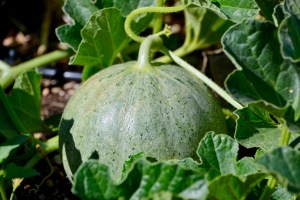
-My giant pumpkins once again couldn’t set blossoms in late June-early July when they should and didn’t set any fruit until August because of the heat and by then it was too late to get big-my biggest was the size of a basketball! Once again foiled. Will try next year again!

AUGUST
The monsoons finally came in August but not a lot. Still, it cooled down things.

Tomato blossoms finally set but we lost 2 months of growing time. Took off the row covers once it cooled down. Unfortunately, when the monsoons came, the nights got cold- in the low 50’s which slows down the growth of tomatoes but at least I had tomatoes! By mid August I had 2 boxes of tomatoes which wasn’t enough to warrant going to the Farmers Market. Normally I have 6+ boxes mid August increasing to 10-12 boxes by the end of August. Not so this year.

-The peppers and eggplants however, loved the heat and were very prolific this season.

-Kale and onions did very well, they don’t mind the heat or the cold!

thumb_img_9273_1024

chard leafminer damage

Chard got leaf miners and I battled them all summer but still harvested a lot.

Turned off drip lines to Giant pumpkins, summer squash in August as they didn’t do well.

-Weeds, oh yea, weeds-they were prolific once the rain did come and I didn’t get on them right away so the battle was on but since I decided I wasn’t going to market and wasn’t on any tours this year, I decided to not be so diligent about weeds and picked them at a more leisurely pace to just enjoy the garden. Plus I went on more flyfishing trips this past summer!

SEPTEMBER
Weather much cooler with some rain. Cold nighttime temperatures slowed growth of tomatoes

-This month the tomatoes continue to grow but more slowly and harvest continues. Only lost 2 plants out of 40 plants to CTV disease this year. Because of little rain, fungal disease was at an all time low which usually hits the tomatoes in Aug-Sept.

-Planted my gorgeous garlic. Varieties were Chenok Red, Music and German White + some Stanley garlic from the SF Farmers Market. Hope they do well next summer at harvest time. Usually I plant garlic in October but I taught a garlic class in Sept and put them in then.

-Beets and Carrots-did well and started harvesting in Sept.

-I didn’t use any organic fungicides or insecticides this year as pressure was lite.

OCTOBER
Wonderful warm fall-best ever which gave the veggies a chance to produce more fruit to harvest

-Harvesting of chard, beets, carrots, potatoes, peppers and tomatoes were good.

-Potato size during harvest this month were smaller. I think I should have watered them more. Will try a bigger variety next year. i tried them in Potato bags and directly in the soil. No difference.

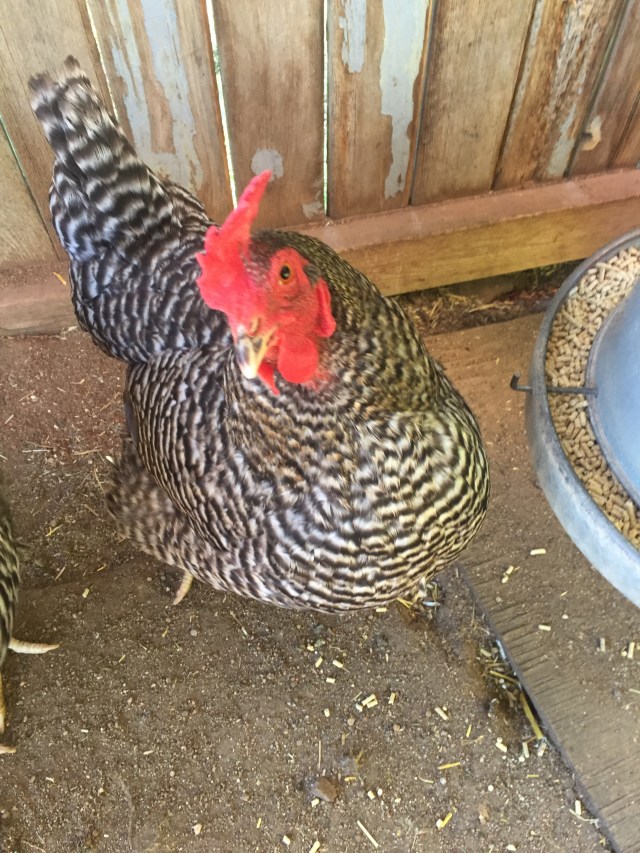
Kale got aphids worse-sprayed them with water and still harvested a lot. The really bad ones with aphids I gave to the chickens-they loved it!

NOVEMBER
Unbelievabley no hard freeze until Nov 9th! I haven’t seen it this warm in November-normally we get a hard freeze in October but not this year!

-Harvested everything left in the garden by end of November-chard, kale, carrots, beets, tomatoes, leeks, winter squash.

DECEMBER
Pretty normal December weather but not much precipitation.

-Cleaned out garden but didn’t have time to add compost to beds. Will add it next spring.

______________________________

FRUIT
This year was pretty good for fruit. By far the most prolific fruit this year were apples.

Strawberries- did ok but I’d like to amend the beds this year for better production.

Rhubarb did well until I lost one to a fungal disease called red leaf disease. I still have one left which is actually enough.

Apricots-Since we didn’t get a late frost this year, we had a little apricot crop (very little) but hey, it’s been 7 years since I’ve had ANY apricots. Got about 8 jars of apricot jam from them. I just enjoy the tree as a shade tree mostly.

Grapes-My Himrod grapes did great this year. Loved them.

Raspberries-This was the first season for them (they were planted last fall) so production was low.

Blackberries-Just planted in the spring. They got established and hopefully I will get some next year. Looking forward to it.

Apple trees-They were very prolific in the fall as we didn’t get a late frost this year. Dried many apples and this year made hard apple cider.

Plum trees and peach trees did not do well and I will replace them next year (they are old) with better varieties of peach and pear trees that will do well here. Will get them from Tooleys Trees in the spring.


Happy Holidays!

wreath1Today I woke up to a white Christmas. It’s been quite a few years since I’ve seen snow on Christmas day. Not a lot,  but a few inches is great! What a great time to make a fire, curl up with some book you’ve been meaning to read or dig in to your new seed catalogs arriving daily and dream of your future garden you’ll be planting this spring. I love doing research either with books or on the internet during the winter months when I actually have time to absorb some of it. I think my brain started out the size of a melon and has now shrunk to probably the size of an orange if retaining info is the guide! So I better enjoy this cold weather because soon enough the growing season will be upon us.


Seed Catalogs/2017

catalogs-2017

My top two seed catalog picks

Even though it’s not 2017 yet, many of you are now getting your seed catalogs in for 2017 season. I just updated for 2017 my favorite seed and garden catalogs. I have many favorites besides the two above. Here they are:

GOOD SEED LIST:

THESE SEED CATALOGS/COMPANIES ARE GREAT. THEY DO NOT BUY ANY SEEDS FROM SEMINIS, A SUBSIDIARY OF MONSANTO AND ARE MY FAVORITES.

Seed Saver Exchange—As a SSE member I want to support this non-profit organization who is dedicated to CONSERVING and promoting heirloom varieties of veggies, flowers, fruits and herbs. It’s catalog is wonderful with many varieties of seeds that are hard to find or have been kept in families for generations. http://www.seedsavers.org

Baker Creek Heirloom Seeds—It features beautiful pictures of many varieties of heirloom vegetables, flowers and fruits, some of which are very unusual and rare. It gives wonderful descriptions and history of where each variety originated. Check them out. www.rareseeds.com

Southern Exposure Seed Exchange– recommended by Baker Heirlooms as another good source for heirlooms. Has many hard to find vegetable seeds. http://www.southernexposure.com/

Wild Boar Farmsspecialize in fantastic OP varieties of tomatoes. wildboarfarms.com
No catalog-go online to order.

Baia Nicchia Farm—specialize in more fantastic OP varieties of tomatoes. Created the Artisan Seed Series of tomatoes in Johnny’s Seeds catalog. Support their company for certain select seeds not available anywhere else and go to Johnny’s for the rest of their Artisan tomato seeds. Support their breeding work by buying directly from them. https://store.growartisan.com/
No catalog-go online to order.

Secret Seed Cartel—specialize in unique, unusual or rare seeds of peppers and tomatoes from Europesecretseedcartel.com
No catalog-go online to order.

Wild Garden Seeds—My new go to catalog for wonderful greens and lettuce www.wildgardenseed.com/ (I use to think they sold in bulk only,  but they sell smaller quantities as well. The packet price listed on top of catalog pages)

John Scheepers Kitchen Garden Seeds—Sells many wonderful hard to find heirloom seeds like Argentata chard and French gray shallots. http://www.kitchengardenseeds.com/

Kitazawa Seed CompanyOldest seed company in America specializing in Asian vegetable seeds. http://www.kitazawaseed.com/

Irish Eyes Garden SeedsGet your different types of potatoes here. http://irisheyesgardenseeds.com/

Native Seed/SEARCHfabulous seeds by native people in the southwest. www.nativeseeds.org/

Hudson Valley SeedThe Hudson Valley Seed Library is an amazing source for heirloom and open-pollinated garden seeds and beautiful garden-themed contemporary art. http://hudsonvalleyseed.com/

Peaceful Valley (Grow Organic)—I get all my row cover and most of my growing supplies from here.www.groworganic.com

Johnny’s Selected Seeds—provides hybrid, heirloom and OP seeds, tools, information, and service. A general all-purpose catalog packed with more than just seeds. www.johnnyseeds.com

There are many other good seed companies that do not buy their seed stock from Seminis.  To see more good seed companies that may be among your favorites, go here. If your favorite seed company is not listed, call them if you are interested.