2020 tomato review-the ‘darlings’ of the veggie garden

2020 Tomato Review

As the Tomato Lady of Santa Fe, this year was a great tomato year in the garden especially compared to last year’s tomatoes which were dismal. This year I started with 38 plants, lost 2 right away to curly top virus and lost several more to a soil fungal disease but overall the disease level was very low due to it being such a dry year.  I think I had good production because I started them super early this year-May 6, which is the earliest I’ve ever put them in the ground and I gave them the water they needed.

Here are the tomato varieties I grew this year. If you haven’t even heard of some of these, I encourage you to try some new varieties for yourself-keeps it interesting!  Some of you may have had a great year with some of these varieties, so use your own experience when selecting which varieties to grow. All varieties are heirlooms or open pollinated unless otherwise noted.

Moby Dwarf cherry tomato trial project-This is a wonderful larger yellow cherry tomato. Wonderfully intense flavor. I was involved 2 years ago growing this out for Craig Lehouiller, author of Epic Tomatoes. I found some of the plants I grew had a anthocyanin blush (purple blush) on its shoulders so I’m continuing to see if we can get this trait to stabilize for future generations. The plant is only 4 feet tall, very prolific and would be great in large pots as well in the ground as I do. You can get the original seeds now online at Victory Seeds. A must try.  63 days to harvest. YES will grow this next year.

Black Cherry-I only grew one plant but boy was it prolific! This is one of my favorites that I grow every year. No disease. Very dependable. Purplish color. Great intense full bodied flavor like a good wine. 64 days to harvest. YES will grow this next year.

Virginia Sweets-A yellow tomato with red blush inside that is sweet, sweet, sweet. This year they did well although in some years not as good. But I always come back to them because when they do well, they are great! 80 days to harvest. YES will grow this next year.

Lucky Cross-One of my all-time favorites. This year the mice seem to really like them so I didn’t get as many as I would have liked. Great sweet flavor. Yellowish peachy color with marbled red interior. Wish I had more plants since I was sharing with the mice! 74 days to harvest. YES will grow this next year.

Ananas Noire-One of my favorites. Don’t be put off by the colors-green with a red blush but the flavor is sweet like nectar. Takes all season to get them but worth the wait. 85 days to harvest. YES will grow this next year.

Large Barred Boar-NEW THIS YEAR! A wonderful tomato from Wild Boar Farms that is slighter larger than Black and Brown Boar which it came from and is a mid-season ripener. It is a med-large mahogany color with green stripes tomato. Great flavor and only 65 days to harvest. YES will grow this next year.

Black and Brown Boar-I’ve always loved this oval shaped tomato from Wild Boar Farms because it has super flavor and is a good producer. Mahogany with green stripes. 68 days to harvest. YES will grow this next year.

Cherokee Lemon-NEW THIS YEAR! This is a new Cherokee variety for me. Its color is a pure yellow with yellow flesh inside and has good sweetness. It was not very prolific though, so I will see if it makes it into next year’s roster but I usually give a new tomato two years to try. 75 days to harvest. MAYBE will grow this next year.

Cherokee Purple-I come back to this tomato every year. A great producer with outstanding flavor.  Purple with green shoulders. 75 days to harvest. YES will grow this next year.

Cherokee Green-A green tomato that turns a yellowish-green that is green throughout with suburb sweet flavor but was not as prolific as last year. 75 days to harvest. MAYBE will grow this next year.

Cherokee Carbon-I adore this hybrid. A cross between a Cherokee Purple and Carbon. Great flavor like Cherokee Purple but bigger and less cracks. Purple with green shoulders/ Great producer too. 75 days to harvest. YES will grow this next year.

Pink Berkley Tie Dye-Usually this is a good producer with great flavor but this year it was a disappointment for me as it did not produce many tomatoes. 65 days to harvest. NO will NOT grow this next year.

Captain Lucky-NEW THIS YEAR! I liked this mostly green with red blush tomato. All around good flavor. 75 days to harvest. YES will grow this next year.

Goliath-One of a few hybrids that I grow every year. Great old fashioned tomato flavor and it rarely gets cracks or blemishes. A good producer. 65 days to harvest. YES will grow this next year.

Pantano Romanesco-This year I was disappointed in this tomato when normally I like it. Good old fashion flavor but not very prolific. 75 days to harvest. NO will NOT grow this next year.

Mushroom Basket-NEW THIS YEAR! I’m kinda so-so about this one. Great big shape with many flutes but ripened unevenly for many of them. Also not a good producer. 75 days to harvest. NO will NOT grow this next year.

Paul Robeson-Another of my all time favorites-this ‘black tomato’ has a rich flavor that wins many tomato contests every year. 75 days to harvest. YES will grow this next year.

BKX-NEW THIS YEAR! An improved version of the Black Krim tomato that did not produce very well. For me the original Black Krim is never a good producer and this one is about the same. If I’m going to grow a tomato it has to be a good producer. 80 days to harvest. NO will NOT grow this next year.

Purple Calabash-NEW THIS YEAR! This is an heirloom from Thomas Jefferson’s garden so I was excite to try it. Sorry to say, I wasn’t impressed. They were small fluted purplish tomatoes with lots of catfacing flaws on bottom. Nice flavor though. 75 days to harvest. NO will NOT grow this next year.

Big Zac-Another good hybrid that can grow some colossal sized red tomatoes with old fashioned tomato flavor. One slice will fill a BLT sandwich. 80 days to harvest. YES will grow this next year.

Goldman’s Italian American-the only paste tomato I grow. It has the best flavor of any paste tomato I’ve ever tried. Makes wonderful pasta sauces. 85 days to harvest. YES will grow this next year.


New pepper this year-Lava Red pepper

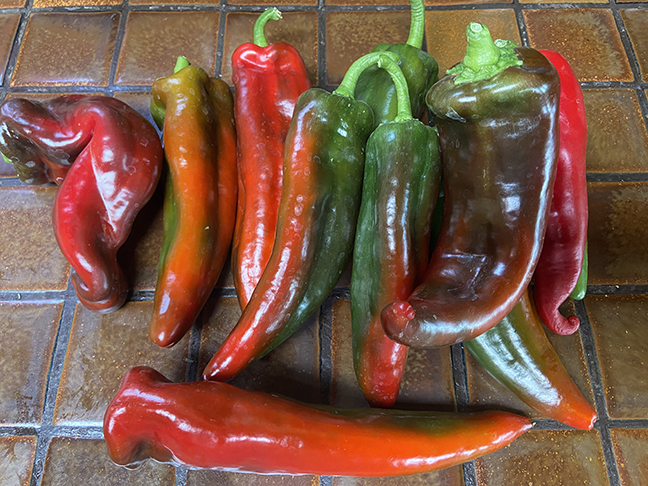
Corno di Toro peppers-Lava Red peppers

I use to start my Jimmy Nardello and Shishito sweet peppers inside under lights the first week of March but since they take so long to germinate and grow out to tranplanting size, I started buying them from Agua Fria Nursery in the past few years. When the nursery ran out of these sweet peppers last spring, I was bummed. Not only because they didn’t have those varieties but also because it takes peppers 8-10 weeks to grow from seed to transplanting size which is why one needs to start them super early or buy in a nursery. I thought I had run out of time.

Lava Red peppers

My best friend, Lava, from Germany had saved some sweet red pepper seeds that her son gave her from a farmers market in Germany. She described them as long red, sweet, thick walled peppers but didn’t know the name. I had the seeds for a few years but didn’t try them since I was hooked on the ‘Jimmys’. In my desperation, I decided to try to grow them out late.  I grew four of them from her seeds and to my surprise, they are a type of Corno di Toro (horn of the bull or bull’s horn pepper). We don’t actually know which variety of the Corno di Toro peppers they are and there are several. I named this one Lava Red pepper after her. Corno di Toro peppers are named after their shape and are a type of Italian frying peppers that are sweet green or red but if you let them turn red, they are a little bit sweeter.

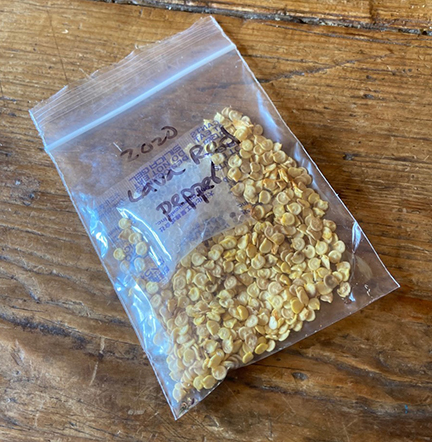
Now at Harry’s Roadhouse here in Santa Fe, I remembered (seems so long ago) they serve some kind of sweet grilled peppers strips in their house salad which I love. So I decided to grill the Lava Red peppers as I now call them and take off the skins like what we do for our hot green chilies here in New Mexico. But before I grilled them, I saved some seeds to freshen up my supply of seeds for future use.

Notice I put one of those dessicant packets (from my vitamin bottles) in with the seeds to make sure they are completely dry. Then I will remove it later.


Normally they would be grilled on the BBQ till the skins are black and then cooled in cold water and the skins slide off from the peppers, leaving the sweet pepper meat. This steps takes a little more work but the flavor of the skinless peppers is superb and well worth the effort.


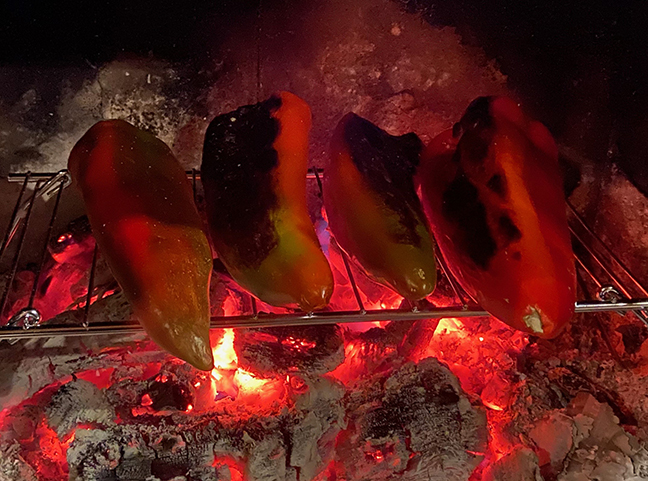
Using a small grill in my fireplace to roast the peppers

The night I wanted to grill them was way too cold outside (in the 20’s) to be standing by the BBQ so I decided to grill them in my fireplace in my house while I watched the World Series. I made a fire of cedar wood and put a small portable grill over the hot coals.


Then I sat there and grilled my peppers over the cedar wood coals. The smell is fantastic and the flavor of the peppers is sweet and the cedar coals added a subtle smoky nuance to them.


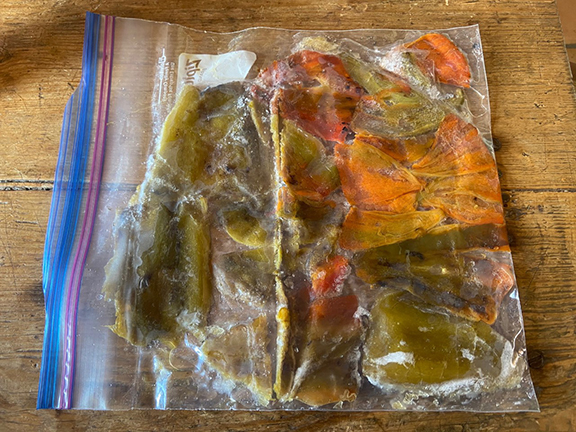
After the skins are off, I put them on wax paper in layers an freeze them and take them out as needed.

I use them in scrambled eggs, on my salads, in sandwiches and I’m sure there will be many other ways to use them. I got 5 lbs of grilled peppers!

They are now one of my favorites. I like the thick walls and sweet flavor. Isn’t it funny, I was forced to try something new and it turned out fantastic! So try some Corno di Toro peppers next year, you won’t be disappointed! You can also eat this pepper raw as well!

October Veggie Garden Update


Here’s the latest update in my garden as of Sunday October 18th. The season is winding down fast now, and so am I. The pics above are what we harvested today.

Some warm season crops like cucumbers, summer squash, green beans, dry beans, butternut winter squash and corn are finished. Today’s harvest of the warm season crops like tomatoes and peppers were picked, including some green tomatoes which I will ripen indoors. I got a couple of butternut squash and cucumbers too. I turned off the drip systems to all of them today.

The perennial fruit crops-strawberries, grapes, rhubarb and blackberries are also done. But the raspberries, which are a fall crop are still giving up some berries but are slowing way down now too. I will leave the drip systems on the perennials till it freezes.

Other cool season crops in the garden are still shining, loving the cooler weather we have right now. These include cabbage, chard, another winter squash (sweetmeat) and kale are still in the main garden and ready to harvest. I’ve been harvesting the kale, cabbage and chard for a long time.

I am harvesting broccoli heads, warm season lettuces and radishes that I planted as succession crops in August in my garlic bed which has been vacant since July. I figured I would have enough time to harvest them before I plant a new garlic crop back in it. The garlic heads are coming this week and I will plant them by the end of October in that bed once the other veggies are harvested.

But the season doesn’t end yet. I currently have some cool season crops that I started inside under lights like lettuces, spinach, arugula and Pak Choi. They will go into my cold frame and greenhouse this week but not in the main garden. I’ve actually been waiting till both the greenhouse and cold frame are cool enough in the day to put them in so they don’t bolt and this week with the daytime temperatures in the 70’s and the nighttime temperatures in the 40s is now perfect to put them out. They should last till December using row cover when the temperatures drop to freezing at night to extend their lives. It will be nice to get greens and lettuce from the garden in November. My last hurrah!


Tomato forest vignette

Here is a ‘tomato forest’ vignette of my tomatoes this season. They are doing fantastic. I have a few problems but overall, this may be the best year ever. They are starting to color up now and serious harvest is around the corner.

First cucumbers into pickles

I had enough cucumbers from the garden to make the first pickles of the season. Many more to come I hope!

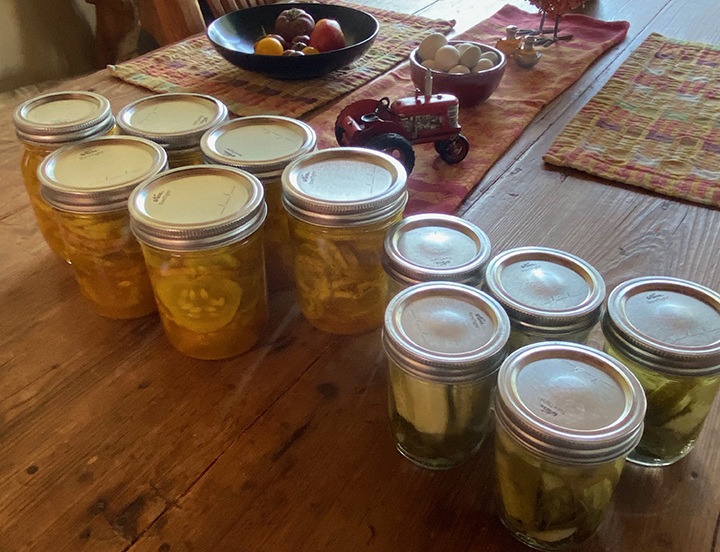
On the left is Boothsby Blonde which will become bread and butter pickles. It is a whitish-yellow cucumber that really is beautiful when you add the turmeric in the recipe. The cucumbers on the right are Parisian which will become Cornichons, a tiny tart pickle famous in France. Here they are both soaking in salt water.


Left is finished bread and butter pickles which were done using a waterbath method. On the right are the cornichins which I do as a refrigerator pickle to keep their crispness.

Giant Beet!

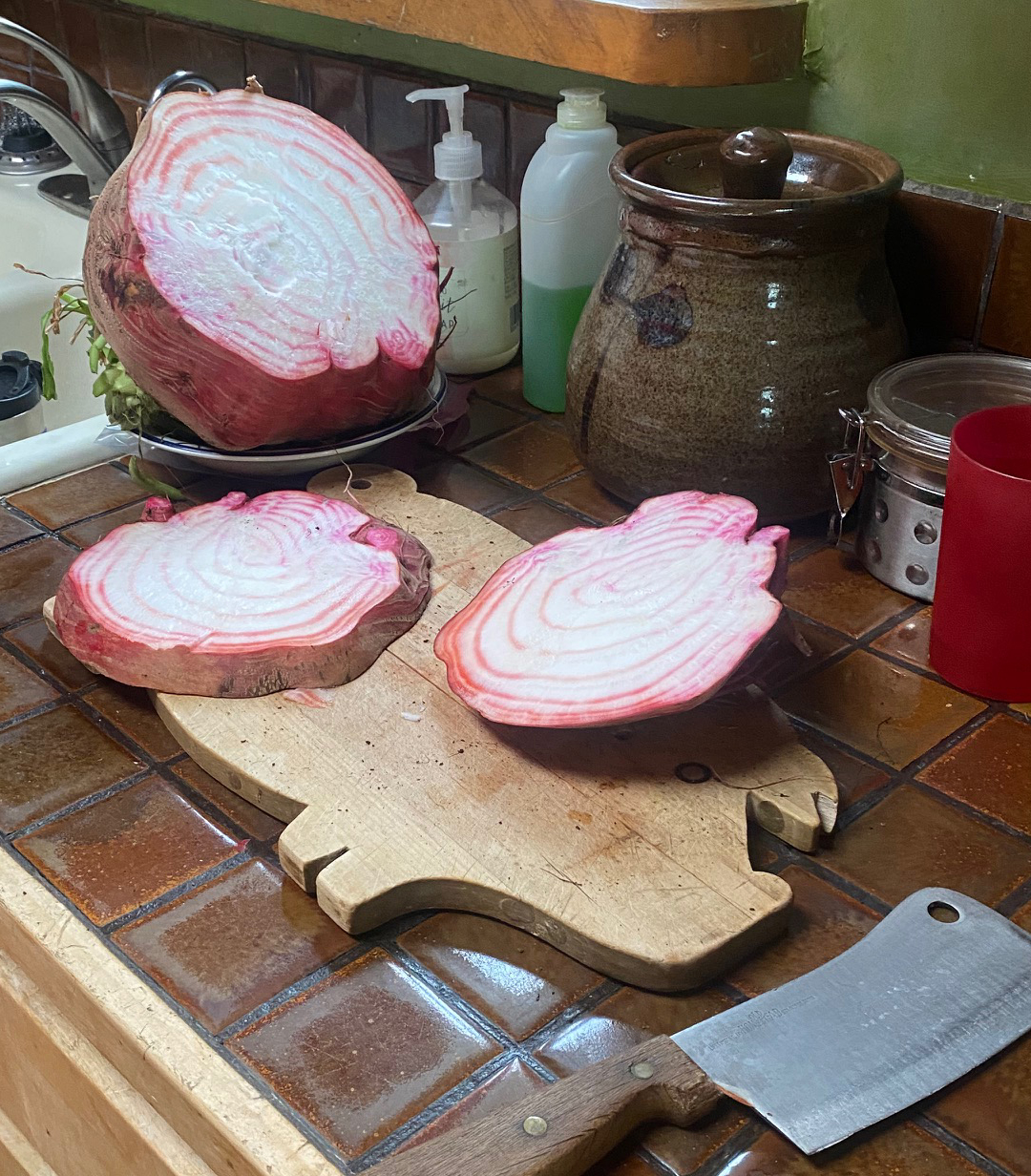
Lookee what I found under a bunch of leaves! A Chioggia beet that weighed 9.6 lbs! I bet if there had been a State Fair this year, it would have taken 1st place for biggest beet! Notice the beet tops look like my hair!


Here you see me opening it up.


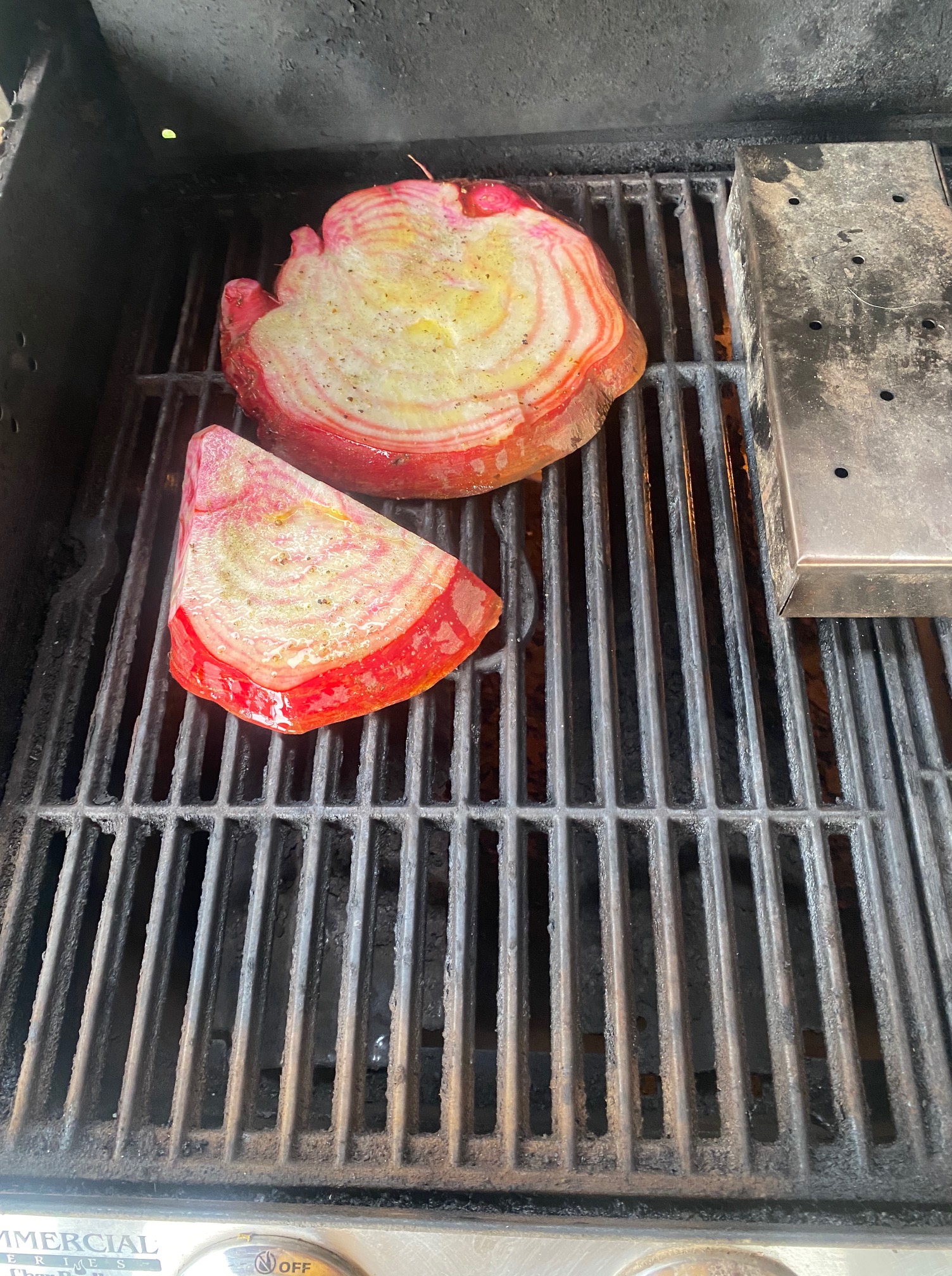
and then I sliced it into ‘beet steaks’.


We grilled them on the BBQ!  I thought it would have been woody and tough but it was not. I was going to drizzle balsamic vinegar on them but they didn’t need it. It was so delicious and sweet and soft. Of course I would never grow them this big on purpose but rather grow them much smaller. I was just glad it turned out well.


July 18-Unveiling the girls!

I’m a little behind in my posting. Here we are unveiling the girls on July 18th which is very exciting for me as I can finally see them without the row cover on them.

I remove the row cover after the beet leafhopper leaves. I think four of the tomato row covers blew off and then the tomato plant got bit by a leafhopper which gave them curly top virus (CTV), a fatal virus. I will pull those plants once I make sure they do have CTV. It is a vector disease which means it’s is passed from insect to a plant and is not contagious between plants. The leafhopper disappears after the monsoons come.

Squash Bug Recipe

Here’s a recipe to try in your garden to discourage squash bugs from NM Farmer’s Market Association. Let us know in the comment section if it works for you.

Mix together and spray on leaves:

  • 1 gallon water
  • 1/4 cup molasses
  • 1/4 cup neem oil
  • 1 teaspoon dish soap

Tomato growing-Beet Leafhoppers and Curly Top Virus (CTV)

I have written about this problem a few times on this site and it might be worth a visit to one of my previous posts if you are interested in learning about CTV:

Identifiying Tomato Curley Top Virus

In addition there is more info on this problem through New Mexico State University (NMSU) here.

The reason I put row cover over my plants is to have a physical protection to keep the Beet Leafhopper off of them. I remove the row covers when the monsoons come in July as they seem to either leave or become suppressed and then I usually don’t have any problems with leafhoppers and CTV. No insecticides seem to work. If it seems that I harp on this problem, I do! I just want you all to be successful with tomato growing here.

First tomatoes!

First tomatoes in 2020-Black Cherry Tomatoes (shown) and Egg Yolk tomatoes (sorry I ate them!)

Well I got my first few cherry tomatoes harvested. I planted all 36 tomato plants really early on May 3rd-snuck them in with such a warm spring. I peeked inside my Egg Yolk cherry tomato plant underneath the row cover (yes it’s still on but hopefully coming off soon) and my Black Cherry tomato plant. I got 2 Egg Yolk tomatoes and 5 Black Cherry tomatoes. Mind you, not a lot but it’s a start! The flavor was divine and now I remember why I wait to eat tomatoes after the season is over. Haven’t had a tomato since last October–well worth the wait!

Lots of blossoms on all the other tomato plants but we will get some blossom drop on some of them with this heat. No matter, they will produce more blossoms that will set fruit again. I’ll see how many have set fruit after I remove the row covers. Speaking of row covers…

Looking more promising regarding the monsoons. Starting this Thursday the temps will drop back in the 80s and thunderstorms are predicted from Thursday on from 20-40%. Hang in there, I am almost ready to remove the row covers-but waiting for the monsoon pattern to really set up to get rid of the leafhopper. Maybe next week. You’ll be the first to know!

I killed my potatoes…

I’m sorry to say I killed my potato crop this year. I started with some fingerling potatoes seeds (and I have grown them in previous years with no problem). I planted them in a trough that was 12 inches deep and covered them with 3 inches of soil. Then I put my drip system on top of them. They grew nicely and after about 6 inches tall, I buried them with more soil. So far so good. Then when they got another 6 inches taller, I buried them again. Still no problems-they grew up through the dirt. Each time I moved the drip line up with them so it was always on the top not buried underneath.

I guess that was my problem as I left on a flyfishing trip and when I came home they never grew up through the soil-they just disappeared. I’m sure they died because of lack of water down by the roots. In hindsight, I figured maybe I should of left the drip system buried where the water would have reached the roots-I think it was too far away from the roots. This heat hasn’t helped either.

So that’s it, I killed the potatoes. If anyone has any advice, I’m open to it. Just leave your advice in the comments.

PS: I’ve decided I’m going to use that bed for fall crops-beets and carrots.

Heat wave here!

So I am very frustrated that the weather apps and weather people are saying we are going to be hot, hot, HOT for about the next 10 days here in Santa Fe and NM which means the monsoons are not quite here yet even though the clouds are building and a few drops are falling.

What does this mean for us veggie growers who are waiting for the temps to cool down and the monsoons to come? Two problems:

ONE: leafhopper is still here (won’t leave till the mosoons comes) so keep the tomatoes covered. I know it is torture at this point but you’ve waited this long so stick with it.

TWO: tomato plants get blossom drop when the temps are 92°F and hotter. So if your plant has already set some blossoms into fruit, they will be fine BUT if there are new blossoms during this time period, they will probably drop off. When the temperatures cool below 92°, they will produce blossoms and self-pollinate and set new tomatoes and the cycle starts again.

Hang tight-Patience will reward you!

Tomato Plants-when to take row cover off

Many of you are asking when can you take your row covers off your tomato plants. NOT YET-be patient

Leave row covers on tomatoes for now-I know we are all anxious to take them off. I leave mine on till the monsoons come and they are NOT here yet—occasional rain is not considered the monsoons and will not drive the leafhopper away. The leafhopper likes dry, hot, windy conditions (which we have now) so I’m sure it’s still around. The leafhopper kills tomato plants by biting your plant, giving it Curly Top Virus (CTV) which is fatal to your tomato plants. The row covers are a physical barrier so the bug can’t get to your plant. So for now, (sigh) I will leave them on even though I’m dying to remove them like you. Historically, the monsoons come somewhere around the 2nd week of July but it could come later too. Hopefully we won’t have to wait much longer.

I will post as soon as I take mine off so you all know…

Warm season lettuce-Batavian or Summercrisp lettuces

I like salads, especially in the summer but most lettuces bolted here in my garden in the summer. Last year I grew some lettuces that grew well in the summer. Most lettuces are cool season crops that bolt with the heat but Batavian (also known as Summercrisp) lettuces did surprisingly well here. I grew them in partial shade and not in the direct sun. Not only was I happy they did not bolt and nor get bitter, but they have a crisp sweet taste to them and lasted all summer. There are many more Batavian lettuces online but these are what I tried. Many of these warm season lettuces are on multiple seed company sites but below is where I got the seeds.I just started these lettuce seeds on July 1 in pony packs to transplant later.

Here are some varieties I grew:

Cardinale-recently saved from extinction. A wine red Batavian crisp-leaf, especially suited to cutting for salad mix because of its juicy crunch, heft, shelf life and well-proportioned leaves. Forms open rosettes for easy picking until full maturity, then folds itself into a beautiful red crisphead. seeds: wildgardenseed


Manoa-A special mini head from University of Hawaii, grown widely in the Islands for its resistance to heat and tip-burn. ‘Manoa’ is actually a tropical-stress selected version of the century-old ‘Green Mignonette,’ itself recognized as a standout heat resistant lettuce. Medium deep green, semi-savoyed leaves form small, compact plants that may be baby cut with an open head, or allowed to mature into a blanched round heart. seeds: wildgardenseed


Anuenue-Another A sweet green header from Hawaii. ‘Anuenue’ (rainbow) works as a thick green cut-leaf for salad, or as an easy, heat tolerant, non-bitter, full-heading lettuce. Undemanding, mellow heads, bred for sun, heat, and humidity. seeds: wildgardenseeds


Jester-Crisp as ice, glossy, juicy as an apple, perfectly proportioned for a plate or a sandwich, flashy red speckles on semi-savoyed leaves with crazy-crisped margins like a Jester’s attire. Slow bolting in any season, this crispleaf type can be harvested at the open head stage, or later as a semi-tight pink-hearted blanched head. seeds: wildgardenseeds


Merlot Batavian-It is an open-headed, Batavian-type with upright, waxy, savoyed leaves. Merlot is perfect for baby leaf cut and come again harvesting or for growth to crisp, full-sized, burgundy heads. Its  juicy flavor and crisp texture will light up the most discriminating of palettes. seeds: John Scheepers


Nevada-Excellent summer variety forms large, open heads of thick, vibrant green leaves. Glossy and beautifully ruffled leaves with a satisfying combination of crunchy texture and buttery smoothness. Summer crisp characteristics. seeds: highmowingseeds


Skyphos-Most adaptable butterhead. Beautiful, large, dark red heads with nicely contrasting green centers. Excellent flavor and texture. seeds: johnnyseeds


Muir-Muir is an extremely heat tolerant variety and was the slowest to bolt in our summer trials. Technically a Batavian type, the light green, extra-wavy leaves form dense heads at a small size and can be harvested as a mini or left to bulk up into large, heavy, full-size heads. The leaves are crisp and have excellent flavor. seeds: johnnyseeds


Magenta-A red Summer Crisp with good flavor. Shiny, slightly puckered, red-tinged leaves form a whorled, conical head with a crispy green heart. Ideal for spring and summer plantings. Tolerant to bolting, tipburn, and bottom rot. seeds: johnnyseeds

Garlic scapes!

Garlic scapes are the curly stem of a garlic

The garlic that I planted last October is now producing scapes. What are scapes? First you need to know that there are two types of garlic-hardneck or softneck. Softneck varieties are the kind that are sold in the grocery stores because it has a longer shelf life than hardneck varieties. Softneck varieties can be braided. But hardneck varieties are suppose to be more flavorful. Hardneck garlic varieties tend to do best in colder climates as they are winter hardy.

So let’s talk about what are scapes. Hardneck garlic varieties produce a tender flower and stalk called a scape which is long, dark green and curly. Removing the scape makes the garlic concentrate it’s energy into producing bigger heads. Cut the scape off where it starts on the garlic. Garlic scapes are harvested in the late spring and the bulbs are harvested later in mid-summer (if you planted garlic in the fall).

garlic-scapes-courtesy of Chatelaine

Garlic scapes taste like a blend of scallions and garlic although less fiery than garlic bulbs. Keep garlic scapes in the crisper—they can last up to two weeks when fresh. You can also chop them up like scallions and freeze them in plastic bags, which will preserve them for much longer. They’re great in stir fry. They can be diced and used in any way you might use scallions.