Native Bee class

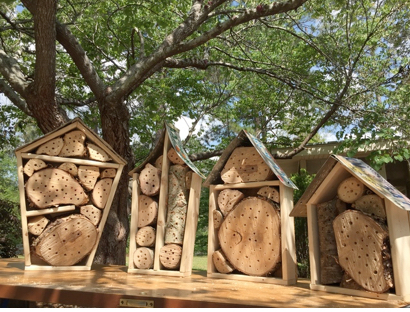
Here is a class that I’m going to bee at this coming Sunday and I can’t wait! We have more native bees than honeybees and need to encourage them to visit our gardens. I own one of these native bees houses and they really do attract them. Hope some of you can make it. There are still some spaces left for attendees. It’s sponsored through homegrownnmexico.org

_______________________________________
Sunday, July 7th
12 noon to 2 pm

Get the Buzz on Native Bees!
Do you like melons, pumpkins, and squash? Well, you should thank the native bees! Honeybees might get the most attention, but native bees really are the major pollinators of food crops. Did you know that there are more than 500 species of native bees just in New Mexico alone? Do you know the differences between the native bee and the honeybee?

Come to the Native Bee class July 7 and learn all about these often overlooked pollinators. Bob Zimmerman, retired biology teacher, will show you how to provide a bee friendly yard for native bees and how to make a native bee house to encourage them to hang around your garden!

Instructors: Bob Zimmerman
Location: Santa Fe Area Home Builders Association building
2520-B Camino Entrada (next to Habitat ReStore on south side of building) • Santa Fe
Fee: $5 for members/$10 for non-member

Please sign up through Eventbrite below:

Eventbrite - Native Bee Houses

STRAWBERRIES-a bumper crop this year!

My strawberries are going nuts this year. This is the biggest crop I’ve ever had in 25 years! I think we’ve harvested about 6 GALLONS of them so far and still more to go. I think it’s because of all the moisture we had this winter and spring AND the Azomite mineral supplement I gave them last year. I’ve taken them to parties, given them to friends who froze some, and I’m am going to make some galettes and strawberry-balsamic jam with some of them and trading Bob’s cherries for some as well (I hope-are you listening Bob?)

Garlic!

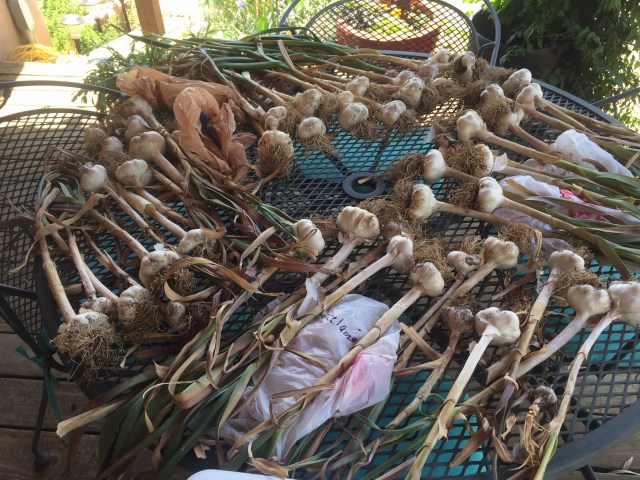
Well, we harvested garlic this last Wednesday at the Master Gardening Vegetable Demo Garden. We had planted 4 varieties last fall, I believe in October.

It is now ‘curing’ on my outside table in the shade of our portal where it is protected from the rain (what rain?) or should I say, potential rain.

Curing is the process of drying out the outer papery layers on the garlic bulb and takes around 3 weeks. If it rains (lol) I will cover it with a tarp so it doesn’t get wet as that would ruin the garlic. Never get garlic wet. It needs to be in a dry, airy, shady location while it is curing.

Curing and then storing garlic allows you to extend your summer harvest of garlic well into winter… and my favorite thing about garlic is that it still stays fresh long after it’s been cured. When you harvest, don’t clean the dirt off the heads. You can do that later but never with water-just brush the dirt off the heads.

Also soft- necked garlic can be braided while the leaves are still soft, (if you like) and the heads are drying out. Hard neck cannot be braided as the stem (think neck) is too stiff. When it is done curing, I will cut off the stems about an inch above the heads and store in a cool dark place in the pantry.

As to my own garlic, it isn’t quite ready to harvest yet. How do I know? It needs to have about half the leaves die back before digging it out to harvest and I’m about 2 weeks away. I love the smell of garlic and can hardly wait to harvest my own!


Major project/Weed control

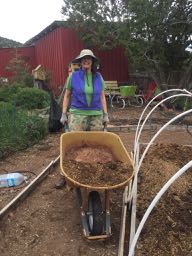
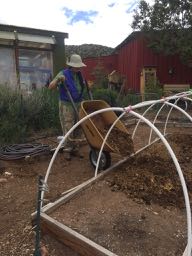
Last year’s major project in my garden was framing with wood my raised beds which was great as the beds don’t wash away when it rains now. This year, with all the weeds on steroids, I decided to do something about it. I’m sick of constantly weeding my paths around my raised beds. It takes the fun out of gardening. It is part of gardening that I hate especially in a bad year. Inside the beds are good with no weeds but the paths were horrible. Janine the WWOOFer actually weeded all the paths around the raised beds. So after the paths were weeded and cleaned up, I got landscape cloth (a 20 year guarantee heavy type) and cut to fit and put it all on the paths in 2 of my 3 sections. Each section is 1000 square feet. The last section will be done as well starting today. Then I put 3-4 inches wood chips that I had Spotted Owl here in Santa Fe deliver on top of the fabric. I know some people say the cloth doesn’t work but I had it down in my giant pumpkin patch some years ago for many years and it worked great. Any weeds that come from seeds dropped in the wood chips never get thru the fabric from the top and are easily pulled and nothing grows underneath in the darkness. So I’m hoping this greatly reduces my weeding. A lot of work to save a lot of work in weeding.

Janine the WWOOFer

Jannine (me-left) and Janine the WWOOFer (right)

Boy the universe was looking after me a few weeks ago. I was co-teaching a drip irrigation class  on May 5th and one of the attendees came up to me and introduce herself. Her name is Janine (same as mine only 2 n’s-Janine not 3 n’s like mine-Jannine). Anyway she explained she was a WWOOFer. For more info on what a WWOOFer is go here. She came up to my mini-farm and was going to help weed for a few days and ended up staying 2.5 weeks! What a blessing as during that period, I hurt my good knee and was barely getting around.

She not only weeded but also put all the compost in each bed, turned it over and planted flowers and vegetables and my tomatoes, and did a lot of drip lines as well. Oh, and she would get up and feed my barn critters as well every morning. We hit it off really well and she was a joy to have around here. A new gardening buddy.

But now like all good gypsies, she has left New Mexico for greener pastures up in Colorado and off to new adventures. I always said I needed a clone, and I found her. Hopefully someday she will show up again! Thanks Janine for all you did while here!


Tomatoes planted on May 24-latest ever for me

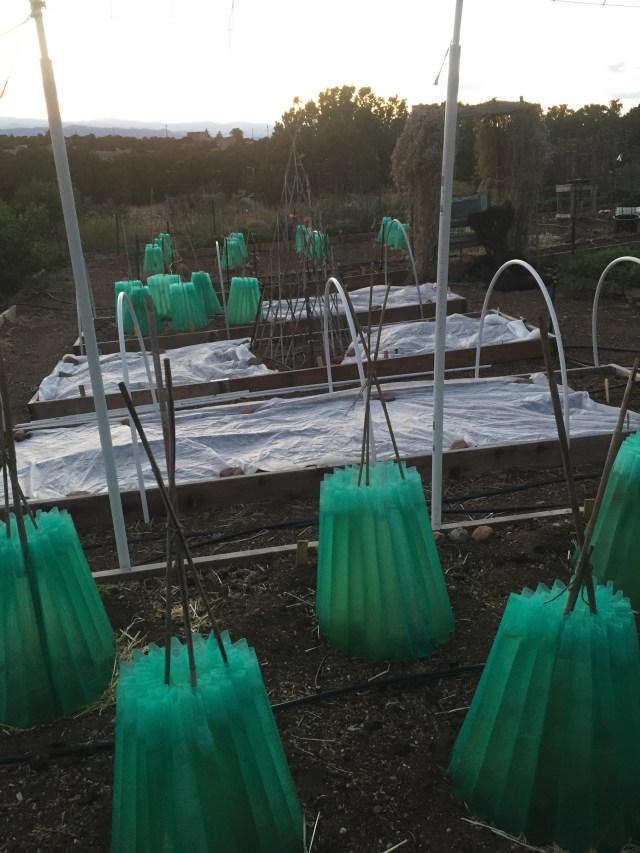
Well now it is June 6 but want to catch up with what’s going on in the garden. All 31 of my tomato plants were planted in Wall of Waters on Friday, May 24. I had a wonderful crew-Bob, Tom and Janine (yes another Jannine!) and me. I hurt my good knee and was hobbling around so I am grateful for their help. Many thanks!

We got it done so quickly that we also planted some Italian beans by seeds, transplanted pepper plants (in wall of waters too), and transplanted some cabbage. With so much cold we’ve been having, I was happy to get them in when I could on a beautiful, warm, non-windy day. The beets and onions were planted 2 weeks before and are doing well. They could handle the cold.

Since that time I have been busy trying to get the last of the veggie garden in. More dry beans, winter squash, summer squash and cucumber seeds are now in the ground and I’m awaiting their germination. Yesterday I planted sweet potato slips. I have still have carrots and flowers to plant. Almost there!

The weather is now in the high 70s to 80 degrees- in the day and in the mid 50’s at night. Amazing how it goes from winter (last week it was snowing) to summer weather in just a few days.


Snow/freezing temperatures on May 20th, 2019

Tomato plants waiting to be planted outside

Here it is May 21st and I’m now glad I waited to put my tomatoes in. I have wanted to get them in the ground since early May, but it was not to be. Last year was much warmer and I got my tomatoes in by May 6th. What a difference a year can make. Last night, it got down to 32°F and snowed. Not enough to stick on the ground but we are past the magic date of May 15th which is suppose to be the first frost FREE date here in zone 6b according to USDA. We’ve had a different spring here in Santa Fe with colder temperatures and lots more precipitation throughout winter and spring than last year.

So my babies are waiting to go into the ground in wall of waters till this Friday when it looks like this cold snap will be over. Wait. Wait. Wait. It will be in the 70s in the day and 40s at night for the next week and hopefully last nite will be the last of the freezing weather. And even though we will hopefully be past any more freezes, it still gets plenty cold for a tomato plant at night. They hate the cold. A good way to ensure they won’t get stressed or die if we get more cold weather again is by planting them in wall of waters. Here is a post on Wall of Waters 101. Meanwhile I wait—ahh crumba!

apricots this year? first time in 12 years!I hope my apricots will be ok. I’ve got a treeful of them right now and haven’t had an apricot harvest in 12 years! I will keep my fingers crossed that this freeze didn’t kill them. Ahh mother nature, whata ya going do?!

Bella Rosa-2009-2019

My favorite goatie, Bella Rosa, has passed on to be with her other goatie friends. She was an African Dwarf Goat. We woke up and she could not stand and later she died in the stall. There was no drama and she passed peacefully. Ten years is old for a goat. We noticed her slowing down the last few weeks but she even ate some grain and fresh grass on her last day. I think her body just gave out.


She was very friendly and even let us dress her once a bee costume for Halloween one year. It was a child’s costume but the belt to hold on the costume was too small so I had a friend make a Velcro extension to go around her Buddha belly. Too cute!

We miss you Bella Rosa! The barn is not the same without you. For such a small creature, you leave a big hole in our hearts.

Tomato plants transplanted into pots

This past Friday, April 19, all the baby tomato seedlings were transplanted from the germination trays into 2.25 pots where they will stay until we plant them outside. There are 155 total tomato plants.

My main helper, Linda Archibald has been doing this with me for about 4 years and this year Tom Pollard joined us to learn how to do it all. It took us 4 hours to transplant them. Thank you folks! There were 4 tomato no shows which isn’t bad for how many we planted. It is amazing how fast the seedlings grow since it has only been 16 days since we planted seeds.

We use Moonshine potting soil from Agua Fria Nursery to grow them in-amazing stuff as everything grown in takes off really fast. So now they are off the heat mats and still inside under lights that will be 3 inches away from the tops of the tomatoes. I put the lights close so they grow sturdy stems. If you put the lights higher they can get too tall and lanky. As the plants grow, I raise up the lights with them. I will actually have around 28 tomato plants and Linda will have 59! The rest are orders. Looks like it’s going to be a big year for tomatoes for Linda! I hope she buys another freezer to store all that sauce she’s gonna be making! I’m hoping to get them out in early May again this year but Mother Nature will decide when they will go out, not me!

FREEZE ALERT!!

Starting tonight, the next 4 nights will be below freezing with the temperatures dipping down to 30°F tonight and 27-28°F for the following three nights so if you have anything outside or in an unheated greenhouse or hoop house or cold frame, you’ll need to put row cover over your plants to keep them from freezing at night.

Tomato seeds starting to come up April 9th

The tomato seeds are starting to germinate in their trays. It has taken only 5 days!  Still more to germinate but many are already up. A few haven’t germinated so I will replant if they don’t come up in a few days. They are under fluorescent ‘daylight’  T-8 lamps that are in a standard 48″ fluorescent light fixture that I got from Home Depot. They are also on heat mats and I have a heat mat thermostat set to 80 degrees. The heat mats and thermostat I got at Amazon. I never use to use a thermostat but one year without it, the temperature went to 100 degrees and the seeds fried. With a thermostat, it controls the temperature perfectly to whatever is the optimum temperature for each crop. In this case, the optimum range for tomato seeds for germination is between 70-85 degrees.

Tomato seeds planted April 5th

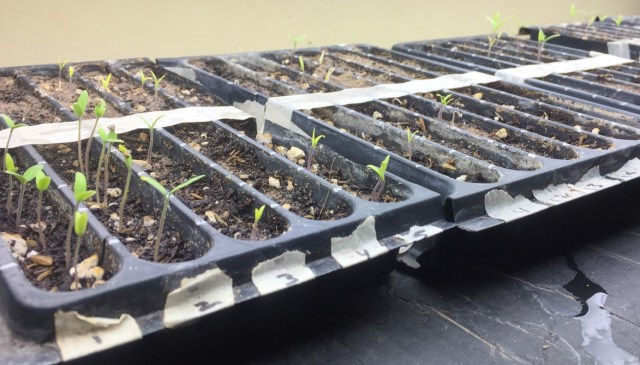
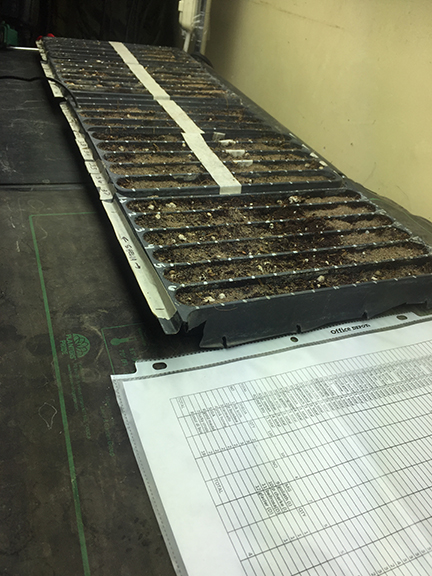
150 tomato seeds planted this year in these germination trays. 42 varieties

Every year it seems, I adjust my tomato seed planting schedule. This year is the latest I’ve ever started my tomato seeds-April 5th. Still trying to tweak it out about when the best time is to start them. If I plant seeds too early, the plants will get too tall before I transplant them outside in wall of waters. Last year I started seeds March 29th. So we will see how they do.

A couple of things have allowed me be able to start them later and get them in the garden earlier.

First, since I changed to Batch 64-Moonshine soil mix (from Agua Fria Nursery), the plants take off growing like a rocket as soon as they germinate. The list of ingredients in it is unbelievable. Once the seeds germinate, there is enough nutrients in this soil mix to basically fertilize your seedling for 6 weeks without adding anything else (except maybe liquid seaweed and Vitamin B at transplanting time to reduce transplant shock). Now I can plant them outside in 5 weeks instead of the 7-8 weeks in years past.

Secondly, I now start my seeds in these germination trays (see pic) where the cells are close together. The trays being shallower, seem to speed the germination process too—less soil to heat. These are a 20 row seedling flat.

Thirdly, it seems to be getting warmer sooner in the spring here in Santa Fe or at least that is my experience. Using wall of waters to protect the young tomato plants from cold nights, I was able to transplant my tomato plants outside on May 3rd, shaving 13 days off the ‘frost free’ date of May 15 that we have here in Zone 6b. They did just fine in their wall of waters.  But last year we were in a warm drought and this year may be different with all the precipitation we got this winter. We’ll see.

And lastly, maybe, just maybe, I’ve become a better gardener through the years…

Plant Greens in the spring!

April is a great time to plant greens like spinach, lettuce, cabbage and mustard greens. Plant now so you will get some greens to eat before it gets too hot. When it is hot they will bolt and become bitter. They can be grown in part shade to last longer when the heat comes. The spinach was actually started last spring and made it through the winter and the chartreuse and purple bok choi were put out 3 weeks ago. All are covered at night with row cover.

Other good crops to plant in April are bok choi and chard. They are real workhorses in the garden being able to withstand our cold and hot seasons. They can be grown in part shade to full sun.

Also good crops to plant in April are beets and carrots. Be sure to plant these in areas of your garden that are getting full sun and water 2 times a day until they are up.

Of course all this is dependent on your soil being warm enough now. How warm should your soil be? Between 40-60 degrees. How do you know how to tell? Get a soil thermometer and stick it in your soil about 2 inches deep. Here is a soil temperature chart to help you know when to plant veggies.

And these plants should still be covered with row cover at night because of our cold temperatures.


NEW! Santa Fe starts a ‘Seed Library’

Santa Fe Seed Library Kickoff-Saturday, March 23
If you are a gardener in Santa Fe, you should be excited about this. Santa Fe is starting a Seed Library in the Santa Fe Southside Library branch off Jaguar. All free this Saturday.

The Santa Fe Seed Library will provide open-pollinated seed to the Santa Fe Community and will encourage the development of a community of seed savers and seed stewards. The Santa Fe Seed Library is a collaboration between the Santa Fe Public Library and the Santa Fe Extension Master Gardeners. In addition to providing access to open-pollinated seeds, the Seed Library will offer a number of free public programs to help facilitate the growth of a community of climate-savvy gardeners.

This Saturday is the kickoff of it with guest speakers, info tables, a Seed Swap and the movie ‘Seed: The Untold Story‘ and of course seeds! I will be there representing Home Grown New Mexico with an info table on our classes this year and will be putting on a mini-seed swap.  It will be open from 1 to 4pm at Santa Fe Southside Library, 6599 Jaguar Dr, Santa Fe, NM, Hope to see you there!

Perennial fruit care in spring

Strawberries grew unbelievably with the addition of Azomite last year

As far as perennial fruit goes, I already cut back the new raspberry plants a few days ago. They are a fall variety called Polana from Norse nursery online. They were fantastic last year with us harvesting lots of raspberries in their first year. So this is their first trimming. I trimmed them back within an inch or two of the ground and they are all still alive. I wasn’t sure as I forgot to water them last fall for a few months but with all the precipitation we got this winter, they are fine.

I also cut back the new blackberry plants called Triple Crown, and saw lots of new start-ups that rooted that I will move. Now I won’t have to buy some to finish up the blackberry row. Hopefully I will get blackberries in their second year.

Today I pulled away all the dead leaves around the rhubarb (Victoria) and they are starting to come up too. A very hardy perennial plant.

I checked the strawberries and pulled all the dead borage plants that grow up in the strawberry patch each year from dropped seeds. Borage is a good companion plant for strawberries and the bees love them. The strawberries need a haircut too-but not too short. The strawberries did fantastic last year.

The verdict is out on the artichoke. It came back last year in its second year but I don’t see any signs of life yet this year. They actually are not supposed to be grown here as a perennial because we are in a colder zone than they like, so we will see if it makes it or not.

Next up is to prune back the grapes and the apple trees and other fruit trees. I’m late on the apple trees but they need to be desperately thinned and pruned now before they come back to life. Last year I put Azomite, a mineral supplement, in my veggie garden which really helped the crops and I have some leftover which I will sprinkle around the fruit trees this year.