2011 Baker Heirloom Seed Catalog Arrives!

2011 Baker Heirloom Seeds Catalog

My 2011 Baker Heirloom Seed Catalog arrived and just in time for me to cuddle up by the fireplace with it and a hot Mexican coffee while it snowed outside. If you are a veggie/flower gardener, this catalog is the most beautiful I’ve ever seen and has a wealth of information. It’s pictures inside are big and gorgeous and make me want to buy everything! It is by far my most favorite seed catalog and if you want to order one, it’s free here at Baker Heirloom Seed (www.rareseeds.com). I get many seed catalogs every year but this catalog is always the best one-year after year. Did I say  it snowed? Yes, snow! We haven’t had any measureable snow here in Santa Fe until yesterday. We got 16 inches of snow (that equals 1.6 inches of rain-10 inches of snow = 1 inch of rain) where I live and I’m so glad because we really need the moisture right now. Hasn’t felt like winter here till this weekend. Now we don’t have to water for awhile!

Don’t Forget to Water in the Winter!

2010 winter precipitation forecast

We haven’t been getting a lot of rain in the Southwest–in fact almost nothing for awhile. That’s because we are in the middle of a La Niña weather cycle, which means less precipitation and warmer temperatures this winter. This means we have to remember to WATER MORE. How much more? Well I WATER EVERYTHING EVERY 2 WEEKS: the perennial gardens and trees (not the dead veggies!), and if we do get a decent amount of snow I water less. I actually write down when I water on a calendar otherwise I could never remember. Last winter we had an El Niño which resulted in more rain and snow, but not this year.

So what is La Niña and what does she have to do with weather in New Mexico? Well, La Niña is caused by colder than normal subsurface ocean water temperatures that start in the tropical Pacific. This cold water is pushed by waves and easterly trade winds towards South America, and results in an upwelling of cold water off Peru and Ecuador that travels north off the coast of South America.

2010 winter temperature forecast

La Niña often creates drier than normal conditions in the Southwest in late summer through the next winter, whereas the Pacific Northwest is likely to be wetter than normal in the late fall and early winter. If you watch the weather, you’ll notice the jet stream, which brings in the storms, gets pushed north of us in the winter and thus we get less rain and snow. So don’t forget to water!

Testing Your Garden Soil

Not having great soil is really a problem here in Northern New Mexico and makes growing anything a challenge. Having good soil where you want to plant veggies is the most important thing you can do. People ask me all the time how do I grow such great veggies and the secret is-it’s all about the soil!  So the more we learn about how to improve our soil the better our growing results will be. So read on.

Here is an excerpt from Payne’s Nurseries site here in Santa Fe on ‘How to Build Your Northern New Mexico Soil’ which is worth reading in it’s entirety.”We have three basic types of soil here in Northern New Mexico: caliche, adobe and sand. All are alkaline, with a pH often over 7.0, and tend to contain abundant quantities of sodium, calcium and potassium. Caliche, adobe, and sand all lack organic matter, the nutrients and organisms of which are essential for sustaining high quality plant growth and production. Caliche is made up of sand, gravel and clay. Adobe is essentially fine clay. Neither soil type is easily penetrated by water. Sand, on the other hand, allows water through but has a limited ability to hold nutrients or moisture.” Check out the article. Most of us have some combination of these 3 types.  Fertilitzers feed the plant but not the soil which also needs to be fertile and more and more people are just learning that.

One of the things I mentioned in an earlier post is I’m getting a soil test specifically for growing my giant pumpkins and I will get one for my veggie garden where I grow tomatoes also. I researched where other pumpkin growers are getting their soil analysis done and I will use A & L Western Laboratories in Modesto, Ca for mine as they can test for any crop I specify versus a general soil test. My fellow pumpkin nuts tell me to get the  S3C COMPLETE Analysis package from A & L and to get the recommendations as well. The soil sample collected should be a composite from 10 to 20 locations within a selected area; a sufficient number to “average out” variations. You can learn how to properly take soil samples from them here. Other soil testing companies may have other protocol so check with whoever you use as to how they want you to collect soil samples.

There is nothing wrong with getting a general soil test (instead of for a particular crop) and that is what I would get if I didn’t grow competitively but I want to get the most out of my soil for my pumpkins.

You can also get a general soil analysis from a NMSU laboratory here and you can go to NMSU Soil Test Interpretations site to learn what your test means. Reading the tests isn’t easy but once you get one done you’ll be better able to understand what needs to be added to your garden for next year’s growing season so you can have a wonderful lush, productive garden next year. I’ll post what the results are as soon as I get them back.

Basic Composting 101

I don’t compost at all in the winter here as it is too hard to keep it ‘hot’ in our frigid weather but here is some general information on composting in case you live in a more temperate climate. In Santa Fe, I compost in the Fall and then let it cook all winter and use it in the Spring after it becomes compost. Then I make more in the Spring and Summer.

1. I build my compost bins to hold the materials out of pallets. I just use 3 per bin and wire them together. I line the interior with hardware cloth (1/2 inch wire holes) to keep it from falling through the pallet  slots. I built 3 of them for the various stages the compost goes through.Works great. Easy.

2. When building my compost pile I alternate layers of BROWN and GREEN materials (2-4 inches of each layer) and when you add a food scrap layer, make sure you sprinkle it with soil and then top off with a brown layer to prevent smells. I use a RATIO OF ONE PART BROWN TO ONE PART GREEN materials. In other words-equal amounts of both. I usually turn it once or twice but I should turn it more (like every week). I also need to water the pile to help with the breakdown process. The compost pile should be moist like a sponge but not drowning. That is usually not a problem as the climate is sooo dry here in Santa Fe. In fact we have to water more because it is so dry. In other parts of the world where it rains more, you may have to cover it from getting too wet.

3. Here is the GREEN (NITROGEN) MATERIAL I USE in my compost pile-grass, food scraps (uncooked fruit and vegetables like old lettuce, old tomatoes, potato peelings, eggshells, coffee grounds, tea bags and egg shells), garden trimmings and FRESH horse manure.  If you can’t get fresh horse or other farm animal manure, then use blood meal or alfalfa meal to get your pile HOT. Just sprinkle it on top of  your green layer.

4. Here is the BROWN (CARBON) MATERIAL I USE dry manure, fall leaves, straw and newspaper strips (dry). I usually start at the bottom of the pile with some leaves and then add the green and kitchen scraps and some dirt and then the brown again. The stuff at the bottom of your pile will start to break down first. That is why you need to turn it over-so it cooks evenly. If you don’t turn it over it will take much longer to to break down and that is ok with some of us.

5. Here is what I DON’T USE in the compost pile- any meat products (attracts animals and may carry pathogens),  no dog or cat poo, no woody or branchy stuff  (takes too long to break down) corn cobs, no veggie garden plants (in case they have some disease)

6. Start by layering your brown and green stuff in one of your bins and pile it high. It will start to cook down in a couple of days and you will notice it will be about 1/2 its original size in about a week-if you have enough nitrogen (manure or blood meal or alfalfa meal) to get it cooking.

7. If you want to, get a compost thermometer which is about 24 inches tall to put in the center of the pile. A hot pile may get from 110 degrees- 160 degrees F which is hot enough to kill most pathogens and it is fun to see how hot your pile is. The hotter the pile, the faster it becomes compost. But this requires more turning to get it to decay faster. This is called HOT COMPOSTING.

8. Lastly you could layer all your stuff and just wait (about a year) for it to decay and become compost on its own. This is called COLD COMPOSTING.

Clean up that garden!

New goats-Sonny (brown), Bella (black) and Wee (white) wanting to help in the garden while Butch and Bear eat their food.

By now most of my gardening friends have finished cleaning up their gardens but I basically just finished cleaning up the veggie garden on Saturday. It was a good day to be out there-51 degrees and no wind. I wanted to try to finish before a snow storm hits today and the temperature plummeted. I’m mostly done now in the garden. I pulled all the tomato cages (60 of them) out and threw them over the fence. So now they are on the outside of the garden (all over the place) and I can go out on a nice winter day to clean up the cages and take my time. At least they won’t freeze in the ground inside the garden.  I raked up all the debris into piles that I will bag and dump. I don’t put any of my garden debris in the compost pile because some of it could harbor disease or pests that won’t die if I don’t get my compost pile hot enough. In fact I don’t compost at all in the winter here as it is too hard to keep it ‘hot’ in the frigid weather.  I mostly compost in early Fall and then let it cook all winter and use it in the Spring after it becomes compost for planting. I also make compost in the Spring and Summer too,  just not winter. This is the biggest garden I’ve ever had and was quite a job cleaning it up. Somehow I must train the new goats (who were watching) to do this last and tedious job! I suppose I could let them into it and see it they eat it all! Now wouldn’t that be nice!

Fantastico Spaghetti sugo (Fantastic Spaghetti Sauce)

Here is the recipe I used when canning all those jars of spaghetti sauce. (Only I don’t add meat when canning). My mom taught me how to make this recipe for spaghetti sauce. She learned it from an Italian friend of ours. Her name was Jenny (funny name for an Italian) and she was a neighbor of ours when I was growing up. She was always so kind to my brother and me. Unfortunately she died of breast cancer in her 40s’ but her spirit lives on in her sauce. I have never shared this recipe until now so I hope those of you who take the time to make this enjoy it.

INGREDIENTS
3 large cans of tomato sauce (I think they are 26 oz)
1 large can diced tomatoes (same as above)
1 small can tomato paste
1 cup water
1/4 cup red wine
1 med onion sliced
1 pkg sliced mushrooms (optional)
2-4 garlic cloves, crushed
2-4 TLB dried basil
1 TLB oregano
1 tsp thyme
1 tsp marjoram
1/4 cup olive oil
1-2 tsp sugar (optional)

Put tomato sauce, diced tomatoes, and paste in a big pot and add 1 cup water. Add all the herbs and olive oil and stir in. Bring to a boil and turn down to simmer.  In a fry pan, saute onions and mushrooms in a good grade of olive oil.  If you want to add Italian sausage, add these first and then saute the veggies in the same pan after they are done. If I want vegetarian style I will saute some sliced zucchini in big 1 inch chunks with the onions and mushrooms. After tender, add crushed garlic last and saute till soft as it will burn if you add it too soon. Then add to the simmering tomato sauce. Stir often. Add wine after simmering for a couple of hours. Stir often. The key to this sauce is to cook it almost all day on very low-do not cook on too too high of heat or it will burn. If the sauce starts to get too thick too soon, I will add more water. Cook, cook cook! I usually cook up a pot on a Sunday when I can be home while doing other things. Eventually the sauce gets thick (as thick as you’d like) and a rusty red color. Taste and if it seems too acidic add about 1 -2 teaspoons sugar to reduce acidity. You don’t want it sweet, just want to cut the acid and sometimes out of the can it can be a little acidic. Of course I use tomatoes right out of the garden but not everyone has that luxury and it is still wonderful when using canned tomatoes.  Refrigerate or freeze the remainder. It tastes even better the next day.

11 quarts/30 pints of Spaghetti sauce-Now that’s a lot of tomatoes!

Well, it’s official. I’m done with canning for the year. Phew, what a push. No wonder I like winter-I get a break from the garden and all the harvest which I love to do, but by the end, I do need a rest and winter is THE perfect time to rest and reflect and get excited for the next gardening year. I push so hard because I just hate to waste any produce. The last push was finishing my tomatoes. I made  lots of spaghetti sauce-11 quarts and 30 pints of spaghetti sauce to be exact. And when you consider it takes 2 pints to make a quart, it blows my mind I made so many! Now that is a lot of tomatoes from the garden. I use to peel the tomatoes (put them in boiling water for a few minutes till their skins crack and then slip the skins off) and freeze them and make my sauce later but when you do actually make the spaghetti sauce, it takes a lot more tomatoes as they have to cook down. So I canned it all and I now I can reach for some spaghetti sauce out of the pantry already pre-made. I also made a zillion pickles earlier in the season which I also canned and dried many apples to munch on.. I do love looking at a full pantry with the harvest from a good season. I still  have to finish up some of those ten things I mentioned in an earlier post but not today. Happy Thanksgiving!

3 Great Pumpkin Soup Recipes

Here are the two soup recipes I posted last Spring and one more great recipe I found for pumpkin soup (or any winter squash soup).

JANNINE’S PUMPKIN SOUP

INGREDIENTS:
About 10 lbs of pumpkin or winter squash
Chicken broth or vegetable broth or water
1 can Coconut milk (whole or  lite)
fresh grated ginger
honey to taste

Cut, quarter and clean out your squash of seeds and stringy stuff.  Put oil on exposed edges and put face down on foil lined cookie sheet and place foil on top so it doesn’t dry out. Cook at 350 degrees for 30-45 minutes until soft when pierced by fork. Scoop out and place in a big soup pot and add 8-10 cups of either water, OR chicken broth OR vegetable broth-your preference. Then take a mixer or one of those hand held  blender wands and mix till smooth. Heat and add the can of coconut milk, some fresh grated ginger (peel first) and honey to taste. Do not boil. Yummy!

Here is another pumpkin soup recipe that I got from my friends Caleb and Genevieve. It’s really yummy too.

SPICED PUMPKIN SOUP
½ tsp fresh grated ginger
½ tsp cumin
2 cloves minced garlic
1 cup chopped onion
1½ cups apple cider
⅓ cup bourbon
¼ cup maple syrup
2 lbs cooked FRESH pumpkin (this is about 4 lbs before cooking)
1 can chicken broth or 2 cups veggie broth or water
2 cups milk
1 TLB flour
1 tsp salt
black pepper to taste
sour cream
3TLB chopped parsley or cilantro

Saute onions, ginger, cumin, and garlic 5 minutes or until lightly brown. Stir in apple cider, bourbon, syrup, pumpkin, and broth. Bring to boil and simmer 10 minutes. Take out mixture and puree in blender in batches until all blended or use (“magic wand” to puree right in pot) Return pureed mixture to pot and add milk, flour, salt, and pepper. Cook till just heated (do not boil) stirring occasionally.
Serve with dollop of sour cream and sprinkle parsley if desired. For vegetarians, leave out dairy and replace milk with coconut milk, chicken broth with veggie broth.

Bobby Flay’s Mesa Grill’s Pumpkin Soup with Cinnamon Crème and Roasted Pumpkin Seeds
Serves: 6-8

Pumpkin Soup
4 cups enriched chicken stock or low sodium canned chicken broth or vegetable broth
3 cups pumpkin puree (not flavored pie filling)
1 teaspoon ground Mexican cinnamon
1 teaspoon ground ginger
1/2 teaspoon allspice
1/4 teaspoon freshly grated nutmeg
2 tablespoons honey
2 tablespoons maple syrup
2 teaspoons chipotle puree NOTE: Canned chipotle peppers in adobo are available at Latino or gourmet markets or from Kitchen Market, 218 Eighth Avenue, New York, NY 10011, 212-243 4433, which has a mail-order list. To make chipotle purée, process canned chipotles in a blender or food processor, along with a little of their liquid.
3/4 cup crème fraiche
Salt and freshly ground pepper
Roasted pumpkin seeds (recipe below)

1. Bring 3 cups of the stock to a boil in a large saucepan over high heat. Whisk in the pumpkin puree, 1 teaspoon of the cinnamon, ginger, allspice, nutmeg, honey and chipotle puree. Reduce the heat to low and simmer for 15-20 minutes, stirring occasionally. Add more stock, if the soup is too thick.

2. Remove from the heat and whisk in 1/4 cup of the crème fraiche and season with salt and pepper to taste.

3. Mix together the remaining crème fraiche and 1 teaspoon cinnamon until combined.

4. Ladle the soup into four bowls; drizzle with the cinnamon crema and sprinkle with roasted pumpkin seeds.

Roasted Pumpkin Seeds (Use regular size pumpkin seeds-giant pumpkin seeds are too thick) Makes 1 cup

1 cup raw pumpkin seeds
2 tablespoons vegetable oil
Kosher salt

1. Preheat the oven to 350º F.

2. Toss the seeds with the oil and season with salt to taste. Spread the seeds evenly on a baking sheets and bake for 25-30 minutes, tossing occasionally, until they are lightly golden brown and crisp. Let cool. Can be made 2 days in advance and stored in an airtight container.

Roasted Pumpkin Seeds

Roasted Pumpkin Seeds (Use a regular size pumpkin for seeds-giant pumpkin seeds are too thick) Makes 1 cup

1 cup raw pumpkin seeds
2 tablespoons vegetable oil
Kosher salt

1. Preheat the oven to 350º F.

2. Toss the seeds with the oil and season with salt to taste. Spread the seeds evenly on a baking sheets and bake for 25-30 minutes, tossing occasionally, until they are lightly golden brown and crisp. Let cool. Can be made 2 days in advance and stored in an airtight container.

Saving Seeds-still time to collect them

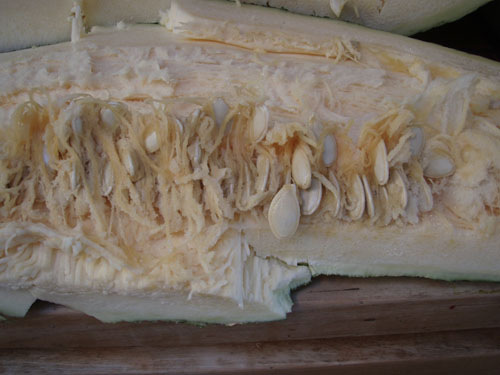
giant marrow opened up exposing seeds

I’ve been collecting some of the seeds that I want to replant for next year-rattlesnake beans, giant marrow, Japonica corn, giant pumpkin, scarlet runner beans, sunflower seeds, tomato seed from my 2.11oz tomato, cosmos, and zinnas. Ones I won’t take are cucumbers, most tomatoes, zucchini, winter squash, and peppers as I grew several of the same varieties and they could of crossed and I might loose the original strain.

giant marrow seeds drying

When saving big seeds like squashes or pumpkins, be sure to thoroughly DRY the seeds before putting them in a zip-loc baggie or jar. Any hint of moisture will ruin them. I just put the cleaned, wet seeds on a piece of wax paper on a cookie sheet in a dry sunny place until dry. That way they will release from the wax paper after they are dry. I always like collecting seeds every year. It’s fun when you plant them the following year. It’s also fun when you don’t have to buy a packet of seeds for $2.49 with 20 seeds in them when you can collect the same seed and get 100’s more.  I have a friend (Fran) who walks and collects the wild flower seeds and broadcasts them on her property and the her natural garden this year looked awesome. (Did I tell you that Fran?!) Awesome!

10 Things To Do in November In The Garden

I’m baaaack! Been on vacation all last week in sunny, warm Southern California down in San Diego playing on the beaches and up to Disneyland. Ahhh, 78-80 degree weather. How nice!   A much needed vacation..But now that I’m back there is still much to do before cozying up to a fireplace and looking at future seed catalogs that I haven’t gotten yet. I’m so far behind, I can’t see. So here is my list of to do’s that I haven’t done:

1. Finish taking out the garden-only partially done. Must dispose of all tomato plants (all now dead), all cucumber and squash plants. I won’t compost any of these as I don’t want to spread any possible diseases they may have had since they are very disease prone and if you don’t get your compost pile hot enough, you may not kill all the pathogens. Also rake any debris and get rid of it. Make the dirt pretty. Here I come city dump!

2. Finish my compost pile. Got to get more coffee grounds, leaves and fresh horse manure or cottonseed meal (to heat up the pile) and add to the partially composted piles. Soon I won’t be adding any kitchen scraps as they will not break down in the dead of winter (at least not for me (I’m not a worm farmer)-Deb F. I need your advice on making hot compost in cold winter climates!)

3. I already took off the drip system timers but need to take out the batteries and put them inside somewhere. I never drain or blow out the drip and never had a problem. Ahh, one less thing to do!

4. Oh oh! I think I blew it. We have already had freezing weather at night, so I may have killed my new little friends-soil microbes in products such as Serenade, Companion and Mycorizial but I’m going to get them anyways out of the garden shed and put them in the house where it is warmer. Hmm, wonder what closet I can hide them in? I know, the cat room closet! Nobody wants to go in the cats room anyways (where the kitty litter boxes are)! I wonder what these microbes do in the winter anyways out in nature?! Hmm, I’ll have to investigate that this winter.

5. Put everything from the Tomato Lady business in the garden shed. Oh yea and clean up and straighten out that garden shed while I’m in there. And set some mouse traps in case they think the row cover is really just blankets for them in the winter.

6. I’m going to get the pumpkin patch soil tested this year and see what amendments I need to add.  I’m going to add amendments to it and the general veggie garden as soon as the sales go on at the garden stores. Last year I picked up my Seaweed, Thrive, Yum, Yum mix, and Fish emulsion really cheap- right about now.

7. Need to make notes about what happen in the garden this year-you know, successes, failures, problems-things I can look at next Spring to refresh my memory. Need to make a diagram of where my diseased tomatoes were before I forget. Shouldn’t replant tomatoes back in those spots again for 3 years. I will be planting less tomatoes next year in an area that either hasn’t had tomatoes or it’s been 3 years since I planted there. It’s called plant rotation-but with the number of tomato plants I plant every year, it’s getting harder to find new places with in the garden to plant them or I may need to expand again next year.  Na, just plant less tomatoes..

8. Finish up my collecting seeds and sorting them. I’ve almost done there.

9. Do you believe this? I’m planting some starts of spinach and lettuce in a cold frame NOW! Just an experiment to see if they will do well or not..

10. Planning to build a small high tunnel to be ready for early Spring. Hope it’s a warm winter…

Pumpkin Bash! Kong=561 pumpkin pies!

Yesterday, (Friday) we had the 3rd Annual Pumpkin Bash and subsequent cutting up of my giant pumpkin, Kong. We started with the kids and then the adults. Everybody got to help bust it up. Then we cut it up and gave it away to all. How could Kong become 561 pies or gallons of pumpkin soup!  561 pies? The answer is yes! Take 421 pounds x 16 oz =6736 oz of pumpkin. Now divide the 6736 oz of pumpkin by 12 oz (it takes 1.5 cups of pumpkin per pie) and you get 561 pies!  And I got the seeds for future little Kongs! Here are some pics..

This slideshow requires JavaScript.

3rd Annual Pumpkin Bash and pumpkin giveaway this Friday-Nov.5th

Hear Ye! Hear Ye! The 3RD ANNUAL PUMPKIN BASH will be held this Friday, Nov 5th at 9am in the parking lot of Liquid Light Glass located at 926 Baca Street here in Santa Fe, NM, where ‘Kong’, the NEW New Mexico State Record Pumpkin has been on display all month.

I’ve invited friends and the Kong boys (the guys who schleped it around for me) to come and try to split Kong in two. We draw straws to see who gets the first whack and wield axes or mauls to (gulp) split Kong. Then we cut it up and give the wonderful pieces to my cook friends who I will contact ahead of time. (Cooks can pick it up after 10am-friday). You can come and watch or participate and please take a piece away! After all we have 421 lbs to give away! Last year it only took an hour for it to disappear. It will make wonderful pies, soup, bread, etc. and can be cooked and frozen for later use as well. So come and enjoy the event!

Tomatoes all picked and everywhere in house!

Monday  finished picking all the tomatoes and then the garden froze that night. Now I have a houseful of green and ripening tomatoes everywhere! Tomorrow I go to our Farmer’s Market and sell them. In fact I have 9 boxes which ain’t bad for end of October.  Usually I sell out and there are hardly any tomato people there now. I’ll wait and see how the rest of the tomatoes develop-just take it week to week as to whether I go back or are finished. Meanwhile the garden is a mess since it froze. I started to clean it up but the plants are too heavy still with water so I’ll wait till they are lighter. I think I’ll hire some help with it.

King Kong meets Godzilla (Stella)

This slideshow requires JavaScript.

Everyday King Kong, my NM State record giant pumpkin (on display at Liquid Light Glass on Baca Street) gets visitors but today was rather special. Godzilla came dressed up as a little girl named Stella and allowed me to take some pictures of her and her parents, Leslie and Mark. Thanks Godzilla (Stella), you made my day!