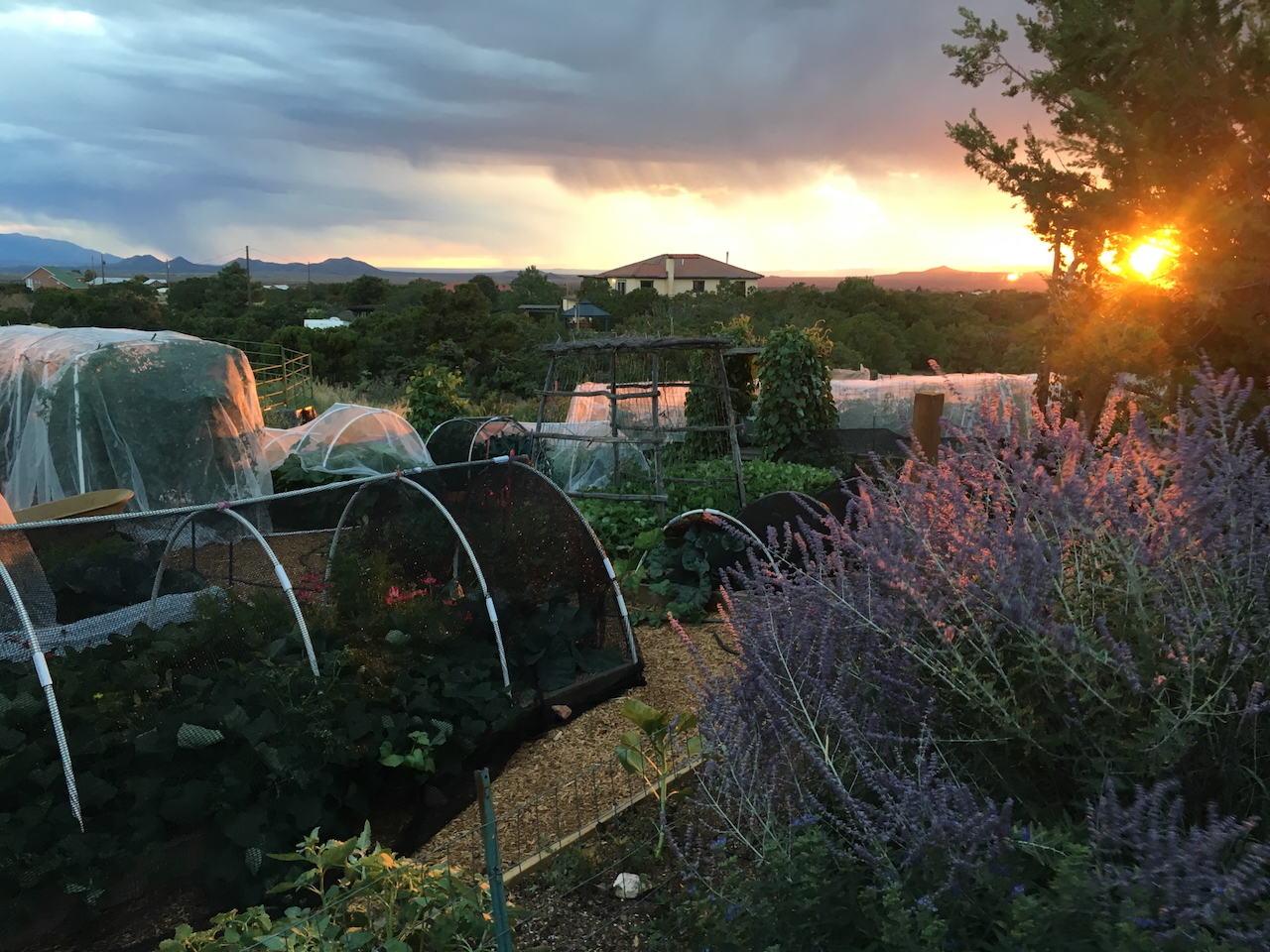
End of 2025-veggie garden review

We tore out all but the chard and perennial fruit plants in the garden. I can hardly believe the Argentata chard is still doing good as of Dec 9th in the garden what with the nighttime temps getting down into the mid-high 20’s and only the rainwater now. It has green leaves with white ribs that are very tender. All the other chard are gone now.

But now on with the review!

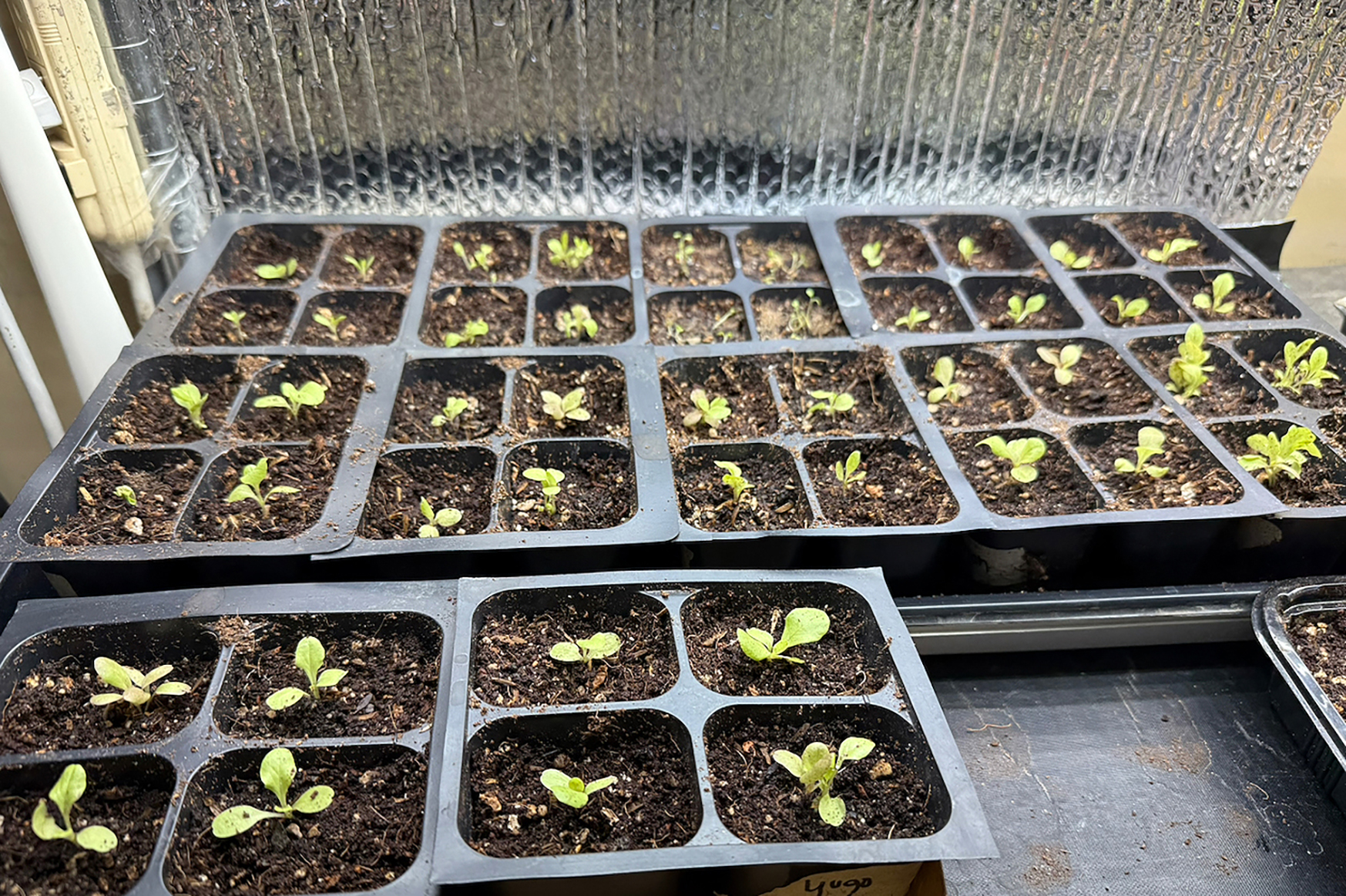
I got a late start in sowing seeds this year due to us being in Europe in spring. When we planted seeds inside on March 28, it was a full 2-3 weeks later than I normally start seeds so this affected the harvest. This year in 2026, I’m going o drop some tomatoes and grow some others alongside my favorites. It’s fun to experiment and perhaps I’ll find some new winners in 2026.


PEPPERS
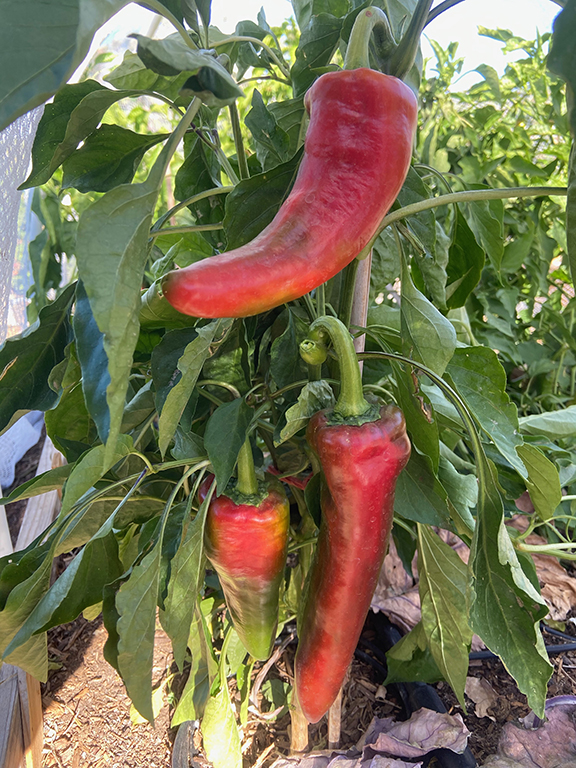
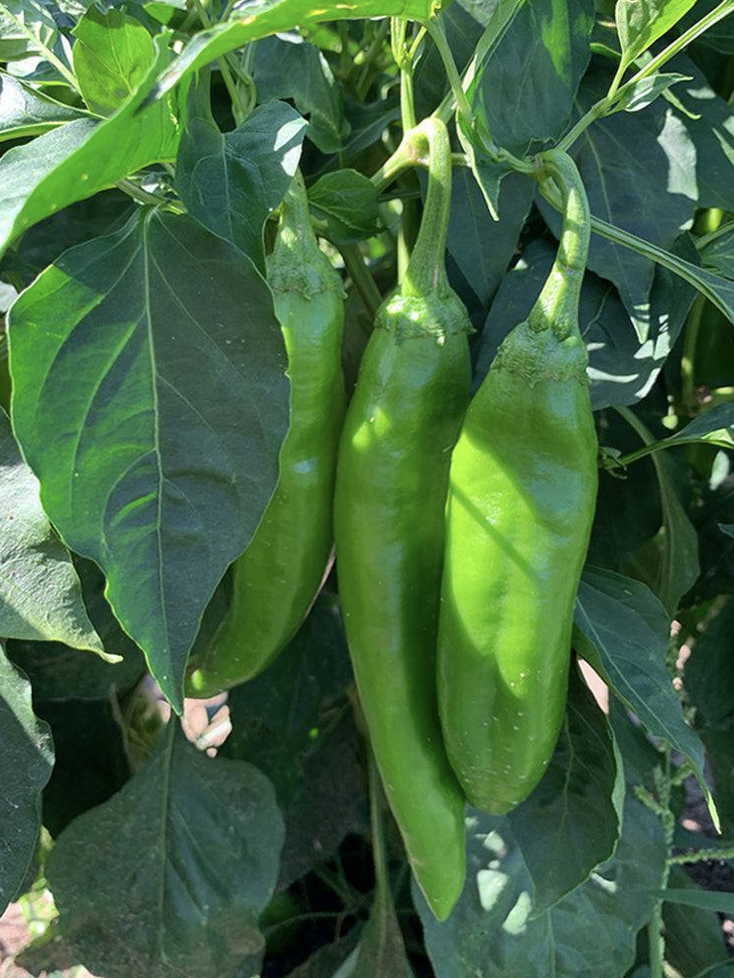
I thought I might not get peppers this year due to the fact I normally start pepper seeds inside in early March as it take 8-10 weeks to be big enough to plant outside by the time the frosts are gone. I wasn’t too far off as we had a less than spectacular pepper season with most producing only a few peppers before the season ended. But one outstanding variety, Sweet Calabrian Caviar pepper produced exceptionally well and saved the pepper season. Next year we are planning to be here during seed starting season. So, Poblano, Lava Red, Jimmy Nardello, and three other pepper varieties only got a few peppers. Over the years, I’ve come to like sweet peppers more than hot. I like to grill or saute them. Because they’ve done well in previous years, YES to all for next year.

TOMATOES
Surprisingly we did pretty well with most of the tomatoes this year despite the late start. The plants didn’t get as tall (4+’) but most produced well. We planted them outside on May 28 due to some late freezes and they were only 4-5 inches when they went in the ground. 8 yes and 5 no. Read on for details.
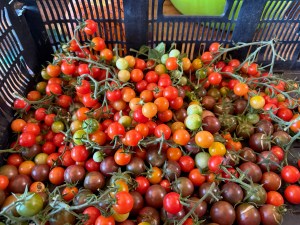
CHERRY TOMATOES
Super Sweet 100-red cherry tomato-very prolific and very sweet-good continuous harvest throughout the season. YES for next year.

Black Cherry-dark purple cherry tomato-very prolific and very sweet, smoky flavor-good continuous harvest throughout the season. YES for next year.

Sungold-yellow cherry tomato-very small, disappointing, average harvest. Fruit were too small for me although the flavor is always very sweet. Looking for a larger yellow cherry tomato for 2026. NO for next year

EARLY SEASON TOMATOES
Large Barred Boar-I’ve always like the flavor of this mahogany colored with green metallic stripes tomato BUT it does not have a long shelf life once picked. You must eat them within a few days or they turn soft-too soft. For 2026, I’m  looking for a dark tomato with a longer shelf life and great flavor. Let me know if you know one. NO for next year.

Sunny Goliath-yellow medium size tomato-my second year growing them. Nice tomato but not very prolific both years. NO for next year.

Goliath Pio-red medium size tomato with little to no cracks-Great old fashioned flavor with balance of sweet-acid. Always a star, My biggest producer this year. It did not disappoint this year-good for canning or fresh eating.YES for next year.

MID SEASON TOMATOES
Black Sea Man-black/purplish-75 days to harvest
-med-small size tomato with good flavor and good  production.Going to try other black tomatoes this coming year. NO for next year.

Cherokee Carbon-Purple with green shoulders-75 days to harvest
-med size-tomato with good flavor and average production. Unusual this year but perhaps because they got in so late, they didn’t produce as well as previous years but it is a winner. YES for next year.

Cherokee Purple-purple color-75 days to harvest
-Perhaps because they got in so late, they didn’t produce as well as previous years but it is also always a winner. YES for next year.

Pantano Romanesco-Red-70-75 days to harvest.Red medium size tomato-old fashioned flavor but didn’t produce that well. I had others that did much better. NO for next year.

Jaune Flamme-orange-70 days to harvest
-Can’t say enough good things about this one. Outstanding flavor, very prolific. YES for next year.

LATE SEASON TOMATOES

Lucky Cross-yellow with pink blush inside-74 days to harvest-Every year either Lucky Cross or Virginia Sweet do well. I like both but Lucky Cross didn’t do as well this year so NO for next year.

Paul Robeson-black/brick color-75 days to harvest-exceptional flavor-wins all kinds of tomato tasting awards. YES for next year.

Big Zac-red-80 days to harvest
. Not very productive this year and fruit were a little smaller than the large fruit they truly are. Excellent old-fashioned flavor. NO for next year.

Virginia Sweet-yellow with red blush inside-80 days to harvest. Did fantastic this year, producing many very large-1.5 to 2 lb tomatoes. A real treat. YES for next year.
_____________________________________________

CUCUMBERS-A bumper crop of 2 of the 3 cucumber varieties I grew this year. So much so, I got tired of making pickles and pickle relish. We couldn’t eat them or can them fast enough.

Poona Kheera-Our favorite fresh eating cuke. A yellow cuke that did exceptional well-sweet melon flavor that we use for fresh eating only. Good producer. Non bitter. YES for next year.

Boothbys Blonde-Another great yellow cuke-I use this variety for making bread and butter pickles and pickle relish. Good producer this year. YES for next year.

Salt and Pepper-new variety for me this year. Not a good producer and small. NO for next year.

Parisian-I use this variety for making cornichon pickles but I still have many jars I canned from last year, so I didn’t grow any this season but I love this one, especially if you like Cornichons, which mean tiny tart pickles.


RADISHES-Two new varieties this year and one I always grow
Pusa Gulabi and Pusa Jamuni-I loved these two and I don’t love radishes so that says a lot. Both were great flavor and look beautiful. They are not round but long. Seeds from Baker Heirloom. YES for next year.

Watermelon radish-I love this variety too but it takes a little longer till harvest. YES for next year.


PEAS
Super Sweet Sugar Snap pea- I normally try to grow these in a pot in SPRING- I say ‘try’ as the plants and harvest are usually small but this year I grew them in the garden in the FALL in a raised bed. What a difference that made! Super big 5′ plants and great producer! YES for next year.


CAULIFLOWER
I grew both orange and white varieties and both did well in the spring/summer. In the previous year, we had a hot summer and I tried a purple cauliflower that didn’t do well in the heat, so I stuck with the other two this year not knowing if we would have a hot summer.
Freedom-white variety-love this. YES for next year.

Cheddar-orange variety-love this. YES for next year.


CHARD
Argentata-a big winner with the white stalks soft like butter when cooked. Very cold and heat tolerant.
YES for next year.

Orange and Ruby varieties-both grew great and looked good together when cooked. YES for next year.


CARROTS
-All carrots did well this year.
Dragon Purple
-Purple outside with orange inside. YES for next year.

Atomic Red-Red outside and orange inside. YES for next year.

Black Nebula-Black inside and out. Makes the most beautiful, tasty purple soup. YES for next year.

Scarlet Nantes-standard orange inside and outside but big! YES for next year.


SQUASH-I grew a yellow, bumpy summer squash called Friulana-looks kind of yellow green in this photo and Butternut winter squash-both did well. YES for next year.


BEETS
Cylindra
-deep red cylinder shaped- grows upright out of soil-easy to pull. Cuts into nice even disks-nice flavor. YES for next year.

Badger Flame-beautiful reddish ,orange-yellow outside with yellow inside. Exceptional flavor. YES for next year.

Chiogga-I can’t resist these red outside with concentric circles of red/white inside-like a bullseye.YES for next year.


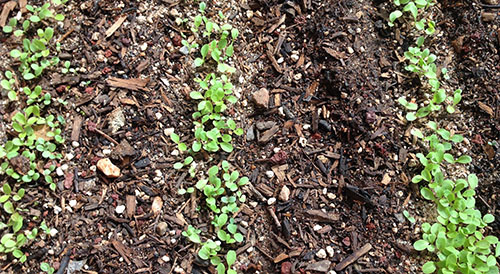
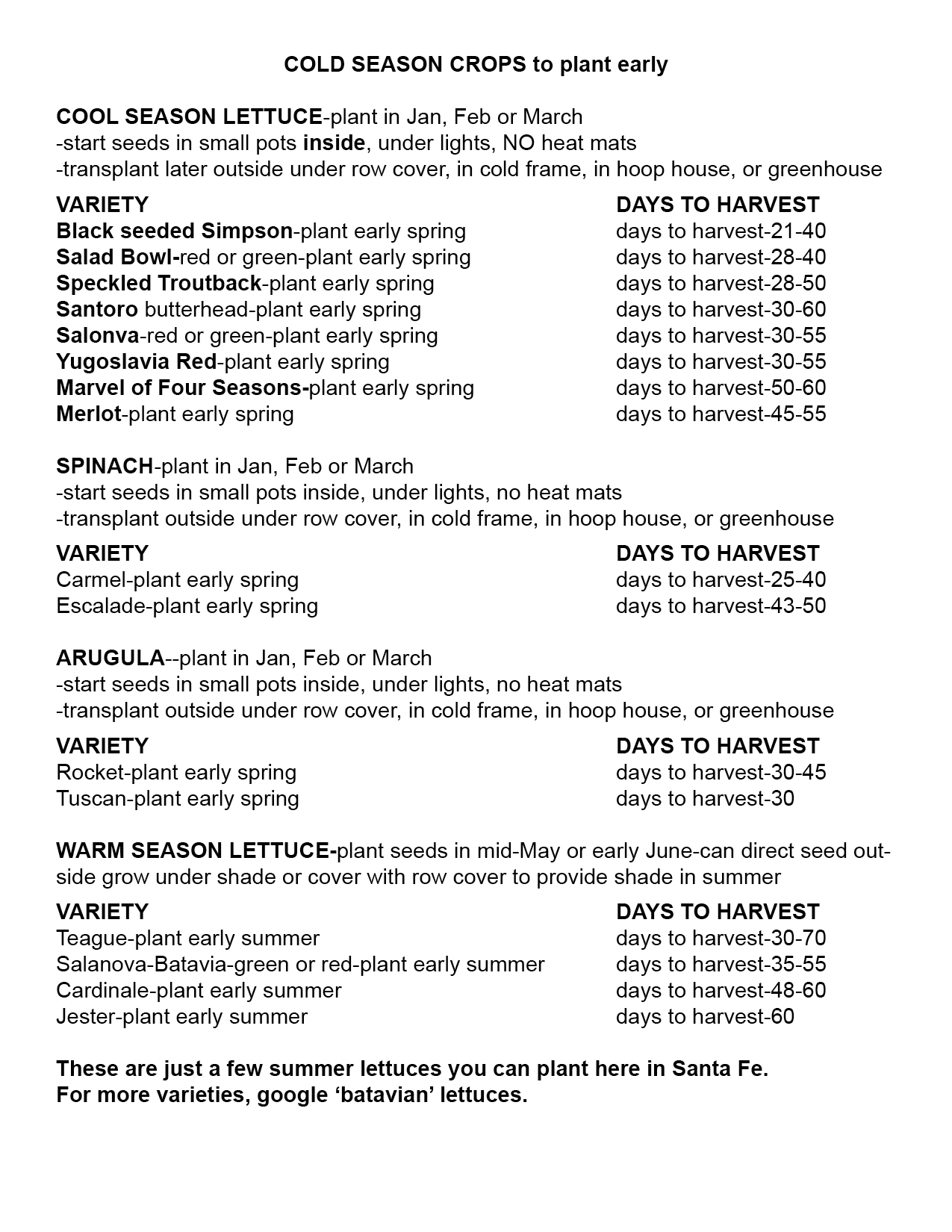
LETTUCES– I grow many varieties under 30% row cover this year outside starting in
early spring. All did well under shade.
Santoro–butterhead
-My favorite lettuce-YES for next year.

Yugoslavian Red-butterhead-good cold tolerant-YES for next year.

Salanova-butterhead-red and green-good cold tolerant-YES for next year.

Oakleaf-good heat tolerant-YES for next year.


NOTE:Fruits and flowers will be in separate posts coming up.


Treat Early Blight when it shows up

Early Blight is a fungal disease that attacks tomato plants starting on the bottom leaves of the plant and works it’s way upwards.  The leaves start turning yellow and get blotchy with brown areas. If left unchecked, it can take over your plant killing it although it won’t die immediately and there are things you can do to reduce it.

Where does it come from? It comes from water splashing soil up onto the lower leaves. The culprit is a bad soil fungus (there are good soil fungus as well).

But before I write about how to treat this disease, I do this first. I always trim off the lower branches so they are not touching any soil and I put straw under each plant so the soil can’t splash up on the tomato leaves. In fact I put straw over the whole bed as the tomato plants get bigger. Water splashing up from hand watering your plants or even rain can splash soil up on the lower branches. But I never cut off branches that have flowers! Flowers=tomatoes! The picture above shows a plant with the lower branches trimmed off and straw over the soil. Underneath the straw is my drip system. The goal is to keep the soil from splashing up and the fungal spores will start to go upwards from the bottom of the plant.

There are several things you can immediately do to help with this disease when you see it

1. The first thing you do is trim off the affected branches where the leaves are yellow.  This week I trimmed all the lower branches off my tomato plants paying particuliar attention to the ones that had a few leaves just starting to yellow with EB (Early Blight). This year I had 3 out of 20 plants showing the beginning of EB. Me bad-I didn’t add the straw or trim them up after I removed the wall of waters earlier. I also tie a ribbon on the diseased plants so I can keep a close eye on them. I’d much rather deal with Early Blight than Curly top virus (which is always fatal and not much we can do about it). At least you can control Early Blight. Keep trimming up your plant as needed.

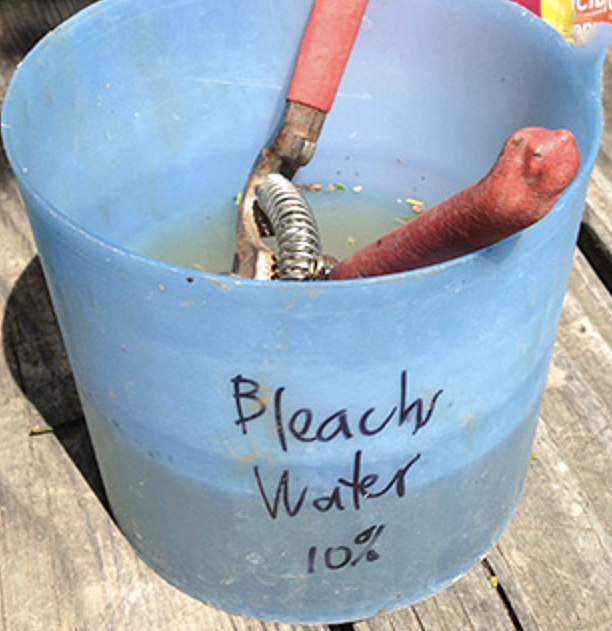
ALWAYS DISINFECT YOUR CLIPPERS IN BLEACH WATER BEFORE GOING ON TO PLANTS THAT DON’T HAVE IT-it is contagious!

2. Beside cutting off diseased branches, trim any branches to make sure they don’t touch the ground

3. Stake  or tie up any branches that might touch the ground.

4. Mulch with straw underneath the plant so the soil can’t splash up on plant when it rains or if you water overhead.

5. I have used a product called Serenade in the past, but it is no longer available. If you have some discard it as the ingredients only lasted several years.

So now I use Monterey Complete Disease Control which I have had good luck with in curtailing or slowing down the disease. Follow instructions. Spray in early evening both on top and UNDERNEATH the leaves.

I also use this for keeping Powdery Mildew at bay on all squash plants.

Time to take your wall of waters off your tomato plants now!

Walll of waters

If you still have your tomatoes in wall of waters, take them off now because the temperatures are suppose to get into the 90’s next week and if that happens, it could fry your plants. I’m taking mine off the next few days.

Covering up the tomatoes with row cover.

Since we haven’t really had much rain to speak of, after I remove the wall of waters (WOWs), I will put cages on and wrap my cages in medium weight row cover (.55) from top to bottom completely covering the cage. This is to protect the tomato plants from getting exposed/bitten by the Beet Leafhopper which can give your plants CTV (curly top virus) which will be fatal to the plants. I will take the row covers off when the monsoon rains come in ernest which is usually just after July 4th weekend but has come earlier in some years. The bug seems to leave or get suppressed once the monsoons start.

Meanwhile June is getting it’s usual heatwave which is normal for June in the Santa Fe area. Come on rain!

Wall of Waters-what they are and how to use them

A

Wall of waters (WOWs)

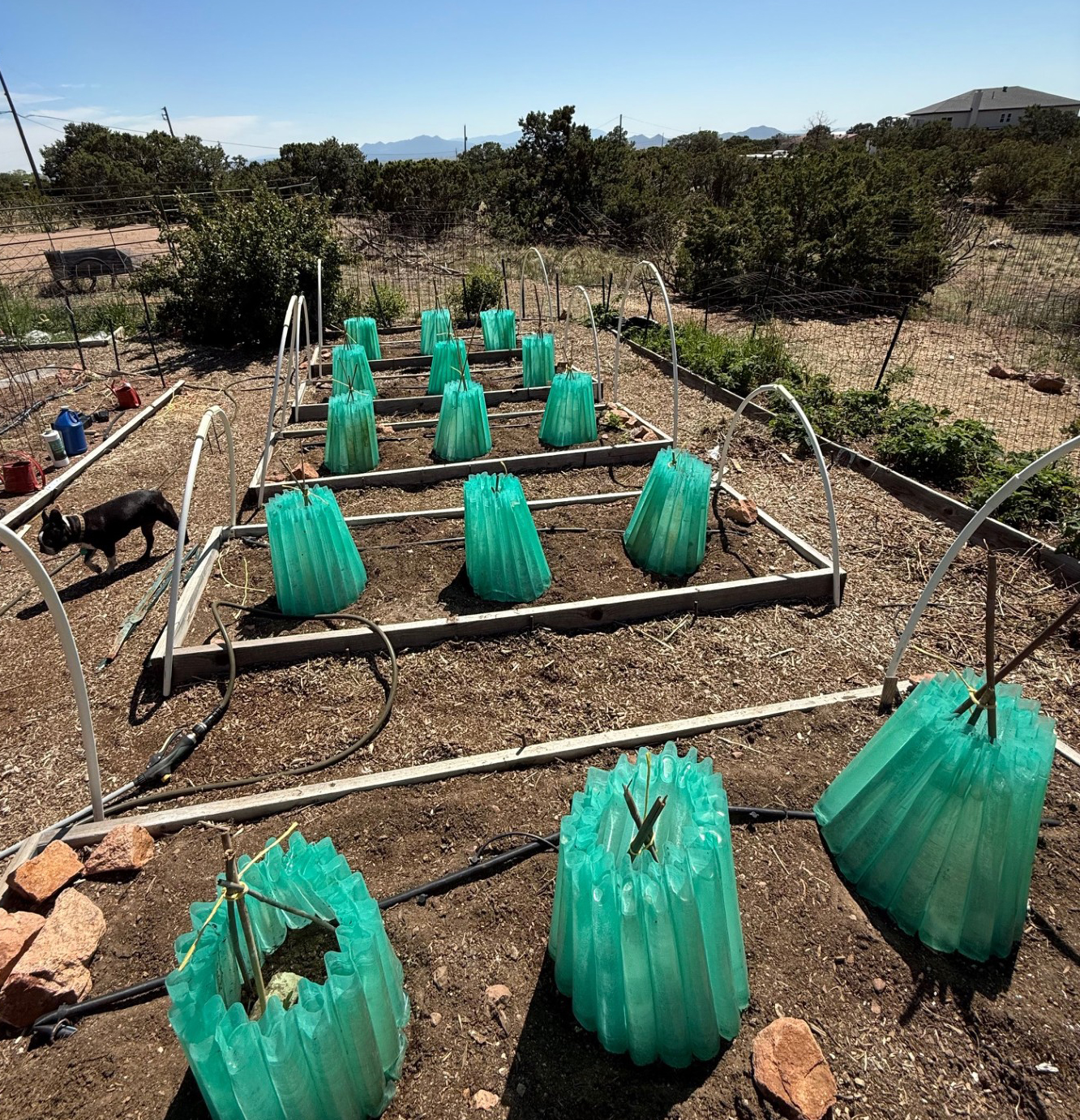
Wall of waters are season extenders to use to protect plants. I use mine as plant protectors in the spring to get certain plants like tomatoes and peppers out earlier in the season when they are smaller than what is normally recommended and cold at night.  Never use them in summer when it is hot-you will ‘cook’ your plant inside them.

What are wall of waters (WOWs)?

When the cells are filled up with water, they keep the plants warm by heating up in the daytime and releasing the heat for the plant at night. Wall of Waters are about 11″ tall so your plant will need to be small enough to fit inside to get protection.

Any taller plants will not be protected if they extend past the top of the wow. It acts as insulation to protect tomato plants from cold, rain, snow and wind.

Always put them around your plant in the morning, on a sunny day, so the water has time to heat up to protect them at nite.

Why do I do this?

-Living in a short growing season area, I can get plants outside earlier, knowing they will be protected from a freezing nite-actually down 26 degrees (I’ve even read it can protect to lower temps!) By using them, I can transplant my tomatoes outside earlier. The last few years, I’ve shaved off about 2 weeks from my schedule. I use to put my tomatoes out around May 15th which is the supposed first frost FREE day here in Santa Fe, NM-Zone 6B. Now I sneak them in the first week of May but maybe not this year with the wild temperature swings. And they work beautifully. This means that I will get ripe tomatoes sooner than if I waited for the outside temps to warm up before planting outside.

-The other thing they do is offer protection from our WIND, which can be ferocious in the spring and thrash your crops.

-And I even used them for my pepper plants too, which are even more cold sensitive than tomatoes. I will wait to plant pepper plants this year till the first week of June. Both tomatoes and peppers are warm season crops. You could even try them for eggplant starts. Wall of Waters come in a 3-pack. There are also many me-too products of wow that should be fine.

You can see the video here of how to use the wall of waters. Notice I plant the tomato in the ground, make a well around the plant, put drip line around the plant if you are using drip, and then put a 5 gallon bucket inverted over the plant, and put your empty wow over the 5 gallon bucket. This helps keep it from tipping over and squishing your plants when you start to fill the plastic cells with water. I usually do 2 cells on one side, and then go across to the opposite side and fill 2 cells and then start to fill the other cells around adjusting the wow to stand straight till all cells are filled up and then reach in and pull out the bucket and the wall of water will stand up. Because I live in a windy area, I also put some bamboo stakes inside right up against the wow on the inside but do not pierce it. This helps fight against the wind from knocking the wow over.

Be sure you take off the wows when it gets hot in June as leaving them on can fry your plants (remember the walls are heating up and it could get really hot inside). I only use these as an aid to get plants out earlier in spring.

-Let them dry out after you are done and store your wow’s in some kind of mouse-proof container to keep mice from eating holes in them in the off season.

Row cover-what is it and how to use it

One of two of my favorite aids to use in the garden

If you look at my vegetable garden throughout the season, you will see lots of white row cover over everything newly planted in my garden especially in spring when first planting crops out.

What is it? How can you use it? Where can you get it?

What is row cover?

Row cover, also called Remay as it is also called is a polypropylene material that you put over your crops or plants for protection from cold, to keep animals out and to help plants acclimate to our environment. Rain or water can go through it and sun comes thru although reduced if you get mid or heavy weight. It is not like a sheet, which doesn’t protect our plants. You’ll need to protect them in some kind of mouse proof container in the winter or the mice will eat holes in them. I store mine in a garbage can in the winter.

It comes in several ‘weights’

winter weight– is for when you need the most protection down 4-6 degrees below freezing. It lets in about 70% of light. I don’t use winter or heavy weight  anymore and  I would never use this weight in summer, the plants don’t need that heavy of material. I want more light to come through in the summer. My go-to now is medium weight.

medium weight– The medium weight of this row cover is 0.50-0.55 oz.
Medium weight covers allow 85% light transmission and provide frost protection down to 28 degrees. Medium or heavy covers is what should be used during our winters (that’s if you have crops then).

I use medium weight the most, especially in late spring and early summer when I’m first planting seeds and transplanting plants outside. If the night is going to be really cold, sometimes I double up the medium weight at night and fold it all back in the day. So if you only want to buy one weight, get this one. No matter what, always fold back the row cover so light can reach it in the day time and cover it back up at night if you have freezing temperatures. This exception is if it is below freezing in the daytime. Then keep it covered for that day. It lasts 2-3 years depending on the wind ripping it up.

light weight-I never use this as it tears up too easily in our spring winds. Waste of money.

How to use row cover

-I use it to protect new transplants from our high altitude sun. Also offers protection from wind.

-I use it to cover seeds I direct plant in the ground to help keep the ground from drying out.

-I use it to keep some plants (especially newly planted) from getting sunburned.

-I use it as a physical barrier to keep bugs that will damage plants off of them.

-I not only use it to protect newly planted plants but also when I put direct-seed like corn or beans in the soil, I put it over the crop-it protects from birds eating the seeds, giving them a chance to germinate. I uncover them when the sprouts are 3-4 inches tall. Birds just love corn and bean sprouts!

-I just lay a sheet of row cover directly over my plants, tacking it down with rocks or 2 x 4 wood so it doesn’t blow away. If you have a cold frame or want to use it on a raised bed, it helps to put some PVC hoops over the bed and then cover the hoops completely with heavy plastic for more protection with the plants inside with the row cover on top of them. You will need to uncover the plants in the daytime and cover at nite AND you need to vent the ends of your mini hoop house to let heat out in the day. You can google how to make a mini hoop house this way. Not hard to do and it let’s you get some crops in sooner.

Freezing weather gone

Screenshot

Last week we had 2 nights in the 27-28 degrees temperature wise. Hope if you planted outside, you had covered your plants with medium weight row cover. (no-sheets don’t work to cover plants). I leave my row cover on but pull it back to expose plants when it is nice out in the day and cover them back up at night.

You can find med weight (.5-.6) row cover in some nurseries, or online. Don’t get heavy weight row cover (.9+ weight-too heavy). Row cover is best for springtime fickle weather when one night it might be 40 degrees and the next night in the 30’s or even colder. We call this the shoulder season with both the daytime and nighttime temperatures swinging wildly in the transition time from winter to spring to summer.

Here is the forecast-Don’t get caught off guard.

Carl Foerster perennial garden

Today I want to share an experience I had while in Germany in March. I went to Paris and Berlin. While in Berlin, my friend, Lava, drove us to a Kandinsky exhibition in the Barberini Museum near Berlin in Potsdam, Germany. It was fantastic. Never seen so many Kandinsky in one museum.

I’ve been dying to see some green-not evergreen green but spring green as spring has been so harsh here in Santa Fe with the horrid winds. Both in Paris and Berlin spring was barely starting-not much green yet. After the Kandinsky exhibition, Lava drove to a garden in Potsdam that she thought I’d like.

It was the green I was craving. It was a small informal garden vs the very formal gardens seen elsewhere in Paris and Germany. It was arranged so beautifully!  It was a highlight while in Germany. I took a lot of photos while in the garden with it’s meandering paths.

While home and organizing my photos, I called my friend and asked if she knew the name of the garden. She said, Karl Foerster garden-I never knew that while there. She didn’t really know who he was but I did.

The garden is over 100 years old and his house, nurseries and greenhouses and a beautiful rustic birdhouse for doves on the property exist there.

So who is Karl Foerster? He is one of Germany’s most famous botanists. He was a German gardener, nurseryman, garden writer, and garden philosopher. He bred over 350 new plant specimens including some delphiniums, phloxes, and Karl Foerster reed grass that many of us in the states have in our perennial gardens.

The story of Karl Foerster grass
‘As the story goes, Karl was on a train when he saw the grass along the tracks. To seize the chance to collect the specimen, Karl pulled the emergency brake, stopped the train, and then quickly collected the specimen that now bears his name’-courtesy of https://thedailygardener.org

My guess was he was the train operator to be able to do that. While many gardeners have heard of Karl Foerster Grass or Feather Reed Grass, I didn’t know the story, or where he was from or really anything about him except that he was one of the most famous botanists in Germany and had a grass named after him.

“Grasses are the hair of mother earth.” I love this quote from him!

Karl kept his Jewish friends employed all through World War II war. After the war East Germany became under the control of the Soviets. Karl was allowed to have his gardens and nurseries.

Karl Foerster grass was the Perennial Plant of the Year in 2001. Karl’s plant performance expectations and appreciation for low-maintenance spaces with year-long seasonal interest helped shape the New German Garden garden design style. Karl Foerster garden had signature plants: grasses, delphinium, and phlox. https://thedailygardener.org

Foerster’s philosophy of planting is current today as we try to create gardens that are friendly to wildlife and the environment.

He bred hundreds of new perennial plants-over 350! What interested me was his influence of making his gardens with year-long interest for every season, hence his garden was already in spring and i got to see it. I hear it is glorious in the summer and fall but it was already beautiful to me in the beginning of spring.

Here are some photos I took while there.


“In my next life, I’d like to be a gardener once again.
The job was too big for just one lifetime.”

Karl Foerster


SPRING EQUINOX-get busy now gardeners

Today, March 20, 2025 is Spring Equinox in the Northern Hemisphere (that’s us here in Santa Fe). It represents the beginnings of spring and oh, how I long to see more ‘green’. The wind’s been particularly brutal this year in March. Hoping the wind and the juniper pollen will abate soon.

Spring Equinox is where the days and nights are equal in length so we will be getting longer days too from here on! I have written several posts on spring equinox that you can access here.

Weekly Weather Forecast-March 20

I’m getting a late start to starting my veggie seeds inside the house as I’m planting them by this weekend. Usually I start pepper/tomato seeds much earlier in March because they take longer to get to transplant size. But I just returned from a Paris and Berlin trip on Tuesday, March 18. Spring is just starting over there (a little, like here), not much budding yet.

But I did see one very inspiring garden outside Berlin while visiting my good friend Lava. I will write a post soon on this garden. It was fantastic.

Meanwhile the days and nights are still cold but the days are starting to get warmer this week. Yay! Time to shake off the winter blues and get busy in our gardens!

As they say, “Spring Has Sprung”, and I’m recharged and ready!

Prune grapes in late winter-early spring

Today I’m gonna attempt to explain grape pruning. I found grape pruning very confusing at first. But not to worry-you will start to understand as you do it. Also look at the many videos on youtube on this subject. If you haven’t pruned your grape plants yet, now is a good time to do it. The best time to prune grape vines is in late winter and early spring, when the leaf buds on the tips of last year’s canes start to swell. There are 2 styles of pruning-cordon pruning and cane pruning. If your not sure what kind of grapes you have, then try cane pruning.

Cane pruning-This is how I prune my table eating grapes. My variety is Himrod, a green seedless table eating grape that does well here in Santa Fe. I have trained my grapes to grow on a fence but you can make supports as seen in the video below if you want.

I started with 2 main vines (called cordons) from the main plant years ago. They’re basically in a T shape off the main. A few years later I let 2 more canes grow on a lower level. Kinda a modified cane pruning because I let more than 2 grow off the main plant–2 cordons on the top and 2 lower. Off these cordons, each year new smaller cane vines will grow vertically from which the grapes come. I will trim back (but not off) these vertical canes before the growing season. I cut the old 1 year growth from last year canes (which are lighter brown than older growth) back to 3 buds on each cane to grow again. Each bud will put out new canes and off these new canes will grow grapes. I try to have at least 6″ to 12″ of space between the canes along the 4 main cordons so as not to overcrowd. Sometimes a cane will grow 4-10′ or more in length. I cut these back the same way. You may think you are cutting off too much, but grape plants are very forgiving and I rather not have a grape plant that is out of control with too many canes growing every which way. Besides your grapes will be bigger.

Look at this video that I found online. I Hope it helps visualize this process:

Pruning Fruit Trees and growing advice

Some years ago I had tree arborist, Tracy Neal, (now retired) out to the house to help me with pruning my fruit trees and give me advice on care of them. Not that I hadn’t already pruned (butchered) them that year, it’s just that I needed some tweaking with my pruning skills. Hmm..

When I put them in 30 years ago, I thought all fruit trees should be pruned in a open vase shape but that’s not true. Apple trees should have one central leader up the middle with all the branches off of it (kinda like a xmas tree) while apricots, peaches and plums have the open vase shape or modified vase shape. Sorry the photo is a little blurred. So what did I find out besides that?


-We had to trim up the four semi-dwarf apple trees and still do almost every year. At least I didn’t just top them off with shears (bad-no-no). At this age of the trees, it’s too late to do any major adjustment without drastically hurting the tree. (Thank god as I was afraid we might have to cut off some branches as big as my wrist). I told him I had cut off about a third of the top smaller branches of the Granny Smith apple as they grew about 6 feet tall last year and put out LOTS of apples. So much so that many of the branches got too heavy and broke off. So I put 1×4 boards or 2×4 boards that were tall enough with a V cut on the top end (to rest the limb vertically into) and had each heavy branch supported by the board that went to the ground. The weight of the branches on the board should hold the board up.

-Also I didn’t want the trees to get too high and out of control.  When I asked how much to trim off each year, Tracy said you can trim back to the top of where you stand on the ladder (LOL) to help keep it contained. Also I was trimming out too much in the interior. I had to put cages around the apples as well to keep the deer from rutting on them as they killed one-half of one of my apple trees by rubbing their antlers on a limb in fall but the tree survived.

-I need to expand the wells around the trees a little, put some Yum-Yum mix fertilizer around them, sprinkle either Planters II mix or Azomite for minerals on top of soil and scratched in . Then innoculate soil with some mycorrhizal. Pound holes into ground to root area and put mycorrhizal in holes-then water well. Add 2-4 inches of mulch on top of soil keeping it 3″ away from the base of the trunk (if you smother the tree trunk with dirt up to the trunk, it will die).

-The apricot tree is fine and he said each apricot tree is a piece of art. Just had to trim out a few branches that were growing in a walking path and add the above amendments. Unfortunately my one apricot tree is now growing in the shadows of pinyon trees, so now it doesn’t produce fruit. But you know what I call an apricot tree? A good shade tree! Plus it has fantastic color in the fall. Any tree that can grow here is good!

-I have one young pear tree that produced 2 pears last year and hopefully will produce more this year. The deer ate one of the fruit so now they have a cage around it to keep off the deer.

-I asked him about how to water an established tree and he suggested using a soaker hose on each tree at the drip line and inside the well. Water deeply (longer) instead of shallow watering. My spaghetti drip line is not enough anymore.

-I had 2 dead peach trees and 1 dead plum tree. I’m NOT going to replace them as they all require more moisture and are not very drought tolerant. I’ll turn off the drip system to the dead ones and take them out. So the only producing fruit trees left are four apple and one pear.

Black Nebula Carrot/Soup

Carrots come in all colors these days and this past season, in addition to Cosmic Purple and Atomic Red carrots I grew, (which are orange inside), I found online a carrot variety called Black Nebula. I always want to explore the garden universe! I like to try new varieties and this sounded interesting! It’s deep purple-black outside and inside. I’ve always seen carrots mostly orange inside, so I thought I’d try it. It is an open-pollinated (OP) rare variety and the seeds can be saved. It does well in our heat and grew all summer till harvest time in the fall-75 days to harvest. I got it from trueleafmarket.com. I thought they would be good roasted in the oven with other colors of carrots and they were very tasty.


Then I thought of making them into carrot soup. The carrot soup  I make always turns out orange. I knew I wouldn’t put the orange carrots and black carrots together to make soup as I thought the soup would be grayish. I gave Mernie, a friend, some of the black nebula carrots and she made them into soup. It turned out the most beautiful purple color and had a nutty/sweet taste. Ah ha-another way to use them! And they don’t taste like beets but true carrot flavor.

Here is a carrot soup recipe I gave her. You can use it for any carrot soup. As you can see, I’ve used it a lot and made some adjustments. So I went ahead and retyped the recipe as this one is too beat up from use.

Here is the recipe for you to print out. Enjoy!

HARVEST CREAM OF CARROT SOUP


How long do seeds last?

Now that the new growing season is upon us, just how long do seeds last and how can you know if they’re too old for germination and when you should replace them? If you are into seed buying right now, read on.

Even though I’ve started buying a few new vegetable seeds of varieties I’ve never tried for this coming season, I’m just going through all my existing seeds to see what might be getting old, what seeds are already too old, I what I should throw out and what I need to replace.

Here’s how to decide what condition your seeds are in to help determine their viability. On most package of seeds, there is a date on them to help you know the age of your seeds and whether they are viable. If there is not a date, I write down the year I bought them on the seed envelope and if I get the seeds from a friend, I ask how old they are and write that date down. I’ve bought seeds with no date and didn’t write the date I bought them which then can become a problem. But there is something you can do to help determine if they are too old.

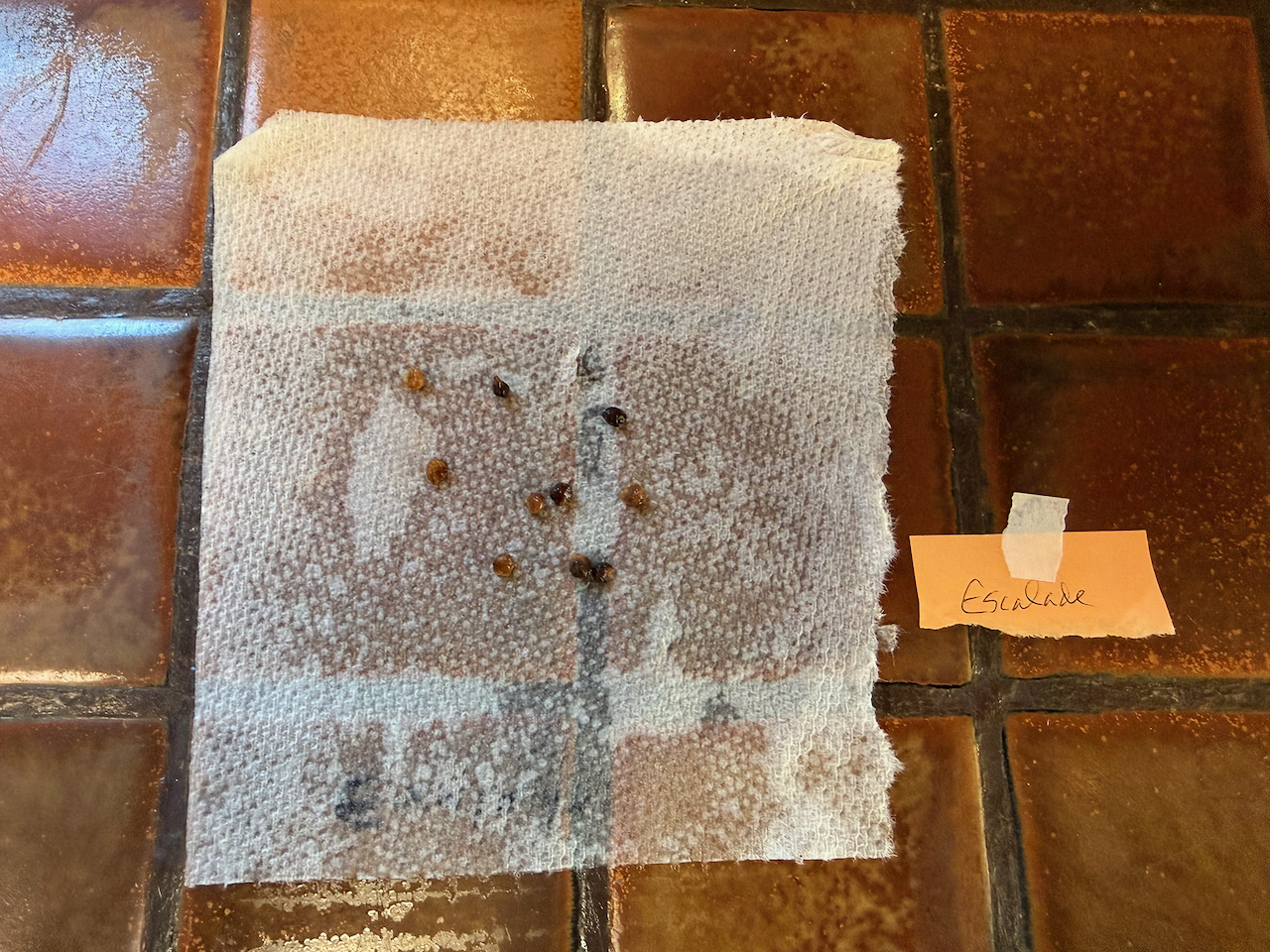
I take 10 seeds of one variety and put them in a damp paper towel folded up and put it in a zipped plastic baggie. Then I put them someplace warm like the top of your refrigerator to help them germinate. Check for germination in a few days up to 10 days. If you have 8 germinate, then you have a 80% germination rate which is excellent. If you have say 5 seeds germinate then you have 50% germination rate. If I find I have less than 50%, I don’t necessarily throw them out but maybe double them when you plant the seeds. If I have 30% or less, I usually toss them. The only problem with doubling up the seeds is if you are on a timetable where you need to get them in the garden by a date you picked and they don’t germinate, you may be replanting the seeds without enough time to start over and get them in the garden in time.

Having said that, I still hold the NM State record for a giant green pumpkin that I grew from a seed that was 9 years old but it was the only seed I had for a green pumpkin and it turned out to be a huge pumpkin at 340 lbs. And I’ve heard of seeds found in Egyptian tombs that germinated.


How you store them has an effect on seed germination. Freezing extends the life of the seed, so that’s an option but you must make sure the seed is really dry. I put one of those little packages of desiccant (you find in your vitamin bottles) inside your freezer baggie. I save those and put one in with the seeds. You must keep the seeds from getting moldy. You don’t have to freeze your seeds. Sometimes, I just let them stay in my greenhouse during winter  in jars but be sure mice can’t get to them. But mostly, I just keep the seeds in their envelopes inside the house in a nice dry place. And you may have heard of the Svalbard vault where they store thousand varieties of seeds in sub-zero environment to make sure they don’t go extinct. Did you know we’ve lost 90% of vegetable varieties through the years by people not keeping the varieties going?

Here is a seed lifespan chart. This is a guide only and some seeds can last longer if you take care of your saved seeds.

So now is a good time to check out your seed supplies and get your replacements before the season starts.


Winter Solstice This Saturday, Dec 21

Photo courtesy of agwaycapecod.com

Winter Solstice is upon us here in the Northern Hemisphere occurring on this Saturday, December 21 at 2:21 am MT in 2024. It is the shortest day and longest night of year in the Northern Hemisphere.

It will be Winter Solstice here in the Northern Hemisphere and is reverse in the Southern Hemisphere (summer).

The Earth’s has a tilt of 23.5 degrees off vertical axis (vertical would be from North Pole to South Pole.) This gives us our seasons. In the winter the sun is furthest away from us here in the Northern Hemisphere and in the summer (Summer Solstice) it is closest to us as as the earth is tilted either away or towards the sun. The sun still rises in the east and sets in the west, it’s the angle that changes.

The most direct sunlight shifts between a band of latitudes, specifically between the Tropic of Cancer and Tropical of Capricorn, throughout the year, with it closest to the Tropic of Capricorn on Winter Solstice.

Here in Santa Fe, as a gardener, I always notice how far south the sun is in winter and how far north the sun is in the summer. This orientation affects how and where we plant our crops. And although most of us are not growing crops in the winter, it is good to note where the sun is for us.

We have a passive solar home where the sun comes in our southern windows all winter, heating our tile floors and providing extra warmth but in the summer the angle of the sun shifts north, shining in our north facing window and the south side of the home stays cooler not receiving any sun on our floors.

Many countries have celebrations surrounding Winter Solstice.

Pagan Traditions

Pagan traditions in parts of Europe celebrated the solstice through gatherings like the Germanic Yuletide, where the Wild Hunt was believed to roam the skies. Scandinavians honored the Norse god Odin during the festival of Jul (Yule).

Indigenous Traditions

Indigenous cultures, such as the Inuit and various Native American tribes, had ceremonies and rituals tied to the solstice. These often involved storytelling, drumming, and ceremonies to honor the change of seasons and the renewal of life.

While it’s dark, the day also marks the “returning of the sun,” and many celebrate the day as a symbolic time of rebirth or a time to celebrate light.

I look forward to longer daylight and use this time to rejuvenate myself and reflect on my gardens and plan the new gardening season.

Part of this post regarding the photo and traditions courtesy of agwaycapecod.com.


2024 Mid-September in my garden

Follow me as I walk-around my garden back in mid-September. This year I had some successes and disappointments. I talk about some o them.


Vegetable Garden Tour with the Tomato Lady

On August 31, my vegetable garden was in the Santa Fe Extension Master Gardener’s private garden tours. People had lots of questions. I thought it might be helpful to address them on my blog so everyone would have access to the information I shared.

When you walk into the vegetable garden, there are immediately two beds with many annual flowers-cosmos, zinnias, hollyhocks, red amaranth, sunflowers and marigolds. More flowers will attract pollinators and beneficial bugs.

Gem Marigolds
This one was most asked about. You can buy seeds on line. This variety keeps flowering, creating huge bouquets of little flowers. I let them dry in the fall and shake them where I want them to reseed the next year.


Rattlesnake beans Around a big pole teepee are Rattlesnake beans, (green bean) which are very heat tolerant. Great for our warm climate.


Kalibos Cabbage
A beautiful red cone shaped cabbage. The head gets very big and when I want to harvest it, I need a sawzall to cut it off at the stem because it is so thick! It has a sweet mild flavor.


Fertilizers
All the vegetable/berry plants are fertilized once a month with a combo of fish fertilizer and liquid seaweed sprayed on the leaves with a hand-held one-gallon sprayer.


Diseases
I use Monterey Complete Disease Control (organic) for Early Blight and Septoria on tomatoes and Powdery Mildew on all cucurbits. I add this with the fertilizers above and spray everything all at once. Also rotate crops every year to help suppress diseases.


Insecticides
For the last several years I haven’t used insecticides. I grow many flowers that attract beneficial bugs that help keep the bugs under control. But when I do have bad bugs, I use organic Neem in a hand held sprayer. Spray in morning to avoid possibly burning the leaves.


Pests
I use snap traps on gophers, mice and rats.


Shade Cloth
I put 30% shade cloth over almost all my plants.

I get it at johnnyseeds online. I like shade cloth because it keeps most hail out, keeps many moths out of my garden (like cabbage moths) and provides relief from the sun for our vegetable plants-even full sun plants. You’ll have to get it online as the local big box stores have 80-90% shade cloth which is too dark.


Hose
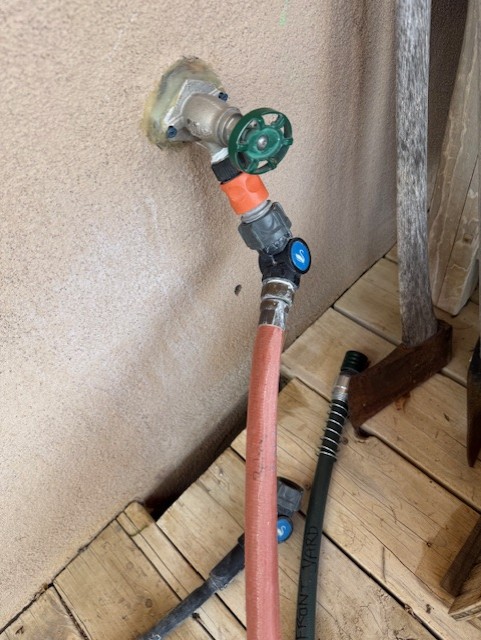
I know this seems like a weird subject, but we’ve all experience hoses that heavy and kink. This is the best hose ever-it NEVER KINKS. Don’t be fooled by its smaller diameter and light weight; this is a great hose and worth every penny. Because it’s expensive, I always bring it inside in the winter. I bought the 500 series at Water Right Hose It can also be found on Amazon.


Soil Amendments
Making good soil is the most important thing you can do for an abundant garden. Here’s what I do:

Compost
Every year I put 2” of compost I make on top of my beds in the spring and lightly dig it in. We have such bad soil out here in our area that I think this is the most important thing to do each year. If you do this, you’ll make healthy soil in a few years. If you don’t make compost, you can buy some locally here in Santa Fe from Reunity Resources. They don’t use horse manure so it is herbicide free.

Whenever you buy compost from soil yards, ask if they use horse manure to make it. Can they guarantee their compost to be herbicide free? Bagged compost is usually fine. Many hay growers spray their hay crops with commercial herbicides similar to RoundUp. If it is in horse manure to make compost, It will kill your crops and ruin your soil.

Azomite
Every 3-4 years I get Azomite from Amazon. Provides minerals and trace elements that plants use up from the soil. It is in powder form and in spring, I sprinkle it over all my annual beds and lightly dig in and for perennial plants  I sprinkle it around the base of plants or over the foliage and water in.

More questions? Email me at jcabossel@hotmail.com