Wall of Waters-what they are and how to use them

A

Wall of waters (WOWs)

Wall of waters are season extenders to use to protect plants. I use mine as plant protectors in the spring to get certain plants like tomatoes and peppers out earlier in the season when they are smaller than what is normally recommended and cold at night.  Never use them in summer when it is hot-you will ‘cook’ your plant inside them.

What are wall of waters (WOWs)?

When the cells are filled up with water, they keep the plants warm by heating up in the daytime and releasing the heat for the plant at night. Wall of Waters are about 11″ tall so your plant will need to be small enough to fit inside to get protection.

Any taller plants will not be protected if they extend past the top of the wow. It acts as insulation to protect tomato plants from cold, rain, snow and wind.

Always put them around your plant in the morning, on a sunny day, so the water has time to heat up to protect them at nite.

Why do I do this?

-Living in a short growing season area, I can get plants outside earlier, knowing they will be protected from a freezing nite-actually down 26 degrees (I’ve even read it can protect to lower temps!) By using them, I can transplant my tomatoes outside earlier. The last few years, I’ve shaved off about 2 weeks from my schedule. I use to put my tomatoes out around May 15th which is the supposed first frost FREE day here in Santa Fe, NM-Zone 6B. Now I sneak them in the first week of May but maybe not this year with the wild temperature swings. And they work beautifully. This means that I will get ripe tomatoes sooner than if I waited for the outside temps to warm up before planting outside.

-The other thing they do is offer protection from our WIND, which can be ferocious in the spring and thrash your crops.

-And I even used them for my pepper plants too, which are even more cold sensitive than tomatoes. I will wait to plant pepper plants this year till the first week of June. Both tomatoes and peppers are warm season crops. You could even try them for eggplant starts. Wall of Waters come in a 3-pack. There are also many me-too products of wow that should be fine.

You can see the video here of how to use the wall of waters. Notice I plant the tomato in the ground, make a well around the plant, put drip line around the plant if you are using drip, and then put a 5 gallon bucket inverted over the plant, and put your empty wow over the 5 gallon bucket. This helps keep it from tipping over and squishing your plants when you start to fill the plastic cells with water. I usually do 2 cells on one side, and then go across to the opposite side and fill 2 cells and then start to fill the other cells around adjusting the wow to stand straight till all cells are filled up and then reach in and pull out the bucket and the wall of water will stand up. Because I live in a windy area, I also put some bamboo stakes inside right up against the wow on the inside but do not pierce it. This helps fight against the wind from knocking the wow over.

Be sure you take off the wows when it gets hot in June as leaving them on can fry your plants (remember the walls are heating up and it could get really hot inside). I only use these as an aid to get plants out earlier in spring.

-Let them dry out after you are done and store your wow’s in some kind of mouse-proof container to keep mice from eating holes in them in the off season.

Row cover-what is it and how to use it

One of two of my favorite aids to use in the garden

If you look at my vegetable garden throughout the season, you will see lots of white row cover over everything newly planted in my garden especially in spring when first planting crops out.

What is it? How can you use it? Where can you get it?

What is row cover?

Row cover, also called Remay as it is also called is a polypropylene material that you put over your crops or plants for protection from cold, to keep animals out and to help plants acclimate to our environment. Rain or water can go through it and sun comes thru although reduced if you get mid or heavy weight. It is not like a sheet, which doesn’t protect our plants. You’ll need to protect them in some kind of mouse proof container in the winter or the mice will eat holes in them. I store mine in a garbage can in the winter.

It comes in several ‘weights’

winter weight– is for when you need the most protection down 4-6 degrees below freezing. It lets in about 70% of light. I don’t use winter or heavy weight  anymore and  I would never use this weight in summer, the plants don’t need that heavy of material. I want more light to come through in the summer. My go-to now is medium weight.

medium weight– The medium weight of this row cover is 0.50-0.55 oz.
Medium weight covers allow 85% light transmission and provide frost protection down to 28 degrees. Medium or heavy covers is what should be used during our winters (that’s if you have crops then).

I use medium weight the most, especially in late spring and early summer when I’m first planting seeds and transplanting plants outside. If the night is going to be really cold, sometimes I double up the medium weight at night and fold it all back in the day. So if you only want to buy one weight, get this one. No matter what, always fold back the row cover so light can reach it in the day time and cover it back up at night if you have freezing temperatures. This exception is if it is below freezing in the daytime. Then keep it covered for that day. It lasts 2-3 years depending on the wind ripping it up.

light weight-I never use this as it tears up too easily in our spring winds. Waste of money.

How to use row cover

-I use it to protect new transplants from our high altitude sun. Also offers protection from wind.

-I use it to cover seeds I direct plant in the ground to help keep the ground from drying out.

-I use it to keep some plants (especially newly planted) from getting sunburned.

-I use it as a physical barrier to keep bugs that will damage plants off of them.

-I not only use it to protect newly planted plants but also when I put direct-seed like corn or beans in the soil, I put it over the crop-it protects from birds eating the seeds, giving them a chance to germinate. I uncover them when the sprouts are 3-4 inches tall. Birds just love corn and bean sprouts!

-I just lay a sheet of row cover directly over my plants, tacking it down with rocks or 2 x 4 wood so it doesn’t blow away. If you have a cold frame or want to use it on a raised bed, it helps to put some PVC hoops over the bed and then cover the hoops completely with heavy plastic for more protection with the plants inside with the row cover on top of them. You will need to uncover the plants in the daytime and cover at nite AND you need to vent the ends of your mini hoop house to let heat out in the day. You can google how to make a mini hoop house this way. Not hard to do and it let’s you get some crops in sooner.

Root Trainers-unique propagating trays

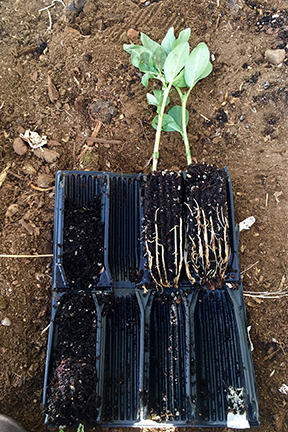
Fava beans in Root Trainer

I started using ‘Deep Root trainers’ last year for my fava beans and other bean crops that need deep cells or for plants that don’t want the roots disturbed when planting. The cool thing about them is that the cells are 5 inches deep and shaped like a clamshell, with two sides that open up like a book.  There are 8 sections total that fit snugly in a tray to hold them upright that comes with the kit. They are great as they have grooves that keep the roots growing straight instead of circling in the cell and strangling the plant. They also air prune when they hit the bottom of the cell.  No need to transplant into another pot, just plant them out in the garden. You just put seed starting soil in each cell, pat it down and put the seeds in. The only drawback is the plastic clamshells are very fragile and must be handled super carefully to keep from cracking but knowing that, I am careful and have them for three years so far. You can get them through Amazon. Get the 5″ deep ones, NOT the 3″ ones.

Pictured above are fava beans in their cells, 6 are already planted in the ground. Just carefully open the clamshell and slide them out into your hole in the ground with no root disturbance for those sensitive plants that hate to be transplanted.

Craupadine beets started in Root Trainer

I also used root trainers with a hard to germinate french variety of beet called ‘Craupadine’. It is probably the oldest beet in existence. I have not had much luck with germination when planting these seeds directly in the ground so I decided to try them in the rootrrainers this year and have much better germination although still spotty. I thought being a root vegetable, they probably would not like to have that main root disturbed. I think they will do well. I won’t wait till the plants are too big.  I am planting them outside after the first true leaves (cotyledon leaves) come out. So far 27 have germinated which is more than I have ever grown at one time.  They are ready for transplant above. I am so excited as these are the sweetest beets I’ve ever eaten. The french farmer markets cook them over a smokey fire in foil and serve them still warm.

Make a seed box

seed-box2

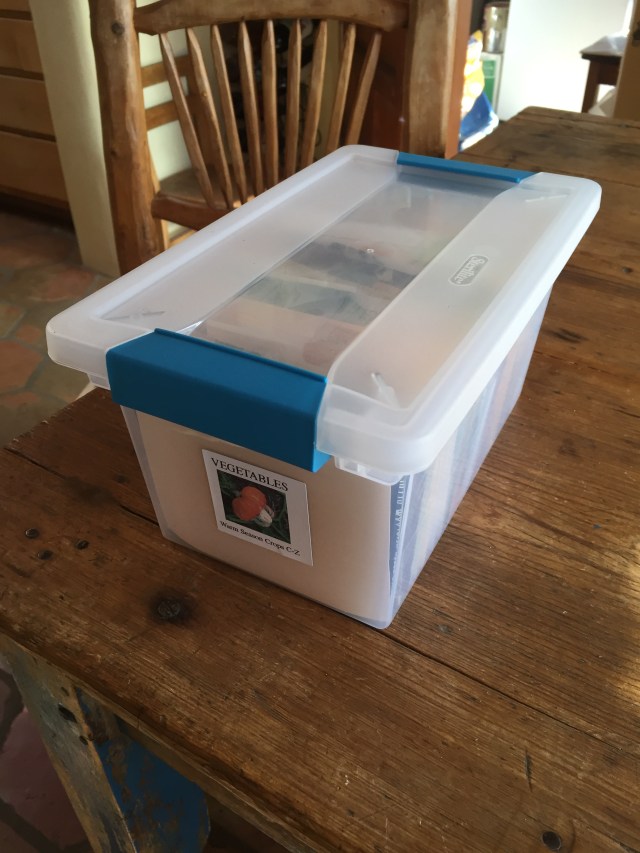
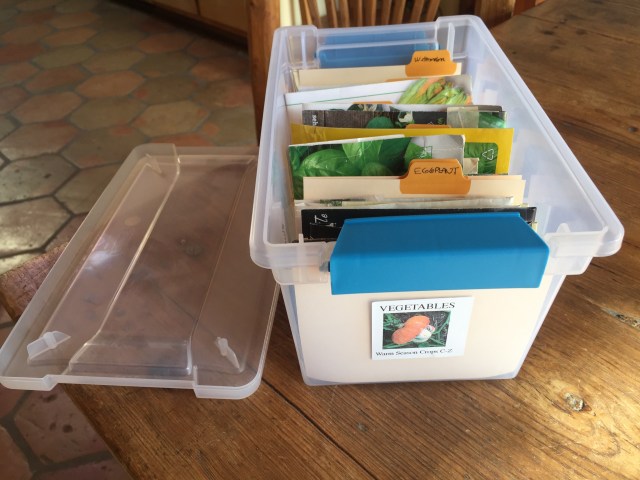
I have my saved seeds everywhere. I had them in cardboard boxes which have seen better days. Some got wet, some got chewed by mice where I keep them in a shed. I needed to get better organized and wanted better protection from the elements and mice so I found some boxes with lids with clasps.

seed-box1

After that, I got some cardboard dividers for the different varieties of vegetable seeds. I had to trim them down to fit in the box and I had to fold over some of the seed packages so they would fit inside. I also made some labels for each box like Cold Season varieties, Warm Season varieties and many other categories. So far I have 6 boxes done. Nice project for winter.

Tomato Hornworms – finding them with UV light at night

tomato-hornworm1

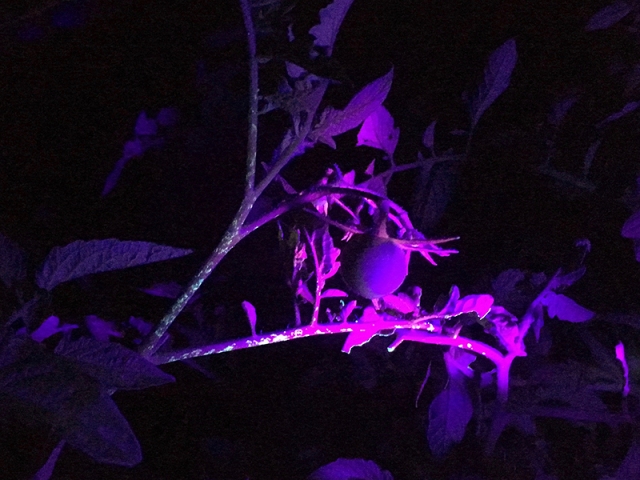
I read that you can see tomato hornworms with a UV (ultraviolet) light. Two nights ago we went out to see if we could spot them. I had gotten a UV flashlight last year but didn’t receive it till after the first freeze so there wasn’t much to see. But not that night!  In the daylight I could only see the chewed up leaves on 2 plants but could not find the hornworms. But at night they are easy to spot with the UV light. We found many small ones as well as big ones that we would have missed if not for the UV light.

tomato-hornworm-bitemarks

Also we noticed that there seem to be either fluorescent bite marks or trails where they had been so if we saw these we would see if any were hiding. We probably got 30 tomato hornworms in all. What a great way to find them.

How to use my gardening website

apricot blossoms

Many people have contacted me about what’s going on in their vegetable and fruit gardens in the high desert of Santa Fe, New Mexico or in Zone 6a throughout the seasons and have particular questions. Feel free to write me but I want to go over how to use this website to your greatest advantage. Every few days I post something about what’s going on in the garden, or garden stuff I want to share. One way is to just go backwards (scroll down) and read them. But let’s say you have a question about growing tomatoes. You could go backwards which would take you forever as I have over 650 posts on various subjects (so far) but another faster way would be go over to the right hand column of this blog. From there:

Go down to ‘GARDEN TOPICS’ and scroll down to whatever interests you (in this case tomatoes) from starting tomatoes from seed, to garden hints, or all the way down to tomatoes in the vegetable section. That way you can cut out subjects that aren’t interesting for you. (What?)

Another thing I like in the right column is the ‘ARCHIVES’  section where you can read my posts for a particular month and even for a particular year. I use this a lot for myself as I look up when I planted something in previous years, or other info I want to review again for a particular month.

Another section is called, ‘PAGES’ which you can access from the right column or on the top menus on the blog. I think this is a great resource as you can look up the page for catalogs I like to get, my garden plans for each year, my seed lists of what I’m planting that year, classes I may offer,  films I’ve made from my Youtube channel-giantveggiegardener, Santa Fe Extension Master Gardener’s radio show, ‘The Garden Journal’ where I talk about what to do in the vegetable garden each month. and even the about me page with info about me and this website (if you care to know!)

So next time it’s snowing or cold and windy outside this winter, take some time to catch up on what’s going on. I know I do!

Use fencing wire for cages over vegetables

fence cage done

Fence cage covered with row cover for protecting vegetables. Shown with Tom-Tom the great packrat hunter!

The other day some of my followers on my blog asked what was under that row cover that was holding it up and I thought it was a great question. I’d like to say it was my idea but it wasn’t. A friend of mine, Tom (who helped me build the greenhouse) gave me those structures. It’s an ingenious idea.

fence cage ready

fence cage ready to go over vegetables

He took a 5′ tall roll of fencing wire (the holes were 2 inches by 4 inches but the hole size doesn’t really matter) and cut it into pieces that when bent in half would be about 15 inches high. You could make taller ones as well. I use to make hoops from 9 gauge wire but this is easier and supports the row cover better especially if it hails. I use them for low growing vegetables, vegetables that may need some shade, vegetables that I need to protect from insects and for transplants that need to acclimate to our harsh climate when I first put them out. The pokey ends get pushed into the ground. Then you put a piece of row cover over it big enough to cover both sides and the ends. The wind won’t pick up the row cover if you put rocks around the edges of the row cover. If you have longer rows, just over lap the cages to extend them.

closeup of fence cage

Closeup of fence cage covering kale and chard. Drip system in place.

I water with a drip system so I don’t have to get under them that much but they are easy enough to lift up on one side and tip back to get to the plants underneath to water. He originally bought the wire to make his tomato cages but found that you can’t get your hands through the holes to harvest and if you cut out some of the wire to make the holes bigger, the sharp edges shred your hands where you cut the wire so he used the wire this way. He had to move so he gave me the wire structures. What a great gift!

Lookee What I Found!

Yesterday I found all kinds of things!  Now I’m not the greatest at putting my tools away after I’m done with them. In fact it’s like leaving a trail of breadcrumbs for anyone to see where I’ve been. So I decided to walk around the gardens here at the house before the Arctic Blast comes in this weekend to see what tools I could still find outside. I wanted to do #9 in my earlier post of 10 Things to Do for December’.

found _lopers

First I found one of my lopers (my best one) hanging on a chair on the deck—and it was in plain sight. I’ve must have walked by it a hundred times and never saw it before!

found _leaf rakeI was wondering where that leaf rake went! Here it is leaning on the arbor in the shadows!

found_rake and apple pickerAnd on the other side of the arbor is a fence and I found an extension cord,  mini leaf rake and apple picker leaning on it (what’s that apple picker doing there? There are no apple trees up by the house!)

found_coffee cupAnd lookee what else I found! My favorite coffee cup still filled with coffee!  Yes that is a cup (the handle is on the other side). I was wondering where I left it cause it’s been MIA for a while. That will be fun to scrub out!

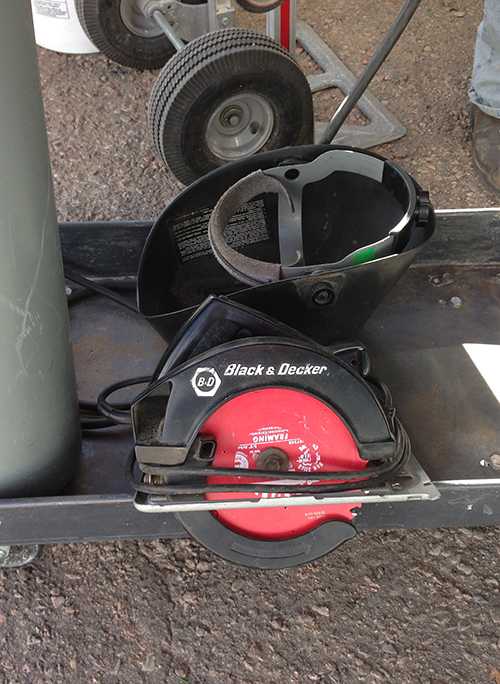
found_sawAnd then when I went to the shop I found the circular saw that I had at the house that mysteriously disappeared.  I took it back to the house so I can finish the greenhouse!

Roo Apron

Roo apron

Got this nifty gift for Christmas-a ‘Roo Apron‘. It fits all and has a large kangaroo pocket where you put your harvest instead of putting it in a basket you lug around. Then you can easily empty it in whatever you want. Also has some handy pockets to hold your cutting tools. I see using it for harvesting my apples when I’m up on a ladder. I can see using it for potatoes, eggplants, peppers, corn and just about anything that won’t crack in the big pocket. When full the bottom opens up to release your produce. Can’t wait to use it next year. So many times I go into the garden and just take a few things and then before you know it my hands are full. Not anymore!

This was purchased at Peaceful Garden Grow Organic website:

http://www.groworganic.com/catalogsearch/result/?order=relevance&dir=desc&q=the+Roo+apron&x=0&y=0