Weigh-Off time is upon us!

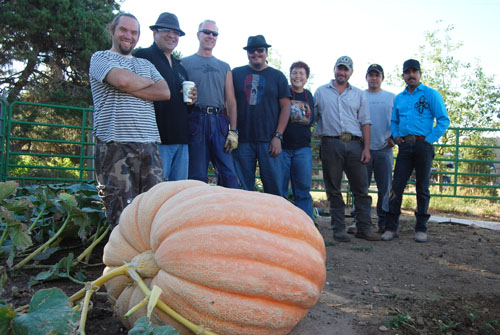
The crew-from left Spooner, Ed, Per, Ira, me, Javier, Daniel, and Beto-THE KONG BOYS!

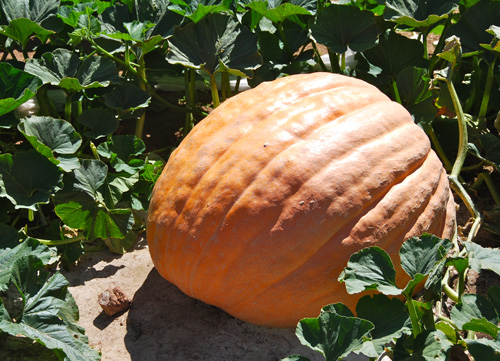
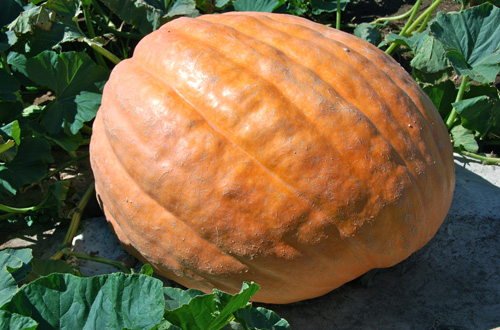
The weigh-off is almost upon us. Tomorrow the pumpkin/greenie squashes will be cut at 8 am and loaded in the truck on pallets. How do I get all this weight in the bed of a truck? 8 strong men! These guys are the best and nicest guys around and I REALLY appreciate their help. I couldn’t do it without them. Here are last year’s crew with my giant pumpkin, ‘Kong’ at 421 lbs. This year’s giant pumpkin, MAD MAX is 463 lbs and the ‘Greenie’ squash, Jabba the Hut is 347 lbs.!  Hope the guys have been working out! More pics tomorrow of the loading of the giants!

MAD MAX reaches 439 lbs!

'MAD MAX' reaches 439 lbs

Well my giant pumpkin, MAX or MAD MAX as my neighbor calls him has now (according to the tape measure) reached 439 lbs! He is squeaking out the lbs but still gaining nonetheless. If this is true he will be the new NM State Record set last year at 421 lbs by Kong. I’m holding out for the Oct 15th GPC Weigh-Off. It’s suppose to get cold later this week-down to 36°F at night but as long as it doesn’t reach 32°F Max will be ok. I always cover MAX every night with blankets but will cover the whole plant as well starting on Thursday when the cold snap hits, just to be sure and give the leaves a few extra degrees of protection. I’ve never gone so late to a pumpkin contest because here at an altitude of 7000 feet high you really are playing Russian roulette with the weather. We always get a freeze in Otober, I’m just hoping it waits till after the contest…

Giant Pumpkin, ‘MAX’ hits 421lbs-same weight as last year’s Kong!

My main pumpkin, MAX reached 421 lbs yesterday! I still have a few warm days of September before the big GPC (Giant Pumpkin Commonwealth) weigh-off on October 15th in Colorado Springs, CO. Hopefully it will keep packing on the pounds although it has slowed to a crawl as it gets colder at night. I brought out a blanket to help keep it warm at night. Sounds crazy but if you think about it, the pumpkin is a really large mass and if you let it get cold, it takes a long time in the day to warm up before it starts growing again-sorta like our glass blowing furnace! It looks like it will beat my last year’s NM State record, Kong if the tape measurements are true. They say orange pumpkins weigh lighter than salmon ones with the same measurements so I still want more weight to ensure a new record. Just hoping this glorious weather holds up and we have no freezes till after the weigh-off. GROW NAGUA, GROW!!

Giant Pumpkin ‘MAX’ hits 350 lbs on Sept 1

MAX hits 350 on Sept 1, 2011

MAX hits 350 lbs today! It continues to grow although it is starting to slow down a bit-no more 11 lb daily gains. I was in the patch and added a few drip emitters and dug the well out again around it and put compost in the well to help slow evaporation.If we get more rain, it might help it gain more as all the secondary vines will suck up water too.

The good news is last year’s champ, Kong was 228 lbs on this date, Sept 1, of last year. I went back and compared pictures and stats from last year’s Sept 1 to this year. They look a lot alike (of course they do their siblings!) only MAX is more orange and bigger. Now mind you Max is 53 days old and Kong was 35 days old on Sept 1 of last year. Max got pollinated earlier than Kong. I figured MAX has extra growing days. Either way I’ll take it. MAX now needs 77 lbs to beat the State record I set last year. I wonder if anyone else is shooting for the State Record this year. Hmmm…

Giant Pumpkin named ‘MAX’

MAX at 216 lbs on August 16, 2011

Well I culled the last little pumpkin on the 895 Grande pumpkin plant, leaving one giant pumpkin who I’ve named ‘MAX’ to suck up all the juice.

Last culled little pumpkin off the 895 Grande 😦

This last little one wasn’t growing for 4 days so I culled it. I only hope nothing happens to MAX that will ruin  my season. It hit 216 lb benchmark today. Hope the rest of August and all of September are WARM which will help put on the LBS! It has been putting on 13 lbs A DAY for a week now which isn’t a lot in the giant pumpkin world, but I’ll take it here at 7000 ft elevation. It is on the main vine but only 8 feet out. Giant pumpkin growers like to wait till the blossoms are 10 feet+ out from the main vine to pollinate.  I thought it would be the one I would have to cull later. But noooooo, MAX decided it wants the vine all to itself robbing all the other little pumpkins of nutrients (juice) and the plant is not putting out anymore female flowers either which is good-all the energy is going to MAX now as it wants!

Just to put this in perspective on this date, August 16 of last year, KING KONG, who became the NM State Record, was 32 lbs! It got pollinated on July 29, and MAX got pollinated on July 10. I figure it has an additional 2-3 weeks to grow bigger than Kong  IF the weather stays warm at night. Wish for a Indian Summer for me… GROW NAGUAS, GROW! (Chinese for grow pumpkins, grow!)

How to tell when to pollinate a female giant pumpkin blossom

Another gardener friend, Mac asked me a great question about the female flower and the timing of the pollination so I thought I’d give you all some more info.

When you spot a female pumpkin blossom that you want to hand pollinate later, you need to watch it daily as it grows.  The optimal position of a female flower will be on the main vine and at least 10 feet out or longer although I did pollinate one this year at 8 feet out for insurance in case no others ‘took’. I will also pollinate every female flower on the secondary vines that grow out from the main vine on the sides. This is all for insurance in case something happens to the best one. Later, after I feel confident which one of these pumpkins is growing the fastest, I will cull all but the first and second fastest growers. So each plant I care about, will have 2 giant pumpkins growing on them. The first and a backup.

Here is a female blossom NOT READY. The blossom is still very green although getting larger.

Here is a female blossom that will be ready to open the next morning. So how do I know when the female blossom will open? I watch the female blossoms closely (they are the ones with the baby pumpkin attached to the base of the flower. I always look for the blossom to get big (still closed) and then the day before, the blossom will get the slightest hint of yellow green on the tip. That’s when I know it will open the next morning. Works everytime. I cover the female flower the night before after the color change and get out in the patch early the next morning.

We have 4 hours from the time the blossom opens which is always first thing in the morning. This is usually between 6am -10am. So I cover the female flower the night before with a piece of row cover and get out in the patch early before the beez take all the pollen from the male flowers. Many times I cover three male flowers that will be ready the next day as well  (they haven’t opened up but look like they will the next day) so I have lots of pollen on them. The beez get out early too and will take it all of their pollen if not covered.  The pollen is food for the bees. It is protein for them. Beez will go after the nectar and the pollen on these plants. I’m sure the beez are attracted to the big blossoms and wonderfully sweet smell the blossoms emit. Someone should make a perfume out of this smell-it is wonderful. What would that be? Parfum de fleurs de citrouille (scent of pumpkin flowers)!! If I know I’m pollinating, I will get up early. Generally between 6-8 am is when I pollinate them but I have forgotten sometimes and ran out at 10 am to pollinate.

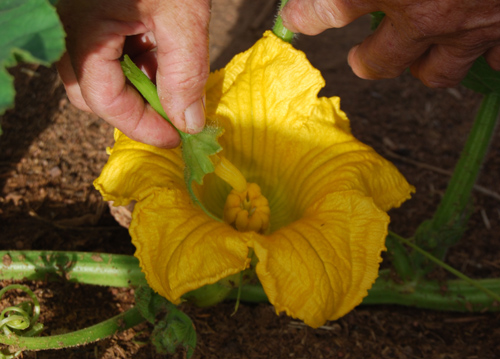
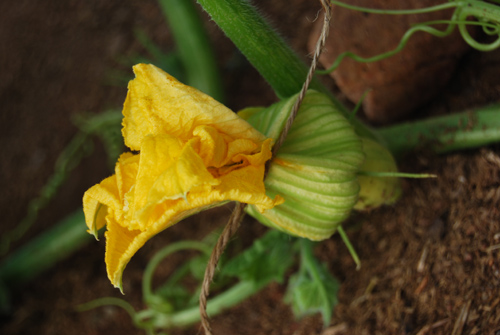
Then after pollination be sure to close up the female with a twistie tie or piece of string for 24 hours as shown here. After 24 hours, you can let the flower open up cause it will either be successful or not and you won’t know till after at least day 10 (that is the benchmark) if it was successful. The female flower shrivels up and drops off (like an umbilical cord) and the baby pumpkin will get larger and larger. If the pollination didn’t take it could be because of several reasons. One reason is because it was too hot the day of pollination (over 90°F). This might cause some pumpkins to abort later. The second reason is because we didn’t get enough pollen on the stigma part of the female blossom. Either way, you’ll see the pumpkin start to grow and then suddenly stop. It looses it shininess, getting duller and softer and usually spots show up as it decays which is a self abortion.  If this happens, cut it off. That is why we pollinate more than we need because sometimes the plant self aborts its babies if something is wrong-kind of like a miscarriage for us.

How to pollinate a giant pumpkin

Here are pictures on how I hand pollinate a giant pumpkin…

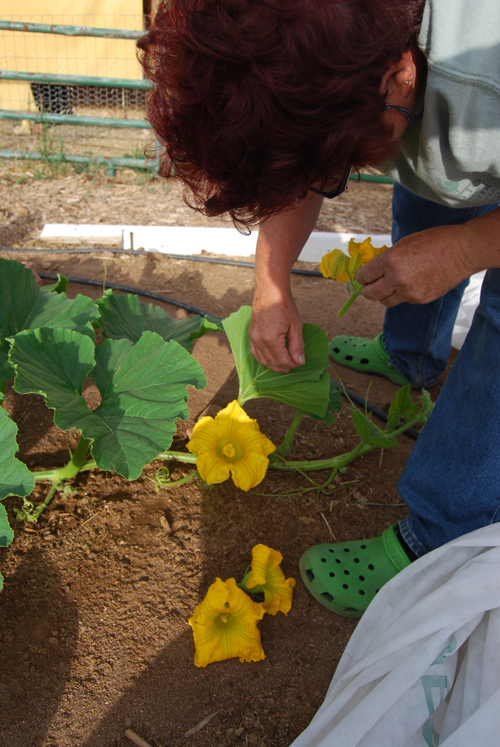
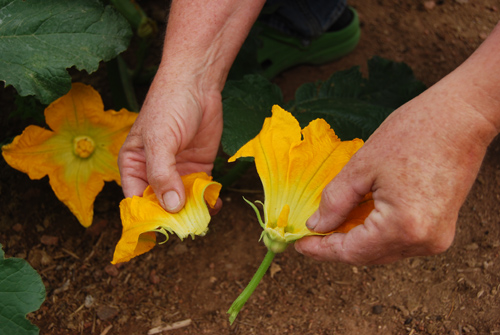
Here I’m getting ready to pollinate a giant pumpkin. I’ve gathered several male flowers that are  by my shoe. I have one in my hand ready. I try to use several male flowers to make sure I get enough pollen on the female flower. Notice the female flower just below my hand that is open and ready to be pollinated.

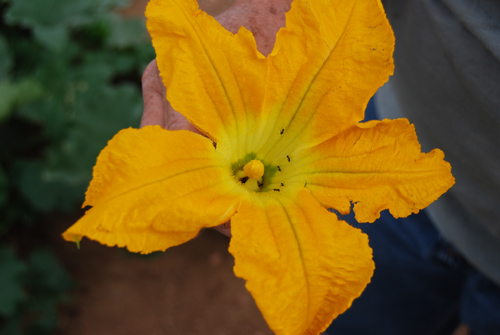
Here is a closeup of the male flower. The ants can be accidental pollinators too.

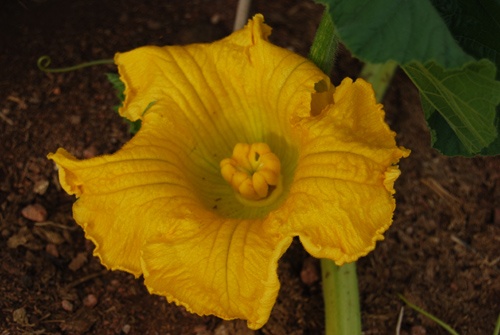
Here is a closeup of the female flower. When she opens up first thing in the morning, she is ready to receive pollen.

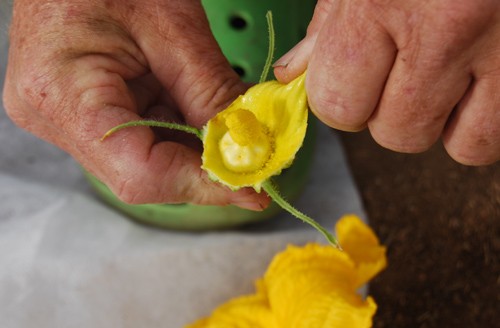
Here I’m peeling off the flower petals from one of the male flowers. I peel off the petals so only the stamen is left. That way it can get to the female stigma.

Here is the male flower with all the petals off.  Notice the pollen on the stamen and around the base.

Now I take the male stamen that is loaded with pollen and use it like a paintbrush to paint the pollen all over the female stigma. then I repeat with the extra male flowers.

Then I tie and close up the female flower so it can’t accidentally get pollinated by the beez. It will stay closed up for one day and then I will untie it as the female blossom will only acept the male pollen for about a 4 hour period. If you want to know who are the parent pumpkins, this is the way to control the assurance of the genetics. We try to get bigger and better pumpkins each year which is why we hand pollinate.

First Giant Pumpkin

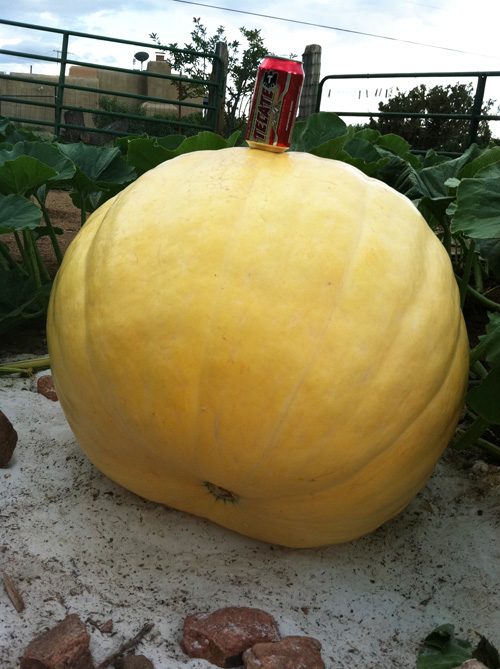
The first giant pumpkin is still growing nicely. Hopefully it won’t abort. We are at day 16 of its life. It is now bigger that a basketball. If it does abort, it will be soon. Hope not. It is bright, shiny and it’s skin is soft. The yellow color is standard with all giant pumpkins. It will turn more orange or salmon color later.  It is currently at 38″ in circumference putting on about 2″ a day.  We measure around the fattest part of the pumpkin for the circumference measurement. I am not using the OTT method until I know it doesn’t abort. The OTT method will include not only the circumference but the length and width too.

I better get some sand underneath it soon while I still can pick it up. I put fine sand underneath it so a small rock won’t pierce it and water can drain around it so it’s not sitting in mud. Ha! No mud around these parts!

Giant Pumpkins on July 26, 2011

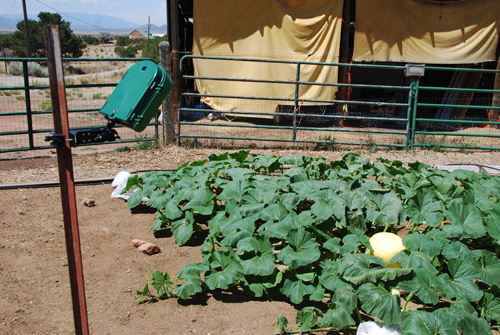
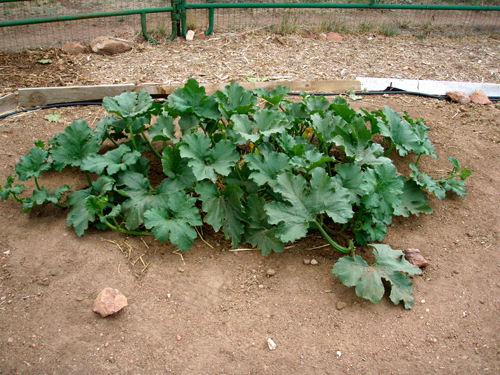
The pumpkin patch is filling in  quite nicely but not quite full yet. Look at those big gorgeous leaves-more leaves, more food for the pumpkins! Notice the row cover on the ground in the background. I’m trying to keep the pumpkins uncovered more since it has cooled down and starting the monsoon season.  I don’t want to promote fungal diseases by keeping them damp and covered. The plants need to dry out between showers. I keep the actual small giant pumpkin fruit covered in heavy row cover and burlap to shade them out of the sun and keep the squirrel off them. I want their skin soft while they are young. Too much sun hardens them up and slows growth.

So far I have 3 little GIANT PUMPKINS (one is growing quite fast) on the 895 Grande plant, none on the 1048 Grande plant (I accidently broke two female flowers off the main vine and a squirrel ate the only pollinated one) on that plant.

I have 2 pollinated ‘GREENIE’ female blossoms (we’ll have to wait to see if the pollination ‘took’ on them but they had the biggest stigmas on both female flowers I’ve ever seen in my giant pumpkin career-4 years. lol. I hope they took as I’ve never grown GREEN PUMPKIN LIKE SQUASH before.

I also have quite a few GIANT MARROWS going (thank god as the squirrel ate one of those too) on the 78 giant marrow plant. The other giant marrow is now just starting to produce more female flowers-the boyz and the beesz are just waiting for them to be ready! I don’t hand pollinate the giant marrows-I let the beez do it. I don’t worry about the marrows cross pollinating with the pumpkins because the pumpkins are in the Curcubita Maxima family and the giant marrows are in the Curcubita Pepo family so they can’t accidentally cross.

I have one more plant in the pumpkin patch and that is a GIANT PEAR GOURD. I haven’t talked much about it yet as it isn’t very big compared to the other gorillas in the patch but it is flowering and I hope the bees pollinated it. It has beautiful soft fuzzy leaves and tendrils and likes the heat.

As for that squirrel, I’m trying fox urine granules that I bought at Agua Fria Nursery. I sprinkle it every 3 feet all around the perimeter of the garden (like marking my territory and also around each plant). OMG that is stinky stuff. I sure hope it works because tonight I will leave everything uncovered in the pumpkin patch. Wish me luck the stuff works and the squirrel doesn’t have a feast..

Plant Cam on Pumpkins

Plant Cam pointed at pumpkins

closeup of plant cam

PLANT CAM

Yesterday I set up a ‘Plant Cam’, which is an outdoor waterproof digitized camera. I set it to take one picture everyday at 9am of my 3 giant pumpkins on the 895 Grande plant as they grow. That way I will be able to make a video of the growth of the pumpkin in a video after the season. Once I choose one to keep, I will cull the other two and zero the camera in on the one remaining.

Pumpkin Sex

Yesterday I pollinated the 895 Grande female pumpkin flower (scroll back to see what it looked like on July 4th and how much it has grown) with an older male flower from the same plant and I took a fresh male flower from the ‘greenie’ which won’t affect the looks of this pumpkin but may produce green pumpkins from it’s seeds. I just don’t have any opened male flowers from the pumpkins so I had to use the ‘greenie’flower. Notice how much bigger the female flower is now.

So this is how it works. To see more lude photos go to last year post here but basically here’s the dirt on GIANT PUMPKIN MATING HABITS!

All pumpkins produce both male and female flowers and normally the bees do the pollinating landing on the male flowers, picking up the pollen from the male flower and visits the female flower and drops off the pollen on the female flower being attracted by the wonderfully sweet smell of the female flower. BUT with pumpkin growers, we need to know which two pumpkins ‘hook up’ so we don’t get an accidental pollination with a winter squash or another pumpkin we don’t want it to mix it up with. We want to get the biggest pumpkin we can so we keep track of those sort of things. So we hand pollinate. Yesterday I took a male flower and took off the petals and ‘paint’ the pollen all over the female flower stigma with the male stamen. Some of the pollen must go down the female stigma flower for pollination to be complete. If I didn’t get enough pollen on it, it will either not take or abort later. After I pollinated the flower, I used a twistie tie to close it for 24 hours so no bees can accidentally pollinate it. I hope it ‘takes’ but it may not as it was very hot yesterday and quite often it won’t take if the temperature gets too high (over 90°F). There are many baby flowers now so it is going to get interesting very soon!

Giant Pumpkin patch growing

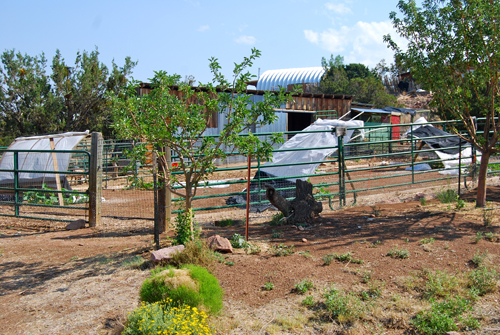
Here are some pictures of the giant pumpkin patch taken on July 4th. There are also 1 greenie squash and 2 giant marrows in the patch so I think it’s gonna get crowded in there. I hope I have a sea of green by August!

Here is the overall view of the pumpkin patch from the road.

I have the low tunnels propped up so I can work on the giant squashes. Kind of like opening a car hood! I took off the row covers for pictures.

The giant pumpkin plants are doing well-they are just coming out of their low tunnels. Here is the 895 Grande plant with the low tunnel off.

Some of those big leaves are 18″ across. I just love this pumpkin plant. It’s sister seed took the NM State record last year. The leaves are much bigger than the 1048 Grande.

Here is the 1048 Grande. It’s leaves are smaller but they say leaf size has nothing to do with pumpkin size. Is that like the shoe size argument?!

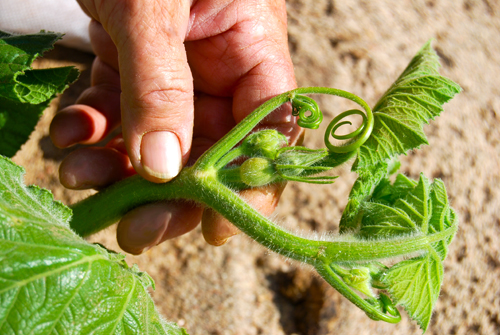
I saw my first female flowers on the 895 Grande pumpkin plant on the end of the main vine. Isn’t it beautiful! The only issue is it is only 7 feet out from the stump. I should wait to pollinate until it reaches at least 10 feet out but may not. We do that to allow the plant to develop more leaves behind the future pumpkin-more leaves-more food. Lot’s of times we pollinate many pumpkins and then cull the smaller ones so I think I will do that.  Notice the oval shape of the possible baby pumpkin.

The only problem is the male flowers that are there are also very small and they usually bloom before the girls even show up. The boys are always the first to arrive at the pumpkin blossom party and usually the girls show up later. It’s ok because my first pollinated pumpkin flower last year was July 27 so perhaps I will be ahead of that date which is important because it will give me more days to put on more pumpkin weight.

Here is the greenie-The greenie looks just like any giant pumpkin plant but the fruit will be green. It is doing well. I saw a really small female flower with the potential baby green fruit. The seed came from 2007 so I was surprised it even germinated The plant looks fantastic. Just goes to show that you can’t always listen to the folks that say get rid of your seeds after 2 years old.

Here is the 78 marrow-kinda bushy. Very different than the other marrow in the patch.

This is the other giant marrow that came from my last year’s plant. I’m very suspicious of this one as it doesn’t look quite like the other marrow above which I know is pure in strain. Mine was pollinated by the bees and so it could of crossed with one of the winter squashes last year. It will be interesting to see what the fruits look like on this one later on!

I also saw one squash bug (which ended up under my shoe) and some eggs on the underside of 3 leaves. I just took off all those leaves that had the eggs on them and put it in a bucket of soapy water-goodbye eggs. I will plant some onion sets in their wells to help deter them and I will probably have to keep the pumpkin plants covered with row cover. I will be on the lookout from here on out.

Giant pumpkin care today

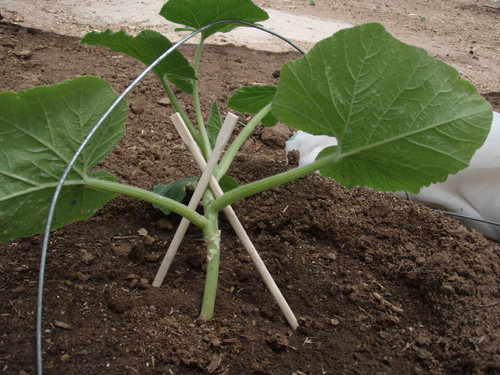
chop sticks help push the giant pumpkin vine down

If you were crazy enough try to grow giant pumpkins this year, here is some advice from this obsessive giant pumpkin grower!

To grow a giant pumpkin, you must BABY them. They need a lot of CARE. It’s like RAISING A VERY LARGE CHILD or more like JABBA THE HUT. You don’t go out and just throw some seeds in the ground and expect to grow a record pumpkin. You wouldn’t be able to go out and become a world boxing champ without training, lots of proper food and working up for it and so it is with giant pumpkins. A person asked me last year at the GPC (Great Pumpkin Commonwealth) weigh-off in Colorado Springs, Co how do I grow them? I asked him if he planted some and he said, “Yes, but they didn’t do anything”. So I asked him if he amended the soil, had them on a fertilizer program, used organic fungicides for diseases, did any preventative insect control or hand pollinated them just for starters. He said, “No, I didn’t do any of that. I just put the seeds in the ground”. I told him that’s probably why he wasn’t successful. Then he asked me, “What do you feed these big pumpkins?” For which I responded looking at his kid, “Small children”! Then he grabbed his child and ran off! The point being you must be some kind of nut to want to grow these behemoths!

Today I fertilized the pumpkin plants, greenie and marrows with Seaweed and Fish emulsion and added Super Thrive since I took off the shade cloth and they have to adjust again.  Mind you they still have a low tunnel over them and another layer of row cover directly on them but I am now weaning them off so much protection since they have gone through their first adjustment well and I see new growth. I also started them on ‘Companion’, an organic fungicide, which helps ward off  fungal diseases. All these things go in a bucket of water so it’s easy to apply. They are still taking 1/2 gallon of water a day. I also put chop sticks over the stem (see photo), making an ‘x’ with them, gently pushing the vine down towards the ground. Push the sticks with the plant  a little farther towards the ground every few days until the plant is lying on the ground. If you let them stay tall, they could snap off in the wind so I must train them to lay low! This pumpkin plant in the picture comes from the same one that last year grew the 2010 NM State Record. I also have it’s cousin plant (who comes from a bigger pumpkin), but this plant is already much bigger than it’s cousin. I love this seed!

Planting Giant Pumpkins-In ground- June 1!

Giant pumpkin inside low tunnel

On Wednesday  I transplanted the giant pumpkins in Bri’s Pumpkin Patch here at the property.

Bri, my horsey, is no longer with me. Last year I used her 2000 sq foot corral as the giant pumpkin patch and I got a New Mexico State Record-421 lbs for Giant Pumpkin last year. I think she is watching over them! I miss her terribly.

Here’s how I plant the pumpkin transplants that I started in the house.

1. First I dig out an area about 4 feet around and 1-2 feet deep where their root system will grow. This year I added generous amounts of compost, 1/2 cup of mycorrhizal, 1 cup humate, and 1 cup of worm castings and mixed it into the area. (I did not add any fertilizers as my soil test I had done in Spring said I was high in nitrogen, potassium, and potash, which is your basic fertilizer ingredients. (This is weird because the pumpkins usually use up all available nutrients by the end of the season. The only thing I did last fall was put some chicken manure on top of the ‘holes’. I didn’t even dig it in but I think the nutrients leached into the soil from the winter snows and increased the levels.)

2. Then I dig a small hole where I place the pumpkins and I add another handful of worm castings and 1/2 cup more of mycorrhizal (it’s dry granule stuff) and mix them together. This way the castings and mycorrhizal will be right in the immediate root zone in the beginning and the bigger amended area will be accessible as the root system grows.

3. I carefully peeled off the peat pot including the bottom so not to disturb the roots but if the pumpkin is root bound, I must carefully squeeze the roots to loosen them up so they can grow outwards. This year I didn’t have to do that. I placed the pumpkins in the bottom of the hole opposite the first true leaf so it grows in the direction I want and put the amended soil back around the root ball. I make a well around the plant so I can add water right to the root zone.

4. In a 5 gallon bucket, I added 1 tsp/1 gallon of water of liquid seaweed and about 3 drops of Super Thrive/1 gallon of water which helps immensely with transplant shock. Super Thrive is super expensive and super good. It has lots of the B vitamin complex in it which helps with stress-just like for us! I first watered the well 2x to make sure all the soil was soaked around the plant, then I added the liquid seaweed/thrive in water to the well.

5. I put the Seaweed and Thrive with the water in each day for about 5 days, then afterwards I normally give them water with fish emulsion once a week but for now since my nitrogen is high I will wait awhile. I do water every day with about a 1/2 gal of water right now.

6. I don’t put fertilizers in the water every time I water, normally just once a week. I will also add other things to the water once a week but will discuss that as I go along in the season. I still have to do a drip system for the pumpkins and will hand water them until I get it up and running.

7. I cover the transplant with a small piece of row cover to help it in it’s transition with the intense sun and wind and keep rabbits away. I tack it down with rocks.

8. On Thursday I put the low tunnels I previously made over the already covered pumpkins to protect them from the heat and wind even more.  Low tunnels are like high tunnels but only go over the plants. You can’t walk inside them-they are low!  They will stay on till the plants grow out of them at the end.  So far they are looking good. The soil is nice and warm at 70°F.

9. Saturday (today) I put the shade covering over the low tunnels as the sun is sooo intense right now. I can take it off once they adjust to the outside elements.
Can any pumpkin become a Giant Pumpkin?

Christy Harp with her 2009 World Record Giant Pumpkin-1725 lbs!

Can ANY pumpkin grow super big if you feed it a lot? The answer is no. Just as there are varieties of tiny pumpkins (like Tom Thumb-2 lbs), there are varieties that grow medium size (field pumpkins-15-25 lbs), big size varieties (Big Max-100 lbs) and then there is ONE variety that grows RECORDS-STATE AND WORLD RECORDS! The current Atlantic Giant Pumpkin World Record is 1810 lbs, grown by Chris Stevens of Wisconsin. The picture above is of Christy Harp of Ohio who held the record in 2009. This picture just shows you how big they are! They say someone will hit the 2000 lb mark within a couple of years but it won’t be me. I don’t live in an area that would be conducive to that-too short of growing season here in Santa Fe. It was hard enough growing a giant pumpkin 421 lbs last year here. Of course I’m trying to break my own record again this year!

Now that we are (finally) getting into giant pumpkin season, I will share my techniques for growing them throughout the season. Stayed tuned…