Easier seed starting schedule

So after thinking about my last post, I realized it might be too much info (TMI). So today I am giving you just some starting dates and planting out dates that I use here in Santa Fe, Zone 6B.  You will need to transplant anything you start inside as it gets bigger before planting outside.

This schedule will be simpler to follow (especially if you only grow a few veggies) and if you want to see when to plant up to a bigger size pot, you can always go to my very detailed schedule from before. Also be aware this is MY schedule and I use row cover and wall of waters to be able to put the crops outside earlier AND weather will always influence when I plant outside. If you don’t use these aids, transplant tomatoes, peppers and eggplants in JUNE.

FEBRUARY-MARCH
-Start COLD SEASON CROPS-INSIDE-greens-lettuce, arugula, spinach and Asian greens, cabbage

MARCH
-EARLY MARCH-INSIDE COOL SEASON CROPS kale, chard, broccoli, cauliflower, kohlrabi

-EARLY MARCH-INSIDE-start peppers and eggplants

-MID-MARCH-TRANSPLANT OUTSIDE COLD SEASON CROPS (with protection) IN GREEN HOUSE OR COLD FRAME OR MINI GREENHOUSE-all greens that were started in FEB

-LATE MARCH-inside-start tomatoes

APRIL
-Transplant starts OUTSIDE-beets, kale, chard, broccoli, cauliflower, kohlrabi, cabbage, onion sets, garlic

-OUTSIDE-DIRECT SEED-Radishes, flowers, carrots, beets

MAY
-plant OUTSIDE-tomatoes (WITH PROTECTION), flowers, and anything above you haven’t planted outside yet

JUNE
-Plant OUTSIDE transplants of tomatoes, peppers, eggplants (if you don’t use wall of waters)

-DIRECT SEED WARM SEASON CROPS OUTSIDE-more flowers, corn, beans, cucumbers, squash, melons, pumpkins

Here it is as a pdf  SIMPLIFIED SEED STARTING SCHEDULE so you can just print it out.


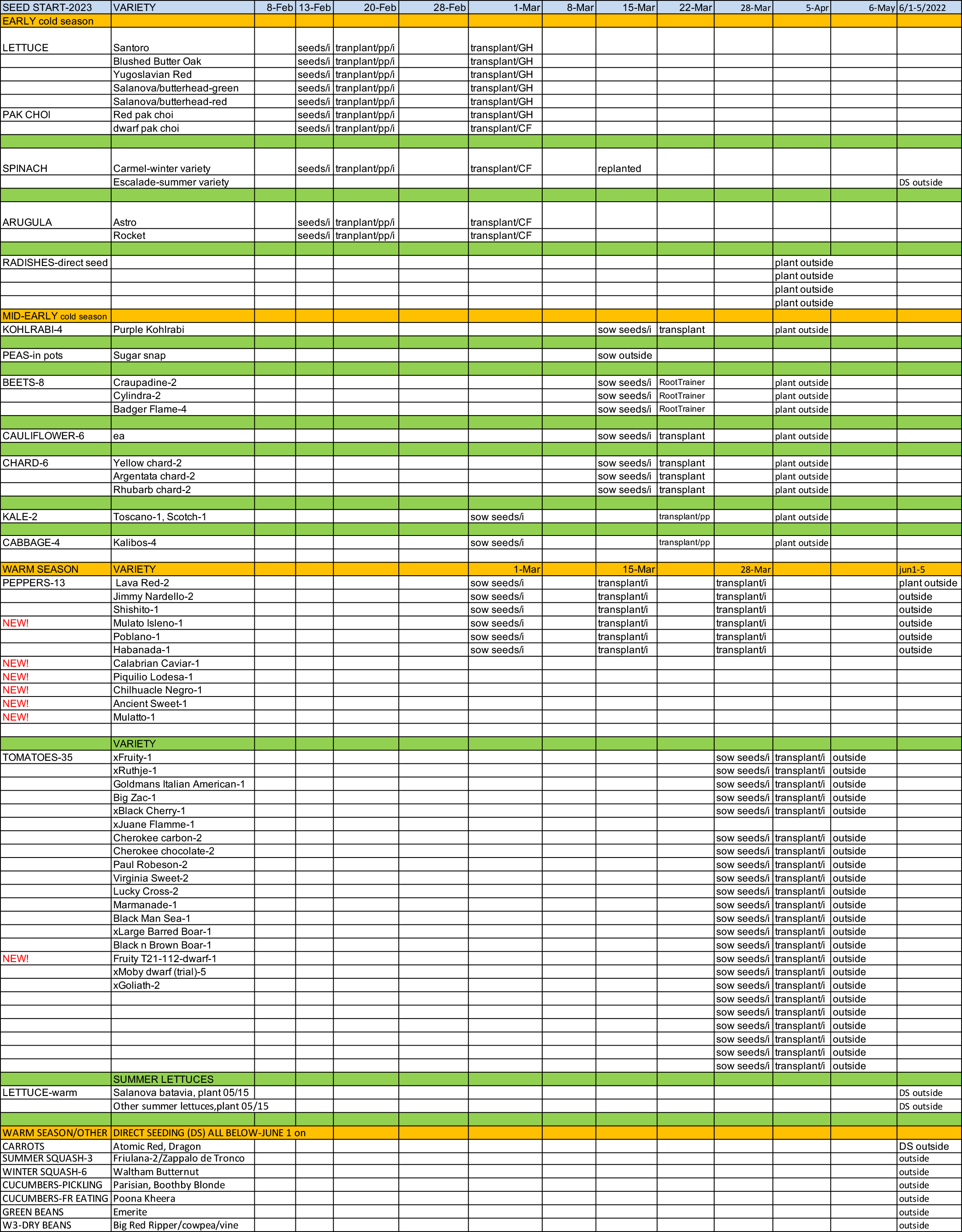
Seed Starting Schedule-2023

With all the snow outside right now isn’t it too early to start seeds inside? NO!

My radio show will air on Saturday, Feb 25 on KSFR 101.1 radio station and airs the last Saturday of every month where I give tips and advise about gardening for the following month.  March will be about my seed starting schedule which I’ve already started but many veggies can be started later too from the schedule.

I want to talk about my planting schedule for 2023. Thought you readers might be interested. Of course, the dates are not carved in stone and changes a little each year but it tells me when I should get growing and how I think when starting crops. Some are started inside and later many warm season crops are started inside and more warm season crops will be direct seeded into the ground when the ground warms up in June. If you plan to grow veggies this year, it is good to be organized. I need to see it in writing.

This may seem a bit much to make up such a detailed schedule but I grow so many varieties of veggies and they each have their own growing season so it keeps me on track. You can use mine or make your own up-you can do it simply in a notebook but I hope this will help you start to think of your planning.

You can listen to the show and pick up the notes and schedule after the show or get them here. This is shown BELOW as a jpeg, but you can print it out the pdf ( 2023 SEED STARTING SCHEDULE) I also have it as an Excel file (2023 SEED STARTING SCHEDULE for those of you who have it-that way you can adjust your own schedule)

Please note that once I plant the early cool season crops outside, I use row cover (polypropylene fabric) over them on a cold nite to keep them from freezing. I have people ask if they can use a sheet-NO and one person told me they used a sleeping bag-NO! It didn’t work! ( I told them the only way they could use that was if they were in it!)

For germination tips, go hereAlso here is (Zone 6a):  SEED GERMINATION CHART which gives the optimal soil germination temperature of crops and how long to germinate.

Later when ready to transplant tomatoes and peppers/eggplants outside, I will use wall of waters (WOWs) to help start the season earlier so if you don’t use either of those aids, then you will have to wait till danger of frost is over. These two aids are invaluable and will give you a head start on getting some of the crops outside in earlier.

I have already started INSIDE with lettuces, spinach, arugula, bok choi, and pak choi. All these will go from the germination trays to pony packs and then after they are big enough, go in either the Green house or cold frame. Seems early? YES but I want to get to harvest the cool season crops before the heat comes and they take 30-60 days to grow to harvest. Must get them out of the house before we start tomatoes inside on March 28 as we need the space inside by then!

PEPPERS

The next thing I will start are peppers inside on Mar 1 (on the schedule), because they take a long time to get sized up.  I always said wait until June 1 but if you have wall of waters (WOWs) they might help get your pepper plants outside a little sooner. Even then, it is still very cool at nite. What happens to peppers if you plant outside when it is still cold at nite? They will stall out and stop growing! And they won’t start growing again-then you would have to buy some because it will be too late to start them again.

TOMATOES

Next- will plant tomato seeds on March 28.

NOTE: Before it get’s hot in JUNE, take off the WOWs as you can fry the plants-all plants.  BUT if you don’t have WOWs, wait till June 1 to plant peppers/eggplants and May 15 for tomatoes outside.

_______________________________________________

For March-to recap

Cool season crops inside, under lights -NO heat mats early March

Warm season crops inside-Tomatoes/peppers/eggplants under lights with HEAT MATS and a THERMOSTAT will help keep the temperature at the correct germination temp. Notice peppers/eggplant seeds are planted earlier because they take so long to size up before planting outside and tomato seeds are being planted Mar 28 this year.

If this is too much info, go buy your plants ready to transplant-you can still use the schedule. Why do I grow my own varieties? Because there are so many more great varieties of veggies you can grow IF YOU START THEM YOURSELF.

_________________________________

LEGEND FOR SEED STARTING SCHEDULE below (in case you don’t know what my initials mean)

seeds/i=starting seeds inside under lights/no heat for cool season crops/warm season crops also get a heat mat.

tranplant/pp/i=transplanting up to pony packs-still inside under lights (4 or 6 cells-like what you buy flowers in)

transplant GH/CF-transplant into unheated Greenhouse/cold frame. Use row cover over crops at nites to protect from cold-I sometimes use 2 layers of row cover if very cold.

DS outside-Direct seed outside

I write notes all over the schedule so I see what I did for next year. For instance, I changed my cold season crops (lettuces/spinach/arugula) to a later date. No reason except I didn’t check last year’s dates and am late, but not too late. I try to be done with them when it gets too warm in the green house or cold frame which is usually around late April-early May before they bolt. Bolting is when they produce a flower stalk which makes them bitter. I either compost them then or feed them to my chickens. I don’t like bitter greens.

2023 SEED STARTING SCHEDULE (EXPAND TO SEE BETTER OR JUST DOWNLOAD ONE OF THE THE FORMATS)


Pepper varieties & how to grow

People ask why don’t I grow green chiles from southern New Mexico or red chiles from northern New Mexico. If I did that, I would need an acre as we eat chile all the time. New Mexicans call their hot peppers chile, not chili, (which refers to the dish chili) while most of the US call them chilies but not here in New Mexico! Confused? I was-when I first move here! The heat of New Mexican peppers can vary drastically so I prefer to buy them already peeled and rated from mild to hot in the fall. (I’m a wuss-I like mild). So I’ve spent some time the last few years growing other less hot, less known pepper varieties and have found some real winners-if you don’t like hot. Besides I want room in my garden to grow other things as well.


Normally I grow 4 varieties of peppers-NONE are hot—Jimmy Nardello, Lava Red (a variety of Corno di Toro), Habanada, which is sweet, (NOT Habanero which is very hot), and Poblano (which is mildly hot-used for chiles rellenos (dried it is called Ancho pepper). I don’t like store bought bell peppers as there are so many better sweet varieties out there.You just need to grow them!


This year, in 2023, in addition to growing my staple of peppers above, I’m gonna grow some new varieties to me. They include Piquillo Lodosa Basque pepper (left pic-courtesy of Secret Seed Cartel), ‘Ancient Sweet’, Calabrian Caviar pepper (I got all from Secret Seed Cartel). None of these are too hot either but look interesting. Secret Seed Cartel has other peppers from all over the world.


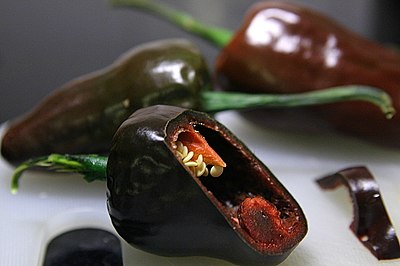
In addition, I just bought some hard to find seeds for Chilhuacle Negro Hot Pepper, an ancient chile from Oaxaca Mexico area. I’m getting those seeds from Terroir Seeds. Suppose to be the original pepper seed for mole negro dish. Hope it’s not too hot!


So when do I start peppers?
-End of March or first week of April, I plant the seeds inside in germination trays, under lights, and on a heat mat.

Around April 15, I transplant them out of their germination trays-maybe 2 weeks (after they get their first true leaves-pic left) and into 4 inch pots where they will still stay inside, under lights till I plant them out in the garden the last week of May through the first week of June. And if they do outgrow the 4 inch pot, transplant them up to a bigger pot before transplanting outside.


-Around May 25-June 1-When I transplant them outside, I put them in walls of waters (WOW) for a week or two to keep them safe if we get one of those cold nites again. But don’t leave them in the wall of waters too long (pull the WOW’s off) as you also don’t want to fry them either and we go from cold to hot quickly here in Santa Fe although lately the past few years, it has been getting hotter sooner. So it is important to really watch the weather to see when it will change to take off the WOWs.

-Why plant outside so late? Because if you plant them earlier outside, the nights are cold and the peppers could stall out and stop growing-FOREVER! Then you would have to start over and they take 10-12 weeks to get big enough to plant out which is not enough time with our short season.

-Most people don’t start the seeds early enough here. Timing is everything.

And lastly, if you don’t want to bother with growing your own pepper seeds, I suggest you go over to Agua Fria Nursery, here in Santa Fe which has many different varieties of pepper transplants starts later (not now). There may be other nurseries here that sell pepper plants but I bet AFN sells more varieties.


SEED LIFESPAN CHART and viability test

For my February garden show, I talked about seed lifespan or viability on my radio show amongst other topics relative to February.

Here is a seed lifespan chart that I compiled from several charts online: SEED LIFESPAN

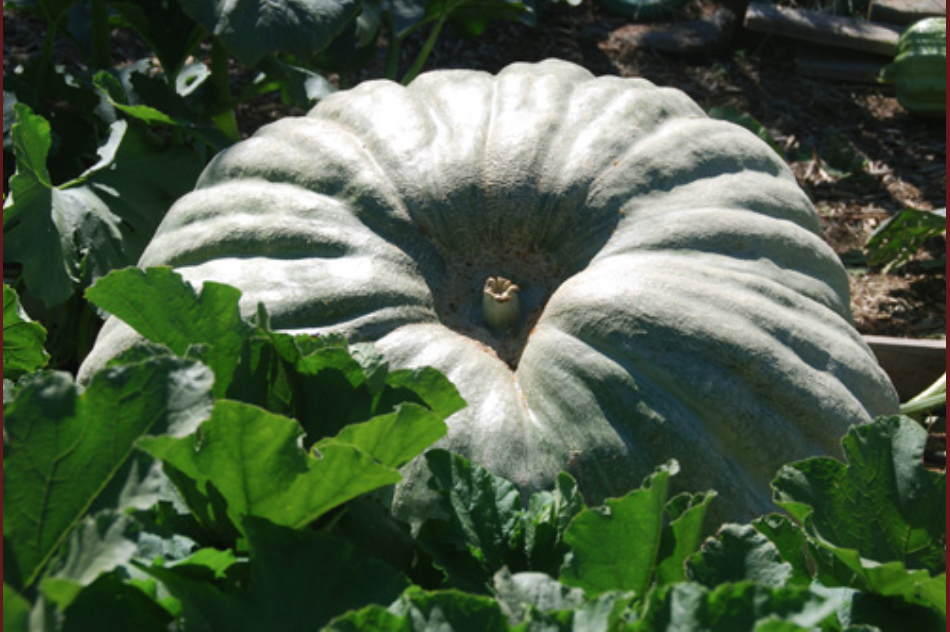
This is a general guideline and depends a lot on how the seeds were taken care of. I’ve had seeds germinate that were way past their prime. In fact, my giant green squash, ‘Jabba the Hut’ set a new NM State record in 2011 of 340 lbs! It came from a seed that was over 8 years old, which according to this chart, the lifespan should have been between 4-6 years old but it was the only seed I had. In fact some seeds have been germinated from tombs in Egypt centuries ago. So if you have a special seed, try it despite what the chart may say.

Below is a chart for optimal seed germination temperatures if you are growing from seed inside. It is very important you try to germinate seeds at their optimal temperature-too cold a temperature then the seeds might not germinate or even rot and too hot of temperature, the seeds may fry. This chart is also good as to what temp the soil should be if you direct seed outside.

(Zone 6a):  SEED GERMINATION CHART

This is an important topic this time of year as many of us are deciding whether our seeds are too old to germinate or still good and if we need to replace them. Here is some of the info I gave on the radio show:

‘Every seed has a shelf life. You can search how long seeds can be stored and how to test their viability. Fresh seeds are essential for good germination. Older seeds have less success of germinating.

To test them, take 10 seeds and soak them in water overnight and then put them in a damp paper towel and put them in a Ziploc bag and on a warm windowsill or on top of your refrigerator (but not a sunny place, you don’t want to fry the seeds). Then in a few days check them to see how many have germinated.’ If all 10 seeds germinate, then you have 100% germination, 5 seeds would be 50% and 2 seeds would be 20% and so on. I will usually get rid of any vegetable seeds 30% or less.


In the case for old flower seeds, I just throw out the seeds in spring and see what pops up. This is from last year’s garden-fantastic but of course we had a very rainy summer so that helped!

Look on the package to see the year the seed company sold them. I have noticed that some seed companies do not put the date on the packages, in which case I write down the year I bought them on the package.

Hope this helps when making decisions about which seeds to save and optimal seed germination temperatures when starting them.