 Early Blight is a fungal disease that attacks tomato plants starting on the bottom leaves of the plant and works it’s way upwards. The leaves start turning yellow and get blotchy with brown areas. If left unchecked, it can take over your plant killing it although it won’t die immediately and there are things you can do to reduce it.
Where does it come from? It comes from water splashing soil up onto the lower leaves. The culprit is a bad soil fungus (there are good soil fungus as well).

But before I write about how to treat this disease, I do this first. I always trim off the lower branches so they are not touching any soil and I put straw under each plant so the soil can’t splash up on the tomato leaves. In fact I put straw over the whole bed as the tomato plants get bigger. Water splashing up from hand watering your plants or even rain can splash soil up on the lower branches. But I never cut off branches that have flowers! Flowers=tomatoes! The picture above shows a plant with the lower branches trimmed off and straw over the soil. Underneath the straw is my drip system. The goal is to keep the soil from splashing up and the fungal spores will start to go upwards from the bottom of the plant.
There are several things you can immediately do to help with this disease when you see it
1. The first thing you do is trim off the affected branches where the leaves are yellow. This week I trimmed all the lower branches off my tomato plants paying particuliar attention to the ones that had a few leaves just starting to yellow with EB (Early Blight). This year I had 3 out of 20 plants showing the beginning of EB. Me bad-I didn’t add the straw or trim them up after I removed the wall of waters earlier. I also tie a ribbon on the diseased plants so I can keep a close eye on them. I’d much rather deal with Early Blight than Curly top virus (which is always fatal and not much we can do about it). At least you can control Early Blight. Keep trimming up your plant as needed.
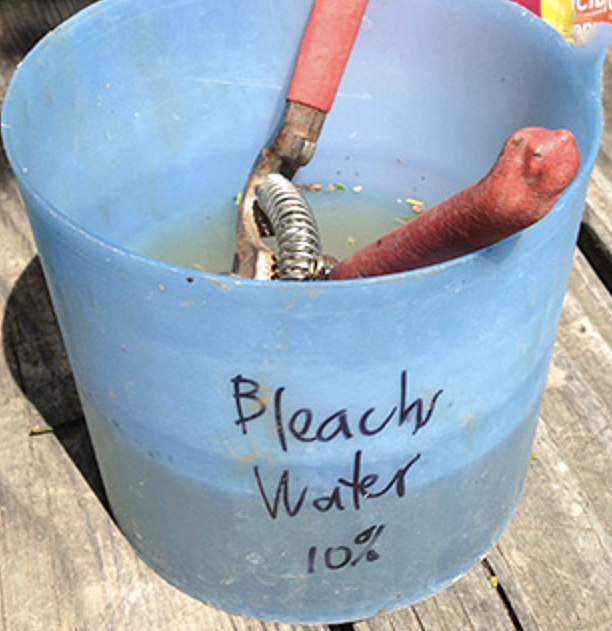 ALWAYS DISINFECT YOUR CLIPPERS IN BLEACH WATER BEFORE GOING ON TO PLANTS THAT DON’T HAVE IT-it is contagious!
2. Beside cutting off diseased branches, trim any branches to make sure they don’t touch the ground
3. Stake or tie up any branches that might touch the ground.
4. Mulch with straw underneath the plant so the soil can’t splash up on plant when it rains or if you water overhead.
5. I have used a product called Serenade in the past, but it is no longer available. If you have some discard it as the ingredients only lasted several years.
So now I use Monterey Complete Disease Control which I have had good luck with in curtailing or slowing down the disease. Follow instructions. Spray in early evening both on top and UNDERNEATH the leaves.
I also use this for keeping Powdery Mildew at bay on all squash plants.
 giantveggiegardener
Where do you purchase your hay?
>
LikeLike
It’s not hay but rather straw. Straw has less weed seeds in it than hay. I just use it for top dressing to keep moisture in the soil. I get it from San Marcos Feed down hwy 14.
LikeLike
Hi,
This was my first year gardening in Santa Fe and I can’t thank you enough. Your site has been a great resource. I’m looking forward to next season and planning to build more garden beds. Cedar is considerably more expensive but offers maybe some more protection. When it’s this dry to you think it’s better than pine or a different 4×4? Was watching the videos and trying to zoom in on your garden boxes, looks like maybe they’re 1 by 6? How long have those lasted?
Thank you for all your help.
Cheers,
Will
LikeLike
Sorry for the late response-been hitting the garden hard.So glad you like my site. My beds are 2′ x 6’redwood boards and dimensions are 4′ x by 8’long (some longer). If you are going to build boards close to a fence or wall, then make them 3′ x whatever. 3′ so you can reach across it.
LikeLike